eBook - ePub
Coaching on the Axis
Working with Complexity in Business and Executive Coaching
- 224 pages
- English
- ePUB (mobile friendly)
- Available on iOS & Android
eBook - ePub
About this book
This book offers an approach to business and executive coaching that properly aligns the practice in the culture of business through the use of a relational "coaching axis" that helps to manage the complexity of the organisation and the individual as dual clients. Business and executive coaching occurs within an organisational context with the goal of promoting success at all levels of the organisation by affecting the actions of those being coached (Worldwide Association of Business Coaches, 2007). This form of coaching is distinct from other types in two ways, firstly it is focused on achieving business outcomes, and secondly, both the individual being coached and the sponsoring organization are simultaneously the client. This book explains how a coach manages the complexity of helping these two clients by acting as a narrative bridge between their stories. It offers a relational approach which resists remedial or curative notions born from coaching's human science roots and instead aligns to workplace realities.
CHAPTER ONE
The complexity of client
Who is the client?
Many authors (e.g., Brunning, 2006; Cavanagh, 2006; De Haan, 2008; Huffington, 2006; Kahn, 2011; Kemp, 2008; Kets de Vries et al., 2007; Passmore, 2007) have established the theoretical and practical foundations for a relational approach to business coaching in which success derives from the quality of the coaching relationship and the degree to which it aligns with the sponsoring organisation. In this view, business coaching is an engagement of relatedness more so than any one particular method or skill.
Central to this relational perspective of business coaching is the fact that both the organisation and the individual being coached are clients. Business coaching has the challenge of “always having two clients to serve: the individual or team that they are directly engaging with, and the organisation that is employing them to do the work” (Hawkins & Schwenk, 2010, p. 204), and each may differ in their expectations of the coaching. Coaches therefore need to attend to both of these client requirements as well as the relationship between them at the same time. Huffington (2006) puts it that in business coaching “there is always an implicit external context in view, [which is] the organisation from which the client comes, in which she or he works, and which pays for the coaching” (p. 41). She calls for business coaches to engage in dual listening to both “the individual in the organisation” and “the organisation in the individual” (ibid., p. 44), and Kahn (2011) concludes that “successful approaches to business coaching incorporate significant consideration of the relational dynamics between the triad of coach, individual client and organisation, and focus on the coaching relationship and its systemic interface with the business environment” (p. 194).
This systemic perspective of business coaching is eloquently captured in The Worldwide Association of Business Coaches’ original definition of the practice: “A process of engaging in meaningful communication with individuals in businesses, organisations, institutions or governments, with the goal of promoting success at all levels of the organisation by affecting the actions of those individuals.” (Worldwide Association of Business Coaches, 2007). The idea that business coaching’s ultimate purpose is the promotion of success of the organisation at all levels through the individual being coached is important. Notice how it is the organisation’s success that is highlighted specifically, not only that of the individual. And many others (e.g., Huffington, 2006; Kahn, 2011; Kilburg, 2007; Right Management, 2009; Stout-Rostron, 2009) describe the practice similarly, for example: “Executive coaching is defined as a helping relationship formed between a client who has managerial authority and responsibility in an organisation and a consultant who uses a wide variety of behavioural techniques and methods to help the client achieve a mutually identified set of goals [i.e., between organisation and individual] to improve his or her professional performance and personal satisfaction and, consequently, to improve the effectiveness of the client’s organisation within a formally defined coaching agreement” (Kilburg, 2007, p. 28). Right Management (2009) simply puts it that business coaching “needs to be regarded not only as an individual event but also as an organisational process driving systemic change” (p. 13).
This means that in business coaching there resides a deep complexity in that both the individual being coached and the sanctioning organisation are framed equally as clients. This differentiates business coaching from life coaching and counselling in a significant way. In the latter, the individual enjoys primacy as the client, and although associated others may form part of systemic considerations, the promotion of their success is at best secondary to that of the individual being coached or counselled. In business coaching, this is not the case. The primary goal is the success of the organisation and the individual’s success is inherently tied to the organisation’s success. It is not one over the other. In fact, if the individual were to enjoy success that has no benefit to the organisation or vice versa, the other party would feel the coaching has failed to add value and deliver a return on investment. Both must feel success has been achieved.
However, from a historical and theoretical perspective, coaching has drawn heavily from the human sciences, where the individual tends to enjoy primacy, such as in psychotherapy and counselling (Gold et al., 2010; Palmer & Whybrow, 2007; Passmore, 2007; Stout-Rostron, 2009). Business coaching’s early influences came from psychology mainly because coaching formed part of the general practice of psychologists and psychologically trained human resource professionals who conducted what was referred to as workplace or developmental counselling, the forerunner to workplace coaching (AMA, 2008; Brock, 2008; Gold et al., 2010). Subsequent influence from adult learning theory, organisational theory, and management practices meant that coaching only later developed beyond a single source foundation in psychology and beyond its curative and remedial associations, into the realm of potential, growth, and workplace productivity (ibid.).
Today, business coaching is a widespread service industry, with a myriad of theoretical and practical influences, open to anyone with few, if any, barriers to entry. Nevertheless, the field of psychology remains the primary influence for the practice, as many coaching offerings tend to be effective conversions from established psychotherapeutic approaches with “a focus on transferring a single model from its therapy origins to coaching” (Passmore, 2007, p. 68). Stout-Rostron (2009) explains: “Coaching does not yet meet the requirements for a ‘true profession.’ It is here that psychology and psychotherapy research offer much insight into the complexity of human behaviour and organisational systems for the business coach” (pp. 21–22). She references Peltier (2001), adding that a range of psychotherapy phenomena positively correlate with coaching interventions such as “insight, awareness of the goal, self-examination, intra-personal understanding, talking about things…, rapport building, and special relationship feedback from an impartial party within a confidential relationship” (p. 24), and this means that “the basic ingredients of the executive coaching relationship are based on a few common themes from the psychology literature” (ibid.).
Although extremely helpful, the formative influence of the human sciences, especially psychology, on the field of coaching presents important challenges for coaching in aligning its practice with the culture of business. Central to these challenges is the tendency for coaches to import the primacy of the individual, as opposed to the organisation, as the client, into the context of business. Seeing the individual as the primary client is an underlying assumption common to the culture of counselling and psychotherapy, with the possible exception of systemic family therapy (Becvar & Becvar, 1998). However, seeing the individual as primary over the group is foreign to the underlying practice of business.
When coaches import this “individual-centric” counselling notion into the workplace context, coaching can proceed with little dialogue with the organisation. In extreme cases, the individual being coached can be in session after session in the coaches’ practice room (next to the quintessential pot plant, clock, and bookshelf—cultural icons of a counselling room) with only their fantasies about the business to work with, having not properly understood or aligned with business expectations or culture. When the individual is granted primary status over the organisation, the probability that business coaching will “promote success at all levels of the organisation” is significantly diminished. This is because, in such an arrangement, coaching occurs in a partial vacuum, standing outside of the organisational context, and ignoring the culture of business and the inherent complexity of client in business coaching practice.
This is not to say that the human sciences, especially psychology and counselling, are unhelpful to business coaches, on the contrary, they are critically important. First, they inform on human nature and behaviour and, second, provide a base of rich and deep theory and research from which coaching is able to draw and build. In many respects, it has been a true blessing that these fields preceded coaching and they continue to provide ongoing nourishment for understanding and progressing coaching practice. The point is that business coaching occurs within the culture of a marketplace not a counselling room or human science department, and thus business coaching should begin with business culture as the starting point informed by psychotherapy and other established fields, rather than the other way around (Kahn, 2011). What is required is a significantly more complex orientation to this work than simply transferring therapy practices to a workplace context.
Understanding the duality of client
The departure point for effective business coaching should therefore begin with the inherent duality constellated between the individual being coached and the organisation sanctioning the service. Each has a set of expectations of the other, both interpret deliverables in their own way and both bring their history and memory to bear on their interactions. This duality continuously needs to be processed in the emergent coaching dialogue. The business coach’s job is simultaneously to help both the individual and the organisation achieve greater success, where the value they receive from each other is maximised and/or transformed. In this view, what an individual says or does and what this elicits in the coach, as she or he listens and observes, needs to always have reference to the organisation, which is omnipresent and sometimes hidden (Huffington, 2006).
This “duality of client” may be understood through the concept of an organisational “role”, where business coaching aims “to further the effectiveness of the client [individual] in his or her role in the organisation” (Huffington, 2006, p. 41). In this notion, a person enters into a contract with an organisation to occupy a role. The role requires the individual to perform tasks and in so doing add value to the business, in return the organisation provides reward. The reward is obviously financial but also non-financial in the form of recognition, job satisfaction and a sense of meaning and purpose. The term “role” also describes less visible forms of organisational relations that are important in the coaching context. Role is a psychosocial concept and exists in both overt and covert ways. Overt roles are part of the conscious organisation; these are negotiated and given labels, while covert roles are psychological in nature and constellated in the group dynamic common to organisational life. In line with this perspective, the role-consultancy approach (Armstrong, 2005; Newton et al., 2006) defines a role as “an idea or conception in the mind through which one manages oneself and one’s behaviour in relation to the system in which one has position, so as to further its aims” (Roberts & Jarrett, 2006, p. 20).
For example, a person working in a bank may for instance fulfill the overt role of investment banker. This label carries with it a set of tasks and responsibilities that are known and expected in relation to the activities of the overt organisation. The same person might also be the shoulder to cry on in the team or the one that challenges the status quo where others simply follow. These kinds of role boundaries are important phenomena because they demand time and energy from the individual and significantly impact the degree to which a person is able to exercise his or her talent in a given context (Struwig & Cilliers, 2012).
Thus, a role is not merely given by the employing organisation; it is also taken—that is, the person in the role makes of it something personal, based on individual skills, ideals, beliefs, and their understanding of what is required. However, what one makes of the role is also influenced by the system, not only by tangible factors such as job descriptions, hierarchical position, and the resources one has access to, but also by other’s expectations of the role and by the culture of the system. (Roberts & Jarrett, 2006, p. 20)
This means that the essential contract between a person and a company positions business coaching as a service that helps individuals take up overt roles and manage covert roles in the most effective way, thereby simultaneously promoting success for both them and their organisation. It is therefore useful to locate the focus point of business coaching at the relational interface constituted in an organisational role. This interface may be conceived of as an axis between the person being coached and his or her organisation, upon which rests the degree to which both the person and the organisation ultimately succeed or fail.
Figure 1 illustrates this axial notion, showing how business coaching is essentially a relational engagement focused on creating value by improving the relationship between the individual and his or her organisation. In this view, coaching interventions create relational bridges or axes between organisations and individuals which facilitate intersubjective story-making processes. These axes deliver value because they offer a unique place to co-create a shared success story; a story that emerges from a meeting of meaning between the individual and the organisation that is based in a sense of mutual responsibility for the business.
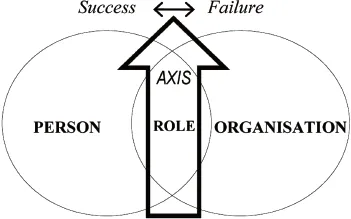
(Adapted from Brunning, 2006).
In this axial conception, the entire organisation is the client in as much a way as the individual being coached, and neither organisation (represented by manager, colleagues, stakeholders and customers) nor individual can be approached as completely separate entities. What is required is a way of working with all the parties in an interdependent web or matrix that is contemplated holistically without positioning one part as necessarily more important than another.
A philosophy that provides such a framework for business coaches can be found in the field of systems thinking and the remainder of this chapter offers an introduction to such with guidance for further learning.
Systems thinking
Systems thinking is not a single discipline but rather a gathering of a wide range of theories that share a set of underlying philosophical notions about reality. Systems thinking stretches from psychology and biology to engineering and ecology, and includes many theories that have been used to underpin services such as family therapy (e.g., Bowen, 1978; Minuchin, 1974), management consulting (e.g., Senge, 1990; Stapley, 2006) and coaching (e.g., Cavanagh, 2006; O’Neill, 2007). The field finds its origin in the study of biological systems. The biologist Ludwig von Bertalanffy developed his general systems theory from the 1920s to the 1960s in an attempt to counteract the limitations of reductionism in traditional science. Bertalanffy (1962, 1968) conceived the world as a whole and opposed atomistic or mechanical approaches to understanding. Thinking of this kind has been around since ancient times in Eastern philosophy (Allen et al., 2011), notably in the eternal Chinese text of the Tao Te Ching (Lao Tzu, 2002) and others such as the Sun Tzu or Art of War (Denma Translation Group, 2001), both written over two thousand years ago.
Simply put, a system “is a set of interacting units with relationships among them” and “in human systems these relations make the system self-organise into characteristic patterns of interaction” (Compernalle, 2007, p. 31). The whole system is different from the sum of its parts and a part of the system derives properties from the whole that it does not have in any other context (ibid., p. 32). Systems also compose subsystems as parts, and so, for example, a systemic view of an organisation allows us to zoom in and out to different levels of an organization, where each level is a subsystem of the next and suprasystem for the level below. As it says in the Tao Te Ching: “Man patterns himself on earth, earth patterns itself on heaven, heaven patterns itself on the Way, the Way patterns itself on nature” (Lao Tzu, Chapter Sixty-Two). To illustrate this, imagine zooming out from the biological level of the brain cell, to the brain, to the person, to the team, to the organisation, and then reversing the process by zooming back in (Compernalle, 2007). In systems thinking, “one is continually aware that different observations at each level lead to different theories, different hypotheses and different interventions” (ibid., p. 34).
Systems theory is seen to be particularly appropriate for any discipline that studies human interaction (Hanson, 1995). In systems thinking, the whole, in terms of the dynamic interplay of the parts, is the object of inquiry. When one sees in wholes, rather than in parts, patterns appear that simple linear cause-and-effect models of reality fail to reveal. A systemic view conceptualises the world in terms of “relational wholes”, and “is an alternative to more reductionistic or mechanical models that encourage study through dissection, then reconstitution, as is traditional in classical biology and medicine” (ibid., p. 27).
In systems theory, the individual is therefore viewed as part of a whole, and the experience of the individual is inherently entangled with their relational field. As Stapley (2006) explains: “There is no such thing as ‘just an individual’ … From birth onwards, we are in a constant state of relatedness to various other individuals and groups” (p. 5). He adds that as children we are dependent on our mothers for our very survival and, on the other end, our mothers are deeply affected by us as they respond to our physical and psychological needs. This process of mutual influence between mother and child is the basic building block of relationship and continues with other people throughout...
Table of contents
- Cover
- Half Title
- Title Page
- Copyright Page
- Table of Contents
- Acknowledgements
- About the Author
- Series Editor’s Foreword
- Introduction
- Chapter One The complexity of client
- Chapter Two The complexity of culture
- Chapter Three The complexity of theory
- Chapter Four Introduction to the Coaching on the Axis framework
- Chapter Five The environmental dimension
- Chapter Six The individual dimension
- Chapter Seven The coaching relationship
- Chapter Eight Coaching on the Axis: technique
- Chapter Nine Case study
- References
- Index
- Endorsements
Trusted by 375,005 students
Access to over 1.5 million titles for a fair monthly price.
Study more efficiently using our study tools.
Frequently asked questions
Yes, you can cancel anytime from the Subscription tab in your account settings on the Perlego website. Your subscription will stay active until the end of your current billing period. Learn how to cancel your subscription
No, books cannot be downloaded as external files, such as PDFs, for use outside of Perlego. However, you can download books within the Perlego app for offline reading on mobile or tablet. Learn how to download books offline
Perlego offers two plans: Essential and Complete
- Essential is ideal for learners and professionals who enjoy exploring a wide range of subjects. Access the Essential Library with 800,000+ trusted titles and best-sellers across business, personal growth, and the humanities. Includes unlimited reading time and Standard Read Aloud voice.
- Complete: Perfect for advanced learners and researchers needing full, unrestricted access. Unlock 1.5M+ books across hundreds of subjects, including academic and specialized titles. The Complete Plan also includes advanced features like Premium Read Aloud and Research Assistant.
We are an online textbook subscription service, where you can get access to an entire online library for less than the price of a single book per month. With over 1.5 million books across 990+ topics, we’ve got you covered! Learn about our mission
Look out for the read-aloud symbol on your next book to see if you can listen to it. The read-aloud tool reads text aloud for you, highlighting the text as it is being read. You can pause it, speed it up and slow it down. Learn more about Read Aloud
Yes! You can use the Perlego app on both iOS and Android devices to read anytime, anywhere — even offline. Perfect for commutes or when you’re on the go.
Please note we cannot support devices running on iOS 13 and Android 7 or earlier. Learn more about using the app
Please note we cannot support devices running on iOS 13 and Android 7 or earlier. Learn more about using the app
Yes, you can access Coaching on the Axis by Marc Simon Kahn in PDF and/or ePUB format, as well as other popular books in Business & Mentoring & Coaching. We have over 1.5 million books available in our catalogue for you to explore.