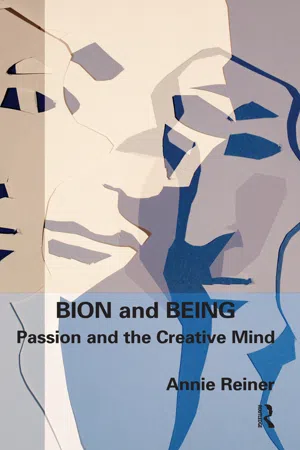
With his concept of "O," Wilfred Bion provided a new psychoanalytic space in which to explore the mind. Dr Annie Reiner's new book, Bion and Being: Passion and the Creative Mind, examines the similarities between this psychoanalytic space and the artist's creative sensibility, as well as mystical and religious states. This most mysterious and revolutionary of Bion's analytic ideas reflects what is essentially a state of being, an experience of mental integrity and union between emotional and rational functions of the mind which is the basis of thinking and creativity. In an effort to provide emotional understanding to Bion's theoretical ideas, Dr Reiner uses examples of artists, poets, writers, theologians, and philosophers, including Rilke, Cummings, Shakespeare, Beckett, and Nietzsche, to illustrate these psychoanalytic concepts. She also presents detailed clinical examples of patient's dreams to explore the obstacles to these states of being, as well as how to work clinically to develop access to these creative states.
- 192 pages
- English
- ePUB (mobile friendly)
- Available on iOS & Android
eBook - ePub
About this book
Information
Chapter One
“O”: Bion’s “truth instinct”*
“Out beyond ideas of wrongdoing and rightdoing there is a field. I’ll meet you there”
(Rumi, 2003, p. 123)
In Bion’s lexicon, the “field” in this excerpt from Rumi’s poem is “O”. It provides an apt description of Bion’s most mysterious idea, representing absolute truth and the state of mind necessary to apprehend it. It is a place of experiential awareness rather than judgement. In a way, Rumi’s words might be an appropriate invitation to our analytic patients, except for the fact that at the beginning of treatment patients are usually unable to meet us in that “field” beyond wrongdoing and rightdoing, for they are often caught up in primitive judgements and confusions which make such a meeting impossible. As analysts, however, we have to be able to join the patient without judgement in whatever field he or she currently resides—in their central essential experience—O.
O is the lynchpin of Bion’s ideas around which all of his theories cohere: reverie, alpha function, thoughts without a thinker, container–contained, the suspension of memory and desire, PsÖD etc., and so an emotional understanding of this idea becomes essential in understanding his work. One might view the metaphysical experience of O as the “selected fact” (Bion, 1962a) that organises and helps make sense of Bion’s theories. It corresponds to the inherent human attribute of a fundamental need for truth, which Grotstein (2007, p. 139) referred to as the idea of a “truth instinct” present throughout Bion’s work. In terms of clinical work, Bion ascribed central importance to O as the foundation of psychoanalytic practice, the necessary psychoanalytic perspective upon which the success of analytic work depends.
This chapter offers an overview of ideas about O that will be more fully explored throughout the book. One writes about O, however, knowing the futility of trying to describe something that is ultimately indescribable. “[O] stands for the absolute truth in and of any object; it is assumed that this cannot be known by any human being” (Bion, 1970, p. 30). Bion also speaks of it as a “… central and basic point … [which] I have tried to signify by a letter O—to signify it, merely to indicate that this is ‘some thing’; but what it is I do not know” (Bion, 1975, p. 30).
Like the metaphorical “field” in Rumi’s poem, there is no such place; it is a state of mind, a state of flux. In psychological terms, it relates to selfhood or being, also in a constant state of flux or becoming. In theological terms, it is the spirit or soul or God. Of course, this state of “being”, a quality used to describe both material and immaterial existence, is no less difficult to describe. The word “being” itself is a gerund, an “action noun”, which has properties of both noun and verb, so we might say that one can be engaged in an act of being while in a mental process of being. In terms of its relationship to O, it can simultaneously reflect both active and passive states of mind, integrating those aspects of one’s material (outer, physical) and immaterial (inner or metaphysical) existence. Bion’s ideas about a Language of Achievement (below, Chapter Six) demonstrate this, language that is potent enough to represent a prelude to action, which I would say is a function of that integrated state of being.
Elusive O
There is a river in Arizona called the Hassayampa, whose name derives from a Native American word denoting disappearance and reappearance. The river goes underground in places, then resurfaces in others. It is analogous to the oscillations in the mind when one relinquishes conscious awareness as one’s ego “disappears” into the dreams of an unconscious realm. One enters that dream-like, semi-conscious reverie as if swept along in the currents of a suddenly appearing river, then resurfaces into consciousness armed with emotional “information” from that realm to which one otherwise lacks access. Access to O depends upon this dream-like state of mind, which presents one’s raw primitive experiences to be transformed into thought (cf. Bion, 1963, reverie, alpha function).
The story told by the Yavapai tribe regarding this sometimes “invisible” river is that once one has stepped into it, he can never again tell the truth (James, 1917, p. 363). It is an interesting myth in view of the fear of the unconscious as a menacing place of obscurity and confusion, and it raises the question as to whether one can never tell the truth again, or, on the contrary, that only in contact with that obscure realm is one capable of telling the deeper truth. Psychoanalytically, this reflects the two views of dreams, either as a distortion of reality as Freud’s theory of dreams suggests, or a means to more essential truth, as Bion’s idea of dreaming upholds.
Bion clearly expressed the ongoing nature of dreaming in waking life as central to processing truth and raw emotional experience. He described a non-pathological state of hallucinosis that is “always present but overlaid by other phenomena which screen it” (1970, p. 36). Dreams are obscured from our awareness by the myriad distractions of external reality, all the perceptions of a sensuous world that are suspended as we sleep. We continue dreaming throughout the day, we just do not see our dreams, like the stars which are invisible to us during the day in the sun’s blinding light. For the analyst, opening the mind’s “eye” to this invisible reality while awake depends upon temporarily closing the mind to the distractions of the senses. One facilitates this by suspending memory, desire, and understanding (Bion, 1970). This temporary suspension of the senses as one connects with a dream-like metaphysical state in waking life can give rise to terrifying feelings of loss of control, since our senses help ground us in the familiar identities of our physical lives.
There is evidence of the revolutionary aspect of Bion’s work in his description of the dangers of this discipline, and the resulting experience of contact with O as “an attack on the ego” (1970, p. 48). Suspending memory, desire, and understanding, he says, gives rise to a state of mind similar to that which occurs in severely regressed patients, and he, therefore, advocates this procedure “only for the analyst whose own analysis has been carried at least far enough for the recognition of paranoid schizoid and depressive positions” (p. 47 fn).
Metaphysical and religious aspects of O
Symington and Symington (1996) describe the metaphysical or religious meaning in Bion’s idea of O as providing a fundamentally different foundation to psychoanalytic thought, which is foreign to the works of Klein or Freud. The concept of O first appeared in Bion’s work in Transformations (1965) and in Attention and Interpretation (1970), causing some of his colleagues to believe he had gone mad (Symington & Symington, 1996). Introducing a metaphysical sense of an infinite unknowable reality to the scientific world of psychoanalysis dealt yet another disturbing blow to man’s egocentric view. It indicated, as had Freud’s idea of an unconscious, that man was not the master of his own mind. Bion’s idea went further, however, as the concept of O introduced questions about the possibility of knowledge itself. He likened it to Heisenberg’s “uncertainty principle” (Bion, 1992, p. 263), which suggested that quantum physicists were not dealing merely with obstacles to their existing methods or current knowledge, but with the limits of knowledge itself. In the world of physics, it was learnt that one could not simultaneously chart the location and momentum of a particle, not because the proper equipment had not been invented to measure it, but because the act of measuring itself interfered with the other measurement. The observer, in other words, presented a disturbance to the field being observed. Similarly, in the mind, the concept of O suggested that it was not the absence of analytic knowledge, but the fact that we are dealing with an ultimately unknowable internal universe. In addition, the observer—the analyst—changes the field of observation in the complex relationship to the patient.
Scientist–inventor, Barry Lebost, describes how scientific truth has suffered from human beings putting themselves at a central position in relation to the observable universe. Even the greatest scientists, he says, have viewed the world as invariant, based on an assumption that the visible world accurately depicts the world that is. He upholds that this kind of “centre stage observance” blinds people to the more complex and dynamic variant world beyond our awareness, and that scientific conclusions have been drawn based on these erroneous assumptions. Lebost (2008) writes, “Physical truth will never be understood until the phenomenon of observer invariance is fully accounted for” (p. xii). Einstein, for instance, saw the speed of light as invariant. However, with the invention of the Chandra X-ray telescope in 1999, new information about the expansion and acceleration of the universe became available, information to which Einstein could not have had access. Based on these findings, conclusions drawn from the erroneous assumption of an invariant speed of light proved untrue. Lebost makes the following observation regarding the expanding, accelerating universe, a phenomenon we cannot see, but which we now know exists.
A new paradigm is emerging that proves that humankind and all living things exist in two realities. The first is the invariant world that we are familiar with, the one in which we think we live. It is what we see … The second is the true universe that is in a relentless pursuit to become larger, a place where all yardsticks continuously become longer at a faster and faster rate. This dynamic and variant world is invisible to all observers because all living observers are integral members of the universal accelerating frame and have been granted no outside references for comparison. When we finally accept the new world we will have taken a giant step into reality. We will have learned that much goes on around us without human awareness. (Lebost, 2011)
This idea of an outside frame of reference is inherently mysterious. How can one observe from outside one’s own frame of reference? How can we see what we cannot see? And yet, this is the implicit proposal in Bion’s concept of O. The analyst is called upon to use a different level of his or her perceptual apparatus, without which assumptions continue to be made based on erroneous beliefs in an invariant world. One is asked to enter a realm of mystical knowledge beyond memory, desire, and the understanding gained from physical perceptions experienced through the senses. In this mental state of at-one-ment, one’s perceptions extend past one’s known self and personal experience. Bion makes it clear, however, that this is not incompatible with scientific knowledge, and he includes scientists in his description of the mystic. “Newton is the outstanding example of such a man; his mystical and religious preoccupations have been dismissed as an aberration when they should be considered as the matrix from which his mathematical formulations evolved” (Bion, 1970, p. 64).
Bion’s idea of O, though derived from Freud’s theory of the unconscious, goes further by including the idea of a transcendent unknowable realm of primal proto-mental knowledge, vestiges, perhaps, of pre-natal experience. It is akin to the realm depicted in Jung’s archetypes, which are seen to “exist in the unconscious as undifferentiated symbols” (McGuire & Hull, 1977, p. 216), and the idea of the collective unconscious, described by Jung as “everything that precedes the personal history of the human being” (ibid., p. 231). The Oedipal myth, Jung explained, was one example of such an archetype, stored in the collective unconscious of the race. Bion (1978) viewed Jung’s ideas of archetypes and the collective unconscious as expressions of the same unaltered fundamental mind he described as proto-mental memories (p. 4). O describes both that unnameable unrepresentable external reality Grotstein describes as “the world as it is, the universe without representations” (2011, private conversation) and the individual’s primal internal preconception of that natural world. The attempt to experience the relationship between these two aspects of O is the essential work of analysis. It is based on an experience of separateness that, paradoxically, is the foundation of union and passion.
Philosophy, art, religion
Although Bion introduced the metaphysical or mystical idea of O to psychoanalysis, the experience it represents is certainly nothing new. Philosophers, poets, theologians, and artists have examined this state of mind since the beginning of history. It is also the essential basis of creative work of all kinds, and Bion recognised the common task of analysts and artists in expressing the elusive metaphysical truths beyond the senses. “It would be useful if we could recognize that all these various disciplines—music, painting, psycho-analysis and so on ad infinitum—are engaged on the same search for truth” (Bion, 1978, p. 43).
At moments of inspiration, the individual inhabits a state of being, although it is more accurate to say that he is inhabited by that state of being to which he succumbs, a feeling of being taken over by a force beyond his control. As if swept up and carried along by that suddenly emerging Hassayampa River, this process of being connects one to an instinctual level of truth and life; exhilarating in its potential for knowledge and creative inspiration, it also inspires fear and resistance at the lack of control over one’s own emotional experience. Alluding to this fear, Bion wrote, “Resistance is resistance to O. Resistance operates because it is feared that reality is imminent” (1965, p. 127). The nature of this reality beyond common everyday reality will be more fully investigated in Chapters Three and Four.
O and morality
In concordance with the notion of Rumi’s field “beyond wrongdoing and rightdoing”, Bion (1965) writes, “[O] is not good or evil; it cannot be known, loved, or hated” (p. 139). His definitions of O as ultimate reality, absolute truth, the godhead, portray a level of reality requiring a more evolved mental state to make contact with it. It corresponds to Nietzsche’s (1886) idea of a new system of values “beyond good and evil”, which would require an Übermensch or superman, a “new philosopher” or “new psychologist” to think it. The task of these “genuine philosophers” (p. 136, sec. 211) was to “overcome the entire past” (ibid.) in order to create a new future. Philosophers, and society in general, were seen by Nietzsche as having lacked an essential awareness, and he lamented those past and current “philosophical laborers” whose job had been to force the existing stores of knowledge and long dominant values into comprehensible formulae. These ideas of Nietzsche, Rumi, and Bion in the varied disciplines of philosophy, poetry, and psychoanalysis, all denote a level of knowledge beyond societal judgement. This “new philosopher”, whose attributes are more fully examined in Chapter Eight, needed to think for himself beyond the beliefs of the prevailing customs, according to his individual mind. This included the capacity for knowledge of one’s inner intentions, an idea of Nietzsche’s that presaged Freud’s theory of the unconscious, the hidden thoughts and intentions which determined behaviour.
O and the Übermensch
Nietzsche’s Übermensch represents an ideal, a human potential for mental capacities still in the process of developing. First mentioned in Thus Spoke Zarathustra (Nietzsche, 1885a), the Übermensch was a Superman of noble tastes, the aim of human development, while man in his current state was something in need of being surmounted. The need for awareness of primitive emotional life contained in psychoanalytic thought is reflected in Nietzsche’s idea that man’s mental evolution would be dependent on a vision able to span the heights and depths of human experience, a marriage of the human and the divine, of primal and higher states of mind. “Man is a rope”, he wrote, “fastened between animal and Superman—a rope over an abyss” (sec. 4, p. 43).
Bion also spoke about the need for further mental development in order to be able to experience and communicate metaphysical states of mind. While thinking might appear to be something everyone can do, both Bion and Nietzsche are describing a kind of thinking dependent upon the fulfilment of a higher mental potential. Thinking, Bion (1962b) writes, “… is embryonic even in the adult and has yet to be developed fully by the race” (p. 85). For Nietzsche, this new thinker is described as the future of man, “a man of tomorrow and the day after tomorrow … His enemy was ever the ideal of today” (sec. 212, p. 13...
Table of contents
- Cover
- Half Title
- Title
- Copyright
- CONTENTS
- ACKNOWLEDGEMENTS
- ABOUT THE AUTHOR
- INTRODUCTION
- CHAPTER ONE “O”: Bion’s “truth instinct”
- CHAPTER TWO Self and other: passion and play in analysis and art
- CHAPTER THREE The development of language
- CHAPTER FOUR “A rose is a rose is a rose …”: the power and limits of language
- CHAPTER FIVE “O”: the spiritual aspect of being
- CHAPTER SIX The language of being and mental wholeness
- CHAPTER SEVEN Being and non-being: a clinical view
- CHAPTER EIGHT Duality and the myth of Sisyphus: a clinical exploration
- CHAPTER NINE Evolving states of wholeness and being
- CHAPTER TEN Summary and conclusions
- REFERENCES
- INDEX
Trusted by 375,005 students
Access to over 1.5 million titles for a fair monthly price.
Study more efficiently using our study tools.
Frequently asked questions
Yes, you can cancel anytime from the Subscription tab in your account settings on the Perlego website. Your subscription will stay active until the end of your current billing period. Learn how to cancel your subscription
No, books cannot be downloaded as external files, such as PDFs, for use outside of Perlego. However, you can download books within the Perlego app for offline reading on mobile or tablet. Learn how to download books offline
Perlego offers two plans: Essential and Complete
- Essential is ideal for learners and professionals who enjoy exploring a wide range of subjects. Access the Essential Library with 800,000+ trusted titles and best-sellers across business, personal growth, and the humanities. Includes unlimited reading time and Standard Read Aloud voice.
- Complete: Perfect for advanced learners and researchers needing full, unrestricted access. Unlock 1.5M+ books across hundreds of subjects, including academic and specialized titles. The Complete Plan also includes advanced features like Premium Read Aloud and Research Assistant.
We are an online textbook subscription service, where you can get access to an entire online library for less than the price of a single book per month. With over 1.5 million books across 990+ topics, we’ve got you covered! Learn about our mission
Look out for the read-aloud symbol on your next book to see if you can listen to it. The read-aloud tool reads text aloud for you, highlighting the text as it is being read. You can pause it, speed it up and slow it down. Learn more about Read Aloud
Yes! You can use the Perlego app on both iOS and Android devices to read anytime, anywhere — even offline. Perfect for commutes or when you’re on the go.
Please note we cannot support devices running on iOS 13 and Android 7 or earlier. Learn more about using the app
Please note we cannot support devices running on iOS 13 and Android 7 or earlier. Learn more about using the app
Yes, you can access Bion and Being by Annie Reiner in PDF and/or ePUB format, as well as other popular books in Psychology & Creative Ability in Psychology. We have over 1.5 million books available in our catalogue for you to explore.