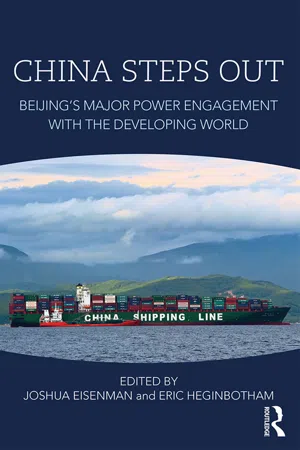
What are Beijing's objectives towards the developing world and how they have evolved and been pursued over time? Featuring contributions by recognized experts, China Steps Out analyzes and explains China's strategies in Southeast Asia, Central Asia, South Asia, Africa, Middle East, and Latin America, and evaluates their effectiveness. This book explains how other countries perceive and respond to China's growing engagement and influence. Each chapter is informed by the functionally organized academic literature and addresses a uniform set of questions about Beijing's strategy. Using a regional approach, the authors are able to make comparisons among regions based on their economic, political, military, and social characteristics, and consider the unique features of Chinese engagement in each region and the developing world as a whole. China Steps Out will be of great interest to students and scholars of Chinese foreign policy, comparative political economy, and international relations.
eBook - ePub
China Steps Out
Beijing's Major Power Engagement with the Developing World
- 438 pages
- English
- ePUB (mobile friendly)
- Available on iOS & Android
eBook - ePub
China Steps Out
Beijing's Major Power Engagement with the Developing World
About this book
Information
Background and History
1
China and the Developing World
A New Global Dynamic
Introduction
On May 14, 2017, over 1,500 people, including twenty-nine national leaders and delegates from 130 countries, gathered at the China National Convention Center in the Olympic Center in Beijing to hear President Xi Jinping’s remarks opening the One Belt, One Road (OBOR) Conference. “What we hope to create is a big family of harmonious co-existence,” Xi said, then announced another 100 billion yuan ($14.49 billion) for the Silk Road Fund, bring the total to nearly $55 billion. Moreover, he added: “The China Development Bank and the Export–Import Bank of China will set up special lending plans respectively worth 250 billion yuan and 130 billion yuan to support Belt and Road cooperation.” During the group photo, Xi was flanked by Russian President Vladimir Putin and Turkey’s President Recep Tayyip Erdogan, who both spoke at the ceremony. Ethiopian Prime Minister Hailemariam Desalegn summed up the mood among the attendees: “China has taken the leadership in laying the foundations for the realization of our shared vision for an open, fair and prosperous world. Achievement of this vision will require our political commitment and a huge sum of resources.”1
For centuries, Western observers have predicted that China would someday emerge as a major political and economic force in regional and world affairs and—as the 2017 OBOR Conference and dozens of similar events demonstrate—that that day has arrived: China has stepped out. Since 2000, by nearly every measure—trade, investment, aid, diplomacy, media, culture, education, party-to-party, person-to-person, military-to-military, and many more categories—China’s engagement with developing countries has witnessed an historic expansion. On a nearly weekly basis, China’s state-owned firms and banks conclude multibillion-dollar investment or financing agreements throughout Asia, Africa, Latin America, and the Middle East.
Indeed, the pace and scope of China’s emergence has been breathtaking. Between 2000 and 2016, China’s real GDP increased more than fourfold to roughly $11.4 trillion at the 2016 exchange rate;2 its foreign trade climbed from $642 billion to $3.7 trillion (in 2016 dollars);3 and its share of the global economy grew from 3.6 percent to 14.9 percent.4 Chinese FDI, which was about $70 billion in 2013, exceeded $170 billion in 2016.5 When Beijing abandoned isolation and began its economic “opening” to the world in the mid- to late 1970s, even the most optimistic Chinese policymaker could not have predicted such a precipitous expansion of economic scale or global engagement.
To cope with excess industrial and construction capacity and gain higher returns, Beijing’s “going out” policy has been expanded into the ambitious OBOR initiative. To help Chinese state-owned and private firms take advantage of new economic opportunities in lesser-developed regions, China has created policy banks and other funding mechanisms (e.g., the China Ex–Im Bank, China Development Bank, the China–Africa Development Fund, and the Silk Road Fund) to lend money to foreign governments to execute infrastructure projects employing Chinese firms. The Beijing-based Asian Infrastructure Investment Bank, unlike the others, is a multilateral institution, but it is also part of China’s larger international development and trade promotion strategy. According to an official media outlet: “With the ‘Belt and Road’ initiative and other strategies serving as a powerful engine … China’s overseas investment will continue to maintain a double-digit growth rate.”6
Politically, Beijing continues to expand the depth and breadth of its “strategic partnerships” with developing countries. China has also created a multilateral institutional framework for its interactions with every region of the developing world except South Asia, where rivalry between India and Pakistan precludes such an effort.7 China’s influence in developing countries has expanded under President Xi, who in 2014 exhorted his comrades: “We should increase China’s soft power, give a good Chinese narrative and better communicate China’s messages to the world.”8 Indeed, Beijing is spending more time and resources hosting and visiting counterparts from developing countries’ political parties than ever before, the People’s Liberation Army (PLA) is building military-to-military ties, Chinese arms suppliers are doing a brisk business, and in 2017 Beijing christened its first overseas military base in Djibouti. Chinese language schools, media training, cultural exchanges, educational and training programs, and other forms of aid and assistance have increased China’s soft power in many countries.9
Yet, China’s push into the developing world has not been without setbacks and problems. China’s economic slowdown, especially the sharp downturn after 2015, precipitated a drop in global commodity prices and raised new questions about the profitability of many government-driven commodity investments. Similarly, after making tens of billions in politically driven loans at favorable rates to high-risk developing countries including Venezuela, Zimbabwe, and Sri Lanka, China now faces problems recouping its capital. One hotly debated question as this book goes to press is whether OBOR will reverse these trends or, more likely, exacerbate them.
Growing trade deficits and asymmetric investment have engendered concern among leaders in numerous developing countries, and, in some cases, drawn protests from local populations. China’s growing hard power, combined with its more assertive approach to territorial and boundary issues in the South China Sea, has also caused some states around China’s periphery to seek closer military or strategic ties with the United States and Japan. Farther afield, in the Middle East and to a lesser extent Africa, Beijing’s commitment to neutrality and non-interference in regional disputes are increasingly being tested as its economic interests expand in ways that require it to behave like a more traditional major world power.
This book has four goals: to assess China’s primary objectives in different parts of the developing world and how they have evolved over time; to unpack and summarize the primary means Beijing uses to pursue those objectives; to evaluate how effective Chinese efforts have been; and to understand how other countries perceive and respond to China’s growing engagement and influence.
China’s Emergence and Evolution as a Major Power
Domestic context is essential to understanding any country’s foreign relations, and this is nowhere truer than when examining China’s relations in the developing world. Prior to the Sino–Soviet split in 1958–59, China viewed developing countries largely through the political prism of Afro-Asian solidarity initiated at the 1954 Bandung Conference. The leaders of the newly founded People’s Republic of China (PRC) sought to establish bilateral relationships with as many countries and revolutionary groups as possible, primarily to gain external validation of Communist Party legitimacy and demonstrate the correctness its own domestic communist ideology. Throughout the 1960s and 1970s, as the rivalry between Beijing and Moscow heated up, China provided military largesse, weapons, guerilla training, and rhetorical support to both anti-colonial and anti-Soviet groups in Asia, Africa, and, to a lesser extent, Latin America. Throughout the Mao era, Beijing cultivated support among the newly independent developing nations of Africa and (less successfully) Asia, and juxtaposed its policies with those of the “imperialist powers,” namely, the Soviet Union and the Unites States.
Under Deng Xiaoping’s leadership, China jettisoned Maoism and adopted a distinctly non-ideological, domestic development-first approach to foreign policy, following the maxims of “keeping a low profile” and “biding time and hiding capabilities” (韬光养晦).10 Chinese leaders began referring to a period of “strategic opportunity,” during which China, free from external threats, could focus on internal development. To ensure a peaceful international environment suitable for growth, China worked with its neighbors to resolve longstanding border disputes, expand trade, and attract foreign investment. Meanwhile, country by country, Beijing built positive international relationships—particularly with the United States, Japan, and other Asian neighbors—and quietly isolated Taipei as an international political entity. Throughout the 1980s, China’s trade with the developing world increased rapidly, both in real terms and as a percentage of its total trade (see Appendix I). Under the mantra of “peace and development,” China’s non-ideological and conciliatory approach to international relations, which Joshua Kurlantzick dubbed China’s Charm Offensive, proved highly successful.11
By the 1990s, Beijing’s growing need for raw materials and markets motivated expanded political engagement with developing states and the establishment of policy banks to support an export-oriented growth strategy. In 1999, China formally initiated its “go out policy,” which aimed to expand export markets and gradually increase foreign direct investment (FDI) to countries around the world. Then, in 2002, Foreign Minister Tang Jiaxuan outlined China’s “new security concept,” emphasizing cooperative security and confidence building with both developed and developing countries.12 Zheng Bijian, an influential Chinese think tank leader, suggested that Beijing should promote its foreign policy under the slogan “ ‘peaceful rise’ to great power status,” though the leadership ultimately adopted the less forward-leaning formulation, “peace and development.”13 These concepts, enabled China to enhance its “comprehensive national power” while minimizing the insecurity of neighbors. They prioritized flexibility, dispute resolution, and involvement in regional institutions. China joined the World Trade Organization, ratified the United Nations Convention on the Law of the Sea, and expanded its participation in UN peacekeeping operations. For three decades China’s well-considered diplomacy succeeded in improving its global image and cultivating international partners.
Since the end of the 2000s, and especially since Xi Jinping’s accession in 2012, China has pursued a more self-confident and assertive approach to foreign affairs. Under the banner of “Chinese Dream” of national rejuvenation, Xi has advanced its concept of “major power diplomacy with Chinese characteristics.”14 China’s rapidly expanding overseas economic interests and growing military capabilities have combined to produce a more muscular foreign policy toward the developing world. Beijing has been more willing to show leadership on the one hand, and has been more assertive in pursuing its narrower “core national interests” (including territorial ones) on the other. Its coast guard and naval ships have confronted foreign vessels in the East and South China Seas, it has established an air defense identification zone in the East China Sea, and it has employed land reclamation to transform tiny features in the South China Sea into military outposts.
Xi Jinping has also sought to buttress “major power diplomacy” with a variety of bold initiatives designed to win hearts and minds and expand Chinese influence in the developing world. The PLA has continued to expand military diplomacy, and the Chinese navy now holds regular port calls throughout the developing world, anti-piracy patrols off the Somali coast, and is actively engaged in a broad range of peacekeeping efforts. Most dramatically, Beijing has also doubled down on economic diplomacy with the 2013 launch of OBOR, which seeks to create a new Sino-centric era of globalization using both traditional tools of Chinese statecraft as well as new types of economic incentives and debt financing arrangements. In spite of these activities, many countries on China’s periphery continue to harbor serious concerns about Beijing’s long-term ambitions and others are ambivalent about excessive dependence on trade with and investment from China. Addressing these concerns while pursuing Beijing’s material goals will challenge Chinese foreign policy leaders for the foreseeable future.
The Developing World in Chinese Strategic Thinking
Chinese foreign policy practice has long parsed political relations according to the characteristics of partner states: specifically, relations with major power (大国); relations with states around China’s periphery (周边国家); relations with developing states (发展中国家); and, since the 18th Party Congress in 2012, relations with multilateral (多边) forums.15 The definition and boundaries among these different types of partnerships are somewhat ambiguous, and many states fall into more than one group.
Major powers are economically developed states of a certain size, including the United States, Russia, Japan, Germany, Britain, or the EU as a whole. States on the periphery include a wide array of both developing states and major powers in East Asia, Central Asia, South Asia, Russia, and Southeast Asia. Former President Hu Jintao is credited with the formulation: “Major powers are the key, surrounding (peripheral) areas are the first priority, developing countries are the foundation, and multilateral forum...
Table of contents
- Cover
- Title
- Copyright
- Dedication
- Contents
- Foreword
- Bios
- Part I Background and History
- Part II Regional Profiles
- Part III Conclusion
- Index
Trusted by 375,005 students
Access to over 1.5 million titles for a fair monthly price.
Study more efficiently using our study tools.
Frequently asked questions
Yes, you can cancel anytime from the Subscription tab in your account settings on the Perlego website. Your subscription will stay active until the end of your current billing period. Learn how to cancel your subscription
No, books cannot be downloaded as external files, such as PDFs, for use outside of Perlego. However, you can download books within the Perlego app for offline reading on mobile or tablet. Learn how to download books offline
Perlego offers two plans: Essential and Complete
- Essential is ideal for learners and professionals who enjoy exploring a wide range of subjects. Access the Essential Library with 800,000+ trusted titles and best-sellers across business, personal growth, and the humanities. Includes unlimited reading time and Standard Read Aloud voice.
- Complete: Perfect for advanced learners and researchers needing full, unrestricted access. Unlock 1.5M+ books across hundreds of subjects, including academic and specialized titles. The Complete Plan also includes advanced features like Premium Read Aloud and Research Assistant.
We are an online textbook subscription service, where you can get access to an entire online library for less than the price of a single book per month. With over 1.5 million books across 990+ topics, we’ve got you covered! Learn about our mission
Look out for the read-aloud symbol on your next book to see if you can listen to it. The read-aloud tool reads text aloud for you, highlighting the text as it is being read. You can pause it, speed it up and slow it down. Learn more about Read Aloud
Yes! You can use the Perlego app on both iOS and Android devices to read anytime, anywhere — even offline. Perfect for commutes or when you’re on the go.
Please note we cannot support devices running on iOS 13 and Android 7 or earlier. Learn more about using the app
Please note we cannot support devices running on iOS 13 and Android 7 or earlier. Learn more about using the app
Yes, you can access China Steps Out by Joshua Eisenman,Eric Heginbotham in PDF and/or ePUB format, as well as other popular books in Politics & International Relations & Political Economy. We have over 1.5 million books available in our catalogue for you to explore.