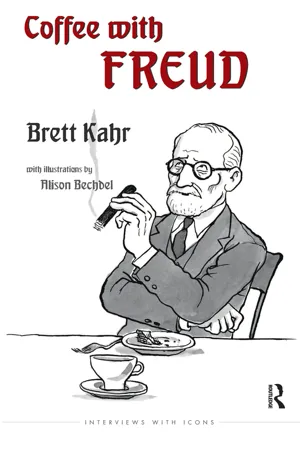
This is the second volume in Brett Kahr's 'Interviews with Icons' series, following on from Tea with Winnicott. Professor Kahr, himself a highly regarded psychoanalyst, turns his attention to the work of the father of psychoanalysis. The book is lavishly illustrated by Alison Bechdel, winner of the MacArthur Foundation 'Genius' Award.Sigmund Freud pays another visit to Vienna's renowned Cafe Landtmann, where he had often enjoyed reading newspapers and sipping coffee. Freud explains how he came to invent psychoanalysis, speaks bluntly about his feelings of betrayal by Carl Gustav Jung, recounts his flight from the Nazis, and so much more, all the while explaining his theories of symptom formation and psychosexuality.Framed as a 'posthumous interview', the book serves as the perfect introduction to the work of Freud while examining the context in which he lived and worked. Kahr examines his legacy and considers what Freud has to teach us. In a world where manifestations of sexuality and issues of the mind are ever more widely discussed, the work of Sigmund Freud is more relevant than ever.
- 336 pages
- English
- ePUB (mobile friendly)
- Available on iOS & Android
eBook - ePub
Coffee with Freud
About this book
Information
The Interview
Dr Kurt Eissler:
“Bier hat der Professor nicht getrunken?”
[“Did the Professor not drink beer?”]
“Bier hat der Professor nicht getrunken?”
[“Did the Professor not drink beer?”]
Dr Walter Schmideberg:
“Soviel ich weiss, nein! Nur Kaffee, wie jeder Wiener.”
[“So far as I know, no! Only coffee, like every Viennese.”]
“Soviel ich weiss, nein! Nur Kaffee, wie jeder Wiener.”
[“So far as I know, no! Only coffee, like every Viennese.”]
Dr Kurt Eissler, Secretary of the Sigmund Freud Archives, in conversation with Dr Walter Schmideberg, 20th July, 1954; reproduced from an unpublished transcript in the Sigmund Freud Papers of the Sigmund Freud Collection in the Library of Congress, Washington, DC, USA (Eissler, 1954, p. 16)
Cup 1
The resurrection of Professor Sigmund Freud
[Wilhelm Kerl approaches the table and then bows.]
WK: Willkommen im Cafe Lwidtmann, Herr Kahr.
BK: Thank you, Herr Kerl. I am very honoured to be here, and I am so grateful that you have agreed that I might interview Professor Freud in your historical establishment.
WK: Professor Freud has long been one of our most distinguished guests. We are very proud that he has chosen the Café Landtmann as his Kaffeehaus.
BK: Vienna boasts so many wonderful Kaffeehäuser.
WK: Ja, ja, we have many coffee houses, this is true. But if you are to interview Professor Freud, you must speak in the Viennese way. I can see that you did not learn your German in Vienna: am I right?
BK: You are correct.
WK: I know this because you placed the accent on the first syllable of the word Kaffeehäuser. That is what the Germans do. They will say Kaffee, meaning coffee in your language. We Viennese, by contrast, pronounce it like the French, and we say Kaffee. We place the accent on the last syllable, not the first. Professor Freud always asked for Kaffee. I think you need to know that.
BK: I am very grateful to you Herr Kerl. Thank you.
WK: It is of no consequence. Professor Freud speaks excellent English.
BK: Indeed.
WK: We were discussing Vienna's Kaffeehäuser.
BK: Ah, yes . . .
WK: You must understand that in its heyday, before the war . . .
BK: The Second World War?
WK: Der Zweite Weltkrieg, ja. Before the Second World War, our coffee houses occupied a very special place in Viennese life. Everyone came here. And when they came, they stayed. Not like your Starbucks of today, with people popping in and out. In our day, the Viennese would come for hours at a time, and they would drink coffee, read the newspapers, eat pastries, meet friends . . .
BK: Much more like a social club.
WK: A place for coffee . . . for food . . . for conversation. You could call it a social club. But also an intellectual club.
BK: Writers and artists have always had a particular penchant for the Kaffeehäuser, I believe.
WK: The writers would often spend ages here, producing reams and reams of poems, and pages of novels. Many an artist became a Stammgast.
BK: Stammgast? A regular guest?
WK: Yes, a "regular", as you would say in English.
BK: Ah, yes. And Professor Freud became a Stammgast here at the Café Landtmann.
WK: Our most prized Stammgast. We have always been very honoured that he patronised us in this way. You know, the Professor could have frequented the Café Demel on the Kohlmarkt – very fine pastries at Demel, so I'm told – or the Café Hawelka, on the Dorotheergasse, or the Café Sperl on Gumpendorferstraβe. But he came here, to the Café Landtmann.
BK: You must be very proud.
WK: Very proud.
BK: I remember having read a lovely memoir by an Austrian writer called Joseph Wechsberg . . .
WK: This name I do not know.
BK: A very fine writer who emigrated to the United States in 1939, I believe. Herr Wechsberg made a very amusing observation about the Kaffeehäuser of Vienna, He quipped, "It was said that some men had more than one woman but only one coffeehouse."
WK: That is absolutely true. People came here for the Jause.
BK: The Jause?
WK: That is a Viennese invention, to be sure: a mid-afternoon break in which patrons could drink coffee with whipped cream, eat pastry, and indulge in much gossip!
BK: Tell me about the history of this Kaffeehaus, Herr Kerl.
WK: We opened here on the Ringstraβe in 1873. Franz Landtmann, from whom we take our name – a most distinguished cafetier – founded this establishment, and then, in 1881, Herr Landtmann sold the café to me and to my brother Rudolf.
BK: But you kept the Landtmann name.
WK: We kept the Landtmann name, ja. And still we have it.
BK: And you are very near to the university, the Universität zu Wien. That must have been rather convenient for Professor Freud, who lectured there.
WK: We had many men from the university come here for coffee, for cake, for reading the newspapers. Many very well-educated university men.
BK: It really meant something, to teach at the university . . . before the Weltkrieg.
WK: We have always treated our scholars with deep respect. Just as they treated the Cafe Landtmann with deep respect.
BK: You mentioned the Second World War earlier – den Zweiten Weltkrieg – but you had already died by that point. You worked here, I believe, during dem Ersten Weltkrieg, the First World War.
WK: Certainly we had our difficulties. Vienna suffered terribly from restrictions and shortages during the war. Very bad food shortages.
BK: With very painfully cold winters, so I understand.
WK: Indeed. Do you know that in August of 1915, I had to remove Einspänner coffee from our menu because of the difficulty we had obtaining milk. Also the Sacher Torte . . . which we always served with whipped cream. And then in November of that very same year, we had to replace sugar wife saccharine. Most distressing. But we survived somehow. It would be many years before Austria enjoyed Schlagobers again.
BK: Coffee with whipped cream.
WK: Ja, coffee with whipped cream.
BK: The Kaffeehaus holds quite a special place in the heart of the Viennese.
WK: Very special. Very special indeed. And I am so pleased that you have pronounced Kaffeehaus now in our Viennese way.
BK: Thank you. I shall do my very best.
WK: You have Viennese ancestry, I believe.
BK: It pleases me to tell you that I do.
WK: I know this from your family name Kahr, which is not, I think, Anglo-Saxon.
BK: Many of my family members did come from Austria generations back, so I have a great interest in your country and, especially, in your capital city.
WK: But you have never lived in Vienna yourself.
BK: I regret to tell you that I have not.
WK: I feel sorry for you. Vienna is a very special place, and not only for the Kaffeehäuser, you understand.
BK: I do indeed.
WK: But forgive me, I see my Oberkellner has not brought you anything to eat or to drink.
BK: Oberkellner?
WK: You would say, I think, "head waiter" . . . the Herr Ober.
BK: Ah, of course. Actually, I think I shall wait until Professor Freud arrives.
WK: But you have made such a long journey here from London. Can I not bring you some Krapfen or some Gugelhupf?
BK: How very tempting, but I do think I will wait.
WK: Of course.
BK: You have a large team working for you, I can see.
WK: Yes, as the cafetier, I have the task of supervising the many waiters who work beneath me and also the little Pikkolo boys beneath them.
BK: Pikkolo boys?
WK: These are the youngsters who fill the glasses of water.
BK: I think that this would not be permitted today, in the twenty-first century.
WK: Perhaps not.
BK: Thank you for explaining the life of the Kaffeehaus to me. I feel much better prepared already.
WK: Of course. But I see that Professor Freud has just arrived.
BK: Oh, gosh. So he has.
WK: You are nervous?
BK: I am very nervous.
WK: But he is a very polite, very kind man. You have no need to be nervous.
BK: You must understand, Herr Kerl, that I have been studying Professor Freud's work for almost the whole of my life.
WK: He will be very pleased to hear that. But look, here he comes. Please do compose yourself. I will introduce you.
[Professor Sigmund Freud enters the main dining room; Herr Kerl bows most reverentially to him and beckons him to the table with a graceful wave of the arm.]
WK: Herr Professor, my entire staff and I bid you our most special welcome.
SF: How long has it been since I have seen you, Herr Kerl?
WK: Too long, Herr Professor. Far too long. We are so honoured to have you back with us today.
SF: I have come to meet a man who has asked to interview me.
WK: May I present to you Herr Kahr, aus England.
[Slowly, Professor Freud transfers his walking stick from his right hand to his left hand, and then he extends his right hand for a shake.]
SF: Aus England? Then I shall speak in English. Welcome to Vienna, Herr Kahr.
BK: Professor Freud, I hardly know what to say. How can I ever thank you for coming back here to speak to me.
SF: Your gratitude is premature. Perhaps you had best wait to see whether I have anything useful to say before you thank me.
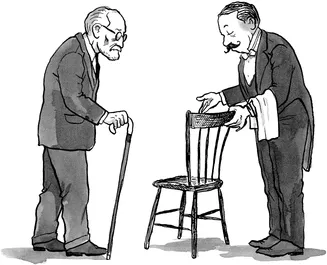
[Herr Wilhelm Kerl pulls out a chair for Professor Freud.]
WK: But you must be very tired after your journey from . . . well, you know where, Herr Professor, Please do sit.
SF: I am tired, but I am also very disbelieving that I am back in Vienna. I have not been here since ... let me see, when did I leave?
BK: You left on 4th June, 1938.
SF: Herr Kerl, this man has indeed been studying my life.
BK: He has come all the way from England to see you.
SF: Well that is not very sensible. I died in England. Could we not have met there?
BK: I had thought, Professor Freud, that it might be pleasant to speak to you here in Vienna, where you invented psychoanalysis.
SF: Of course, of course. But still, it is such a long journey back for me. You understand?
BK: Well, yes, of course. As I have already said, I am really most grateful.
WK: Gentlemen, I trust that you will have a most pleasant interview. My waiters and I will be on hand to attend to your every desire. May I have the honour of bringing your first coffee to you personally, Professor Freud?
SF: Not just yet, Kerl. I am still adjusting to the idea that I seem to be alive again after all this ...
Table of contents
- Cover
- Half Title
- Title
- Copyright
- Dedication
- Contents
- ABOUT THE AUTHOR AND ILLUSTRATOR
- INTRODUCTORY NOTE
- THE INTERVIEW
- EPILOGUE: How I came to meet Freud
- GERMAN GLOSSARY
- ACKNOWLEDGEMENTS
- REFERENCES
- INDEX
Trusted by 375,005 students
Access to over 1.5 million titles for a fair monthly price.
Study more efficiently using our study tools.
Frequently asked questions
Yes, you can cancel anytime from the Subscription tab in your account settings on the Perlego website. Your subscription will stay active until the end of your current billing period. Learn how to cancel your subscription
No, books cannot be downloaded as external files, such as PDFs, for use outside of Perlego. However, you can download books within the Perlego app for offline reading on mobile or tablet. Learn how to download books offline
Perlego offers two plans: Essential and Complete
- Essential is ideal for learners and professionals who enjoy exploring a wide range of subjects. Access the Essential Library with 800,000+ trusted titles and best-sellers across business, personal growth, and the humanities. Includes unlimited reading time and Standard Read Aloud voice.
- Complete: Perfect for advanced learners and researchers needing full, unrestricted access. Unlock 1.5M+ books across hundreds of subjects, including academic and specialized titles. The Complete Plan also includes advanced features like Premium Read Aloud and Research Assistant.
We are an online textbook subscription service, where you can get access to an entire online library for less than the price of a single book per month. With over 1.5 million books across 990+ topics, we’ve got you covered! Learn about our mission
Look out for the read-aloud symbol on your next book to see if you can listen to it. The read-aloud tool reads text aloud for you, highlighting the text as it is being read. You can pause it, speed it up and slow it down. Learn more about Read Aloud
Yes! You can use the Perlego app on both iOS and Android devices to read anytime, anywhere — even offline. Perfect for commutes or when you’re on the go.
Please note we cannot support devices running on iOS 13 and Android 7 or earlier. Learn more about using the app
Please note we cannot support devices running on iOS 13 and Android 7 or earlier. Learn more about using the app
Yes, you can access Coffee with Freud by Brett Kahr in PDF and/or ePUB format, as well as other popular books in Psychology & Social Science Biographies. We have over 1.5 million books available in our catalogue for you to explore.