Handbook of Item Response Theory
eBook - ePub

Handbook of Item Response Theory

Volume 3: Applications

  1. 576 pages
  2. English
  3. ePUB (mobile friendly)
  4. Available on iOS & Android
eBook - ePub

Handbook of Item Response Theory

Volume 3: Applications

About this book

Drawing on the work of internationally acclaimed experts in the field, Handbook of Item Response Theory, Volume 3: Applications presents applications of item response theory to practical testing problems. While item response theory may be known primarily for its advances in theoretical modeling of responses to test items, equal progress has been made in its providing innovative solutions to daily testing problems. This third volume in a three-volume set highlights the major applications.

Specifically, this volume covers applications to test item calibration, item analysis, model fit checking, test-score interpretation, optimal test design, adaptive testing, standard setting, and forensic analyses of response data. It describes advances in testing in areas such as large-scale educational assessment, psychological testing, health measurement, and measurement of change. In addition, it extensively reviews computer programs available to run any of the models and applications in Volume One and Three.

Features

  • Includes contributions from internationally acclaimed experts with a history of advancing applications of item response theory
  • Provides extensive cross-referencing and common notation across all chapters in this three-volume set
  • Underscores the importance of treating each application in a statistically rigorous way
  • Reviews major computer programs for item response theory analyses and applications.

Wim J. van der Linden is a distinguished scientist and director of research and innovation at Pacific Metrics Corporation. Dr. van der Linden is also a professor emeritus of measurement and data analysis at the University of Twente. His research interests include test theory, adaptive testing, optimal test assembly, parameter linking, test equating, and response-time modeling as well as decision theory and its applications to problems of educational decision making.
Trusted by 375,005 students

Access to over 1.5 million titles for a fair monthly price.

Study more efficiently using our study tools.

Information

Year
2017
Print ISBN
9781466514331
eBook ISBN
9781351643702
Section III
Test Design
9
Optimal Test Design
Wim J. van der Linden
CONTENTS
9.1Introduction
9.2Introductory Example
9.3Solving Test-Assembly Problems
9.4Test Specifications
9.5Formalizing Constraints
9.5.1Quantitative Constraints
9.5.2Categorical Constraints
9.5.3Logical Constraints
9.6Objectives for TIFs
9.7Item Sets
9.8Multiple Forms
9.9Formatted Test Forms
9.10Adaptive Test Assembly
9.10.1Performance of the Solver
9.10.2Alternative Adaptive Formats
9.11Concluding Remarks
References
9.1Introduction
Item response theory (IRT) lends itself perfectly to the application of optimal design principles to the problem of test assembly. The first to open our eyes to the opportunity was Birnbaum in his contributions on the three-parameter logistic (3PL) model to Lord and Novick (1968). His basic idea was to use the notion of the Fisher information on the test takers’ ability parameters in the responses to the test items to optimize the selection of a test form from a calibrated item pool.
In this chapter, we follow Birnbaum’s lead and review the principles of optimal test design for the same model, which explains the impact of the abilities of test takers p = 1,… , P and the properties of items i = 1,… , n on their success probabilities πpi as
πpi=ci+(1ci)exp[ai(θpbi)]1+exp[ai(θpbi)],p=1,,P;i=1,,I,
(9.1)
where θp ∈ (−∞, ∞), ai ∈ (0, ∞), bi ∈ (−∞, ∞), and ci ∈ [0, 1] are parameters for the test takers’ abilities and the discriminating power, difficulty, and impact of guessing for the items (Volume One, Chapter 2). In the current context of optimal test design, θ is an unknown parameter but the item pool is assumed to be well calibrated, so its parameter estimates have enough precision to treat them as known.
Psychometrically, the test-assembly problem amounts to the selection of a combination of item parameter values from the pool that results in optimal estimation of the as-yet-unknown ability parameters of the future test takers. Birnbaum’s (1968) choice of criterion of optimality was maximization of the (expected) Fisher information in the item responses about the ability parameters, which for the current model can be shown to be equal to
Ii(θ)=ai2[1pi(θ)][pi(θ)ci)]2pi(θ)(1ci).
(9.2)
Taken as a function of θ, Ii(θ) shows us how much information a response to item i is expected to deliver about each of the unknown θ parameters. As the Fisher information is known to be asymptotically equal to the inverse of the variance of the maximum-likelihood estimator of θ, optimization of it is also known as an application of the criterion of D-optimality. For an introduction to the Fisher information, see Chang et al. (Volume Two, Chapter 7), while Holling and Schwabe (Volume Two, Chapter 16) should be consulted for a review of statistical optimal design theory and the prominent position of the criterion of D-optimality in it.
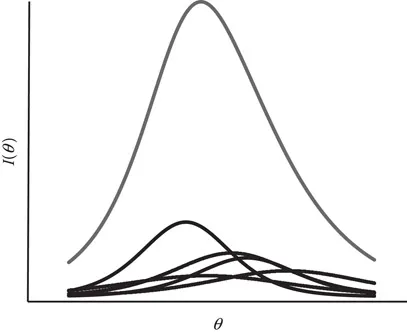
A helpful feature of Equation 9.2, due to conditional independence of the responses given θ, is its additivity. For a test of n items, the test-information function (TIF) follows from its item-information functions as
I(θ)=i=1nIi(θ).
(9.3)
Figure 9.1 illustrates the additivity in Equation 9.3 for five different test items.
fig9_1.webp
Figure 9.1
Information functions for five different test items along with their TIF.
More specifically, Birnbaum’s method of optimal test design consisted of the following three steps: (i) formulating a goal for the use of the test; (ii) translating the goal into a target for the TIF; and (iii) selecting a subset of items from the bank with the sum of information functions that matches the target best. Figure 9.2 shows possib...

Table of contents

  1. Cover
  2. Half Title
  3. Title Page
  4. Copyright Page
  5. Contents
  6. Contents for Models
  7. Contents for Statistical Tools
  8. Preface
  9. Contributors
  10. Section I: Item Calibration and Analysis
  11. Section II: Person Fit and Scoring
  12. Section III: Test Design
  13. Section IV: Areas of Application
  14. Section V: Computer Programs
  15. Index

Frequently asked questions

Yes, you can cancel anytime from the Subscription tab in your account settings on the Perlego website. Your subscription will stay active until the end of your current billing period. Learn how to cancel your subscription
No, books cannot be downloaded as external files, such as PDFs, for use outside of Perlego. However, you can download books within the Perlego app for offline reading on mobile or tablet. Learn how to download books offline
Perlego offers two plans: Essential and Complete
  • Essential is ideal for learners and professionals who enjoy exploring a wide range of subjects. Access the Essential Library with 800,000+ trusted titles and best-sellers across business, personal growth, and the humanities. Includes unlimited reading time and Standard Read Aloud voice.
  • Complete: Perfect for advanced learners and researchers needing full, unrestricted access. Unlock 1.5M+ books across hundreds of subjects, including academic and specialized titles. The Complete Plan also includes advanced features like Premium Read Aloud and Research Assistant.
Both plans are available with monthly, semester, or annual billing cycles.
We are an online textbook subscription service, where you can get access to an entire online library for less than the price of a single book per month. With over 1.5 million books across 990+ topics, we’ve got you covered! Learn about our mission
Look out for the read-aloud symbol on your next book to see if you can listen to it. The read-aloud tool reads text aloud for you, highlighting the text as it is being read. You can pause it, speed it up and slow it down. Learn more about Read Aloud
Yes! You can use the Perlego app on both iOS and Android devices to read anytime, anywhere — even offline. Perfect for commutes or when you’re on the go.
Please note we cannot support devices running on iOS 13 and Android 7 or earlier. Learn more about using the app
Yes, you can access Handbook of Item Response Theory by Wim J. van der Linden in PDF and/or ePUB format, as well as other popular books in Psychology & Probability & Statistics. We have over 1.5 million books available in our catalogue for you to explore.