- 272 pages
- English
- ePUB (mobile friendly)
- Available on iOS & Android
eBook - ePub
About this book
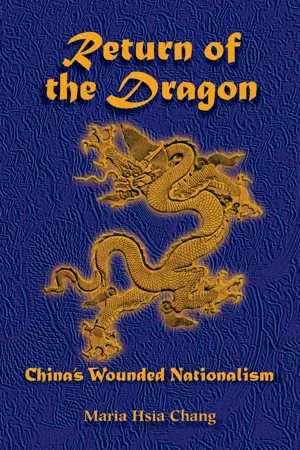
As Maoism recedes, and especially after the 1989 Tiananmen Square massacre, Beijing has increasingly turned to patriotic nationalism for its ideological inspiration and legitimation. Return of the Dragon begins with a discussion of the definitions, typologies, and theories of nationalism. The formation and development of the Chinese people are explored, including their myths of origins, early beginnings, the classical feudal period, and the enduring state and empire of the Middle Kingdom. The Opium War began the ?hundred years of humiliation? when dynastic China steadily deteriorated and eventually succumbed to the forces unleashed by imperialism. Western and Japanese imperialism also transformed the Chinese from a people into a nation. The ideas of early Chinese nationalists are explored, particularly those of Sun Yat-sen, whose thought stands in stark contrast to those of Mao, but shares significant similarities with the developmental nationalism of Deng Xiaoping.The last chapters of Return of the Dragon describe contemporary China's patriotic nationalism as it is represented in the writings of Chinese intellectuals, the youth, and the military. The portrait that emerges is a disquieting mix of narcissism and insecurity, wounded pride and resentment, a Darwinian worldview and an irredentist resolve to restore China to its former glory. The book concludes with an examination of the Chinese polity that remains authoritarian, as well as U.S. policy implications.
Information
1
The Problem
The dawning of a new millennium is bringing closure to the bloodiest hundred years in human history. Not only did the twentieth century witness two cataclysmic world wars, it also gave birth to the phenomenon of totalitarianism, a “historically unique and sui generis”1 form of government that is unparalleled in its systematic and organized brutality. In a totalitarian dictatorship, political rule is “all-embracing”2 because the state attempts to control every aspect of society, including the individual’s private life and thoughts.3
Totalitarian systems are conventionally subdivided into those of the right and the left. On the right are Nazi Germany, Fascist Italy, and Imperial Japan—the Axis powers and aggressors in World War II. On the left is the subspecies of communist countries, epitomized by the Soviet Union and the People’s Republic of China (PRC).
Although right and left totalitarianism, in the judgment of Carl Friedrich and Zbigniew Brzezinski, “are sufficiently alike to class them together,”4 they differ in several important aspects. Anti-Semitism, while often cited as one such distinction, does not seem to qualify. Lawrence C. Mayer contended that whereas racism in general and anti-Semitism in particular constituted a key element in Nazi ideology and that, although Marxism preached the brotherhood of an entire economic class that would presumably encompass all races, in practice the Soviet Union became “one of the world’s most vociferously anti-Semitic states.”5
All totalitarian systems are characterized by central control and direction of the entire economy, but in right totalitarianism, state control of the economy is effected through the economic system of corporatism, which retains the private sector with its private property ownership and enterprises. Left totalitarianism, in contrast, abolishes private ownership altogether and replaces it with state ownership and central planning. Right and left also differ in their enemies. Whereas the ideology of left totalitarianism pivots on Karl Marx’s notion of class warfare and identifies the domestic and international bourgeoisie as the enemy, right totalitarianism’s worldview is not class-based but is animated instead by an aggressive and expansionist nationalism.6 Right and left totalitarianism also differ in their durability. All three exemplars of right totalitarianism were defeated in World War II and became successfully democratized. The communist left, in contrast, has proven to be more pervasive and enduring.
Russia was the first country to embrace communism, in the Bolshevik Revolution of 1917. From the newly founded Soviet Union, communism ultimately expanded to some 150 countries in almost every continent in the world—in Eastern Europe, Asia, Africa, and Latin America. At its zenith, communism was the ruling system for over one-third of humanity and accounted for more than 40 percent of industrial production in the world.7
Communism’s inspiration and legitimation was the ideology of Marxism-Leninism, at the heart of which was the promise of universal brotherhood and equality. But “the Devil may appear in the vesture of the Angel of Light.”8 Despite its utopian impulse, the reality of communism proved to be very different. As Brzezinski expressed it, communism, born out of “an impatient idealism” that rejected the injustice of the status quo and sought a better and more humane society, captivated some of the brightest minds and the most idealistic hearts. Despite those benign impulses, communism produced mass oppression and “prompted some of the worst crimes of this or any century.”9 With the clarity of hindsight, Klaus Risse, head of Section A of East Germany’s secret police, now could see that communism’s basic flaw was that it failed to take into account “the inner Schweinehund.” Communism could have worked only if people had been angels.10
Instead of utopia, what actually transpired in Marxist states was a dystopic nightmare that took the lives of 85 to 100 million people who perished from misguided economic experiments and deliberate abuse and murder by the state. The People’s Republic of China has the dubious distinction of having the greatest human toll, at 45 to 72 million.11 In the Soviet Union between 1917 and 1987, anywhere from 32 to 62 million people lost their lives;12 in Lithuania between 1940 and 1955, some 1.2 million were killed or were dispatched to labor camps; in Hungary 15,000 died in Budapest during the 1956 uprising; in Vietnam a minimum of 65,000 were executed after 1975; in Cambodia, in a span of merely three years between 1975 and 1978, the Khmer Rouge regime exterminated a third (2.3 million) of the population.13 At a minimum, the human costs of communism amounted to 50 million lives, representing “without a doubt” the most extravagant and wasteful experiment in social engineering ever attempted.14
It was because of communism that, instead of international peace, the end of World War II was followed by a Cold War. For more than four decades, the world teetered on the brink of nuclear war between the two superpowers that led their respective ideological camps. Only with the abrupt dissolution of the Soviet Union in 1991 did the Cold War end. Until that time, the West had regarded communism with equal measures of loathing and fear. If not immutable, communism was believed to be inherently stable.
As an example, Samuel Huntington wrote in 1970 that he expected “revolutionary” one-party systems like the Soviet Union to evolve through three phases to become “established” one-party systems—their evolution propelled by the political leadership’s successes in the earlier phase.15 There were even those in the West who seemed convinced that communist countries possessed strengths, superior to those of representative democracies, which would ensure not only their enduring survival but their continuous advance in the world.16 Jean-Frangois Revel, for one, observed that democracies were inherently vulnerable to what he called “the totalitarian temptation,” their chief weakness being their disposition to be excessively self- critical about the perceived economic and moral failings of capitalism. Communist countries, in contrast, were impervious to that corrosive selfdoubt because of the state’s iron control over speech, information, and communication. Once a people came under communist rule, Revel lamented, it would be “too late to escape it should they change their minds.” After a generation, their capacity to dream and to think would begin to fail because of propaganda and cultural isolation, rendering them incapable of imagining either past or future. Revel concluded that the transition to totalitarian rule “is by definition irrevocable, except in the case of some cataclysm like a world war.”17
In the aftermath of the rapid dissolution of the Soviet Union and its satellite states in Eastern Europe, the West’s insecurity now seems misplaced. What was, to Revel, the major weakness of democracies turned out instead to be their strength. As a leader of Poland’s Solidarity movement put it, “only democracy—having the capacity to question itself—also has the capacity to correct its own mistakes.”18
The almost overnight disappearance of the Soviet bloc has revealed communism to be far from irrevocable, but inherently flawed and untenable. Although Brzezinski in 1961 was convinced that there was no reason to conclude that the existing totalitarian systems would disappear as a result of internal evolution, the same Brzezinski in 1989 recognized communism to be a “grand” and “historic failure” whose fatal flaws were “deeply embedded in the very nature of the Marxist-Leninist praxis.” Possessed of intrinsic shortcomings in every aspect—its operation, institutions, and philosophy—communism “no longer has a practical model for others to emulate.”19
Since their dissolution, the erstwhile communist states in Russia and East Europe have had varying success at effectuating successful transitions to market-based democracies. Thus far, the more successful cases include Hungary, Poland, and the Czech Republic. For Romania, Russia, and the other constituent republics of the former Soviet Union, the outlook is uncertain. The least effective transitions would have to be those of Albania and Yugoslavia. In the case of Albania, after a spontaneous popular uprising against its corrupt post-communist government, the country dissolved into anarchy that left 2,000 people dead by the end of 1997. For its part, the end of communist rule in Yugoslavia saw the country’s descent into the bloodbath of “ethnic cleansing,” which was contained only by the forceful intervention and subsequent occupation by NATO troops led by the United States.
The effort to understand, explain, and predict the evolution of communist systems20 must go beyond the former Soviet bloc countries to take into account the world’s remaining communist countries. The latter are subdivided into two distinct groups. A first group is comprised of the unregener- ate and unreformed communist states of North Korea and Cuba, the economies of which are in precipitous decline.21 By introducing market reforms, China pioneered the way for a second group of remnant communist states comprised of China and Vietnam. Unlike the former Soviet Union where Mikhail Gorbachev instituted political reform before (and without) significant economic reform, the Chinese Communist Party (CCP) took an opposite course of action. Beginning in late 1978 under the leadership of Deng Xiaoping, the CCP undertook radical reform of the economic system while eschewing any meaningful political reform.
Reform of the Chinese economy began in December 1978 in the countryside with agricultural decollectivization. Mao’s gargantuan communes were dismantled and the unit of farming reverted to China’s millennial tradition of the family household, to which the state conferred usufruct rights over land. From the countryside, the economic reform rapidly expanded to the cities. Private and collectively owned businesses and industries began to proliferate in cities, towns, and villages; an “open door” policy toward the West was inaugurated to attract foreign trade and investment.
The results of Deng’s economic reforms were quick and impressive. Since 1979, the Chinese economy has grown by an average real rate of 9 to 10 percent a year—a record that is unprecedented in recent world history. If China can sustain that rate of growth, its gross national product (GNP) will double every ten years,22 catapulting the People’s Republic to superpower status by 2025.
By making China stronger and more prosperous, the economic reforms have extended the lifespan of Chinese communism—but at the cost of ideological dilution. Nor is ideological dilution the only tradeoff. Deng’s economic reforms have also spawned a host of unintended consequences that are social, economic, demographic, ecological, as well as political. Today, the most serious of those problems threaten not only the CCP’s political power but the very integrity and continuity of the People’s Republic.23
Seymour Martin Lipset once noted that political leaders in developing countries must suffer the brunt of the resentments and problems caused by industrialization, including rapid urbanization and a growing gap between the newly rich and the poor. If the leaders fail to find an effective way to resolve those problems, they lose their hold on the masses. In the case of socialist developing countries, where “there is still a need for intense political controversy and ideology,” the position of political leaders is even more tenuous. If the leaders were to admit that Marxism is an outmoded doctrine, they would risk becoming conservatives within their own societies, a role that they cannot play and still retain a popular following. Lipset expected the political leadership to adopt a strategy of blaming the ills of development on scapegoats who could be domestic capitalists, foreign investors, Christianity, or “the departed imperialists.”24
To further complicate the Communist Party’s predicament, the ideo- cratic25 nature of China’s political system demands more than pragmatic legitimacy. From its inception, political rule in the People’s Republic was legitimated by the CCP’s claim to possess special truths and insights imparted by an absolutist and comprehensive ideology that presumed to know the past and present, as well as predict the course of societal evolution. Given its ideocratic character, the Communist Party is compelled to see...
Table of contents
- Cover
- Half Title
- Title Page
- Copyright Page
- Dedication
- Contents
- Acknowledgments
- 1 The Problem
- 2 On Nationalism
- 3 Children of the Dragon
- 4 One Hundred Years of Humiliation
- 5 The Early Nationalists
- 6 The Developmental Nationalist Ideology of Sun Yat-sen
- 7 From Mao Zedong to Deng Xiaoping
- 8 Patriotic Nationalism of the People’s Republic
- 9 Chinese Irredentist Nationalism
- 10 The Other Face of Janus
- Index
Trusted by 375,005 students
Access to over 1.5 million titles for a fair monthly price.
Study more efficiently using our study tools.
Frequently asked questions
Yes, you can cancel anytime from the Subscription tab in your account settings on the Perlego website. Your subscription will stay active until the end of your current billing period. Learn how to cancel your subscription
No, books cannot be downloaded as external files, such as PDFs, for use outside of Perlego. However, you can download books within the Perlego app for offline reading on mobile or tablet. Learn how to download books offline
Perlego offers two plans: Essential and Complete
- Essential is ideal for learners and professionals who enjoy exploring a wide range of subjects. Access the Essential Library with 800,000+ trusted titles and best-sellers across business, personal growth, and the humanities. Includes unlimited reading time and Standard Read Aloud voice.
- Complete: Perfect for advanced learners and researchers needing full, unrestricted access. Unlock 1.5M+ books across hundreds of subjects, including academic and specialized titles. The Complete Plan also includes advanced features like Premium Read Aloud and Research Assistant.
We are an online textbook subscription service, where you can get access to an entire online library for less than the price of a single book per month. With over 1.5 million books across 990+ topics, we’ve got you covered! Learn about our mission
Look out for the read-aloud symbol on your next book to see if you can listen to it. The read-aloud tool reads text aloud for you, highlighting the text as it is being read. You can pause it, speed it up and slow it down. Learn more about Read Aloud
Yes! You can use the Perlego app on both iOS and Android devices to read anytime, anywhere — even offline. Perfect for commutes or when you’re on the go.
Please note we cannot support devices running on iOS 13 and Android 7 or earlier. Learn more about using the app
Please note we cannot support devices running on iOS 13 and Android 7 or earlier. Learn more about using the app
Yes, you can access Return Of The Dragon by Maria H Chang,Amy Joseph in PDF and/or ePUB format, as well as other popular books in Politics & International Relations & Chinese History. We have over 1.5 million books available in our catalogue for you to explore.