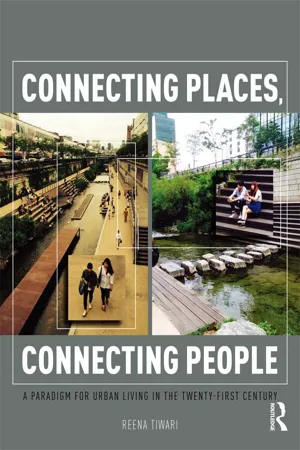
Connecting Places, Connecting People asks seemingly simple questions. What is a better community? How can we reconfigure places and transport networks to create environmentally friendly, economically sound, and socially just communities?
These questions are fundamental to our task of grappling with environmental and social challenges. These include growing pollution, depleting fossil fuels, rising gasoline prices, traffic congestion, traffic fatalities, increased prevalence of obesity, and lack of social inclusion (Friel et al., 2011; Litman, 2016; Ribeiro et al., 2007). Analyzing the interactions between urban form and motorized travel provides some important insights for reshaping our environment and our community.
With the worldwide number of cars on the road reaching 907 million (using 2014 data; Statista, 2016), and this number projected to rise to between two and four billion cars by mid-century (Ford, 2011), simply building more roads for more cars and planning cities with more super-highways are not viable options. There is a worldwide movement to reduce the use of private vehicles and the vehicular kilometers traveled per year, to promote healthier communities and more sustainable urban forms (Newman & Kenworthy, 2015; Suzuki et al., 2013). Sadly, these strategies are unlikely to have the necessary impact, largely due to the failure to engage the local communities during their formulation and implementation. Real progress and successful implementation of policies and strategies requires local insight and ownership.
The concept of connecting places, connecting people is offered as a way forward. This concept is truly a paradigm shift. It involves reordering urban planning principles from prioritizing movement of vehicles to focusing on places and the people who live in them. The concept recognizes that people need to reach places and interact, and that movement between places needs to be efficient, environmentally benign, and conducive to healthy communities. The term ‘connecting places’ conveys this meaning. ‘Connecting’ indicates that sustainable forms of movement enable interaction between places. ‘Places’, while being the central focus, implies high-quality areas with a strong sense of locale, within which the community can live, work, shop, learn, and play.
A key distinction between this book and others in the same field is the perspective of place making. Instead of a simplistic reliance on manipulating form and materiality in the creation of a place, the emphasis is on synthesizing physical and cultural components with the needs and aspirations of people. Place making is about making visible people’s ‘right to their cities’ and urban spaces (Purcell, 2002, p. 102).
The book is based on an ‘enabling’ approach, connecting people to people, people to transport, and people to places.
There is another level of connectivity occurring in our cities. The quest to create ‘super-smart’ cities with the ‘Internet of Things’1 through smart devices is resulting in a global digital mesh connecting individuals, their homes, and communities. Are the connections made online in isolation more important than connections made socially on the streets? While face-to-face street connections can revitalize urban spaces and local communities, the future for the millennial-driven culture for disruptive change in public spaces could be devoid of difference, vibrancy, and interaction. What is the way forward?
As well as reconfiguring urban morphology and movement to confront a car-induced disconnection, Connecting Places, Connecting People offers ways of community-enabled place making to strengthen connections between people, place, and transport.
References
All online references retrieved August 17, 2016.
Ford, B. (2011). 1. Retrieved from www.ted.com/talks/bill_ford_a_future_beyond_traffic_gridlock/transcript?language=en.
Friel, S., Akerman, M., Hancock, T., Kumaresan, J., Marmot, M., Melin, T., & Vlahov, D. (2011). Addressing the social and environmental determinants of Urban Health Equity: Evidence for action and a research agenda. Journal of Urban Health 88(5), 860-874.
Litman, T. (2016). Well measured: Developing indicators for sustainable and livable transport planning. Retrieved from www.vtpi.org/wellmeas.pdf.
Newman, P., & Kenworthy, J. R. (2015). The end of automobile dependence: How cities are moving beyond car-based planning. Washington, D.C.: Island Press.
Perera, C., Liu, C. H., & Jayawardena, S. (2015). The emerging Internet of Things marketplace from an industrial perspective: A survey. Retrieved from https://arxiv.org/pdf/1502.00134.pdf.
Purcell, M. (2002). Excavating Lefebvre: The right to the city and its urban politics of the inhabitant. Geo Journal, 58 99-108. Retrieved from http://faculty.washington.edu/mpurcell/geojournal.pdf.
Ribeiro, S. K., Kobayashi, S., Beuthe, M., Gasca, J., Greene, D., Lee, D. S., & Zhou, P. J. (2007). Transport and its infrastructure. In B. Metz, O. R. Davidson, P. R. Bosch, R. Dave, & L. A. Meyer (Eds.) Climate Change 2007: Mitigation—Contribution of Working Group III to the Fourth Assessment Report of the Intergovernmental Panel on Climate Change (pp. 323-386) Cambridge: Cambridge University Press.
Statista (2016). Number of passenger cars and commercial vehicles in use worldwide from 2006 to 2014 in (1,000 units). Retrieved from www.statista.com/statistics/281134/number-of-vehicles-in-use-worldwide/.
Suzuki, H., Cervero, R., & Iuchi, K. (2013). Transforming cities with transit: Transit and land-use integration for sustainable urban development. Washington, D.C.: World Bank.