eBook - ePub
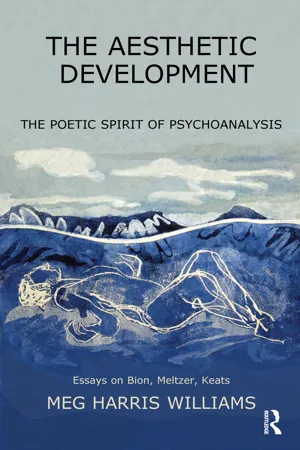
The Aesthetic Development
The Poetic Spirit of Psychoanalysis: Essays on Bion, Meltzer, Keats
- 224 pages
- English
- ePUB (mobile friendly)
- Available on iOS & Android
eBook - ePub
The Aesthetic Development
The Poetic Spirit of Psychoanalysis: Essays on Bion, Meltzer, Keats
About this book
'Few people would be better qualified than the author to write this innovative and eagerly anticipated post-Kleinian book. Deeply versed in the opus of Bion and Meltzer, the author enhances the concept of "catastrophic change". The analyst who "eschews memory and desire" observes the subtle interplay of transference and countertransference (Meltzer's "counter dreaming") as it works through aesthetic conflicts. The ensuing reciprocity of the patients and analysts unconscious is revealed as the aesthetical and ethical basis of psychoanalysis. In that sense the psychoanalytical process parallels that of poetic and artistic inspiration. They are all generated by creative internal objects. Harris Williams' intellectual tour de force demonstrates convincingly the human capacity for symbolic thinking that underlies literary, artistic and psychoanalytic creativity. Her encyclopaedic understanding of literature, art and psychoanalysis contributes to this book's virtuosity.'- Irene Freeden, Senior Member of the British Association of Psychotherapists
Information
Chapter One
Psychoanalysis: an art or a science?*
This chapter is intended to map out the epistemological background to the field of inquiry of the present book, with its focus on the artistic qualities of psychoanalysis. In subsequent chapters, I shall go into more detail over some of the features touched on here—in particular, the nature of symbol-formation, inspiration, the psychoanalytic (or self-psychoanalytic) dream encounter, and I shall also say more about the central aesthetic concepts of Bion and Meltzer.
The modern answer to the question “art or science?” must be “both”. As Meltzer says, “The great artist and scientist has always been the same person” (1975, p. 221).1 The interest of the question lies in the way artistic or scientific aspects interrelate in the quest for knowledge of the mind; and the way this quest is perceived (as well as performed) will be dependent on one’s model of the mind. Just as Aristotle defined man as a “political animal”, which accounts for his lying and manipulative propensities, so Bion sees man in his truth-seeking capacity as a scientific, artistic, and religious animal. These are all orientations concerned with reality, whether external or internal, and Meltzer would say they all focus on the “aesthetic object”, whether this be an internal object, an artwork, or the world itself. In the domain of psychic reality, the interdependence of the domain and the instrument for investigation places knowledge about the mind beyond the reach of sinlevertex science; therefore, the spirit of scientific inquiry needs to be modified by these other “vertices”. It is the tension and overlap between them that is important:
It would seem absurd if the tension between these three groups—science, religion and art—which are all fundamentally devoted to the truth, was either so slack or so tense that it was unable to further the aim of truth. [Bion, 1973–1974, Vol. I, p. 96]
Science and art merge into one another through observation and exploration of the sensuous world; art and religion through reverie and inner focus; religion and science through their respect for the idea of a reality that is neither invented nor imagined, but that exists beyond our desire or control. The disciplines conflict when they become propagandist, single-vertex, and, to some extent, selfcaricaturing. Any single-vertex approach tends in the direction of the lie (covering-up of a truth once glimpsed); elsewhere, Bion calls this “calcification” (2005a, p. 11), and he regards it as endemic to psychoanalytic thinking. The links between the vertices need to be not too slack, not too tense; they need to come under the category of communication, not of denial or action to remove the unpleasantness of the tension. An initial mutual suspicion may stimulate in the direction of “the truth”, but neglect or obliteration will not.
Although the artistic element was present in psychoanalytic practice from the very beginning, it has only recently begun to become explicitly valued. The emotional composition of the mind is traditionally the field of interest of artistic disciplines such as music and poetry, which employ sensuous means to convey mental abstraction. For, as Bion keeps stressing, we do not know what the mind is, or even if its boundaries correspond to an individual’s body. Do mental transactions take place somewhere “in the air”, as poets have often described the arrival of inspiration? Part of the endeavour of Bion, Meltzer, and others has been to establish psychoanalysis’s links with the humanist disciplines which already have a language of their own to describe this suprasensuous exploration. It is this that has helped to make the formal designation of “psychoanalysis as an art form” a convincing and useful proposition.
The distinction between scientific and artistic ways of knowing is at least as old as Plato and Aristotle, and probably marks a dualism as ancient and innate as the human species itself. A list of pairings which seem to derive from this fundamental dichotomy would include the following: the classical one of doxa (opinion) vs. episteme (truth); the quantitative (measurable) vs. the ineffable (suprasensuous); practical and contemplative; right and left sides of the brain; reason and intuition; discursive vs. presentational forms; analysis and synthesis; conscious and unconscious; masculine and feminine components of the personality; and so on. Each of these cognitive pairings has, at some time, been taken to reflect the dualism between science and art, often with descriptive plausibility, and sometimes with practical application to techniques of learning and teaching. Nonetheless, any humanistic discipline, when pursued to a degree of depth, will find itself forging complementary links between these modes of knowing and will probably discover that they support rather than undermine one another.
In the history of psychoanalysis, the possibility of its being an art form began to emerge when mind and brain were recognized as different entities and, in particular, when Freud realized that transference and countertransference were not screens which clouded true scientific vision, but, rather, the tools of intuition. Here, if anywhere, was the “truth” about the mind to be found. This makes psychoanalysis a “presentational form” (in the jargon of aesthetics) rather than a discursive one, an art more than a science. Nonetheless, the idea of psychoanalysis actually being an art form would have been received with incomprehension at that time, and is even now likely to be resisted and distrusted. There are both intellectual and social reasons for this. People fear that “scientific rigour” may be replaced by “artistic licence” (as in “wild analysis”): there would be no standardization of procedures or results, no consistency, no reliability, no respect for academic hierarchy. As Meltzer points out, science is respectable, art is not (Meltzer & Williams, 1988, p. xii). Social problems—disguised as organizational problems—arise, such as: how can assessment of analysands or trainees take place? What meaning can be given to the “qualification” of being either a trained therapist or a trained analysand? Is there any difference between a “qualified” person and any other type of bourgeois acceptability, and does not this cynically undermine the spiritual purposes which are the very raison d’être of psychoanalysis? Or, as Bion frequently puts it, the label is not a reliable guide to the contents.
These social aspects of the question are more to do with the image of psychoanalysis than with the thing itself: would it look better as an “art” or a “science”? Much of the academic debate revolving around the “scientific” qualities of psychoanalysis reads like a disguised attempt to evaluate its social status, giving the impression that some apology is needed for its foundation in subjective emotional contact. It is subtly derogatory and pessimistic. Psychoanalysis is seen, in effect, as a pseudo science or, at best, a second-rate science struggling conscientiously with an unfair endowment of irrationality. The approach of Bion and Meltzer, by contrast, focuses on the concept of “the truth of an emotional experience”, which is seen as a fact in itself, to be apprehended with all the attendant joy and trepidation of the quest. They regard the nonsensuous nature of the mind’s existence not as a hindrance, but as a stimulant; indeed, an object of awe and wonder which genuinely awakens scientific curiosity of a descriptive orientation, but which cannot be explored by solely scientific means.
The limitations of Promethean science
Meltzer writes that “the history of science could be written as a constant wrestle with the unexpected” (1975, p. 220), but the problem occurs with our emotional reception of the unexpected, which can arouse childish delusions of omnipotence and “supernatural power”. If science is by nature sense based, rational, progressive, categorizable, then it is but a short, seductive step to translate this into “explicable”: “truth modified to lie within man’s comprehension” as Bion’s religious vertex (Priest) puts it in the Memoir (1991). This is the characteristic hazard of the scientific vertex when it loses touch with the other vertices of knowledge.
Bion and Meltzer continually stress the dangers of trying to explain the mysteries of the mind. In addition, says Bion, “addicts’” of psychoanalysis have a “curiously two-dimensional quality” (1973–1974, Vol. II, p. 56). They do not partake of the peculiar capacity to make human beings and situations look real, which is conferred by artistic methods. It would be a relief, says Bion, if scientific papers could somehow remind us of real human beings, so that they were not such a pain to read. Aesthetic theory, from Aristotle onwards, recognizes that this realistic capacity is something necessary to human identification and participation in what is essentially an abstract process: a meeting of minds. It is the prescriptive role of interpretation that holds psychoanalysis back in the straitjacket of pretending to be a science. The novice or overly rigid analyst believes his task is to seek out a correct interpretation and communicate it, or coerce the patient into accepting it. Bion recounts wryly how he first realized the inadequacy of this pseudoscientific approach:
One of the painful, alarming features of continued experience was the fact that I had certain patients with whom I employed interpretations based on my previous experience with Melanie Klein, and, though I felt that I employed them correctly and could not fault myself, none of the good results that I anticipated occurred. [Bion, 1991, p. 559]
He explains that “mechanical thinking” and “mechanical interpretation” have their place, but should not be used in such a way as to “preclude the development of the ultra- or infra-sensuous, even though I may not know what that is or even if it exists” (ibid., p. 204). Correct interpretation does not make the clinical situation one of learning from experience. Scientific accuracy is not sufficient. It is, in effect, two-dimensional; it does not remind one of real life; it does not promote growth. Some other type of communication between analyst and analysand is necessary, some other process needs to be activated: not the acquisition of knowledge, but the getting of wisdom. “Wisdom or oblivion,” says Bion starkly, “take your choice” (ibid., p. 576). Or, as he frequently formulates the problem, how do you change an activity that is “about psychoanalysis” to one that “is psychoanalysis”? (1970, p. 66). Being right is not the same thing as telling the truth. Rightness is a function of the self (the ego), whereas telling the truth involves interaction between internal objects of both analyst and patient.
The scientific mind in its most primitive form was modelled for Bion by the tomb-robbers at Ur, a Freudian archaeological model. It is what Meltzer terms “Promethean science”, as distinct from “inspired science” (1986, p. 183). The Promethean steals the fire of knowledge from heaven, rather than being smitten by the lightning command to “know thyself” (see Coleridge, Biographia Literaria; 1997, p. 152). It does not ignore religion so much as override it. After many centuries, the robbers broke through the invisible restraints of a religion that had fossilized into superstition in the form of the guardians of the tomb, the “ghostly sentinels of the dead and their priestly attendants” (Bion, 1973–1974, Vol. I, p. 11). The tomb-robbers, he says, must have been “brave men”; and they are “the patrons of the scientific method”. This primitive type of scientific research (unalleviated by art or religion) will lay open some aspects of the truth while obscuring others: it is not, in itself, a sufficient model for “thinking for oneself”. Science has overcome superstition, but at the expense of making the link with religion too confrontational, too tense, just as in Freudian psychoanalysis it is too slack. The “scientific, psychoanalytic” view of religion, says Bion, “flattens out” religious feeling (1973–1974, Vol. I, p. 52).
Milton describes science-as-robbery in his great epic, Paradise Lost, when the fallen angels, led by Mammon (the “least erected spirit to fall from heaven”), “ransack the centre” of Mother Earth and “rifle her bowels” in search of gold and riches (Paradise Lost, I: 684–686). This mentality sees the aesthetic object as containing secrets to be possessed, rather than a mystery to be apprehended and respected for its richness and otherness. The intellectual counterpart of Mammon-man is Belial, the pseudo-thinker, who leads the little devils in academic theological debates about “Fixed fate, free will, foreknowledge absolute”. Their “false philosophy” has no emotional reality, owing to its divorce from the knowledge of God. It embodies the lie-in-the-soul, which looks like the real thing but is, in fact, a Negative Grid imitation of it: “cannot we his light/Imitate as we please?” In Bion’s terms, they perform mental “monkey-like tricks”; they are clever, but not wise. (When asked what was the difference, he said, “wisdom takes longer” [Bion, 1973–1974, Vol. II, p. 54].) We cannot understand the nature of thinking without understanding the nature of not thinking: “We have to use a method which includes not only understanding but also misunderstanding” (Bion, 1973–1974, Vol. 1, p. 40; see also 1980, pp. 68–69).
The operation of Promethean scientific method in this nonsensuous domain encourages the operation of infantile omnipotence, the sterile imitation of God. It is associated with premature claims to scientific status and the desire for respectability. Blake, in his poem Milton, said we needed to cast off the “rotten rags of Memory” and replace them by “Inspiration” (Blake, 1966, p. 533), one of those terms that, as Bion says, need to be revitalized in order to rediscover its meaning (see Chapter Three). Projective identification alone is not sufficient. The fruits of thinking are scientific only in so far as they are the result of real experience, not the inventions of fancy or memory, which are types of rationalization. The scientific vertex needs the influence of art and religion to ensure that the experience is a real one, that it is discovery, not invention, in the distinction continually emphasized by Meltzer.
To remind ourselves of the feeling of “discovery”, we may invoke Keats’s poetic formulation in his sonnet “On First Looking into Chapman’s Homer”:
Then felt I like some watcher of the skies
When a new planet swims into his ken; . . .
When a new planet swims into his ken; . . .
The discovery is of an old idea (Homer) but it is still a “new planet” to the astronomer-poet. Bion uses Keats’s phrasing to convey the first encounter with a proto-mental element (beta-element), saying that all we can do is to provide “boxes” for such categories “in case that strange creature should exist and should it swim into my ken” (1997, p. 29). The “new planet” feeling of science-as-discovery is illustrated by Milton in Paradise Lost. His picture of the newly-fallen Satan, finding his way through “darkness visible”, is based on his admiration for Galileo and his new instrument of discovery, the telescope. The unfamiliar universe of hell represents the realm of an “unpremeditated” experience which has been “won from the void and formless infinite”, in the phrase much admired and often quoted by Bion (Paradise Lost, III: 12). As Satan moves tentatively over the “burning marl”, prefiguring twentieth-century landings on the moon, he bears an aura of magnificence, his shield cast behind his shoulder like the moon itself:
The moon, whose orb
Through optic glass the Tuscan artist views
At ev’ning from the top of Fesole,
Or in Valdarno, to descry new lands,
Rivers or mountains in her spotty globe.
Through optic glass the Tuscan artist views
At ev’ning from the top of Fesole,
Or in Valdarno, to descry new lands,
Rivers or mountains in her spotty globe.
[Paradise Lost, I: 287–291]
The moon on Satan’s shoulder is like the viewing glass (telescope) itself, an attribute of the poet-scientist. Satan swims into the poet’s sight with the moon on his shoulder, extending the imagination, and saying: “Space may produce new worlds” (1. 650). Milton’s identification with Galileo (the “Tuscan artist”) underlies his own venture into the unknown spaces of the mind, to give birth to previously unknown facts of feeling, giving form to the formless. Paradise Lost is full of imaginative conjecture about outer space, the infinite source of ideas not yet thought into existence.
It is also worth noting that although, for Blake, Newton represented the devil himself, most Romantic poets and philosophers looked optimistically towards an eventual unification of the types of knowledge. Keats, for example, kept his medical books because he regarded every “department of knowledge” as being “part of a great whole” (letter to Reynolds, 3 May 1818; 1970a, p. 92). The Romantic poets were, in general, fascinated by new scientific developments, and used the language of physics and chemistry metaphorically to enhance their expression of psychic realities (atoms, molecules, magnetism, valency, electricity, particles, matter, ethereal, gaseous, decomposition, etc). Coleridge, indeed, coined the word “scientist” for his personal discussion group; he attended Humphry Davy’s lectures and hailed him as “the man who born a poet, first converted poetry into science”.2 Bion’s usage of scientific and mathematical language to convey metaphysical speculation is analogous.
According to Bion, therefore, the single-vertex approach of the pure scientist is, in the context of psychoanalysis, a type of philistinism. He is scathing about “scientific...
Table of contents
- Cover
- Half Title
- Title
- Copyright
- Contents
- ACKNOWLEDGEMENTS
- ABOUT THE AUTHOR
- Dedication
- INTRODUCTION
- CHAPTER ONE Psychoanalysis: an art or a science?
- CHAPTER TWO Aesthetic concepts of Bion and Meltzer
- CHAPTER THREE The domain of the aesthetic object
- CHAPTER FOUR Sleeping beauty
- CHAPTER FIVE Moving beauty
- CHAPTER SIX Psychoanalysis as an art form
- AFTERWORD My Kleinian ancestors
- REFERENCES AND BIBLIOGRAPHY
- INDEX
Trusted by 375,005 students
Access to over 1.5 million titles for a fair monthly price.
Study more efficiently using our study tools.
Frequently asked questions
Yes, you can cancel anytime from the Subscription tab in your account settings on the Perlego website. Your subscription will stay active until the end of your current billing period. Learn how to cancel your subscription
No, books cannot be downloaded as external files, such as PDFs, for use outside of Perlego. However, you can download books within the Perlego app for offline reading on mobile or tablet. Learn how to download books offline
Perlego offers two plans: Essential and Complete
- Essential is ideal for learners and professionals who enjoy exploring a wide range of subjects. Access the Essential Library with 800,000+ trusted titles and best-sellers across business, personal growth, and the humanities. Includes unlimited reading time and Standard Read Aloud voice.
- Complete: Perfect for advanced learners and researchers needing full, unrestricted access. Unlock 1.5M+ books across hundreds of subjects, including academic and specialized titles. The Complete Plan also includes advanced features like Premium Read Aloud and Research Assistant.
We are an online textbook subscription service, where you can get access to an entire online library for less than the price of a single book per month. With over 1.5 million books across 990+ topics, we’ve got you covered! Learn about our mission
Look out for the read-aloud symbol on your next book to see if you can listen to it. The read-aloud tool reads text aloud for you, highlighting the text as it is being read. You can pause it, speed it up and slow it down. Learn more about Read Aloud
Yes! You can use the Perlego app on both iOS and Android devices to read anytime, anywhere — even offline. Perfect for commutes or when you’re on the go.
Please note we cannot support devices running on iOS 13 and Android 7 or earlier. Learn more about using the app
Please note we cannot support devices running on iOS 13 and Android 7 or earlier. Learn more about using the app
Yes, you can access The Aesthetic Development by Meg Harris Williams in PDF and/or ePUB format, as well as other popular books in Psychology & Literary Criticism in Poetry. We have over 1.5 million books available in our catalogue for you to explore.