1 Introduction
Studying Presidents and the Presidency
Lori Cox Han
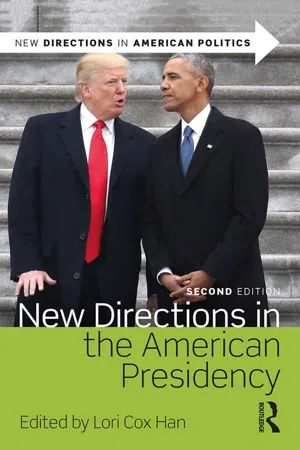
On January 20, 2017, Donald J. Trump took the oath of office as the 45th president of the United States. Trump won the presidency in what was perhaps the most negative presidential campaign on record, and he entered office with the lowest approval rating (45 percent)1 of any president since the advent of public opinion polling in the 1930s. Historically, a presidential inauguration represents an important political ritual for American citizens, as it serves as a time of renewal of faith in the U.S. constitutional system to witness the peaceful transition of power from one leader to the next. Presidents look to the inauguration, and in particular the inaugural address, as an opportunity to set the tone for their tenure in office with both the public and other political actors, and most use the event as an opportunity to talk about broader political principles and their vision for the country. Aside from the constitutional requirement that presidents must take the oath of office, inaugurations are one of the many symbolic acts in which a president engages, and it is the first time that they address the American public—the national constituency that they uniquely represent within the political system—as president. Each president also faces unique circumstances on the day they take office, and therefore may have different strategies and goals that they and their advisors are attempting to achieve.2
For Trump, the political environment at the start of his presidency was marked by a deep partisan divide as well as shock and even hatred among his political opponents that the unconventional—and at times controversial—business man with no political experience had won the White House. Striking a populist tone, similar to his messaging throughout the 2016 presidential campaign, Trump stated that:
What truly matters is not which party controls our government, but whether our government is controlled by the people. January 20th 2017, will be remembered as the day the people became the rulers of this nation again. The forgotten men and women of our country will be forgotten no longer. Everyone is listening to you now.3
Despite protests (some violent) over Trump’s election, the constitutional requirements of the inauguration had been met, and the government continued to function. Once again, the United States had seen a peaceful transition of power, no matter how contentious the election had been.
In addition to the political, constitutional, and symbolic significance of presidential inaugurals, the start of a new presidential administration also serves as a milestone for those who study the presidency—a brand new president and administration to assess and analyze. The study of the American presidency, both as a political institution along with those who have held the office, is one of the most fascinating and dynamic fields of study within political science. While the framers of the U.S. Constitution may have envisioned coequal branches among the legislative, executive, and judiciary, the powers of the presidency have expanded throughout the past century as contemporary American presidents, for better or worse, have often been the driving force behind policymaking at both the national and international levels. As such, the actions of the current administration, as well as other recent administrations, raise numerous questions for scholars to consider about the powers of the office, the complex nature in which presidents shape the policy agenda, and various other aspects of governing.
Trump and his three most recent predecessors—Barack Obama, George W. Bush, and Bill Clinton—have opened myriad avenues of analysis regarding a broad spectrum of issues for presidency scholars, both as individual political actors as well as the institutional implications of their actions while in office. For example, Obama took office at a time of economic crisis, as the United States faced the most daunting economic downturn and recession since the Great Depression of the 1930s. In addition, the new commander in chief inherited two wars in Iraq and Afghanistan, both initiated by his immediate predecessor as part of the War on Terror. Expectations for Obama’s presidency were high—his supporters expected him to fix the economy, bring home American troops from the Middle East, reform health care, and heal the partisan divide in the nation as part of a new post-racial era in American politics. However, Obama left office in 2017 with a mixed record—major initiatives on health care and the environment had been enacted, though devastating losses for the Democratic Party at all levels of government during Obama’s time in office meant a likely reversal for many of the accomplishments. For George W. Bush, one major component of his eight years in office will forever be linked to the expansion of presidential war powers in the aftermath of the September 11, 2001 terrorist attacks. In addition, the Bush years will also be remembered for an increasing budget deficit, the prominence of a socially conservative policy agenda, and an escalation of partisanship at the national level. While Bill Clinton may have left office with a budget surplus, his time in office was marked by six years of divided government, an impeachment, and his ability to politically outmaneuver his political opponents through strong political and communication skills (which also contributed to the partisan divide in Washington).
These presidencies and related topics are just a sampling of issues that animate current research on the American presidency. That research, in turn, also animates how presidency courses are taught at both the undergraduate and graduate levels. While presidential studies itself is considered a subfield within the discipline of political science, numerous subfields within presidential studies have also emerged as part of the growing literature on both presidents and the presidency. For example, presidential/congressional relations, presidential powers, the executive branch as a political institution, and the public aspects of the presidency are just a few of the areas where scholars have focused their attention in an effort to better understand (and sometimes predict the actions of) the president, his staff, and/or other relevant political actors within the executive branch. In addition, interdisciplinary research on the presidency has merged the growing literature in political science with that of psychology, history, communication, economics, and sociology, among others. As a result, both the quality and quantity of research devoted to presidents and the presidency continues to grow.
This chapter provides an overview of presidential studies and the current state of presidency research. Having a better understanding of topics such as the different eras usually associated with the presidency and the methods of study used by presidency scholars can aid students in learning about the various facets of the institution of the presidency as well as those who have held the office. This chapter considers the general categories used to organize presidents and their presidencies by historical eras, which provides a sense of how the institution itself, along with the day-to-day job responsibilities of the president, has evolved throughout U.S. history. Next, the state of presidency research is considered, including how the various methodological tools now available to presidency scholars have greatly expanded our understanding of presidents as political actors and the presidency as a political institution. Finally, the plan of the book explains how the essays in this volume illustrate the new and emerging trends within presidential studies and how that research provides both a guide and a basis for analysis of the presidency for students. If the 2016 presidential election and the early days of the Trump administration show us nothing else, it is that the presidency continues to challenge the conventional wisdom of presidency scholars while forging new areas of research and exploration.
Presidential Eras
The American presidency remains one of the most fascinating institutions in history, and the powers and intricacies of the office seem to defy comparison to anything before or since. Individual presidents have come and gone, serving their country with varying degrees of success, but the presidency as an institution remains a focal point of political power both nationally and internationally. The presidency of the eighteenth century, as outlined by the framers of the U.S. Constitution, may seem weak compared to the powers that had emerged by the start of the twenty-first century, but the essential characteristics of the American presidency are as recognizable today as they were 230 years ago. Despite wars, scandals, economic turbulence, and even assassinations, the presidency has endured and is one of the most resilient political structures ever created. Still, the powers of the office, along with the public presence of presidents themselves, have varied at different times due to different circumstances (political and otherwise). Generally, the history of the presidency can be divided into three eras: the traditional presidency, the modern presidency, and the postmodern/contemporary presidency.4
The traditional presidency includes those presidents from the late eighteenth century until the turn of the twentieth century who “performed within modest limits and largely with unmemorable results.” The most notable presidencies during this time include George Washington (1789–1797), Thomas Jefferson (1801–1809), Andrew Jackson (1829–1837), and Abraham Lincoln (1861–1865), all of whom are “towering exceptions” during an era when presidential powers remained modest and limited.5 Truth be told, the presidency was not a coveted prize for most founding-era politicians, nor was the associated role of commander-in-chief. Particularly during the late eighteenth century, talented public officials had little incentive to seek an office whose risks and uncertainties outweighed the potential benefits, as the presidency offered modest prestige, narrow authority, and meager resources. In most cases, governors of politically prominent states, such as New York, Massachusetts, and Virginia, wielded more power and prestige than the nation’s presidents. Although American presidents of the early republic were honored and respected by their fellow Americans, not least because of their service and contributions prior to 1789, they occupied an office that was unassuming and limited, which is just what the framers of the Constitution had intended. Similarly, throughout the nineteenth century, most presidents merely carried out the laws passed by Congress, which assumed the role of the dominant policymaking branch. Despite the political reforms of the 1820s and 1830s, which opened the electoral process to middle- and lower-income voters and eased restrictions on office holding, presidents, for the most part, remained passive participants in national policymaking.
The potential power of the presidency, particularly in shaping the national agenda, waging wars, and connecting with the American public, would not be tapped until the twentieth century. The development of the modern presidency, with all its power and bureaucratic machinery, laid waste to the modestly crafted, humble office erected by the framers. Of the three branches of government, the executive has traveled farthest from its origins and least resembles the intent of its creators. Theodore Roosevelt (1901–1909) and Woodrow Wilson (1921–1929) were its “architects, as asserters of bold undertakings in domestic and foreign affairs, as gifted mobilizers of public opinion, as inducers of congressional concurrence.”6 With the election of Franklin D. Roosevelt in 1932, a dramatic expansion of the size and power of the federal government began. FDR’s presidency (1933–1945) brought with it important changes that would define the modern presidency: enhanced presidential staff resources, a greater presidential role in policymaking, a stronger relationship with the mass public, and a greater presence in the foreign policy arena. Two themes also emerge in explaining the ...