- 200 pages
- English
- ePUB (mobile friendly)
- Available on iOS & Android
eBook - ePub
About this book
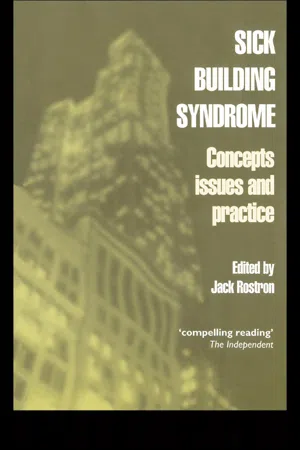
Sick building syndrome is for many of us an enigma. The legislative precedents currently being set in North America underline the need for rational examination of the problem. This new collection of expert writing will help unravel the complex issues involved. The book explores sick building syndrome from a range of perspectives: architectural, medical, psychological and legal. Each chapter offers detailed insights into the condition and taken together they highlight the need for a collaborative approach. The effects of sick building syndrome should not be underestimated as it is thought that up to 30 percent of refurbished buildings may suffer from the condition. Extreme cases may lead to increased absenteeism among employees, reduced performance and ultimately building closure.
Information
CHAPTER 1
Introduction
Jack Rostron
It is clearly important that buildings should provide a healthy, safe and comfortable environment for their occupants. A relatively recent phenomenon, sick building syndrome, SBS [1] has been acknowledged as a recognizable disease by the World Health Organization [2]. Since its recognition in 1986, increasing concern has been directed towards identifying a cause and eliminating it from occupied buildings or those at the design stage [3–8].
It has been estimated [2] that up to 30% of refurbished buildings and an unknown but significant number of new buildings may suffer from SBS. The consequences of the syndrome are, inter alia, increased absenteeism, reduced work performance and possibly even building closure. While it is not life threatening or disabling it is clearly important to those affected by it.
The effect of SBS on individuals is a group of symptoms which are experienced specifically at work. The typical symptoms are headache; loss of concentration; itchy, runny or stuffy nose; itching, watering or dry eyes; dry skin; lethargy; and dryness or irritation of the throat. Such symptoms exist in the general population, but are distinguished by a higher incidence, as a group, in some buildings than others.
SCOPE AND PURPOSE
It is against the background of this increasing concern, from the point of view of both the health of individual workers, and the productivity of organizations employing them, that this book was prepared. By inviting the views of recognized specialists in diverse fields it attempts to offer both practical guidance and up-to-date discussion on certain aspects.
The contributions are aimed at a diverse readership, ranging from those looking for an immediate practical ‘solution’ to students and academic researchers interested in exploring the latest thinking on concepts and techniques.
Chapter 2 offers a detailed overview of the possible causes of SBS and makes recommendations for improving the internal work environment. It deals in synoptic form with heating and ventilation systems, environmental science aspects, control systems and the design and maintenance process.
Chapter 3 offers an examination of the concept of light and lighting and its relationship to the health of building occupants. It describes the physical nature of light and how it can cause SBS. The importance of natural and artificial light is explored. The health consequences of inappropriate lighting conditions is explained and means of designing lighting systems to reduce the incidence of SBS are suggested.
The medical aspects of SBS are discussed in Chapter 4. The syndrome as a medical concept is evaluated and thoughts on its investigation and management from the clinical viewpoint are explored.
Chapter 5 examines the psychological issues associated with the syndrome. The different types of workplace illness are discussed and suggestions for a multidisciplined approach to the subject are postulated.
Maintenance of the working environment has been recognized as an important means of reducing the syndrome’s incidence rate. Chapter 6 describes in a practical way the principal procedures necessary to implement an effective plant maintenance programme and cleaning regime. It is written in a simple and easily understandable style suitable for facilities managers who have not acquired an in-depth knowledge of the engineering issues involved.
The importance of human resource management in reducing the impact of SBS is comprehensively discussed in Chapter 7. The latest research findings and personnel management concepts are evaluated in terms of restructuring office work, the relationship between technology and people, personnel policies to help cope with the syndrome, the role of the occupational health service, worker participation and the physical environment.
The legal implications of SBS are increasingly becoming recognized. Chapter 8 explains the law both in the UK and the European Community. Both statute and common law aspects are stated and their significance is explained.
Since the first studies of SBS in the mid-1980s, the health scares over legionnaires’ disease and international efforts to reduce energy consumption in buildings, among other factors, have helped to encourage research effort into the human, social and environmental aspects of buildings. Chapter 9 explores some of the recent concepts affecting thinking about building management and design. Their implications are examined, especially for strategic thinking about buildings and their occupants.
A practical and ‘simple’ to use procedure to identify and rectify the existence of SBS in buildings is described in Chapter 10. A synopsis of the main promoters of the syndrome is offered and each known cause is reduced to a checklist which facilitates ‘easy’ diagnosis and an indication of the remedies.
The importance of advanced computational techniques in diagnosing and responding to SBS is reviewed in an appendix [9] which describes an expert system SBARS v2.1 [10] that offers a process for assessing the existence of sick building syndrome in existing and new buildings. A rapid and cost-effective process for rectifying existing buildings or eliminating the known promoters of SBS at the design stage of new buildings is discussed.
Despite extensive international research efforts, there is still disagreement about the cause of SBS. While there is common agreement about the deleterious effect the syndrome has on people, the search for a cure is being pursued.
THE FUTURE
The future concerning SBS is mixed. On the one hand some believe that continuing organizational and technological change which affect the way employees work may be adding further troublesome ingredients to an already unpleasant cocktail of factors adversely affecting employee morale and well-being. The government’s decision to shift responsibility for sick pay to the employer is bound to create tighter control over persistent absentees, such as those suffering from the syndrome, who may feel it necessary to return to work, although the work environment could perhaps have been the cause of their illness in the first place.
Another equally valid viewpoint is that the current weight of international scientific research effort [3,4,5,10], may yield the specific cause of the syndrome. It may then be possible to affect a ‘cure’ and eradicate the serious consequences which SBS currently brings.
It is hoped that in some way the various contributions contained in this book will assist in ameliorating some of the problems which the syndrome has brought to the world of work.
REFERENCES
1. Sykes, J.M. (1988) Sick Building Syndrome: A Review, Health and Safety Executive, Specialist Inspector Reports No. 10.
2. Akimenko, V.V., Anderson, I., Lebovitze, M.D. and Lindvall, T. (1986) The sick building syndrome, Indoor Air, 6, Swedish Council for Building Research, Stockholm, pp. 87–97.
3. Leinster, P., Raw, G., Thomson, N., Leaman, A. and Whitehead, C.
(1990) A Modular Longitudinal Approach to the Investigation of Sick Building Syndrome, Building Research Establishment, Garston.
(1990) A Modular Longitudinal Approach to the Investigation of Sick Building Syndrome, Building Research Establishment, Garston.
4. Whorton, M.D. (1987) Investigation and work up of tight building syndrome, Journal of Occupational Medicine, 29.
5. Wilson, S. and Hedge, H. (1987) The Office Environment Survey: A Study of Building Sickness, Building Use Studies Ltd, London.
6. Sterling, T.D. and Sterling, E.M. (1987) Environmental tobacco smoke and indoor air quality in modern office environments, Journal of Occupational Medicine, 29.
7. Hedge, A. and Collis, M.D. (1987) Do negative ions affect human mood and performance?, Annals of Occupational Hygiene, 31 (3), 285–90.
8. Valbjern, O. and Skov, P. (1987) Influence of indoor climate on the sick building syndrome, Proceedings of the 4th International Conference on Indoor Air Quality and Climate, Vol. 2, Institute for Water, Soil and Air Hygiene, Berlin.
9. Rostron, J. (1994) Sick building syndrome, Public Service and Local Government, May.
10. SBARS v2.1 (1994) Sick Building Assessment and Rehabilitation System, Environmental Management and Intelligent Information Systems Ltd, EMIIS Ltd, Salford.
CHAPTER 2
Overview of the possible causes of SBS and recommendations for improving the internal environment
Alison J.Rayner
Included in this chapter are some of the possible causes of SBS and possible ways of eradicating these problems. Problem areas have been identified from research carried out extensively on a worldwide basis. Much research has been carried out to try to prove conclusively the cause of SBS. This unfortunately has not as yet been achieved, with many of the previously held ideas being disproved. Heating and ventilation systems, air quality, noise levels, humidity and temperature will be investigated for their contribution to SBS.
COMMON FEATURES OF SBS
The range of symptoms and their prevalence depends on various factors. Studies in the UK show a number of common factors [1]:
- Symptoms are most common in air conditioned buildings but can also occur in naturally ventilated buildings.
- Clerical staff are more likely to suffer than managerial staff, and more complaints arise in the public than the private sector.
- People with most symptoms have least perceived control over their environment.
- Symptoms are more frequent in the afternoon than the morning.
The World Health Organization [2] identifies a number of features that are common to sick buildings [1]:
- They often have forced ventilation (the WHO does not specifically refer to air conditioning, even though it falls into this category).
- They are often of light c...
Table of contents
- COVER PAGE
- TITLE PAGE
- COPYRIGHT PAGE
- FOREWORD
- PREFACE
- ACKNOWLEDGEMENTS
- CONTRIBUTORS
- CHAPTER 1: INTRODUCTION
- CHAPTER 2: OVERVIEW OF THE POSSIBLE CAUSES OF SBS AND RECOMMENDATIONS FOR IMPROVING THE INTERNAL ENVIRONMENT
- CHAPTER 3: LIGHT AND LIGHTING
- CHAPTER 4: MEDICAL ASPECTS
- CHAPTER 5: PSYCHOLOGICAL ISSUES: A MULTIFACETED PROBLEM, A MULTIDIMENSIONAL APPROACH
- CHAPTER 6: MAINTENANCE
- CHAPTER 7: HUMAN RESOURCE MANAGEMENT
- CHAPTER 8: LEGAL ISSUES
- CHAPTER 9: DESIGN FOR MANAGEABILITY
- CHAPTER 10: ASSESSMENT AND RECTIFICATION
- APPENDIX A: USEFUL ADDRESSES
- APPENDIX B: EXPERT SYSTEMS
Trusted by 375,005 students
Access to over 1.5 million titles for a fair monthly price.
Study more efficiently using our study tools.
Frequently asked questions
Yes, you can cancel anytime from the Subscription tab in your account settings on the Perlego website. Your subscription will stay active until the end of your current billing period. Learn how to cancel your subscription
No, books cannot be downloaded as external files, such as PDFs, for use outside of Perlego. However, you can download books within the Perlego app for offline reading on mobile or tablet. Learn how to download books offline
Perlego offers two plans: Essential and Complete
- Essential is ideal for learners and professionals who enjoy exploring a wide range of subjects. Access the Essential Library with 800,000+ trusted titles and best-sellers across business, personal growth, and the humanities. Includes unlimited reading time and Standard Read Aloud voice.
- Complete: Perfect for advanced learners and researchers needing full, unrestricted access. Unlock 1.5M+ books across hundreds of subjects, including academic and specialized titles. The Complete Plan also includes advanced features like Premium Read Aloud and Research Assistant.
We are an online textbook subscription service, where you can get access to an entire online library for less than the price of a single book per month. With over 1.5 million books across 990+ topics, we’ve got you covered! Learn about our mission
Look out for the read-aloud symbol on your next book to see if you can listen to it. The read-aloud tool reads text aloud for you, highlighting the text as it is being read. You can pause it, speed it up and slow it down. Learn more about Read Aloud
Yes! You can use the Perlego app on both iOS and Android devices to read anytime, anywhere — even offline. Perfect for commutes or when you’re on the go.
Please note we cannot support devices running on iOS 13 and Android 7 or earlier. Learn more about using the app
Please note we cannot support devices running on iOS 13 and Android 7 or earlier. Learn more about using the app
Yes, you can access Sick Building Syndrome by Jack Rostron in PDF and/or ePUB format, as well as other popular books in Architecture & Architecture General. We have over 1.5 million books available in our catalogue for you to explore.