The Unborn Child is essential reading for parents, potential parents and grandparents, as well as professionals with responsibility for children, and bringing babies into the world. This book describes prenatal and perinatal development, considering the legacy of health from both parents and grandparents. It explores the effects of the mother's mental and physical state during pregnancy, on the physiology and psychology of her expected child. The earlier in a child's development, beginning paradoxically before conception, that the wisdom of experience and science is applied, the greater the chances of a child's mental and physical health for life. Understanding these issues offers a way of healing early problems that contribute to such disorders as depression or compulsive behaviour. Here are invaluable guidelines towards generating children with their full genetic potential for basic health and emotional stability. This fascinating book is rooted in the experience of both authors, complete with authoritative case studies and scientific references. It has been extensively updated and restructured by the author, who has added entirely new material on nutrition from before conception.
eBook - ePub
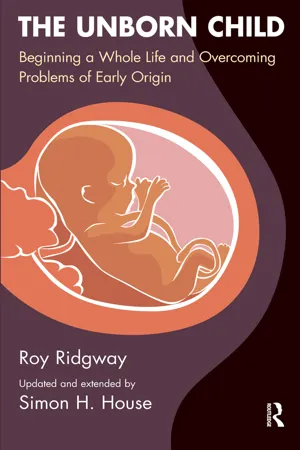
The Unborn Child
Beginning a Whole Life and Overcoming Problems of Early Origin
- 272 pages
- English
- ePUB (mobile friendly)
- Available on iOS & Android
eBook - ePub
The Unborn Child
Beginning a Whole Life and Overcoming Problems of Early Origin
About this book
Information
Introduction:
inner nature and outside world
"We had to go for a medical and Michele stood shuddering in her knickers when the doctor came near her. He said: 'My goodness/she is nervous, isn't she?' I said, 'Well, I was pregnant with her in a cellar during the war; I should think that counts for something.'"
Motherland (Ann McFerran, 1988)
Care to last a lifetime
Violence towards children is endemic. In 13 years following publication of this book's first edition, over 2 million children were killed in wars and civil conflicts, and between 4 million and 5 million have been disabled (UNICEF, 1998). Nearer home, in Britain, the NSPCC reports an appalling record of cruelty and neglect. An advertisement headed "Cruel Britannia", placed by the Children's Society in the British press, points out that we march for animal rights, respond generously to humanitarian tragedies across the globe, and campaign for a better environment. Yet we have the worst record in Western Europe for caring for our children.
Another press report points out that Britain shares with Romania (UNICEF-WHO, 2004) one of the worst records in Europe for babies seriously underweight, with increased risks of death within a month, mental handicap, blindness, deafness, cerebral palsy, epilepsy, and autism.
In the first edition of this book I wrote about child suicide in the United States. According to Dr Perihan Rosenthal (Rosenthal & Rosenthal, 1984), a director of child ambulatory services at the University of Massachusetts Hospital, doctors dismissed child suicides as accidents, but he said he found children as young as 2 who deliberately attempted to take their own lives.
A little boy was asked by Rosenthal why he had injured himself. "Daddy and Mummy don't love me any more", he replied, as if he was trying to punish himself because his parents had left him and he felt that their rejection was his fault. Sadly, the problem of child suicide is still with us. In the Children's Society advertisement referred to above, Josie (aged 12), who had tried to commit suicide, said, "I wish I'd never been born." What a terrible thing to say in the springtime of life!
We talk about educating our children in numeracy and literacy while many of them are more in need of help with their emotional problems—even more essential to their wellbeing, and also to their skills. The Mental Health Foundation's report on mental health of children (1999) states that "at any one time 20% of children and adolescents experience psychological problems" (http://www.mentalhealth.org.uk/html/content/youngoffenders.pdf).
This world-wide epidemic of child cruelty leads many to mental and physical ill-health, and often to a lifetime of misery lawlessness, and exclusion from society How can it be prevented? There is, of course, no easy fix, but one important factor in human development and behaviour that is not yet taught in our schools is that all human relations have their origin in parental attitudes from before conception.
And this brings me to the reason why I have been persuaded to bring out a second edition of this book: its main message has so far been widely ignored.
The book presents a concept of care that spans a lifetime, the whole lifecycle, from before conception onwards. It describes new ways to protect new lives. It tells how people are finding new ways of healing. The book has powerfully influenced a small but worldwide community of dedicated people, including experts in prenatal and perinatal psychology, but they have not yet received the recognition they deserve. They are researching into the beginnings of life, but society is scarcely aware of the problems and their causes, or of the newfound possibilities of healing.
Bonding
Environmental conditions significantly determine health from before life begins in the womb. Genes play an important part in establishing who we are and how we behave, but there is mounting scientific evidence that, in the age-old dispute between nurture and nature, nurture usually wins.
The American developmental neuropsychologist James Prescott has demonstrated this in his studies of the long-term consequences of lack of bonding, which formed part of a broad programme of systematic research on the origins of violence carried out over 25 years at the US National Institute of Child Health and Human Development (Prescott, 1996). They showed that neural circuits were damaged through rejection or abandonment of a child by parents or through inadequate bonding. The degree of bonding depends on the amount of attention given to the physical and emotional needs of a developing child at each stage of development—preconception, pregnancy, infancy, childhood, and adolescence. Economic and social pressures also affect these natural developmental processes.
Prescott found abundant evidence to show that bonding rests on three emotions: trust, affection, and love, each in a system of the brain (Prescott, 1996). Trust rests on the vestibular-cerebellar sensory system. Affection rests on the somesthetic, touch-sensory system. Intimacy rests on the olfactory, smell-sensory system. The love-bond consists of these three combined. Feelings of pleasure arise, says Prescott, and bonding, when these three systems are fully integrated in development. Lack of this integration is the principal neuropsychological condition for expression of violence.
Prescott carried out cross-cultural studies on 49 primitive cultures distributed throughout the world. Among these, he found 29 violent cultures and 20 peaceful ones. His findings showed that the degree of physical and psychological bonding in the maternal-infant relationship was a reliable predictor of the degree of peaceful or violent behaviour in those cultures. He concluded that violence was culturally determined—a fact that can also be demonstrated in the learned behaviour of chimpanzees.
Main cause of violence particularly sexual
"The failure to integrate the physical pleasure of bonding into the higher brain centres associated with consciousness", says James Prescott, "is the main neuropsychological condition for the expression of violence, particularly sexual violence."
He was talking about different degrees of pleasure, from pleasure experienced as purely physical or sexual to a love in which the physical and spiritual are integrated. Love is described in different ways by different people. To the neuropsychologist, it has something to do with neural circuits in the brain. To the lover it is the physical pleasure of intimacy, a feeling of closeness. All relationships begin with physical pleasures of touch, smell, and a sense of trust. But it is not just a matter of determinacy—as if we cannot help ourselves being who and what we are. It is more a matter of the choices we make, our intentionality. To be human is to be responsible for one's own feelings and thoughts, being attentive to the feelings and needs of others, acknowledging what Heidegger called our state of "being with others in the world" (Heidegger, 1953). In other words, being a human being means being in relationship with others and with nature; and, I would add, an awareness of a spiritual or creative intelligence at work in the universe, with an attitude, "Not my will, but the will of a creative intelligence be done". Looked at from the point of view of the psycho-neurologist, these basic physical pleasures should in all healthy nurturing and development go on to become integrated into the higher brain centres as transcendental states of human spirituality. However, as a result of incomplete bonding, pleasure is experienced by some only at the genital-spinal reflex level or limbic level of brain function. We then become slaves of our animal instincts—of those parts of the brain that have been described as reptilian and mammalian.
Love can, of course, include the sexual appetite; but when it becomes integrated into the higher consciousness, there is regulation and restraint or, in neurological terms, there is "regulation and inhibition of those neural circuits that mediate depression and violent behaviour" (Prescott, 1996).
The transcendental state of human spirituality is described by the Jewish mystic Martin Buber as the "I– Thou relationship"—a feeling of oneness between two people—that is experienced at the beginning of life before a child feels separated from its mother (Buber, 1958). Later, as this state becomes integrated into the higher consciousness, it is experienced as trust, affection, and physical closeness, and we do not think in terms of an object to love (which is the I—It relationship, expressed in the purely sexual relationship—i.e. sex without love); there is just a loving relationship where there is mutual respect and tenderness.
Blake wrote of love moving "silently, invisibly" (Love's Secret). This is a poetic way of saying it happens without words or definitions or protestations. It is a force that is there at the beginning, in the nurturing of a child, and it can become a "guiding light" throughout life. "Never seek to tell thy love", Blake wrote, "love that never told can be." Love often becomes distorted by words, degenerating into possessiveness or dependency, except in the powerful lines of a Blake or Shakespeare or Shelley or Elizabeth Barrett Browning. But love needs no words; it exists in its purest sense pre-verbally. It is the state of being described in the East as our unborn Buddha nature, or kensho, when the self vanishes, leaving a state of absorption in the activity of the moment: being present to the Other.
Love is experienced as a common bond with humanity. It includes relationships with nature and animals as well as human beings, which Wordsworth, with his universal sense of religion, saw as a powerful force at the very centre of life.
As we enter the new millennium, I believe the best way for science to ensure a more peaceful world is not by playing about with genes, as some believe, but by getting to grips with the psychological, social, cultural and religious problems of human love; and the place to begin is before conception, with the understanding of what it means and what it requires to create another life.
"The understanding of the nature of human love", James Prescott says, "is a proper subject for scientific study and such studies are essential if human violence is to be understood and prevented."
Love spans a whole lifetime and begins when a couple take on the responsibilities of parenthood. As scientists such as Prescott have demonstrated, bonding during pregnancy and at birth lays the foundation for much that follows in life. But science is just one way of knowing. Other ways of knowing are through art and religion.
Condemned to please
What science is teaching us today is that we can never be certain of anything. And we know from the lives of many people that even if there is love at first, even if the bonding goes well, it does not necessarily lead to loving relationships later in life. The denial of love increases the likelihood of violence. Truly caring love reduces its likelihood. The main trouble as the child begins to gain a sense of independence is that socio-economic pressures interfere with the healthy development of relationships within the family and love is perceived as synonymous with social approval. The good—"loveable"—boy or girl is one whose behaviour is socially acceptable. This, as Sartre said in his autobiography (Sartre, 1964), means that the child is "condemned to please". Love, which most people experience at the start as both spiritually and physically nurturing, becomes confused with dependency and possessiveness, and this is probably the origin of much that goes wrong in interpersonal relations in the home, the community, and even on the world stage of international relationships.
If I may bring a personal note into this thesis, I am aware, when looking back at my own childhood and boyhood, that the real problem (in the 1920s and 1930s) lay outside the family home. Being loved—that is, winning approval—in the outside world was mainly a matter of obeying rules of social behaviour, but in the home you could break the rules and still feel loved. But although you enjoyed loving or caring relationships in the home, the world outside could be very cruel and have a damaging effect on your character, sometimes, as I remember, splitting the male breadwinner in two—into a tender home-loving father and thick-skinned businessman, the latter perceived as supportive to the former. Cruel, indifferent behaviour is justified as a means to an end. Not only is this true on the small stage of business and family relations, it happens on the big stage of international relations. But means and ends are one process, and, as Eliot wrote in East Coker, "in my beginning is my end". Means determine ends. The wrong means cannot produce the right results any more than wrong motives.
Yet most of us separate outside from inside. We live in two different worlds. Even some of the most ruthless dictators experienced the unconditional love of a mother, which they continued to respond to in loving ways. For instance, Stalin's mother, a peasant woman in the last few years of her life when Stalin was at the height of his power, talked of her "loving, considerate son". Stalin visited her regularly in her two-roomed flat in Titlis, Georgia. There was a very close bond between them.
When Stalin was a child, life was hard for his mother, Katherine Djugashvili, in the family's little dark house with its leaking roof and empty larder. The family was very poor and suffered ill-health and malnutrition. Then later, when Stalin—the man of steel—became one of the most ruthless dictators of all time, the memory of a loving mother remained with him, but it could not prevent him from committing acts of terrible savagery. Indeed, the memory of his mother's suffering may have contributed to his ruthlessness in creating what he regarded as a fairer society, where the State looked after its people. It was mainly the economic and social circumstances of Stalin's childhood that had moulded his personality, which saw danger everywhere, making him turn on people who had done him no real harm. In his case, violence was linked both to a cruel father and to the poverty and injustice he had experienced early in life: currently referred to as "structural violence". The bonding was not strong enough to counter this.
Alice Miller blames Stalin's persecution mania on the brutality of his father, who had mercilessly beaten him when he was a child. There are many instances in the past, and even in recent times, of fathers who ruled their families with rods of iron. It was also once common practice for the State to inflict brutal physical punishment on citizens who broke the law. Those who perpetrated these crimes were part of a social system that not only condoned but encouraged such behaviour. In blaming them, we are blaming the victims of an unjust system; the fault lying in the thinking that creates such systems. Fragmented thinking fails to see the whole of life from beginning to end as one continuous process. Holistic thinking, seen from the outside as development or progression or deterioration, is felt inside as harmony, following a universal design that we call intelligence.
Life was hard for many of us in Britain before and after the Great War of 1914-18, especially when I was a boy during the depression years on Merseyside, where there was a lot of misery brought about by poverty and malnutrition. I remember the despair outside the family home, but I also remember all the love within the home in spite of a bad-tempered father, who worked in Liverpool in a job he hated. This was the pattern in many homes on Merseyside—loving mother, hard-working, battle-weary, bad-tempered father.
It was a time when many families were bereaved after four years of trench warfare. There were men suffering from post-traumatic stress disorder (PTSD), which they called shell shock in those days; and every family had lost someone or knew of someone who had been killed in the trenches of the Great War. No one came out of that war without some form of psychological damage. To paraphrase Yeats, too much exposure to suffering can make a stone of the heart. I have experienced the numbness myself in wartime. I worked for a while as a medical orderly in the resuscitatio...
Table of contents
- Cover
- Half Title
- Title
- Copyright
- Dedication
- Contents
- ABOUT THE AUTHORS
- FOREWORD
- FOREWORD
- PRELUDE TO THE 2006 EDITION
- PRELUDE TO THE 1987 EDITION
- Introduction: inner nature and outside world
- REFERENCES AND BIBLIOGRAPHY
- RELEVANT ORGANIZATIONS
- INDEX
Trusted by 375,005 students
Access to over 1.5 million titles for a fair monthly price.
Study more efficiently using our study tools.
Frequently asked questions
Yes, you can cancel anytime from the Subscription tab in your account settings on the Perlego website. Your subscription will stay active until the end of your current billing period. Learn how to cancel your subscription
No, books cannot be downloaded as external files, such as PDFs, for use outside of Perlego. However, you can download books within the Perlego app for offline reading on mobile or tablet. Learn how to download books offline
Perlego offers two plans: Essential and Complete
- Essential is ideal for learners and professionals who enjoy exploring a wide range of subjects. Access the Essential Library with 800,000+ trusted titles and best-sellers across business, personal growth, and the humanities. Includes unlimited reading time and Standard Read Aloud voice.
- Complete: Perfect for advanced learners and researchers needing full, unrestricted access. Unlock 1.5M+ books across hundreds of subjects, including academic and specialized titles. The Complete Plan also includes advanced features like Premium Read Aloud and Research Assistant.
We are an online textbook subscription service, where you can get access to an entire online library for less than the price of a single book per month. With over 1.5 million books across 990+ topics, we’ve got you covered! Learn about our mission
Look out for the read-aloud symbol on your next book to see if you can listen to it. The read-aloud tool reads text aloud for you, highlighting the text as it is being read. You can pause it, speed it up and slow it down. Learn more about Read Aloud
Yes! You can use the Perlego app on both iOS and Android devices to read anytime, anywhere — even offline. Perfect for commutes or when you’re on the go.
Please note we cannot support devices running on iOS 13 and Android 7 or earlier. Learn more about using the app
Please note we cannot support devices running on iOS 13 and Android 7 or earlier. Learn more about using the app
Yes, you can access The Unborn Child by Simon House,Roy Ridgway in PDF and/or ePUB format, as well as other popular books in Psychology & Gynecology, Obstetrics & Midwifery. We have over 1.5 million books available in our catalogue for you to explore.