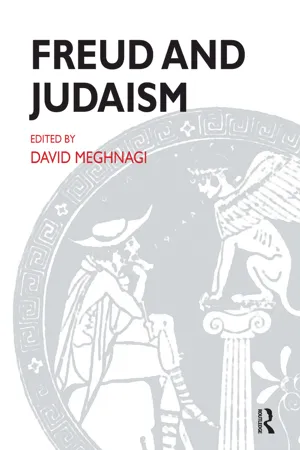
- 212 pages
- English
- ePUB (mobile friendly)
- Available on iOS & Android
eBook - ePub
Freud and Judaism
About this book
In this wide-ranging collection, there can be found studies that are representative of the tendencies in research during the last few years.
Information
Chapter One
'Wir Und Der Tod'
A previously untranslated version of a paper by Sigmund Freud on the attitude towards death
Translator's Introduction
Mark Solms
On 16 February 1915 Freud presented the lecture translated below—'Wir und der Tod ['Death and Us'l—to the Vienna lodge of the International Order of the B'nai B'rith (the Sons of the Covenant).1
Freud had been a member of the B'nai B'rith since 29 September 1897 and had addressed it on numerous previous occasions. Included among the earlier lectures were the following titles: The Interpretation of Dreams' (presented in December, 1897); The Psychology of Forgetting' (February, 1899); The Mental Life of the Child' (February, 1900); 'Chance and Superstition' (February, 1901); 'On Dreams' (April, 1902); The Physiology of the Unconscious' (1905); 'Psychology in the Service of the Administration of Justice' (March, 1907); The Problem of Hamlet' (1911); and 'What Is Psycho-Analysis' (November, 1913).2 The reader will readily deduce from these titles—and from the dates of their presentation—that the B'nai B'rith lectures served as models for some celebrated publications by Freud.
The special interest attached to 'Death and Us' is that it is the only lecture in this series that was ever published3—and the only one, therefore, that survives today. It has long been recognized that this lecture was the basis for the second part of Freud's Thoughts for the Times on War and Death' (1911b)— that is, for his essay entitled 'Our Attitude Towards Death' ('Unser Verhältnis zum Tode'; see Jones, 1953-57, Vol. 2; Strachey, 1957). However, the fact that this lecture was published has only recently been rediscovered (D. B. Klein, 1981).4 The aim of the present chapter, therefore, is to make this unique document available to English-speaking scholars of psychoanalysis.
The singularity of the document resides in the fact that it is the only known text by Freud that exists in two distinct versions. It is true that rough drafts and notes for some well-known works by Freud have been published, as have transcripts of some unpublished manuscripts; and it is also true that Strachey's meticulous footnotes to the Standard Edition trace chronological revisions of those of his works that appeared in multiple editions; but there is no other single text that exists in two deliberate versions, written more-or-less simultaneously, for two different audiences.
The first version of this lecture was composed for oral presentation, to a lay, almost exclusively Jewish audience—an audience for which Freud felt considerable personal affection.5 In the second version the lecture was rewritten as an essay, expressly for printed publication, in a specialist journal, with a predominantly psychoanalytical readership.6 Comparison of the two versions could, therefore, provide new insights into Freud's methods and style of working—as a writer and an orator—into the way in which he thought about the concepts and ideas discussed in this work, and, indeed, into some aspects of his public persona and his personality as a whole.
With these possibilities in mind, the present chapter is arranged as follows.
We are dealing with four texts:
a. the original German version of a lecture presented to the B'nai B'rith, first published in 1915 in the Zweimonats-Bericht fur die Mitglieder der österr. israel Humanitätsvereine B'nai B'rith:7
b. an English translation of that lecture, published here for the first time;8
c. the original German version of an essay, based upon the B'nai B'rith lecture, first published in 1915 in Imago;9
d. the English translation by James Strachey of that essay, published in the Standard Edition.10
Text b, the first English translation of the 1915 lecture, occupies the main body of the present chapter. This translation is punctuated, at regular intervals, by footnotes that compare the equivalent passages in the revised, essay version (i.e. in text d). The differences between these two versions are indicated to the reader in the footnotes by means of bold type.
In a few isolated instances it was necessary to make minor modifications to Strachey's authoritative translation in order to convey subtle differences between the two German versions.11 All modifications of this sort are clearly identified as such in the footnotes.
Thus—barring the exceptions just mentioned—the English translation of the B'nai B'rith lecture presented in the main body of the text below (i.e. text b) differs from Strachey's Standard Edition translation of the Imago essay (i.e. text d) in a manner that exactly parallels the differences that existed between the two original German versions—texts a and c.
The reader will see that Freud subjected the B'nai B'rith lecture to a very thorough revision before he published it in the essay form. In most respects, however, these changes are barely perceptible at first reading. Apart from a few obvious deletions (consisting mainly of passages of exclusively Jewish interest) and equally few additions (essentially of scholarly references and the like), the two versions of this work appear at first to be identical. It is only on much closer examination that the pervasive but subtle shift in emphasis and style from the lecture to the essay becomes apparent. In fact, only a handful of sentences across the two versions are exactly alike.
The differences between the two texts can be broadly characterized as follows.
1. Firstly, as mentioned above, all passages of exclusively Jewish interest are expunged In the Imago version. The most obvious example of this type is to be found in the opening lines of the text, where Freud suggests that he might have amended the title of his lecture:
Instead of: 'Death and Us', it could have read: "Death and Us Jews', for it is precisely we Jews who reveal most frequently and in the most extreme ways the attitude towards death that I wish to deal with before you today.
Other examples of this type are to be found in footnotes 1, 5, 16,29, and 41.
2. Also deleted from the Imago version are numerous jokes and anecdotes, some of which are of a specifically Jewish character (see footnotes 5 and 16), others not (footnotes 5, 18, 46, 53, 54). The omission of such material has the effect of decreasing the immediacy and directness of contact between the author and his audience. This diminution of immediacy and directness is effected in other ways as well. Thus, for example, Freud made frequent use of rhetorical questions (cf. footnotes 2, 5, 20, 24, 25) and of first- and second-person references (footnotes 5, 6, 15, 17, 21, 23, 30, 38, 45, 46, 49, 51-55, 58, 61) in the lecture, all of which are deleted in the Imago version.
3. The tone of the lecture is also more tentative and sympathetic than that of the essay. Freud seems to have been extraordinarily sensitive to the uncomfortable feelings that his topic might have evoked in his audience (see footnotes 6 and 24). In the opening paragraph of the text, for example, Freud actually apologizes for the very subject-matter of his lecture:
Please do not suppose that I gave my lecture such an eerie title in order to upset you. I know that there are many people who wish to have nothing to do with death—perhaps, therefore, amongst yourselves too—and I wanted to avoid luring these Brethren into a lecture that would distress them.
Similarly, at one point, when discussing the war, Freud identifies himself with the patriotic feelings of his German-speaking audience (see footnote 45). Freud also took greater care in the lecture to orientate his audience to the unfolding argument, by means of frequent examples, reminders of points already established, and references to forthcoming conclusions (see footnotes 1, 6, 24, 46, 54, 56).
4. Other changes of a similar kind relate to the fact (already mentioned above) that the essay version was directed to a specialist psychoanalytical readership, whilst the original B'nai B'rith lecture was addressed primarily to a lay audience (see footnotes 5, 6, 19, 23, 28, 32, 46, 49, 55), Here Freud's choice of everyday language to represent technical terms is of particular interest. In the lecture version, for example, he describes psychoanalysis as being 'a sort of under-water psychology'. Similarly, the term 'unconscious impulses' in the Imago version corresponds to 'unspoken thoughts' in the lecture version, and the phrase 'cravings of the lust to kill' in the lecture version corresponds to 'hostile impulse' in the essay. Other changes of a comparable sort consist in expansions and improvements of the arguments originally presented in the lecture, and in additions of scholarly material such as references and annotations (see footnotes 6, 8, 14, 20, 27, 28, 31, 32, 33, 36, 37, 42-46, 51, 52, 58, 59, 61).
5. Finally, the grammar and style of Freud's language in the Imago version is more formal and correct than it was in the lecture (see footnotes 8, 14, 15, 17, 18, 20, 22, 27, 28, 32, 35, 39, 45, 46, 48, 49, 52, and 60). This is due in part to the requirements of oral versus written presentation, but also to the fact that the two versions were addressed to different audiences. However, some of the changes in syntax and grammar are rather painstaking and might appear to the reader to serve little objective purpose, such as alterations in the punctuation, switching the order of words, substituting synonyms, and so on {see footnotes 9, 13, 17, 19, 20-22, 26, 30, 39, 48-50, 55, 60). Thus, for example, 'a child or a friend" in the lecture version becomes 'child or close friend' in the essay; the phrase 'whom he certainly loved' becomes 'whom he undoubtedly loved' in the essay; and 'impulsive or instinctive' becomes 'instinctive and impulsive'.
The implications of these changes for our understanding of Freud's cognitive style, his method of writing, his Jewish identity, and so on, are not specifically discussed in this chapter.12
'Death and Us'
Sigmund Freud
Honourable Presidents and dear Brethren,—Please do not suppose that I gave my lecture such an eerie title in order to upset you. I know that there are many people who wish to have nothing to do with death—perhaps, therefore, amongst yourselves too—and I wanted to avoid luring these Brethren into a lecture that would distress them. I could also have amended the other part of my title. Instead of: 'Death and Us', it could have read: 'Death and Us Jews', for it is precisely we Jews who reveal most frequently...
Table of contents
- Cover
- Half Title
- Title
- Copyright
- Dedication
- Contents
- CONTRIBUTORS
- FOREWORD
- PREFACE
- 1. 'Wir und der Tod' A previously untranslated version of a paper by Sigmund Freud on the attitude towards death
- PART ONE Judaism and psychoanalysis
- PART TWO Historical aspects
- PART THREE Cultural aspects
- PART FOUR ‘Moses and Monotheism'
- PART FIVE Applied psychoanalytic studies
- BIBLIOGRAPHY AND REFERENCES
- INDEX
Trusted by 375,005 students
Access to over 1.5 million titles for a fair monthly price.
Study more efficiently using our study tools.
Frequently asked questions
Yes, you can cancel anytime from the Subscription tab in your account settings on the Perlego website. Your subscription will stay active until the end of your current billing period. Learn how to cancel your subscription
No, books cannot be downloaded as external files, such as PDFs, for use outside of Perlego. However, you can download books within the Perlego app for offline reading on mobile or tablet. Learn how to download books offline
Perlego offers two plans: Essential and Complete
- Essential is ideal for learners and professionals who enjoy exploring a wide range of subjects. Access the Essential Library with 800,000+ trusted titles and best-sellers across business, personal growth, and the humanities. Includes unlimited reading time and Standard Read Aloud voice.
- Complete: Perfect for advanced learners and researchers needing full, unrestricted access. Unlock 1.5M+ books across hundreds of subjects, including academic and specialized titles. The Complete Plan also includes advanced features like Premium Read Aloud and Research Assistant.
We are an online textbook subscription service, where you can get access to an entire online library for less than the price of a single book per month. With over 1.5 million books across 990+ topics, we’ve got you covered! Learn about our mission
Look out for the read-aloud symbol on your next book to see if you can listen to it. The read-aloud tool reads text aloud for you, highlighting the text as it is being read. You can pause it, speed it up and slow it down. Learn more about Read Aloud
Yes! You can use the Perlego app on both iOS and Android devices to read anytime, anywhere — even offline. Perfect for commutes or when you’re on the go.
Please note we cannot support devices running on iOS 13 and Android 7 or earlier. Learn more about using the app
Please note we cannot support devices running on iOS 13 and Android 7 or earlier. Learn more about using the app
Yes, you can access Freud and Judaism by David Meghnagi in PDF and/or ePUB format, as well as other popular books in Theology & Religion & History & Theory in Psychology. We have over 1.5 million books available in our catalogue for you to explore.