Seismic Performance of Asymmetric Building Structures presents detailed investigations on the effective assessment of structural seismic response under excessive torsional vibrations, demonstrating behavioural aspects from local response perspective to global seismic demands. The work provides comprehensive analytical, computational, experimental investigations, and proposes improved design guidelines that structural engineers can utilize to enhance the seismic design of asymmetric building structures.
Combining extensive experimental and numerical data stock for seismic performance assessment with a particular focus on asymmetric building structures, the book includes:
• An overview of asymmetric building structures from seismic damage perspective • Local and global performance assessment of asymmetric structures under extreme seismic actions • Post-earthquake damage evaluation from varying frequency trends • Extended numerical applications for experimental response validations • Evaluation of critical regions of asymmetric structure with stress concentration • Statistical distribution of seismic response under varying design parameters • Design guidelines for asymmetric building structures
This work's comprehensive evaluations are carried out with modern sensing techniques planned with meticulous attention to cover objectives with a particular focus on asymmetry in reinforced concrete and steel structures. It assesses various aspects of asymmetric building structures that are rarely dealt with in the current literature. It gathers fruitful information from various building design codes and explains their limitations in addressing damage-related challenges, which is not only useful for practicing engineers but also for academics.
The book will be invaluable for experts, researchers, students and practitioners from relevant areas, as well as for emergency preparedness managers.
Chapter 1 Introduction to the seismic performance of asymmetric building structures
1.1Introduction and background
Seismic events stand out amongst nature’s most prominent threats to civil infrastructure facilities and human life because throughout the years they have caused the devastation of urban areas and cities on almost every continent prone to seismic risk. They are the least comprehended among natural hazards, and the most critical distinction of such hazards is that the risk to life is associated with man-made structures. Seismic hazard poses a unique engineering design problem, and the optimum engineering approach is to design the structure so as to avoid a collapse under major earthquakes. This ensures no loss of life and accepts the possibility of damage under rare earthquakes. With exception to the landslides under severe earthquakes, seismic impacts that lead to broad death tolls are collapses of buildings, bridges, dams and other man-made civil infrastructure facilities. To ensure the safety of these structures, only the development of seismic-resistant design strategies can counter the seismic risk associated with these structures. This demands successful implementation of engineering knowledge to avoid damage to the building structures under seismic actions.
From previous research investigations corresponding to the collapse of building structures under earthquakes, it has been well understood that one of the major reasons of the collapse of these buildings was the irregularity of these structures (Sharma et al., 2016; Bikçe and Çelik, 2016; Shakya and Kawan, 2016; Zhao et al., 2009; Varum et al., 2018). Irregularity is a term associated to building structures when their centers of mass (CM) and stiffness (CR) are no-coincident (Hejal and Chopra, 1989b; Harasimowicz and Goel, 1998; Chandler and Hutchinson, 1986). Such structures exhibit higher probability to get damaged under seismic actions compared with counter regular structures. With recent developments in infrastructure, the advancement in the architecture of building structures has significantly improved (Fig. 1.1). However, irregularities tend to develop when aesthetic/functional considerations are made during the architectural planning of these structures. Torsional response can occur for various reasons even in symmetric structures that are highly favored in current earthquake resistant design provisions of various codes. These reasons include but are not limited to rotational components of seismic excitation, non-uniform yielding in the structure, random distribution of the internal loads, inelastic behavior and site-specific characteristics of the seismic excitation. Hence, to some degree, almost all real-life structures experience torsional vibrations. Therefore, perfect symmetry is an idealization and very rarely occurs as real-life structures are almost always asymmetric. Irregularities in a structure are very difficult to define as they dramatically vary in their nature and in principle. Broadly classifying the structural irregularities, they can be of two types: (1) plan-asymmetric structures and (2) vertically asymmetric structures. Starting with plan-asymmetry, previously executed studies demonstrate that this type of irregularity results in severe damage to the plan-asymmetric structures since it produces floor rotations along with floor translations (torsional coupling). Such irregularities form because of the irregular distributions of stiffness/strength and mass in the structure. Various investigations in the past have evaluated the impacts of torsional coupling in plan-asymmetric structures by considering simplified one-story analytical models. Such models were considered for the development of design provisions for various one-story asymmetric structures as well as multi-story asymmetric structures. However, these models are not justified for multi-story asymmetric structures especially for the inelastic response and therefore, such numerical investigations are only applicable to a few cases of the realistic asymmetric structures. Despite the fact that these models are incapable of addressing the problem of asymmetry very well, they are still used by numerous researchers to provide particular qualitative demonstration of the problem.
Figure 1.1 Silicon Alley, New York representing different asymmetric structures (Photo credit: Dave Lindblom, https://upload.wikimedia.org/wikipedia/commons/6/67/Flatiron_District.webp)
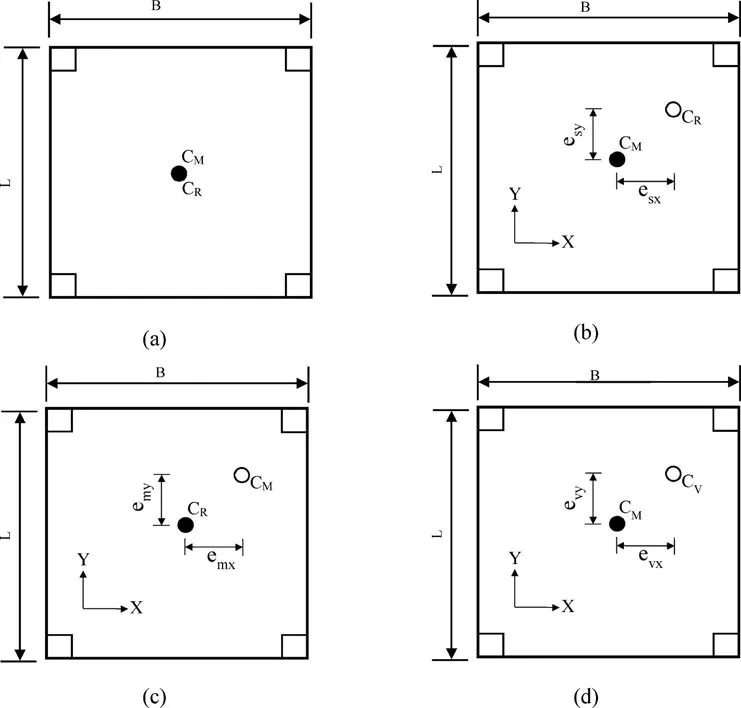
The components of a moment resisting structure, resisting the seismic actions, are defined as lateral force resisting systems (LFRS). In asymmetric structures, damage is generally formed by stress concentration at weak locations of the LRFS. These weak locations cause further deterioration of the structural components thereby causing the structural failure. The reason behind the stress concentration at weak locations is the inherent eccentricity (difference of CM and CR) in the structural floor plan. Asymmetric structures can be broadly classified as plan-asymmetric and vertically asymmetric. A typical example of plan-asymmetry (De Stefano et al., 1998; Ghersi and Rossi, 2001; Bhatt and Bento, 2014) is illustrated in Figure 1.2.
Figure 1.2 Typical example of symmetric and plan-asymmetric structures: (a) symmetric system, (b) stiffness eccentric system, (c) mass eccentric system and (d) strength eccentric system
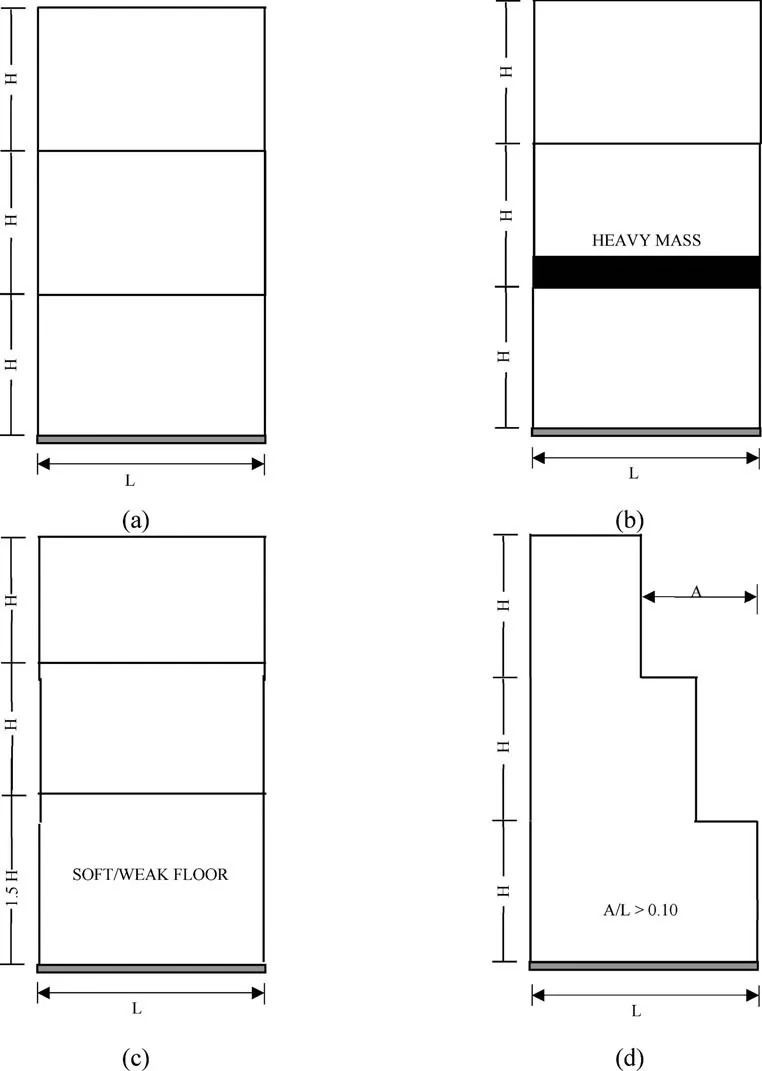
Similarly, vertical-asymmetry can be defined as the irregular distribution of stiffness/strength and/or mass along the structure’s height. There are various reasons for real-life structures to be vertically asymmetric. For instance, in majority of the commercial structures, basements are created by eliminating central columns which eventually leads to the soft story mechanism at basement level. Another practical reason behind vertical-asymmetry is the reduction in the sizes of columns and beams in the higher order floors mainly for two purposes: (1) to fulfill functional requirements such as storing heavy mechanical appliances and (2) cost-reduction of the construction. This creates difference in the vertical distribution of stiffness/strength and/or mass with respect to the adjacent floors. Besides, there are several other reasons for the formation of vertical-asymmetry such as variation in the material properties, improper construction methods and construction mistakes. Typical examples of vertically regular and irregular structures (Moehle, 1984; Truman and Cheng, 1990; Das and Nau, 2003; Nezhad and Poursha, 2015; Basu and Giri, 2015) are illustrated in Figure 1.3.
Figure 1.3 Typical examples of symmetric and vertically asymmetric structures: (a) symmetric system, (b) irregular mass distribution, (c) soft story structure and (d) setback structure
This chapter provides a detailed picture of the work presented in previous studies on the damage response of vertical and plan-asymmetric structures under the influence of torsional vibration, mainly highlighting the research background, challenges addressed in this book, objectives of the book, methodology adopted to address the challenges and finally an outline of the book.
1.2Challenges addressed in this book
Post-earthquake inspections have indicated stress concentration at weaker locations as the main cause of damage to asymmetric structures. In this regard, seismic design codes acknowledge the relevance of torsional coupling to structural damage response. To estimate the contribution of torsion on the seismic response, several simplified procedures have been established by many researchers. In general, two kinds of eccentricities are considered in the seismic design: (1) static eccentricity (natural or inherent eccentricity) and (2) dynamic eccentricity (multiple of accidental eccentricity and a coefficient). The common design practice is to use accidental torsion to indirectly account for (a) uneven yielding of structural members, (b) changes in the geometric and material properties of the LRFS, (c) difference in the distribution of designed mass and reactive mass and (d) varying orientations of seismic excitations. The potential damage to the buildings from previous major earthquakes is evident, and the main cause of structural damage is the local stress concentration at weak locations in the buildings. Asymmetric structures are more vulnerable to damage at these weak locations than their regular counterparts. The current design practice to deal with the potential influence of torsional vibrations in the asymmetric structures has been established on over-simplified procedures, and in relevance to this issue, despite the compliance of asymmetric structures with the seismic design guidelines, the asymmetric structures are still potentially vulnerable to damage.
From previous research studies and the provisions of various international design standards, it is evident that the problem of structural irregularity has been viewed as a global parameter. However, location-specific influence corresponding to the seismic damage response has not been explored very well. Moreover, in recent times, development in modern architecture has evolved which has led to the presence of more severe circumstances of irregularities in the structure. For instance, a structure can have multiple irregularities in its plan and elevation at the same time. The interaction of these irregularities may lead to more severe damage. The current design practice considers these irregularities separately. Moreover, the whole emphasis is only on the global response, ignoring entirely the local distress in the structure. Therefore, the primary emphasis of this book is to evaluate the damage characteristics of asymmetric structures keeping in view both the local and global response perspective under the interaction of irregularities. The research target is achieved by evaluating the damage behavior of plan-asymmetric RC structure. The plan-asymmetric RC structure was initially tested in elastic range, and then the structure was transformed into a highly inelastic state by progressively increasing the seismic excitation. However, to simulate the damage-based results for a wide range of asymmetric scenarios, an extensive experimental investigation on vertical and plan-asymmetric steel structures has been carried out. All the experimental models were carefully equipped with calibrated instruments to thoroughly investigate both local and global structural response.
Through the observations of the structural failure phenomenon in the simulated seismic shake table tests, the damage mechanism is analyzed, and the corresponding observations have been established to study the weak links in the structure and establish seismic design guidelines. Moreover, for monitoring and inspection of existing asymmetric structures, it is a huge challenge to determine the structure’s state of collapse and the location where it is likely to occur. Using the findings of this book, a comprehensive guideline is established to determine the state of possible threat to asymmetric structures under seismic actions.
1.3Objectives of this book
The main focus of this research is to produce, by both experimental and numerical investigations, a reliable connection between the seismic damage response and the influence of torsional vibrations in vertical and plan-asymmetric structures. The purpose of establishing this connection is to provide detailed information about critical locations in asymmetric structures and the development of improved seismic design guidelines. In this regard, following are the objectives of this research:
To carry out a feasibility study on applications of FBG strain sensors for effective monitoring of damage response in the asymmetric structures under dynamic loading. The feasibility and successful implementation of the FBG sensors were ensured by comparing the damage response with varying dynamic characteristics.
To conduct detailed experimental testing on plan-asymmetric RC structure under progressive seismic excitation and to monitor the local damage and global response during the transformation of the structure from elastic to inelastic state.
To investigate the behavior of local seismic response at the FS of the structure experiencing tensile/compressive deformations.
To establish the parameter for the prediction of the cracks and formation of plastic hinges at weak locations.
To construct a wide range of asymmetric steel models ranging from highly torsionally stiff (TS) to highly torsionally flexible (TF) and then conduct detailed experimental testing for local/global response simulation.
To develop the strain contour plots for the assessment of the local response transition from the FS to the SS of the structure.
To determine the parameters influencing the ...
Table of contents
Cover
Half Title
Title Page
Copyright Page
Contents
List of figures
List of tables
Acknowledgments
List of abbreviations
Principal notations
1 Introduction to the seismic performance of asymmetric building structures
2 A review of research on design guidelines and seismic performance of asymmetric building structures
3 Experimental strategy and seismic loading program
4 Damage response investigation in asymmetric structures
5 Numerical evaluation of complex local behavior
6 Global seismic behavior of asymmetric building structures
7 Influence of design parameters on the statistical distribution of structural response
8 Seismic design guidelines for asymmetric structures
9 Conclusions
References
Appendix A Local response of RC model
Appendix B Local response of steel models
Appendix C Global behavior of steel models
Trusted by 375,005 students
Access to over 1.5 million titles for a fair monthly price.
Study more efficiently using our study tools.
Frequently asked questions
Yes, you can cancel anytime from the Subscription tab in your account settings on the Perlego website. Your subscription will stay active until the end of your current billing period. Learn how to cancel your subscription
No, books cannot be downloaded as external files, such as PDFs, for use outside of Perlego. However, you can download books within the Perlego app for offline reading on mobile or tablet. Learn how to download books offline
Perlego offers two plans: Essential and Complete
Essential is ideal for learners and professionals who enjoy exploring a wide range of subjects. Access the Essential Library with 800,000+ trusted titles and best-sellers across business, personal growth, and the humanities. Includes unlimited reading time and Standard Read Aloud voice.
Complete: Perfect for advanced learners and researchers needing full, unrestricted access. Unlock 1.5M+ books across hundreds of subjects, including academic and specialized titles. The Complete Plan also includes advanced features like Premium Read Aloud and Research Assistant.
Both plans are available with monthly, semester, or annual billing cycles.
We are an online textbook subscription service, where you can get access to an entire online library for less than the price of a single book per month. With over 1.5 million books across 990+ topics, we’ve got you covered! Learn about our mission
Look out for the read-aloud symbol on your next book to see if you can listen to it. The read-aloud tool reads text aloud for you, highlighting the text as it is being read. You can pause it, speed it up and slow it down. Learn more about Read Aloud
Yes! You can use the Perlego app on both iOS and Android devices to read anytime, anywhere — even offline. Perfect for commutes or when you’re on the go. Please note we cannot support devices running on iOS 13 and Android 7 or earlier. Learn more about using the app
Yes, you can access Seismic Performance of Asymmetric Building Structures by Chunwei Zhang,Zeshan Alam,Li Sun,Bijan Samali in PDF and/or ePUB format, as well as other popular books in Technology & Engineering & Civil Engineering. We have over 1.5 million books available in our catalogue for you to explore.