eBook - ePub
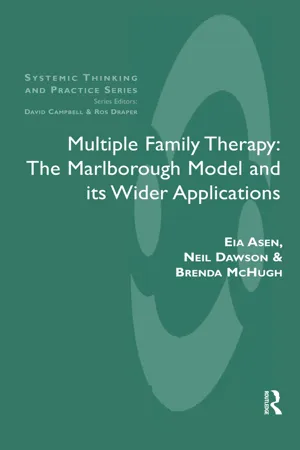
Multiple Family Therapy
The Marlborough Model and Its Wider Applications
- 152 pages
- English
- ePUB (mobile friendly)
- Available on iOS & Android
eBook - ePub
Multiple Family Therapy
The Marlborough Model and Its Wider Applications
About this book
If a troubled family contains the resources to solve its own problems, then why not bring such families together, to share their experiences and support each other? This is the approach of the Marlborough Family Service, the institution at the forefront of development for child-protection cases, school-based interventions and family therapy for ethnic-minority communities for over twenty years. In this book three long-standing staff members describe for the first time their innovative work with a range of family problems, from marital violence and child abuse to educational problems and eating disorders.
Information
CHAPTER ONE
Developing a contextual approach
The work described in this book has been developed over the past twenty-five years at the Marlborough Family Service. This is a publicly funded institution, part of Britain’s National Health Service, serving a defined catchment area and located in the middle of London. The Marlborough offers a range of therapeutic and consultative work for children, teenagers, adults, couples, and families. It is a child and family consultation service, integrated with the adult psychotherapy service and with a strong link to the local community health team which caters for seriously mentally ill adults. The Marlborough is an all-age service, with the youngest client 2 days of age and the oldest 96 years old. It therefore can take referrals without having to be limited by the traditionally rigid age boundaries between child and adolescent and adult and old-age mental heath services. The Marlborough is staffed by a multidisciplinary team of child, adult, and family therapists, social workers, teachers, nurses, clinical psychologist, and psychiatrists. All staff, however diverse their trainings and interests, share the basic values of the family systems approach. This means adopting an interactional framework that counteracts the potential for overemphasizing individual blame. Conceptualizing behaviour in the context of relationships is liberating as it offers the potential for a far-wider range of choices about how things might change if they have got stuck. The approach developed—the Marlborough model—above all emphasizes context: individuals live in contexts, usually families. Families live in contexts: their neighbourhoods. Within their living context, families and their individual members relate to friendship networks, to work spheres, to schools or nurseries, to religious or cultural institutions, to professional networks which enter their lives. A contextual approach attempts to address all these contexts, all the different systems and sub-systems of which the child, the adult, and the family are part.
Twenty-five years ago this emphasis on context seemed somewhat out of place. The biomedical model, then as dominant as it is now, looks for causes of disorder inside the person, inside the person’s mind and brain. The preferred site of intervention is the individual or part of the individual. In this model, relatively little importance is attributed to context or to interpersonal issues, with funding mostly going to research into genes and biochemistry. While this approach has some merit, when working with disadvantaged individuals and families it can prove unrewarding. Their daily suffering—from poverty to racism, from poor education to other forms of discrimination and social exclusion, from their daily struggles with alcohol abuse to intra-familial violence—is so predominant that any interventions have to have a large psychosocial dimension. It is simply not possible to focus on neurones when the larger system hurts.
When Dr Alan Cooklin became the director of the Marlborough in 1976, the institution was known as the Marlborough Day Hospital, clearly signalling a medical framework with all its implications of “patients”, “illness”, and “treatment”. One of Alan Cooklin’s first actions was to change the name to the Marlborough Family Service, reflecting its new emphasis: providing a service to families. Initially, many referrers were more than puzzled by this sudden re-naming and re-framing. They found it difficult to know how to refer families when, in their view, it was the individual who had problems or was ill. However, undeterred by these initial responses, the Marlborough team embarked on a course of educating referrers. These told us that they simply did not know how to tell one of their clients or patients that they should have “family therapy”. They were worried that they might alienate them. All they wanted was to send a difficult problem to the Marlborough and leave it to us to sort it out, with or without the family. We gradually accepted that it was our job—and not that of the referrer—to turn individuals into families. This meant frequently that the referred person was seen on his or her own, but individual sessions were conducted in such a way that therapeutic system was kept open, ready for family members to join as soon as possible (Jenkins & Asen, 1992).
Desperate to practise “family therapy” in the late 1970s, we subjected each and every referral to this mode of treatment. Having encountered the great family therapy stars, including Minuchin, Haley, Watzlawick, Palazzoli, and Ackerman, we treated families between once weekly and once monthly with our peculiar brand of family therapy. We discovered soon that while our approach seemed to work for some families, it did not for others. Once-weekly or once-fortnightly family therapy certainly did not seem intensive enough for some of the types of families that were increasingly referred to us. These families seemed to have many different problems simultaneously, with seemingly chaotic structures, diffuse or non-existent boundaries between various sub-systems, high degrees of enmeshment, and the absence of hierarchies. One very striking feature was that these families presented themselves as united in relation to the outside world (and social services/social welfare departments in particular), while at the same time failing to organize internal family affairs, such as finances, household work, child care, employment, and day-to-day activities. It was our encounters with the seemingly disorganized families that first led us to pose a crucial question which remains a guiding principle for much of our work: “What is the context that we need to use or invent in order to address the issues that this family or this referrer wants or needs to address?” Weekly family therapy seemed entirely insufficient to address the multiple issues in these families, which often included violence, drug or alcohol abuse, adult mental illness, social exclusion, and other daunting presentations. We therefore had the idea of creating a day unit that families could attend six to eight hours a day every day of the week for weeks or months. It also seemed to us that having quite a number of families attending at the same time might help deal with their social exclusion and isolation. Problems such as physical and sexual abuse, alcoholism, and domestic violence have a tendency to isolate families from neighbours and friends (Asen, George, Piper, & Stevens, 1989). Moreover, the stigma attached to these problems further enhances the sense of being different or feeling marginalized. Bringing families together and encouraging them to make contact with one another counteracts such isolation. The Family Day Unit was thus born (see chapter two).
Through our work with seemingly chaotic families, who often did not come to appointments and therefore had to be seen at least initially in their homes, we have never really been able to avoid seeing and experiencing their contexts. This has meant seeing the problems where they manifest themselves. Undertaking outreach work implied encountering families in contexts that are quite different from traditional clinic settings, with their one-way mirrors, videotape, and teams of fours. No such luxuries were or are available when working with families in their homes.
The Marlborough Family Service receives each week between ten and twenty new referrals, from a whole range of different sources, such as doctors, social workers, schools and courts, as well as self-referrals. The team meets at the beginning of each week and considers how to respond to these different requests. The principle that guides the work is embodied in the question: “What is the most relevant context within which to respond to the request?” This question frames the possible response. For example, it is possible to think that it might be best for the referred person to be seen on her or his own. It is also possible to consider that it might be more relevant for the person to be seen together with one other significant person, or the whole family. It is also possible to consider seeing the referred person together with the referrer and members of the family. Or, a meeting with the referrer only might be regarded as the most appropriate way to address the presenting problem. And there are other possibilities. In other words, when it comes to choosing the “relevant context” there is a whole range of options, and the clinician will have to reflect on which of these should be pursued, based on the information provided, on the clinician’s prejudices—and on a number of other factors. The place where the first and subsequent encounters take place is another context: it could be the home, a school, a family day unit, a mental hospital, an office. Many different responses are possible to each individual request for help or consultation. If therapists continually question their own practices, uncomfortable though this may be at times, then they are more likely to ensure that they provide appropriate contexts for therapy, rather than fitting clients and their families into institutional contexts. Our own team has critically examined our practices on many occasions. For example, at one time we thought that we could best deal with all clients and their problems referred to us by refraining these as soon as possible into family issues. Logically, we prescribed family therapy which was dished out by a therapist, with colleagues behind a oneway screen, preferably in teams of four, and sessions lasting for 60-90 minutes. While this context is still relevant for some clients, we no longer believe that everyone benefits from it or that it is indeed appropriate in many cases.
The search some eighteen years ago for relevant contexts for change led us to invent a family school (see chapter three). This was in response to being asked to provide services for pupils who had been excluded from their schools because of serious learning difficulties, violence, or disruptive behaviours. The schools seemed to lay all the blame at the family’s door, while the family tended to blame the school entirely for the educational failure of the children. The more the family blamed the school, the more the school blamed the family. Soon an impasse was reached, with the child caught between the warring parties. The family refused to seek psychiatric or psychological help, and the teachers no longer wanted these difficult children in their classes. To overcome this impasse, we decided to open a “family school”, where parents could witness their children’s educational problems and where teachers could witness the family issues that are often transferred into school. The focus for intervention was not on the individual pupil, but on the whole family and the school system. Designing a model of therapeutic practice set in a classroom proved to be effective in creating situations and opportunities for interventions with children and their parents. The unique feature of the Marlborough Family School is that all children who attend have to be accompanied by at least one parent, thus creating a unique context for change.
Another observation we made, when looking at referral patterns, was that we had remarkably few clients and families from the different minority ethnic cultures that are so prevalent in the centre of London, with its huge first- and second-generation immigrant population. We had to ask ourselves what it was that made it so difficult for families from other cultures to access our services. Posing the question “What is the context that we need to create to get these families to use our service?” again proved useful. We examined our own practices, including our own prejudices and non-conscious racist practices. We started recruiting colleagues from different cultures, and we talked to community leaders. Eventually we managed to persuade local politicians and health managers to fund a programme by which we would employ and train community workers from Bangladesh, India, Pakistan, and China in delivering culture-appropriate systemic services to their local communities. Of course, this had to be a two-way process: these colleagues also had to train the Marlborough team to understand their cultures and the specific meanings of symptoms and illnesses within these. Five years ago, our Asian Counselling Service was born and now receives many referrals particularly from the Bangladeshi community. Chinese clients and their families have proved more difficult to engage, and, again, we asked ourselves “What is the relevant context that we need to create or utilize for us to be able to provide relevant services for this population?” This led us to set up an outreach project in Soho—London’s Chinatown—where once a week, in a Chinese health centre, two of our Chinese family counsellors see people on “site”, which is much more acceptable in the local community than being seen out of their familiar context.
The Marlborough Family Service, with its clinicians, has over the years undergone considerable changes, some of them less comfortable than others. It has invented, discarded, and re-invented therapeutic contexts for change and in this way attempted to provide relevant contexts for change for many clients, their families, and intervening professionals. Given that it often seems arbitrary as to who the identified patient or designated client is, the Marlborough has adopted an all-age referral policy, thus bridging the often unhelpful gap between child- and adult-oriented mental health services. This has allowed us to work with anybody who is sent for help—irrespective of their age or presenting problem. These seemingly ill- or undefined entry criteria to our service have resulted in us receiving a vast range of clients and problems, often those that no other agency wanted to deal with. The impetus for starting multiple family group work was very much related to one specific client group: those families that had more than their fair share of difficulties.
Multi-problem families
The term “multi-problem families” is quite problematic and has very different meanings to professionals, lay persons, and indeed the families who are so labelled. Clearly, it is a potentially stigmatizing description, one that many of the families themselves would not accept. Clinicians tend to use this term as shorthand for a number of characteristics that seem common to certain families. Some of these are referred to as “treatment-resistant” or “intractable” families, terms that surely should not have a place in a circular model, as they suggest a linear relationship between persons who provide treatment and other persons who accept, resist, or reject such treatment. Implied in the term “treatment resistant” is the reproachful question that asks how these families dare to defeat the well-meaning efforts of therapists to make them “get better”. The interactional nature of the concept of “treatment resistance” is made apparent by posing specific reflexive questions. For example:
1.“What is it that this family does that makes me believe that they are intractable?”
2.“What is it that I do as a therapist that makes the family behave as if they were intractable?”
This type of curious inquiry challenges the seeming intractability of certain families, a point so well made in the original Milan team’s descriptions of the paradoxical relationships that their client families had with helpers (Selvini Palazzoli, Boscolo, Cecchin, & Prata, 1980).
A “typical” feature of so-called multi-problem families is their apparent “chaotic” structure (Minuchin et al., 1967), with diffuse or non-existent boundaries between various sub-systems, high degrees of enmeshment, and an absence of hierarchies. As stated earlier in this chapter, these families frequently present themselves as united in relation to the outside world but at the same time fail to organize their internal family affairs (Asen et al., 1982). This apparent lack of structure evokes the wish in professionals to create a context that is very structured. The initial design of the Marlborough Family Day Unit programme very much reflected this—a tightly constructed timetable requiring families constantly to adapt to the ever-changing contexts and requirements.
Violence is another common feature in these families: violence between partners, violence of parent against child, violence of child against parent, violence between children, violence of parents against professionals—and, from the families’ point of view, violence of professionals against families. The language of violence, both physical and verbal, evokes strong responses from professionals who not infrequently react by being (socially) violent themselves, acting in punitive ways through removal of a child or adult via Emergency Protections Orders, Care Orders, or Sectioning under the Mental Health Act. On other occasions, the responses of professionals can be seen as being violent by omission—for example, when little or no protection is offered to children who are known to be the victims of domestic violence. In such circumstances, the professional network itself can become “dangerous” (Dale, 1986). Moreover, professionals tend to defend themselves against their own anxieties by involving an ever-increasing number of colleagues. This does precious little as far as clarity and focus are concerned and usually results in fragmentation and confusion, rendering already vulnerable children and adults even more vulnerable. Such fragmentation of helping responses and potential splits within the helping system can be addressed when families attend a multiple family therapy programme, where they are seen for a significant time each day. This alone gives a strong message to the network and relieves anxieties temporarily. Once the families and professional system have agreed to such intensive work, the risk of uncoordinated offers of “help” is significantly reduced. In a day-unit setting, families often feel initially as if they are being put under a microscope. This inevitably puts pressure on them, leading to tension and crises as well as to mutual learning. In our programme, any such crises are controlled as they take place in a therapeutic environment, under the eyes of many people, both staff and clients.
Far from providing a sanctuary from everyday stresses, multi-family settings are expressly intended to create and replicate familiar crises. Having a number of families present at the same time intensifies living. Providing a therapeutic context that deliberately generates crises (Minuchin, 1974)—crises that are familiar in that they revolve around everyday issues—allows planning and a proactive approach. However, this is very different from the apparently random production of crises that multi-problem families tend to achieve, forcing professionals continually to react. Deliberately creating contexts that are intensive allows exploration of and experimentation with different behaviours, whether this is around issues of violence, inappropriate sexual behaviours, or drug and alcohol abuse.
Another feature commonly present in so-called multi-problem families is their sense of social isolation. The stigma of mental illness, of abuse, or of violence is addressed when different families presenting with similar problems of living exchange their experiences and can feel that they are “all in the same boat”.
It is extremely rare for middle-class families to acquire the label “multi-problem family”. There is a strong social dimension to this concept: multi-problem families tend to be at the bottom of the class system and to be socially disadvantaged. They tend to consist of unemployed, single parents with multiple short-term relationships; adults and children who have daily experiences of racial abuse and discrimination; or people who live below the poverty line, frequently in appalling housing conditions. Many multi-problem families seem stuck in their habitual ways of interacting with one another around child-care tasks, play, outings, or relationship issues. Exploring these in a group setting can feel liberating, particularly if group tasks ...
Table of contents
- Cover
- Half Title
- Title Page
- Copyright Page
- Table of Contents
- Editors’ Foreword
- Foreword
- About the Authors
- Preface
- Introduction
- Chapter One Developing a contextual approach
- Chapter Two Multiple family therapy—history and concepts
- Chapter Three Developing a day unit for families
- Chapter Four The Family School
- Chapter Five Applications of the Marlborough Model
- Chapter Six Skills and techniques in multiple family therapy
- Epilogue
- References
- Index
Trusted by 375,005 students
Access to over 1.5 million titles for a fair monthly price.
Study more efficiently using our study tools.
Frequently asked questions
Yes, you can cancel anytime from the Subscription tab in your account settings on the Perlego website. Your subscription will stay active until the end of your current billing period. Learn how to cancel your subscription
No, books cannot be downloaded as external files, such as PDFs, for use outside of Perlego. However, you can download books within the Perlego app for offline reading on mobile or tablet. Learn how to download books offline
Perlego offers two plans: Essential and Complete
- Essential is ideal for learners and professionals who enjoy exploring a wide range of subjects. Access the Essential Library with 800,000+ trusted titles and best-sellers across business, personal growth, and the humanities. Includes unlimited reading time and Standard Read Aloud voice.
- Complete: Perfect for advanced learners and researchers needing full, unrestricted access. Unlock 1.5M+ books across hundreds of subjects, including academic and specialized titles. The Complete Plan also includes advanced features like Premium Read Aloud and Research Assistant.
We are an online textbook subscription service, where you can get access to an entire online library for less than the price of a single book per month. With over 1.5 million books across 990+ topics, we’ve got you covered! Learn about our mission
Look out for the read-aloud symbol on your next book to see if you can listen to it. The read-aloud tool reads text aloud for you, highlighting the text as it is being read. You can pause it, speed it up and slow it down. Learn more about Read Aloud
Yes! You can use the Perlego app on both iOS and Android devices to read anytime, anywhere — even offline. Perfect for commutes or when you’re on the go.
Please note we cannot support devices running on iOS 13 and Android 7 or earlier. Learn more about using the app
Please note we cannot support devices running on iOS 13 and Android 7 or earlier. Learn more about using the app
Yes, you can access Multiple Family Therapy by Eia Asen, Neil Dawson, Brenda McHugh, Eia Asen,Neil Dawson,Brenda McHugh in PDF and/or ePUB format, as well as other popular books in Psychologie & Geschichte & Theorie in der Psychologie. We have over 1.5 million books available in our catalogue for you to explore.