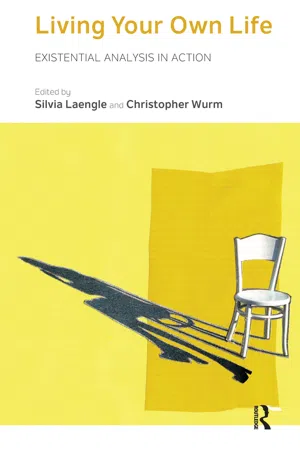
eBook - ePub
Living Your Own Life
Existential Analysis in Action
- 218 pages
- English
- ePUB (mobile friendly)
- Available on iOS & Android
eBook - ePub
Living Your Own Life
Existential Analysis in Action
About this book
This multi-author anthology is a short introduction to the world of existential psychotherapy, and specifically Existential Analysis. It gives concrete answers and demonstrates a way to apply this thinking in practice, providing outlines of its theoretical background, including Alfried Langle's four fundamental motivations. The main themes of the book are: working with emotionality and subjective experience and its importance for a fulfilling life; meaning and happiness; and spirituality and temporality. It covers psychological disorders and their treatment in adults and children, and also deals with disability and handicap.
Information
Chapter One
Can I rely on my feelings?
Alfried Längle
A strange question
Can people rely on their feelings? This might seem like a strange question. But in general do feelings have any noticeable significance? Do they play an important role in life or a more secondary role somewhat like a side effect—pleasant if we feel joy or happiness, disturbing if we feel anger, rage, jealousy, envy, fear, or depression?
Whether feelings are a side effect or not, many people regard them as a “solely private matter” and not something to be discussed in public. In an age of scientific and technological rationalism, feelings are often pejoratively referred to as the “stuff of the soul” and therefore something one should not pay too much attention to. That may be why the opinion that we should, “keep our feelings to ourselves”, is so widespread. Feelings arise much like a motor being warmed by its own activity and can make a person hot if they are not cooled by reason. It is fashionable for many people to be cool, and therefore above and untouched by a situation. Feelings do not have any further significance for them, except that they point out certain tendencies and weaknesses. In this context, feelings are hidden, somewhat like our undergarments. Showing our feelings openly in public is, therefore, similar to being caught in our underwear! This could prove quite embarrassing, perhaps even scandalous, and so many people deal with their emotions privately.
Others may regard feelings as an inner activity that occurs as a result of outward stimuli. Seen as a product of outward stimulation, feelings are much like ripples caused by a stone skipping across the water. For such people feelings are something alien, like a stone in a shoe that causes pressure or—in the best case—a tickle. These people are eager to get rid of feelings as soon as they arise. Feelings are experienced as pressure and “pushed away” to the outside. But how do you get rid of feelings? Feelings such as rage, anger, and joy are acted upon or played out in the immediate moment because the individuals believe that to keep their feelings in check or to keep their feelings to themselves would literally make them sick.
As we see from these introductory remarks, there are different conceptions of what feelings may mean to us and consequently there are different ways of dealing with them. It is not surprising that in our daily lives we sometimes don’t know what to do with our feelings. It is not always easy to understand and to interpret them. It may sometimes be difficult to deal with them and to get along with their intensity and force, but also with the fact that they make us insecure, shocked, or hurt. The question that began this chapter, “Can (and may) I rely on my feelings?”, is therefore worthy of exploration.
Behind our (often not further elaborated) ideas about emotions lie our experiences with the feelings. Our experiences with certain emotions, for example, may not have been consistently encouraging. If we have experienced being in love and following our hearts only to be subsequently rejected, the result may be that we develop a clouded or distorted idea about love or relationships.
It is not surprising that for many people facts—data, numbers, proofs, arguments and logical reflections—rather than emotional experiences, are considered reliable. To rely solely on feelings after such bad experiences would be considered out of touch with reality, like the behaviour of a naive, incurable, or idealistic romantic or mystic. The “hardliner” of reason would believe that placing a primacy on one’s emotions is similar to making decisions by reading tea leaves. Such a person considers inner strength and personal success to be the outcome of rational, consistent, and logical strategies. Through these he can pursue his goals and achieve what he wants.
Emotions: a meaningful reality
The question remains whether feelings can be disregarded for a long time or if they are in fact a power that can make the heart pound and the hands shake of even the “coolest” and most rational person. Should feelings demand our attention?1
A closer look at emotions reveals the substantial part they play in human existence. A great part of our life takes place within our feelings. Our lives are saturated with emotions; they are present during our waking hours and even while we sleep and dream. Emotions are present from the very beginning of life until old age. Emotions make demands of us and ask us to deal with them to a certain degree. We may not even be conscious of the fact that emotions accompany every action we take and every experience, thought, and affect we have, both past and present. To experience anything in life is to feel emotion about something. And only when we truly feel do we experience. Emotions are the basis and power for motivation, and in this sense they carry with them and are the trigger for both the beginning and cessation of behaviour. One of the first things we notice when we wake up in the morning is the mood we are in. We might be joyful or sad, happy or annoyed, cheerful or angry.
Our entire waking condition until sleep sets in is carried by, and saturated with, moods. As mood and motivation, as power, and as background to experience, feelings are woven into every aspect of our lives. A person’s biography is laden with patterns of emotions. This extends to biological life and the degree to which our bodies are formed and transformed by emotions. Feelings contribute to the form and contours of wrinkles in a face, the position of a head, or a person’s posture. They speak about the states of feelings that have been dominant throughout the course of our lives. A patient once told me: “Against feelings reason is powerless,” as she described being terrorised by fear for thirty-five years. The denial of feelings only leads to them hiding behind the power of the body. With the additional assistance of the body, feelings—now encoded—affect a person even more intensely. Buried feelings eventually reveal themselves in disturbed sleep, migraines, problems with digestion or breathing, and psychosomatic disturbances.
Owing to their constant presence and their tremendous influence on our lives, those of us who work in the field of psychology and therapy hold that feelings are just as real as the body we see before us. To overlook feelings, and the effect they have on us both psychologically and biologically, is akin to overlooking a patient’s constant abuse of her body. Someone who never exercises, gets inadequate amounts of sleep, eats unhealthy food, drinks alcohol to excess, and smokes will, sooner or later, become sick. The body will eventually rebel. This is not so different from someone who constantly disregards her feelings by repressing them or keeping them suppressed through distractions such as excessive work, constant activity, or perhaps even drugs.
But it is not only the negative consequences that convey the power and significance that feelings have. Feelings are a positive reality in our lives as they are the bridge that enables closeness—closeness and relationships to people, to oneself, even to things and objects. This is because emotions constitute our body of experience. Only when we participate emotionally in life do we get anything substantial out of a the experience. Without the resonance of emotions, the world would remain flat and silent—music would have no sound, pictures no colour, and our memories would be pale and silent. Everything in life is revitalised through our experience and expression of emotions. Feelings bring life into our life. Feelings are the reason that we go to eat at a good restaurant, watch a particular movie, seek out and meet others. When the feelings lose their natural position, all must become more “extra-”—extraordinary, exotic, special—in order that a meal tastes, a movie gives pleasure, and an encounter is of value.
As central as emotions are to humankind, they are also somewhat sinister. This dimension of emotions is fleeting and intangible. Because of this, emotions have a different nature than the body, which is more tangible and predictable. In the West, we have been taught to see things objectively and to rely on that objectivity. Therefore our feelings seem rather frightening to us. Feelings fluctuate and moods can be unstable, changeable, freakish, labile, exorbitant, and, of course, purely subjective in their being and expression. We cannot count, weigh, or measure them reliably. It causes us to feel insecure when observing how feelings can change and, in fact, often we do not know why they change, or why they sometimes change so rapidly. Feelings arise from seemingly unknown and uncontrollable depths, stay with us for a while, and then disappear again; we do not know where they have gone. The minimal control we seem to have over them and the sense of being at their mercy can evoke fear. We cannot be apathetic about the commotion caused by our feelings, for they affect us deeply and dramatically. The feelings make us vulnerable; we can be insulted or hurt, feel stress or insecurity. On the other hand, we are also capable of feeling happy, joyful, cheerful, humorous, or hopeful on account of emotions.
A sixty-seven-year-old patient came into my care afraid that he was going to have another heart attack and therefore wanted to have his blood pressure checked. He had suffered a severe heart attack ten years prior and had been receiving his pension since then. The cause of his fear, however, was the stress and tension he had been experiencing because of his wife’s decision to get a divorce. He had not expected his wife to be contemplating divorce, despite the fact that he had recently had extramarital relationswith a widow his age and expressed that for the first time in his life he was in love. He did not count with any attempt of divorce from his wife because she had always had affairs. Up until this time the relationships his wife had had were of no concern to him; he was not really conscious of them. But his wife was now taking the opportunity—it seemed for financial reasons—to get a divorce.
This man did not consult me for psychological reasons—not pain, anguish fear, worry, or insecurity about the future. These feelings were not tangible enough for him; they were not real enough. He wanted, rather, to have his body examined! My patient believed his feelings were subordinate to his physical welfare and of no real importance at all. This behaviour is both typical and widespread amongst those who do not know how to deal with the reality of their emotions.
After I had checked the man’s blood pressure I spoke to him about his fear. I told him that his fear of another heart attack was understandable but that I was under the impression that his fear ran deeper than that. He agreed; at which point he said that ever since childhood he had lived in fear. In his profession he had always been afraid to trust his colleagues. He was always afraid of being disappointed. While talking about his fear of being disappointed he recalled a sentence his mother had often repeated. His mother, who had been a very energetic woman, had been to a renowned psychotherapist in Vienna for treatment when he was almost a year old. The therapist had advised: “One has got to keep the inexpressibly active women away from their children, out of fear that they might smother them.” His mother had recited this sentence often in front of guests and friends. As a consequence, she had never caressed or held her children. Did she ever realise what this might have meant to her young son? He was hindered in the development of his emotional life and his basic trust was shaken.
The following excerpt from a conversation I had with this man reveals to some degree the outcome of the effect of this on his life and the inattentive manner in which he subsequently dealt with his emotions. In any of the talks we had he always viewed emotions as subordinate. I therefore asked him directly whether behind the difficult relationship he had with his energetic wife was perhaps a simultaneous longing for his energetic mother. At this point the sixty-seven-year-old man blushed and was noticeably moved. After uttering a few irrelevant words he composed himself and then in an objective manner stated that this had been so at that time and that one could not do anything about it now anyway. He did not feel any sadness on account of this. All of this had simply made him harder and more prone to logical thinking. He was thankful to his mother for this.
P: It really is of no use to have such feelings. It is only like self-pity.
TH: Self-pity, I would think, might be what you could now give yourself as compensation in lieu of what your mother did not provide: that you have feelings for yourself, that you yourself feel.
P: I do not want to do this.
TH: When you think this way you lock yourself in and are barred against many emotions.
P: People also say that I do not have any joy ... Is it possible that there is a connection with my being afraid of emotions?
TH: There are many painful and sad feelings within ...
P: Chaotic feelings, I would say, and much sensitivity ... I can control thoughts, but feelings? That is why I always lived in the rational world. My wife almost went crazy on account of my logical analyses. I have always had trouble living out my emotions. I always felt emotions to be a nuisance.
TH: Perhaps you could not eliminate your emotions as much as you thought and, in the end, the feelings came to control you?
P: It is possible that this distanced basic mood, the pessimism and the fear, originate there. And that I had the constant feeling that my feelings would be disappointed.
I was moved by the encounter with this man. It made me sad to see him, at the age of sixty-seven-years, having suffered from his heart infarction and with his ruined marriage, and having so much fear inside him. In spite of his age and professional success, on the inside he remained that lonely and abandoned child he had been when he was two or three years old. If only he had had an opportunity earlier in his life to rely on his feelings! If he could have accepted his feelings of longing for his mother, if he could have cried! Instinctively I thought that had that been the case, his life would have taken a different course. The relationship he had with his wife, indeed with himself and his body, would not have been so distanced. What he lacked was in fact never that distant from him. He had felt the feelings he lacked in his childhood and now, in the present moment of therapy, he had blushed, revealing their secret presence. Who, I wondered, had told him that he could not have these feelings of longing, sadness, and fear? How much could someone have helped him by being interested in what the small boy had felt and sensed?
In order for us to have the courage to rely and depend on our feelings, we need the assistance and encouragement of other people from time to time, especially from those closest to us who understand us. The person who remains alone with his or her emotions will soon have to push them away in order not to be overwhelmed by them. Because my patient never felt that anyone took notice of the condition of his soul, he came to believe that it was important to shove aside any feelings he had. And this attitude was reinforced as he progressed from boyhood to manhood.
This man also showed that one can somehow remain alone in life, after all. This is helpful in situations in which there is no other way to escape, to survive. But if problems are pushed away and not addressed, they are not solved! My patient’s physical condition, the direction his marriage took, and his falling in love late in life, were all indications that his life was not content the way it was. Because of his suffering and fear, his attention was focused on something that he himself could not understand.
Feelings as signposts and indicators: emotional states and moods as perceptions of our present life conditions
When we focus on the importance of emotions, it is equally important to look at the limitations of their significance. We are not always well served when we follow our feelings unrestrained. We must understand our feelings—a little—in order to know what they mean.
The patient described in the example above did the right thing on the one hand by not giving into his fears. He had shoved his feelings aside throughout his life. He could not have lived, had a family, or had a career had he acted on his fears and distrust. Given his emotional disposition and the fact that he had only himself to rely on, this man probably made the best possible choices for his life. He was successful because he distrusted his emotional states and produced a heavy reliance on logic alone. Once again, given his dominant feelings of fear and distrust, this was probably the best course of action. This was correct in his situation since the predominant feelings of angst and distrust were deduced feelings. They arose as a consequence of his suppressed longing for his mother, which he had never expressed. In turn, the suppression of the feelings caused him to lose touch with what was important to him. Specifically, the lack of motherly contact and the subsequent loss of a personal inner relationship produced feelings of insecurity. These feelings were strong enough that he felt as though the ground beneath his feet was neither stable nor secure. With his life surrounded by fear, insecurity, and a “basi...
Table of contents
- Cover
- Half Title
- Title
- Copyright
- Contents
- ABOUT THE EDITORS AND CONTRIBUTORS
- FOREWORD
- CHAPTER ONE Can I rely on my feelings?
- CHAPTER TWO Meaning and happiness: on the vital significance of meaning
- CHAPTER THREE Spirituality in psychotherapy? The relationship of immanence and transcendence in existential analysis
- CHAPTER FOUR The dimension of time as a challenge to truthful existence
- CHAPTER FIVE Steps towards meaning: the method of grasping meaning
- CHAPTER SIX Crisis: threat and opportunity
- CHAPTER SEVEN Fear: the royal road to existence—what hides behind fundamental fear and anticipatory anxiety?
- CHAPTER EIGHT "I am afraid of falling out of this world": a case study of a patient with severe mutism and complete social withdrawal
- CHAPTER NINE The path towards inner motion: an existential-analytic psychotherapy on depression
- CHAPTER TEN "... And after a suicide attempt I have to keep on living!"
- CHAPTER ELEVEN "After all, only dumb people can be happy": narcissistic personalities
- CHAPTER TWELVE Anna: the child wounded in her boundaries
- CHAPTER THIRTEEN Sandplay: therapy with a child of divorced parents
- CHAPTER FOURTEEN Encountering a disabled person: attitude and experience of the therapist
- AFTERWORD Living beginnings
- USEFUL WEBSITES
- INDEX
Trusted by 375,005 students
Access to over 1.5 million titles for a fair monthly price.
Study more efficiently using our study tools.
Frequently asked questions
Yes, you can cancel anytime from the Subscription tab in your account settings on the Perlego website. Your subscription will stay active until the end of your current billing period. Learn how to cancel your subscription
No, books cannot be downloaded as external files, such as PDFs, for use outside of Perlego. However, you can download books within the Perlego app for offline reading on mobile or tablet. Learn how to download books offline
We are an online textbook subscription service, where you can get access to an entire online library for less than the price of a single book per month. With over 1.5 million books across 990+ topics, we’ve got you covered! Learn about our mission
Look out for the read-aloud symbol on your next book to see if you can listen to it. The read-aloud tool reads text aloud for you, highlighting the text as it is being read. You can pause it, speed it up and slow it down. Learn more about Read Aloud
Yes! You can use the Perlego app on both iOS and Android devices to read anytime, anywhere — even offline. Perfect for commutes or when you’re on the go.
Please note we cannot support devices running on iOS 13 and Android 7 or earlier. Learn more about using the app
Please note we cannot support devices running on iOS 13 and Android 7 or earlier. Learn more about using the app
Yes, you can access Living Your Own Life by Silvia Laengle, Christopher Wurm, Silvia Laengle,Christopher Wurm in PDF and/or ePUB format, as well as other popular books in Psychology & History & Theory in Psychology. We have over 1.5 million books available in our catalogue for you to explore.