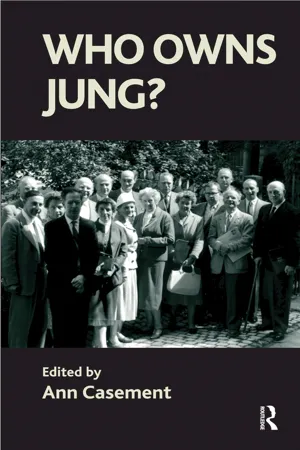
This book has a similar, though not identical, format to Who Owns Psychoanalysis? in being divided into sections as follows: academic, clinical, history, philosophy, science. Who Owns Jung aims to be a celebration of the diversity and interdisciplinary thinking that is a feature of the international Jungian community. Many of the contributors are practising analysts and members of the International Association for Analytical Psychology; others are scolars of Jung whose work has been influential in disseminating his ideas in the academy, though it is worth noting that a number of the analysts also work in academe.Contributors:James Asto; Astrid Berg; Joe Cambray; Ann Casement; Andrea Cone-Farran; Roberto Gambin; Wolfgang Giegerich; Joseph Henderson; George B. Hogenson; Mario Jacoby; Hayao Kawai; Toshio Kawai; Thomas B. Kirsch; Jean Knox; Roderick Main; Denise Gimenez Ramos; Sonu Shamdasani; Michael Sinason; Hester McFarland Solomon; David Tacey; and Margaret Wilkinson.
- 376 pages
- English
- ePUB (mobile friendly)
- Available on iOS & Android
eBook - ePub
Who Owns Jung?
About this book
Information
History
CHAPTER EIGHT
Some memories and reflections concerning my time at the C.G. Jung Institute in Zürich (1956 until 2006)
Mario Jacoby
It is quite a complicated business to write about the Jung-Institute in Zürich. I would not have chosen to undertake such a task myself, yet I was asked to do it by the editor and had first of all to reflect upon my legitimation and my own standpoint. What I especially esteem in Jung’s own attitude was his insistence on taking into account the personal equation. From what standpoint can I best approach this task? I am not a historian but what finally made me accept this task is my long experience with and in this place. This dates back to the year 1956 when I entered the Instiute for the first time just to hear a lecture given by Jolande Jacobi. The long term result of this first visit was that I applied for a full training to become a Jungian analyst. But as I was at the time a performing violinist, musician and teacher, I had first, or at the same time, to study at the University to get an academic degree. This means that my presence at the Institute as a trainee lasted over nine years until 1965 when I received my diploma. After graduation I soon began lecturing at the Institute and already by 1970 I was advanced by the Curatorium to the status of a training analyst. At about the same time I was elected to be President of the Swiss Society of Analytical Psychology, and this implied also being an ex-officio member of the Patrons of the Institute. In 1980 I was elected to be a member of the Board of Directors, the Curatorium of the Institute, until I stepped back from this responsibility in 1997. Since then I have worked as senior training and supervisory analyst and was a personally elected Patron of the Institute until March 2006, when I definitely left the Institute and joined fully the newly founded ISAP (International School for Analytical Psychology). Thus I experienced the Institute for 50 years from a variety of functions over the course of time.
For this reason I consider myself to be much less a kind of amateur historian, than a witness of the time (Ein Zeuge der Zeit) and shall give mainly a verbal history of some events during my time at the Institute.
The Institute was founded in 1948 and I set foot in its premises for the first time in Spring 1956. Thus for an account of its process of foundation and for the events during the first eight years I have to rely on documents or oral accounts of people who were present at the very beginning and even active in its organisation like, for instance Jolande Jacobi. Of course, what Jung himself has written is of the main importance.
The beginning of the Jung-Institute was informal although the facts about how it became an organized entity are few and unclear. This is the opinion of Deirdre Bair who spent many years interviewing contemporaries who were still involved. (Bair, 2003, p. 529). But the facts seem to be that Jung’s health had become more and more problematic, such that among his followers at the Psychological Club (founded by Jung himself in the year 1916 see Sonu Shamdasani, 1998, p. 23) it became an urgent question of how to organize the possibility of teaching Jung’s ideas on a wider scale. Jolande Jacobi personally told me that she had collected, even before World War ll, much information about other clinics and foundations, about government rules and regulations, and about faculty, curriculum or finances. She showed it to Jung with the idea of eventually founding an institute. But Jung was ambivalent and hesitant. And then the war came in between and the realisation of such an endeavour had to wait. At that time, C.A. Meier was also apparently actively planning for a place where Jung’s psychology could be taught. In any case, there was, as far as I remember, a dispute between Jacobi and Meier about who initiated the plans and its detailed organisation for a future Institute.
There has always been a rumour around that Jung did not want to form an organized training center and especially that it should not be run under his name. He would have agreed with Toni Wolff to call it “Institut für komplexe Psychologie” or simply the Institute for Analytical Psychology. But he let it happen when his followers voted to call it the C.G. Jung Institute. On the other hand, it is also said that there was resistance and ambivalence in the Club, as many Club members were quite content to keep the dissemination of Jung’s analytical psychology to themselves and for themselves only. This again was criticised by Jung and he attributed their attitude to the extreme introversion of the membership.
Once Jung agreed to found this Institute in order to organise it, he proposed a Curatorium i. e., a governing board, independent of the Psychological Club, to be elected for life or at least for as long as members chose to serve. It was originally composed of five persons and later expanded to seven. A design for the organisation and areas of work for an Institute in Analytical Psychology devised by Jolande Jacobi was incorporated into its work. Jung was the first president of the Curatorium, whose other members were C.A. Meier, K. Binswanger, Liliane Frey and Jolande Jacobi. Upon Jung’s retirement, his wife Emma Jung served on the Curatorium until her death in 1955. Mrs Aniela Jaffé was the first secretary of the Institute. (Report of C.G. Jung-Institut Zürich, 1948–60, p. 14).
By suggesting the Curatorium as the governing board Jung wanted an organisation based on the so called “Stiftungstatuten”. Those statutes are under the supervisory authority of the Board of Education of the Canton of Zürich, to give the founder of an organisation a guarantee that his intentions concerning the purpose of his particular organisation shall continue forever and cannot be changed, unless the aim of the foundation gets distorted or there is financial bankruptcy.
These statutes are fundamentally not democratic at all. Jolande Jacobi (who, paradoxically was born and raised in the Austria-Hungarian Monarchy) criticised this fact and said: “Future dispute is guaranteed”. (Oral communication) How right she was showed itself in many subsequent conflicts but especially in our day, more then 50 years later, when the present conflict within the Institute has lead to a most serious split with the result that more than half of the analysts and teachers from the Institute left the place and founded a new Jungian Training Center, the International School for Analytical Psychology (ISAP). But this will be reported later.
Jacobi was not at all popular amongst the Club members for many reasons but especially so for her outspoken bluntness. However, although she talked against Jung’s plan to put the Curatorium, and thus the whole Institute under these authoritarian foundation laws, Jung was far-sighted enough to insist, against heavy resistance from the Club members, to choose her as a member of the Curatorium, saying that the board needed her badly because she was the only person who knew how to function in the world at large. Thus without explanation or elaboration, Jacobi was pronounced a member of the Curatorium (Bair, 2003, p. 531).
On April 24, 1948, there was the official inauguration to celebrate the founding of the Institute. Jung gave an address at this occasion and it is remarkable that he never mentions one of the main purposes of the Institute, namely the training of new Jungian analysts. He seems mainly interested in research and in the manifold possibilities for the further development of complex psychology. “I have had to leave many beginnings unfinished because of more pressing tasks that claimed my time and energies” (Jung, Vol. 8, p. 475). He put together a list to give the reader a rough idea of what had already been achieved in complex psychology, but also announced directions, which future researches conducted by the Institute might be expected to take.
The institute began its activities and was located during the first few years in the premises of the Psychological Club in Zürich at Gemeindestrasse 27.
The organisation of the training
Some more detailed remarks of its first organisation may be in place here. Although Jung, in his inaugural speech, had said hardly anything concerning the training of new analysts, this endeavour became the main activity of the Institute from the beginning. The training apparently followed very much the original design devised by Jolande Jacobi (C.G. Jung Institute Report, 1948–60).
The requirement for students to be accepted for training was already at that time a medical licensing exam or medical degree, or an academic degree (at least a master’s degree) in other academic departments. During my time of training and for a long time after, students may have been accepted for training, providing they were going to achieve their academic degree before they were entitled to receive the Diploma at the end of their training.
Twenty-eight was the minimum age for applicants to get accepted and the most important condition was that the entire training had (and still has) to be accompanied by a personal Jungian analysis of at least 300 hours minimum. The candidate may choose freely his or her analyst among the “Training-Analysts” designated by the Curatorium. During their training, the candidates had to pass two exams in the following subjects: basic Principles of Analytical Psychology, Theory and Technique of the Association Experiment, Psychology of dreams, Theories of Neuroses, Psychopathology, Psychology of “Primitives” (as native people were called at that time), Psychology of Fairy Tales and Myths, general History of Religions. These were, and partly still are, the subjects of the theoretical exam, the so called Propaedeuticum. The Final Exams before the Diploma can be obtained have more to do with the practical ability to handle cases and interpret their unconscious material. Still, psychiatry and Jungian ideas of the individuation process are until today also subjects of the Diploma-Exam.
Candidates had and still have to deliver a “scientific” work on a chosen topic related to analytical psychology, the so-called Diploma–Thesis. They also have to write reports on their “control-cases”, after having done at least 250 hours of case-work under supervision. In the first few years up to the sixties, the number of hours a candidate had to work with the “Control-analyst” to supervise his cases was not fixed at all, only more or less recommended. I remember Dr Riklin, the President at the time, suggesting that candidates had only to come to him for supervision if they themselves felt the need to do so, for example, if they ran into difficulties and did not know how to proceed. Jolande Jacobi, in contrast, insisted that a candidate had to come to see her regularly, the minimum being every fortnight. She also wanted to see personally the candidate’s analysand–quite unaware of what such a contact may do to the transference situation between the “control-case” and his or her analyst in training. I personally went regularly every fortnight to Kurt Binswanger, M.L. v. Franz, Liliane Frey and J. Jacobi, to discuss my control-cases. By that time, in the late sixties, the number of supervision-settings began also to be regulated and fixed by the Curatorium.
Before a candidate could be accepted for Diploma candidacy (after the Propedeuticum) or for the Diploma-Exam at the end, he or she had to present a written recommendation by the personal analyst, “concerning psychological maturity, character and professional proficiency” (Jung-Institute Report, 1948–60, p. 23).
Some personal subjective observations on the general atmosphere of the early days
I want to begin this part of oral history with a quote from Jung’s “Memories, Dreams, Reflections” He wrote: “As a child I felt myself to be alone and I am still. I know things and must hint at things which others apparently know nothing of, and for the most part do not want to know” (MDR, p. 389). Although MDR was published only after Jung’s death in 1961, this quote throws a characteristic light on an inner psychological state which was, to my mind quite striking amongst us students at the time I had come to the Institute in early 1956. But it was perhaps even more so for that generation of analysts which were our teachers—of course not for all. Many of us had come from a certain loneliness, as we had been in our neurosis or life-crisis on the search for something, we did not know quite what. But now, thanks to Jung, we belonged to the few-ones who wanted to know and felt that they did know more things between heaven and earth then the rest of the world would dream of—especially those rationally minded professors at University, not to speak of the “reductive Freudians”. There was definitely an elitist spirit among us, especially in the early days. One knew that Jung had written about the dangers of inflation, but there was much good reason to be fascinated by the rich, new soul-world to which Jung had found the key. Such was the overall atmosphere at that time—at least how I remember it. Maybe there is also a good deal of projection in it of the effect that the encounter with Jung’s psychology had on me personally.
But at the same time the critical side in me was never completely silenced. Thus I want to contribute some subjective impressions about trends and incidents which I have been part of or witnessed in the early days and also in the course of history of being a Jungian at the Jung-Institute in Zürich.
When I first started, the Institute, as mentioned before, was still located in the premises of the Analytical Psychology Club and we listeners were seated in comfortable, slightly worn out old fashioned armchairs. What I remember specially are the many enormous mandala-pictures on the wall and a statue of Jung’s head—and for an uninitiated greenhorn like myself this whole atmosphere reminded me slightly of an anthroposophic assembly room. But then Jolande Jacobi started to lecture. She was an elegantly dressed, very lively woman with a loud and sha...
Table of contents
- Cover
- Half Title
- Title
- Copyright
- Contents
- Dedication
- FOREWORD
- ABOUT THE CONTRIBUTORS
- INTRODUCTION
- ACADEMIC
- CLINICAL
- HISTORY
- PHILOSOPHY
- SCIENCE
- EPILOGUE
- INDEX
Trusted by 375,005 students
Access to over 1.5 million titles for a fair monthly price.
Study more efficiently using our study tools.
Frequently asked questions
Yes, you can cancel anytime from the Subscription tab in your account settings on the Perlego website. Your subscription will stay active until the end of your current billing period. Learn how to cancel your subscription
No, books cannot be downloaded as external files, such as PDFs, for use outside of Perlego. However, you can download books within the Perlego app for offline reading on mobile or tablet. Learn how to download books offline
Perlego offers two plans: Essential and Complete
- Essential is ideal for learners and professionals who enjoy exploring a wide range of subjects. Access the Essential Library with 800,000+ trusted titles and best-sellers across business, personal growth, and the humanities. Includes unlimited reading time and Standard Read Aloud voice.
- Complete: Perfect for advanced learners and researchers needing full, unrestricted access. Unlock 1.5M+ books across hundreds of subjects, including academic and specialized titles. The Complete Plan also includes advanced features like Premium Read Aloud and Research Assistant.
We are an online textbook subscription service, where you can get access to an entire online library for less than the price of a single book per month. With over 1.5 million books across 990+ topics, we’ve got you covered! Learn about our mission
Look out for the read-aloud symbol on your next book to see if you can listen to it. The read-aloud tool reads text aloud for you, highlighting the text as it is being read. You can pause it, speed it up and slow it down. Learn more about Read Aloud
Yes! You can use the Perlego app on both iOS and Android devices to read anytime, anywhere — even offline. Perfect for commutes or when you’re on the go.
Please note we cannot support devices running on iOS 13 and Android 7 or earlier. Learn more about using the app
Please note we cannot support devices running on iOS 13 and Android 7 or earlier. Learn more about using the app
Yes, you can access Who Owns Jung? by Ann Casement in PDF and/or ePUB format, as well as other popular books in Psicología & Mente y cuerpo en filosofía. We have over 1.5 million books available in our catalogue for you to explore.