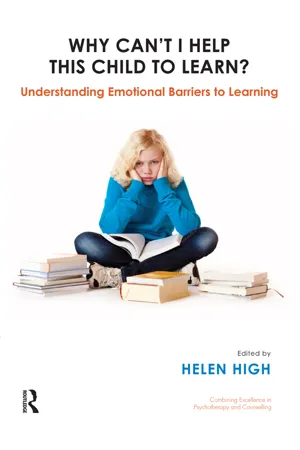
The book outlines theories of child development from the point of view of the kinds of relationships children make with adults and the effects of their relationships on their learning. In addition, anxieties that some children show about reading, writing and arithmetic are described. In exploring these issues the book draws on Attachment Theory and on Psychoanalytic theories of emotional development. It includes detailed case studies to illustrate ways in which children's learning can be hindered by their difficulties in relating to teachers and the feelings and fantasies that some children have about words and letters. There has been recent political concern that children should all learn to read in their early years at school and extra help should be offered to those who are falling behind. The expectation in political circles seems to be, however, that straightforward extra help with reading will be sufficient, in all cases, to enable a child who has fallen behind to catch up. There has been no general recognition of the need to address underlying emotional problems in some cases, such as those described in this book.
eBook - ePub
Why Can't I Help this Child to Learn?
Understanding Emotional Barriers to Learning
- 166 pages
- English
- ePUB (mobile friendly)
- Available on iOS & Android
eBook - ePub
About this book
Information
Part I
The Theoretical Background to Educational Psychotherapy
Chapter One
Theoretical principles applied in educational psychotherapy
In developing the theory and practice of Educational Psychotherapy, Irene Caspari drew on a variety of theoretical principles derived from the study of:
- Cognitive Development and Behavioural Theory
- Attachment Theory
- Psychoanalytic Theories of Child Development and Defence Mechanisms (see Chapter Two).
Cognitive development and behavioural theory
In her thinking about teaching children who have specific difficulties in learning, the following principles were central to Irene Caspari’s thinking:
- Practice is essential to master a skill.
- The motivation to master a skill can bring its own reward when the person experiences sufficient improvement with practice to enjoy the feeling of progressively mastering that skill.
- Those who have difficulty in learning a skill need more practice than others, which can be irksome and discouraging.
- When there has been a history of failure in learning, the main motivation may be to avoid the pain of further failure by avoiding tasks associated with that failure.
Caspari concluded that it was essential to tackle the demoralization of children who had developed an aversion to learning through a history of failure. She did so by breaking the learning task into small easy steps, to ensure sufficient experience of success at each step. This thinking was in line with Behaviour Modification principles based on the Learning Theory of conditioning by means of rewards and punishments.
Case example
On testing Peter, the nine-year-old boy I referred to in the Introduction, he proved to be of average intelligence and showed no evidence of any specific cognitive or perceptual problem. He was almost a complete non-reader when I started seeing him once a week for educational psychotherapy. He was extremely resistant to any reading task, particularly reading from books, and became very anxious when attempting to read. In order to introduce Peter to a reading task in small steps, I dispensed with books for the time being and used very simple word and picture matching cards. I helped him to match nine 3-letter words to pictures of the objects named on the cards, before asking him to do so on his own. He could only match two or three of the nine words to the right pictures. I helped him with the others, encouraging him to try to memorize them. Over several weeks, with repeated practice, he gradually learnt the rest of them until one week he got them all right. I then suggested that, as he now knew all those words, he might like to try the next set of cards. He said “No, I want to do that one again”. In fact he did it over and over again, as if to get his fill of this experience of perfect success. I am sure it was a first for him to manage to complete a reading task without a single mistake. This was a turning point for Peter. The experience of finding that he could learn words he had not known before and perform a task perfectly, convinced him that he was capable of learning to read. This made a huge difference to his motivation. There was a lot more to his resistant attitude to reading than that, as will be described later (see pp. 25–26), but his tendency to give up and avoid the painful experience of failure was an important element in his resistance. Giving him tasks that were easy enough to enable him to experience success overcame that element. It was then possible to introduce new learning very gradually and help him with it while he continued to experience more success than failure at each stage on the way. When he had built up a sufficient sight vocabulary, and had learnt to sound out simple new words phonetically, we went back to reading books. I chose a series of books in which the vocabulary was carefully graded so that new words were introduced slowly and used repeatedly to reinforce learning. He was delighted to discover that he could now read books. With children like Peter, who are so discouraged and turned off from learning by their history of failure, it is very important to find a level at which they can feel rewarded by the experience of success.
Attachment theory
Caspari’s colleagues at the Tavistock Clinic included John Bowlby. His research collaborators included Mary Ainsworth, who helped to identify patterns of attachment that first develop during infancy.
The secure attachment pattern
When mothers were sufficiently attuned and responsive to their babies’ needs in early infancy, the babies became securely attached to their mothers. As long as they experienced their mothers as reliably there to return to, securely attached infants felt safe to explore, to reach out to the wider world, to learn about it and the objects in it.
The anxious-ambivalent attachment pattern
When a mother’s behaviour towards her baby was inconsistent and unpredictable the infant developed an anxious-ambivalent attachment pattern.
The anxious-avoidant behaviour pattern
When a mother was rejecting in her responses to her baby an anxious-avoidant behaviour pattern ensued.
These attachment patterns, first developed during infancy, persist into later life, and are transferred into later relationships, including relationships with teachers. While a child with a secure attachment pattern will tend to be ready to trust his/her teacher, an insecure attachment pattern interferes with the development of trust. Learning in school takes place in a relationship between child and teacher, so whatever attitudes, expectations, hopes, or fears the child brings to that learning relationship affects the child’s capacity to learn from the teacher.
The disorganized/disorientated attachment pattern
Some babies showed disorganized/disorientated behaviour in the mother’s presence during the research study, freezing with a trance-like expression hands-in-air, or turning away from the mother to the wall while crying.
These peculiar behaviours were concluded by Main and her colleagues to show a disorganized version of one of the three typical patterns, most commonly the anxious-resistant pattern (Main & Weston, 1981). Some infants who showed these aberrant patterns of behaviour had been physically abused or neglected by the parent. Others had mothers who had themselves been abused as children, or were still preoccupied with mourning the loss of a parent during their childhood, or who were suffering from a severe manic depressive illness and were very unpredictable in the treatment of their child.
Case example
In a previous article Jenny Dover described a child with an anxious-ambivalent attachment pattern, who was referred to the Child and Adolescent Mental Health Services (CAMHS) by her teacher. The teacher described her as, “In my face constantly and very demanding of my attention, but cannot settle to a task although she is intelligent. She seems terribly unhappy and I fear she gets nothing out of school”. In the early stages of Educational Psychotherapy, Dover found, “While Carla rejects me as a teacher, her behaviour is designed to keep my attention constantly on her so that our interaction, though negative, is ceaseless. She cannot disconnect from me sufficiently to focus on a task” (Dover, 2003).
In Chapter Five, on “Work with a Hard-to-Reach Child”, Jenny Dover gives an example of a child whose avoidant attachment pattern was a strong barrier to being taught, as he avoided contact with her and did not let her know when he needed help. The chapter illustrates how an indirect approach, which allowed this avoidant child to express his emotional problems, related to his traumatic family experience through the medium of a serial story, which had a therapeutic effect and led to progress in his learning.
Chapter Two
Psychoanalytic theory of development and unconscious mental processes
Unconscious mental processes and defence mechanisms
Freud and his colleague Breuer, who were both medical doctors, discovered that when patients whose physical symptoms had no physical cause were asked to talk freely, saying whatever came into their minds, their physical symptoms sometimes cleared up, as they remembered distressing experiences from the past. One of Breuer’s patients referred to this as “the talking cure”. This led to the discovery of unconscious mental processes and the recovery of memories from the past, which had been repressed, or pushed out of consciousness. Freud concluded that those memories live on somewhere in our minds and continue to influence us in ways of which we are unaware. He discovered that they sometimes find expression in disguised ways such as conversion into physical symptoms, as in the patient who referred to “the talking cure”.
Case illustration
A 13-year-old boy, Jonathan, had developed paralysis of his right arm (he was right-handed). Medical investigations failed to reveal any physical cause for this symptom. The doctors concerned arranged some physiotherapy for him, but thought that psycho logical causes should also be investigated. When Jonathan was interviewed to explore the psychological aspects of his problems, he spoke in very disapproving terms of the violent and destructive behaviour of teenagers “these days”, commenting, “I’d never do anything like that”. After a pause he added, “unless my Dad hit me, then I’d hit him back”. He then sat staring silently at his paralysed arm, with which he was powerless to hit anybody.
Freud’s formulation about what he called a “conversion symptom”, where a physical symptom is related to a psychological problem, was that it expressed, in a disguised form, both sides of an unconscious conflict. Considering his symptom in those terms, Jonathan’s paralysed arm can be seen as expressing both his aggressive feelings towards his father, the wish to hit his father, and the wish to stop himself from doing so, by renouncing any aggression (“I’d never do anything like that”). He could not even allow himself a fantasy of an aggressive act towards his father, unless he could justify this by imagining his father having hit him first. The psychoanalytic view of a conversion symptom is that the two opposing sides of the conflict neutralize each other in the physical symptom. As a result of this neutralization Jonathan could not do anything with his right arm, he was paralysed. Neither Jonathan nor his parents wanted to think of psychological reasons for his physical symptom and they declined the offer of psychotherapeutic help. As he was showing some improvement since starting physiotherapy, they wanted to carry on with that treatment, hoping it would be enough to help him get over the problem. They did not want anything more to do with the psychological services, so I do not know the outcome. My speculation was that if the symptom of paralysis of his arm cleared up it might be replaced by some other manifestation of the underlying emotional conflict, as is prone to happen with this kind of symptom, if the underlying cause is not resolved.
As Freud was a doctor in the first place, he saw patients with physical complaints and encountered those whose physical symptoms were an indirect expression of psychological problems, as I did in this particular case, which was referred by a doctor. In working with educational problems, however, we more often come across those whose psychological problems are expressed in an attitude to school or a difficulty in learning.
Case illustration
George, a 12-year-old boy I was seeing for educational psychotherapy, became obsessed at one point with the wish to move to another school. He was complaining that everyone at his school was against him, the other children were unkind to him, and none of the teachers liked him. I could not take this at face value, as he had previously talked positively about friends at school. I had also visited his school and met teachers who spoke positively about him and wanted to try to help him. I was sure there was more to it than he was telling me, but I got nowhere in trying to explore things further by direct discussion. When, instead, I suggested he did a drawing, he drew a court scene in which a policeman was dragging him into the dock by the hair in front of an audience of angry-faced onlookers. I imagined the onlookers represented the people at school he was complaining of, but when asked about it he said they were “all my family, angry because I can’t read”. This gave us the chance to talk about his reading difficulty and his worry about what other members of his family felt about it. After that I heard no more about his wish to change schools. His anxiety about the feelings of “all his family” had been displaced onto “all the people at school”. This example illustrates how offering another means of expression for an emotional problem, in this case through a drawing, can enable a child to show more about the underlying problem.
Psychoanalytic theory of stages of child development
Freud developed the theory, based on his experience of psychoanalytic work, that the emotional development of the infant and child is closely related to their experience of bodily functions. He deduced that, from infancy onwards, there are childhood stages of sexual development, in which parts of the body are invested with special qualities of excitability and sensuality, with corresponding emotions and fantasies. He named these stages the Oral Stage, Anal Stage, and Oedipal Stage. The characteristics of these stages are as follows:
The oral stage
Babies begin life with a special sensitivity and sensuality of the mouth. During feeding, pleasurable feelings in the mouth, tongue, and lips are experienced while sucking the nipple of the breast or the teat of the bottle. A baby also explores new objects by putting them in the mouth, learning how they feel by oral sensations, as well as through other senses such as sight and hearing. The baby’s relationship with the mother, too, is experienced via the mouth, as a relationship with the breast, or the bottle, is felt to be part of the mother. Needs and emotions are also expressed through the mouth by crying and other vocal utterances. Young children feel and express their emotions very much through their bodies. Their loves and hates are often expressed by the mouth, or experienced as belonging to the activities of the mouth. Nursery age children often express their anger in terms of biting, spitting or such like, either in action or in words. Grown-ups too sometimes say things like “I love her so much I could eat her up”. This cannibalistic desire probably starts with the baby at the breast wishing to devour the breast. It expresses a love of total possession.
Some learning difficulties relate to early oral conflicts. Reading, in particular, seems to be equated in our minds with feeding. Like feeding, reading involves taking things in. This is reflected in our language, in the metaphors commonly applied to reading, such as calling someone a voracious reader or a bookworm (Strachey, 1930).
Case illustration
I was asked to see Alan when he was nearly seven years old, because, although intelligent, he was not learning to read. At a few weeks old he had had an operation for a painful condition of the stomach, which obstructed the flow of milk and led to an alarming symptom of violent vomiting. Although the operation had been completely successful, in the subsequent years, Alan’s mother continued to be very anxious about Alan’s feeding, worrying about whether he was getting enough to eat. This meant his experience of feeding and eating had continued to be imbued with his mother’s anxiety. Alan showed signs of emotional disturbance and I thought it likely that his reading difficulty was linked with emotional problems. He was placed in a small class, with an experienced Infants Teacher, in a special unit for children with emotional and behaviour difficulties. When he could not spell a word, he would ask the teacher to write it on a piece of paper for him to copy into his written work. The teacher began to notice that, after copying a word in this way, Alan would habitually put the slip of paper with the word on it into his mouth and chew it. It was as if he was eating the words she had “fed” to him. He made good progress and quite quickly caught up enough to return to mainstream school.
The anal stage
The anal stage relates to toilet training. Before reaching that stage, the mother simply disposes of the baby’s dirty nappies, the baby just evacuates. During the toddler stage the child develops sensitivity to bodily sensations, around the anus, that signal the need to evacuate, and gradually learns to control the excretory functions. This control enables the child to give something to, or withhold it from, the mother or carer, who is encouraging the toddler to use business in the potty. In the feeding relationship the mother offers the food and the child can accept or refuse it. In toilet training it is the other way round; the mother wants something from the child, who has some power to give or withhold it. A child’s fantasies about its faeces may be of something precious it has produced and does not want to lose. The child may then resent the mother for taking them away and tipping them down the toilet, leaving him/her feeling empty and depleted. Other fantasies that children express are of faeces used as a means of attack, in which case soiling can be a hostile act. Evacuation of the faeces is sometimes experienced in fantasy as an explosive attack.
Case illustration
I was seeing Roger for Educational Psychotherapy. He was seven year...
Table of contents
- Cover
- Half Title
- Title
- Copyright
- CONTENTS
- ACKNOWLEDGEMENTS
- ABOUT THE EDITOR AND CONTRIBUTORS
- INTRODUCTION: THE ORIGINS OF EDUCATIONAL PSYCHOTHERAPY
- PART I: THE THEORETICAL BACKGROUND TO EDUCATIONAL PSYCHOTHERAPY
- PART II: EDUCATIONAL PSYCHOTHERAPY CASE STUDIES
- PART III: APPLICATIONS OF EDUCATIONAL PSYCHOTHERAPY
- REFERENCES
- INDEX
Trusted by 375,005 students
Access to over 1.5 million titles for a fair monthly price.
Study more efficiently using our study tools.
Frequently asked questions
Yes, you can cancel anytime from the Subscription tab in your account settings on the Perlego website. Your subscription will stay active until the end of your current billing period. Learn how to cancel your subscription
No, books cannot be downloaded as external files, such as PDFs, for use outside of Perlego. However, you can download books within the Perlego app for offline reading on mobile or tablet. Learn how to download books offline
We are an online textbook subscription service, where you can get access to an entire online library for less than the price of a single book per month. With over 1.5 million books across 990+ topics, we’ve got you covered! Learn about our mission
Look out for the read-aloud symbol on your next book to see if you can listen to it. The read-aloud tool reads text aloud for you, highlighting the text as it is being read. You can pause it, speed it up and slow it down. Learn more about Read Aloud
Yes! You can use the Perlego app on both iOS and Android devices to read anytime, anywhere — even offline. Perfect for commutes or when you’re on the go.
Please note we cannot support devices running on iOS 13 and Android 7 or earlier. Learn more about using the app
Please note we cannot support devices running on iOS 13 and Android 7 or earlier. Learn more about using the app
Yes, you can access Why Can't I Help this Child to Learn? by Helen High in PDF and/or ePUB format, as well as other popular books in Psicologia & Psicologia dell'educazione. We have over 1.5 million books available in our catalogue for you to explore.