eBook - ePub
Learning Outdoors
Improving the Quality of Young Children's Play Outdoors
- 128 pages
- English
- ePUB (mobile friendly)
- Available on iOS & Android
eBook - ePub
Learning Outdoors
Improving the Quality of Young Children's Play Outdoors
About this book
It is now officially acknowledged that outdoor play is extremely important for young children's development and that a few old bikes and a climbing frame just will not do. This book shows how to develop an outdoor learning environment properly for young children and how adult supporters should behave in this space.This book offers examples of good
Information
SECTION 1
OUTDOOR LEARNING IN PRACTICE
1 Deciding on the size and scope of your project
In this chapter we will be looking at the various ways of approaching the development of outdoor provision. Some settings may want to redesign a whole area involving a long-term plan, others may want to develop a specific aspect or need a ‘quick change’ approach such as collecting many recycled materials and organising them in bays. Whether you have a designated outdoor area leading off from the main nursery room or a tarmac space between the front gate and the door, there’s always plenty of options for change and improvement.
The following examples and ideas illustrate the diverse approaches taken by some of the settings in the Brent outdoor play project. They are presented in a variety of styles, which reflect the different ways the projects developed.
A complete overhaul in a year
Context
This privately run full-day nursery caters for 30 children between the ages of 2 and 5 and is held in a church hall. The practitioners have to clear away at the end of each day and they do not have a designated outdoor area. At the beginning of the project, they were using a small, grassed area at one side of the hall and part of the car park. They recognised the need to develop their outdoor provision and so booked a place on the outdoor play project. The following account is taken from the diary kept by the team during the year of the project.
The starting point
The outdoor space consists of a large tarmac area of driveway, which practitioners cordon off with a portable wooden fence (Figures 1.1 and 1.2). In the past they took the toys and equipment outside during the morning and invited the children to ‘come and play’ for short periods of time.
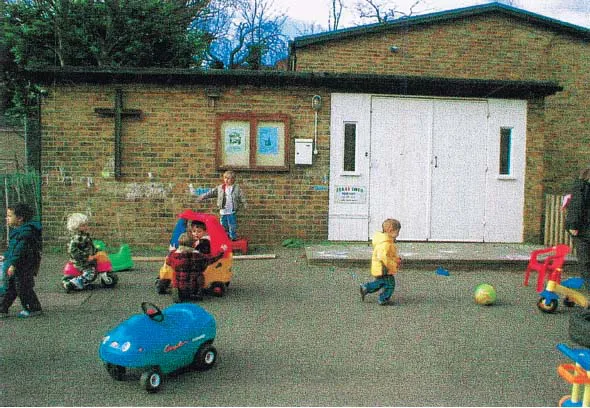
Figure 1.1 A space to run and play
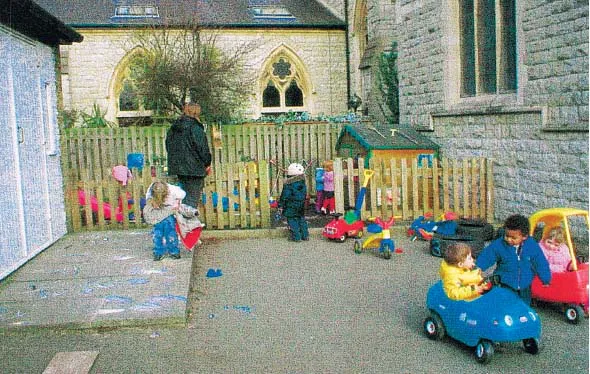
Figure 1.2 The outside area before it was developed
After attending the first day of training, practitioners got together and began to think in more detail about the changes that could be planned. They came up with the following overall aim (Figure 1.3) and then began to decide on the improvements they would like to make and how to go about making these changes happen.
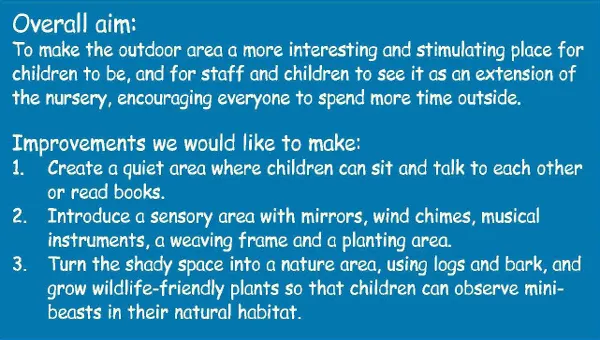
Figure 1.3 Our overall aim
What happened
1. One member of the team attended the Outdoor play project.
2. On her return to the setting, a meeting was organised to discuss outdoor provision.
3. During the meeting, practitioners drew up an action plan.
4. In order to raise the money needed to fund the developments they organised fund raising events, including a raffle and a Christmas concert.
5. New pieces of large equipment were sourced and bought, including an outdoor storage cupboard and storage boxes.
6. They gave the environment a ‘face lift’ by painting the fence and playhouse. They also painted tnumbers on the fence.
7. Practitioners were finding it exhausting getting resources together and taking them out each day, so they thought about different ways they could manage this. The advisory teacher suggested creating boxes of resources for each of the bays. This would allow the children a wide range of materials with which to work, which could be packed away each day, stored overnight and got out again the following day.
8. At another staff meeting they decided who would be responsible for each of the bays.
9. They decided on a budget for the bays and shared thoughts on what to put in each.
10. They set about collecting materials for the boxes for each bay.
11. As they got the materials together they set up the bays.
12. Construction workers on a neighbouring building site provided the setting with logs and gravel, which formed the basis of their natural area.
13. One of the most successful additions to the garden (and also the cheapest) has been the provision of large equipment such as planks, tyres, crates and boxes, which have been combined with resources such as ropes, dressing-up clothes and fabric. These additions have formed the basis for many imaginative games (Figure 1.6). They began by arranging the planks, tyres, etc. but gradually the children have taken the initiative and created their own constructions.
We placed chipped bark on the ground in this small shady corner to create a nature...
Table of contents
- Cover
- Halftitle
- Title
- Copyright
- Contents
- Foreword
- Acknowledgements
- About the authors
- Preface
- Introduction
- Background
- Section 1 Outdoor Leaming in Practlce
- Section 2 Forms and Checkllsts
- Section 3 Further Ideas and Materials to Develop Outdoor Provision
- Bibliography
- Useful contacts
- Index
Trusted by 375,005 students
Access to over 1.5 million titles for a fair monthly price.
Study more efficiently using our study tools.
Frequently asked questions
Yes, you can cancel anytime from the Subscription tab in your account settings on the Perlego website. Your subscription will stay active until the end of your current billing period. Learn how to cancel your subscription
No, books cannot be downloaded as external files, such as PDFs, for use outside of Perlego. However, you can download books within the Perlego app for offline reading on mobile or tablet. Learn how to download books offline
Perlego offers two plans: Essential and Complete
- Essential is ideal for learners and professionals who enjoy exploring a wide range of subjects. Access the Essential Library with 800,000+ trusted titles and best-sellers across business, personal growth, and the humanities. Includes unlimited reading time and Standard Read Aloud voice.
- Complete: Perfect for advanced learners and researchers needing full, unrestricted access. Unlock 1.5M+ books across hundreds of subjects, including academic and specialized titles. The Complete Plan also includes advanced features like Premium Read Aloud and Research Assistant.
We are an online textbook subscription service, where you can get access to an entire online library for less than the price of a single book per month. With over 1.5 million books across 990+ topics, we’ve got you covered! Learn about our mission
Look out for the read-aloud symbol on your next book to see if you can listen to it. The read-aloud tool reads text aloud for you, highlighting the text as it is being read. You can pause it, speed it up and slow it down. Learn more about Read Aloud
Yes! You can use the Perlego app on both iOS and Android devices to read anytime, anywhere — even offline. Perfect for commutes or when you’re on the go.
Please note we cannot support devices running on iOS 13 and Android 7 or earlier. Learn more about using the app
Please note we cannot support devices running on iOS 13 and Android 7 or earlier. Learn more about using the app
Yes, you can access Learning Outdoors by Maggie Woonton,Helen Bilton,Karen James,Ann Wilson, Helen Bilton,Karen James,Anne Wilson, Helen Bilton, Karen James, Anne Wilson in PDF and/or ePUB format, as well as other popular books in Education & Early Childhood Education. We have over 1.5 million books available in our catalogue for you to explore.