Unlike many children's television shows, Mister Rogers' Neighborhood did more than simply entertain or occupy children's attention. The show educated them in the affective domain, encouraging such things as appreciation for difference, collaboration, self-expression, and self-worth. It also introduced them to the areas of culture, art, and music through guests, trips, art objects and processes, and demonstrations, making it accessible and meaningful in a way that a child could understand. While the educational content of children's television programming has improved greatly since the late 1960s, no other children's program has ever attempted such a mix of high art, low art, folk art, industrial production, learning in the affective and social domains, and more, all with a whimsical sense of humor, insight, and a level of interconnected detail unmatched by any other children's television program. This book illuminates and examines the world of Mister Rogers' Neighborhood through world design, narrative, genre, form, content, authorship, reception and more.
- 108 pages
- English
- ePUB (mobile friendly)
- Available on iOS & Android
eBook - ePub
The World of Mister Rogers’ Neighborhood
About this book
Information
1Welcome to the Neighborhood
Fred Rogers is a teacher. … And what’s so important about what Fred Rogers does on television is that it is unlike anything else on television. There is nothing else … no one else like him. And what is he teaching? How to count to ten? No! How to name all the capitals in the United States? No! Here’s what he’s teaching: “You are like nobody else. There is only one person in the world like you, and … people can like you exactly the way you are.”
David McCullough, author and historian 2
To understand both the uniqueness of Mister Rogers’ Neighborhood, as well as its similarities with other children’s television shows, one must first place the show in the context of its era and look at some of the other programs airing at the time, the “neighborhood” of children’s television that Rogers’ show would join. It was Rogers’ attention to prosocial, affective, and experiential learning that led the way for other programs toward a more integrated and intentional approach—not by separating seriousness from play and fantasy from reality, but instead by integrating them carefully together in a way that children could understand while still challenging them to use their imaginations. While Rogers would not be the first to do many of the things he did, it was the way he combined them into the shape of a world, and the depth of detail and feeling that he gave them, that would finally lead to his hallmark style and his critical acclaim, popularity, and longevity.
Early Children’s Television
Children’s television had been around for over two decades when Mister Rogers’ Neighborhood came on the air in 1968. The live nature of many shows meant a great deal of unscripted ad-libbing, as was the case on one of the most popular early shows, Burr Tillstrom’s Kukla, Fran, and Ollie (1947–57), where Fran Allison was the human host who interacted with Tillstrom’s puppets. Another show that relied heavily on puppet characters was Howdy Doody (1947–60), hosted by Buffalo Bob Smith. The show was performed in front of a live audience of children (the “peanut gallery”) and involved both verbal and slapstick comedy; entertainment was the show’s main goal, and there was relatively little educational content.
After playing the clown Clarabell on Howdy Doody and working on a number of other children’s shows, Bob Keeshan hosted his own program, Tinker’s Workshop (1954–8), and went on in 1955 to create the program for which he was best known, Captain Kangaroo (1955–84), which aired on CBS and later PBS. Keeshan did not talk down to his child audience, and unlike other children’s shows of the time, Captain Kangaroo’s pace was gentle and calming, not exciting, a trait that would be shared by Mister Rogers’ Neighborhood (Rogers was a guest on Captain Kangaroo in 1975, and Keeshan appeared in episodes 1126 and 1162 of Rogers’ show). Like Rogers, Keeshan gave music an important role on the show, with “record productions”, written to pre-existing pieces of music, and “operettas”, including one based on Cinderella; the show’s last program was a musical, “Lawrence the Lion”. Although the show was based more on entertainment than education, 3 Keeshan was careful about what was shown, screening every commercial that would be aired on the program and rejecting exploitative advertising methods and certain kinds of toys (like war toys), sometimes to the chagrin of network executives, for whom this meant lost income. 4 At the same time, Keeshan was not above engaging in slapstick comedy, as his endurance of many showers of ping-pong balls on the program can attest (one can hardly imagine Rogers enduring such humiliation, even to entertain). Originally an hour-long program appearing five days a week, and performed live until the appearance of videotape recording technology, Captain Kangaroo had minimal time for planning and scripting; this kept the show from being able to contain coherent, multi-episode storylines or delve into issues the way Mister Rogers’ Neighborhood would later be able to do.
The other long-running children’s show with which Mister Rogers’ Neighborhood is sometimes compared is Sesame Street (1969–present), which started a year after Rogers’ show and also aired on PBS (Rogers appeared as a guest in episode 1575 of Sesame Street in 1981). Produced by the Children’s Television Workshop, Sesame Street used a magazine format that had a rapid pace, with short segments that moved fast and changed often and were modeled after television commercials. 5Sesame Street had a definite 1960s influence, according to Jane Henson, wife of Muppets creator Jim Henson:
I guess I’m talking about the mid-sixties, mid-sixties on. You were just so enthused about everything … and the idea of sitting children in rows in school—some of the confines of what had become established were just unacceptable; you just couldn’t do it, and that’s why I was, I don’t know, but “Whoa, this isn’t the way to learn!” … That’s one of the things that I love about Sesame Street, too, is that it holds on to some of that stuff that we knew from the sixties … that life is a great explosion, that life is just a ball. 6
Whereas Mister Rogers’ Neighborhood concentrated on learning in the affective domain, valuing feelings and encouraging children’s self-esteem and self-worth, Sesame Street, at its start, was mainly concerned with learning in the cognitive domain; things like letters, numbers, alike and different, and so on. According to Sesame Street creators Lloyd Morrisett, Joan Cooney, and Dr. Edward Palmer, Sesame Street’s main goal was to educate and entertain children who were at-risk in school, particularly the disadvantaged and those of a lower socioeconomic home background. As Executive Producer David Connell described it,
In terms of setting, we decided to put it on an inner city street because that is something that an inner city child could identify with and we felt it might be helpful to them and it certainly wasn’t going to be harmful to a kid from Larchmont. 7
Not surprisingly, then, Lynette Kohn Friedrich and Aletha Huston Stein’s 1973 study, Aggressive and Prosocial Television Programs and the Natural Behavior of Preschool Children, revealed that children from a higher socioeconomic standing tended to prefer Mister Rogers’ Neighborhood more than those from a lower socioeconomic background. 8 While Rogers’ program is not specifically targeted at any particular socioeconomic group, his neighborhood, world, and characters tend to be more middle-class and suburban, reflecting an environment similar to that of Rogers’ own childhood in Latrobe, Pennsylvania.
Because of the specificity of their mission, Sesame Street was heavily dependent on and formed by research, making it the most heavily-researched television show in history. 9 Teaching was more direct on Sesame Street, and the setting and cast interaction conveyed a sense of the racial and gender equality that was to be part of the show’s message. Lacking the funds and research staff that Sesame Street had, Rogers took a different approach, which combined his own background in ministry and music, leading more toward prosocial messages, affective learning, and arts appreciation (while Sesame Street also featured these things, they were not as central to the focus, at least initially). Rogers did employ research, too (discussed more in Chapter 2), but nowhere near the degree that Sesame Street did.
Interestingly, in its earlier days, Sesame Street tried shows with continuing plotlines reaching over the whole hour, but their research told them that children would lose the thread of the story. 10 Yet Mister Rogers’ Neighborhood often had week-long storylines in the show’s Neighborhood of Make-Believe segments that extended across five half-hour shows, which children were apparently able to follow easily; and sometimes it had continuing narratives across the television home segments at the same time. 11 Rogers’ show even had more advanced intertextual references reaching across weeks, and even decades, of programming; see Chapter 3).
Sesame Street’s emphasis on early education motivated Captain Kangaroo to move a bit more in that direction, and it certainly brought a faster pace to children’s programming. 12Sesame Street, however, due to its workshop funding, had a much larger budget to work with: about $28,000 per episode in 1969, compared with the $6,000 per episode cost of Mister Rogers’ Neighborhood in 1968. 13Sesame Street also had a greater ability to generate its own funding through licensing; by 1984, the Children’s Television Workshop had made $200 million in character licensing, which helped to fund the show. 14
But Rogers’ goals did not need as much funding as Sesame Street; his show was only half an hour, and after 1979, he made far fewer episodes as well (averaging just under 15 a year, compared to Sesame Street’s 125 to 130 episodes per year), and the format of his program remained pretty much the same for the next twenty-two years, until he retired and the show ended in 2001. The regularity of the show’s format was something children could rely on, and its familiarity could have a calming effect on its young audiences, yet there was enough variation to keep it interesting and fresh, for children as well as for the adult audience who watched the show with them, and for whom it was made.
A Typical Day in the Neighborhood
The show looks deceptively simple. Then you start looking at it, and realize how rich it is.
Hedda Sharapan, associate producer 15
The format of Mister Rogers’ Neighborhood is different than that of most children’s shows, and Rogers himself described it as a “visit”: “I don’t think of our half-hours as ‘shows’ or even ‘programs’ as much as I consider them visits: television visits. I try to make them quiet and comfortable times with a caring neighborhood”. 16 The neighborhood concept, then, is used throughout the show, which opens with a high-angle establishing shot of a neighborhood, the tabletop model neighborhood seen at the beginning and end of the show. The camera begins zoomed in on a building with an asymmetrical slanting roof: a building designed after the National Educational Television (NET) logo (the NET logo was actually incorporated into a building in the model, from November 10, 1969 to October 2, 1970, but then was replaced by a building with a similar shape; see Figure 1.1). As the music plays an instrumental piano rendition of the theme song, “Won’t You Be My Neighbor?”, the camera zooms out to show the neighborhood model (in later episodes, a track has been installed in the model and a miniature trolley is passing through), pans across it, and begins zooming back in on a little yellow house at the end of a road, the house representing the exterior of Rogers’ television house. As the house is neared, we usually cut to the interior of the house, often to a close-up of the flashing yellow traffic light in between the front room and kitchen. Author Amy Hollingsworth suggests that the yellow light, meaning “caution”, indicates that “it’s time to slow down”. 17 The camera then pans across the room to the front door, which opens as Rogers enters, singing the words to the song (“It’s a beautiful day in this neighborhood”). This is not always the case, however; in episodes 1465, 1476, and 1483, for example, the camera tracks along the studio neighborhood exteriors outside the television house’s front porch, Rogers walks into the shot, enters the house, and only then do we cut to the interior. In episode 1475, which introduces an opera, we track past the studio neighborhood exteriors and stop on Rogers’ porch as he sits down on the swing, not even entering the house. Thus, most of the time in the opening sequence, even the blocking of the movement serves an educational purpose; Rogers walks in from left to right, and the Trolley enters the Neighborhood of Make-Believe from left to right, with both directions of movement deliberately designed to match the way children learn to read languages in the most of the Western world. 18
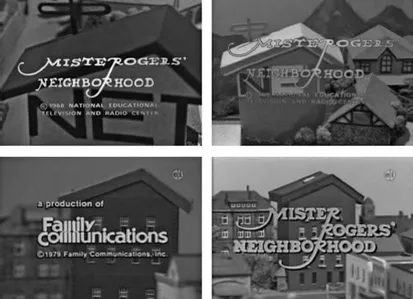
Figure 1.1The building with the asymmetrical roof in the neighborhood model over the years: in 1968 (episode 0094; top, left); in 1969 after the show’s move to color (episode 1028; top, right); in 1979 (episode 1465; bottom, left); and in 1999 (episode 1746; bottom, right).
In episodes in which Rogers enters the television house, this is the first point where variations typically occur; Rogers sometimes carries something as he enters the house, often obscured from view in a bag or box, which will become the object of discussion that the show will open with, after the song. As the song continues, so does Rogers’ famous routine: the change from suit jacket to cardigan sweater (almost all Rogers’ sweaters used on the show were knitted by his mother) and the change from dress shoes to sneakers, complete with a shoe tossed from one hand to another. Asked by a viewer why he tossed his shoe, Rogers replied,
One day I was in an especially playful mood when our visit began, and I tossed my shoe. It was fun, and it’s become a game between Mr. Costa, our musical director, and me. He tries to play certain notes on the piano just as I catch my shoe. Sometimes we do it together just right, and sometimes we don’t, but it’s fun for us to try each time because it’s like a game. 19
The shoe toss game is an example of the improvisational elements present on the show; unlike other shows, where music is prerecorded or added later in postproduction, the musical acco...
Table of contents
- Cover
- Half-Title
- Series
- Title
- Copyright
- Contents
- Acknowledgements
- Introduction
- 1 Welcome to the Neighborhood
- 2 A History of Mister Rogers’ Neighborhood
- 3 The NeighborhoodsInterconnected Spaces and Places
- 4 The Neighbors : A Diverse Sociological and Ontological Spectrum
- 5 “And I’ll Have More Ideas for You” : Ideology and the Neighborhood
- 6 Mister Rogers’ Legacy
- List of Episodes
- Notes
- References
- Index
Trusted by 375,005 students
Access to over 1.5 million titles for a fair monthly price.
Study more efficiently using our study tools.
Frequently asked questions
Yes, you can cancel anytime from the Subscription tab in your account settings on the Perlego website. Your subscription will stay active until the end of your current billing period. Learn how to cancel your subscription
No, books cannot be downloaded as external files, such as PDFs, for use outside of Perlego. However, you can download books within the Perlego app for offline reading on mobile or tablet. Learn how to download books offline
Perlego offers two plans: Essential and Complete
- Essential is ideal for learners and professionals who enjoy exploring a wide range of subjects. Access the Essential Library with 800,000+ trusted titles and best-sellers across business, personal growth, and the humanities. Includes unlimited reading time and Standard Read Aloud voice.
- Complete: Perfect for advanced learners and researchers needing full, unrestricted access. Unlock 1.5M+ books across hundreds of subjects, including academic and specialized titles. The Complete Plan also includes advanced features like Premium Read Aloud and Research Assistant.
We are an online textbook subscription service, where you can get access to an entire online library for less than the price of a single book per month. With over 1.5 million books across 990+ topics, we’ve got you covered! Learn about our mission
Look out for the read-aloud symbol on your next book to see if you can listen to it. The read-aloud tool reads text aloud for you, highlighting the text as it is being read. You can pause it, speed it up and slow it down. Learn more about Read Aloud
Yes! You can use the Perlego app on both iOS and Android devices to read anytime, anywhere — even offline. Perfect for commutes or when you’re on the go.
Please note we cannot support devices running on iOS 13 and Android 7 or earlier. Learn more about using the app
Please note we cannot support devices running on iOS 13 and Android 7 or earlier. Learn more about using the app
Yes, you can access The World of Mister Rogers’ Neighborhood by Mark J P Wolf,Mark Wolf in PDF and/or ePUB format, as well as other popular books in Media & Performing Arts & Television History & Criticism. We have over 1.5 million books available in our catalogue for you to explore.