- 200 pages
- English
- ePUB (mobile friendly)
- Available on iOS & Android
eBook - ePub
About this book
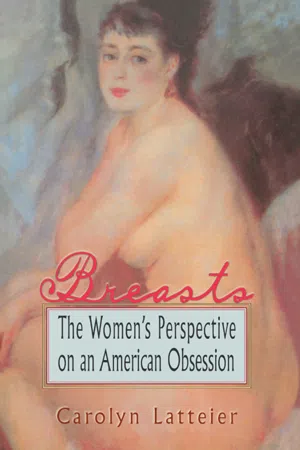
Breasts: The Women's Perspective on an American Obsession describes and explores our national breast fetish, which is defined as a culturally constructed obsession that is deeply interwoven with beauty standards, breastfeeding practices, and sexuality. By tracing the complex history of this erotic fascination and discovering how it affects men's an
Information
IMAGE AND ICON
Chapter 1
Love and Loathing
Sometimes I stand looking at my breasts in the mirror and I think: “Not bad. Not too saggy.” They are more or less of equal size (the left one is slightly larger). They are small and round and the nipples and areolas are rosy brown. But then I look closer and think: “Not so good.” There are tiny, jagged stretch marks on the upper hemispheres. The texture has gone soft, and the skin looks as if it has been stretched and not completely snapped back. These breasts are not going to make anybody say, “Wow!”
I have been looking at my breasts for a long time. I started watching as I was approaching puberty, and there was really nothing to see. While other girls were bursting out all over, my chest remained stubbornly quiescent. My breasts were still no more than little bumps when I reached eighth grade, and it had become absolutely unbearable not to be wearing a brassiere in the gym class locker room. After a good deal of private agonizing, I went to my mother. In a flood of tears, I begged her to get me a bra and, I added, better make it a padded one. I remember dreaming one night that I stood looking in my mother’s bedroom mirror and, to my deep satisfaction, my breasts grew large, the way flowers bloom in a time-lapse film.
In my mid-twenties, I became pregnant and that dream more or less came true. I watched my breasts grow and grow and finally start to look like I had always thought they were supposed to. Then one morning I woke up and saw blue-lined stretch marks all over them. When the baby arrived, my breasts grew big as bowling balls and hard as rocks, and milk came out of them.
During my thirties and forties, my breasts went through monthly cycles, reaching a glamorous, firm fullness when my estrogen levels were cresting. “Boy, are they healthy-looking,” my husband would say just before my period arrived, and then they shrank back down to normal. Since I have given up caffeine, they no longer swell and shrink, but I imagine they will keep on changing. If I live long enough, I will probably end up as an elderly woman with soft dugs hanging benignly against my chest.
It has taken me a long time to achieve this degree of acceptance of my breasts. There were many years when I despaired at the sight of my shirt lying practically flat against my chest. I would spend time searching for fluffy blouses to suggest there was something more underneath there. My discomfort with small breasts was more than just cosmetic. I felt the lack as a poverty of being, as if my very nature were somehow stark and bony. A hollow chest equaled a hollow heart. I was so used to this feeling that it puzzled me after I gave birth to my first child and began walking around in public with those big, lactating breasts on my same old skinny body. Suddenly, and unexpectedly, I was turning heads on the street. Later, when I saw my first copy of Playboy, I experienced a shock of recognition. My God, I thought, these women all look like nursing mothers.
Over the years, it was always those changeable breasts in the mirror—the little nubs with their pale, swollen nipples or the premenstrual pears and their deflated postmenstrual sisters or the swollen pregnant breasts with their dark nipples and blue veins lying on my swollen pregnant belly. All the time it was as if I could see them from two different perspectives. Personally, I was fascinated with the physical reality of each new incarnation. But the social me felt a critical, judgmental distress that they seldom looked much like I knew they should.
It was not hard to figure out what breasts were supposed to look like, though at first my ideas were pretty vague. I grew up in the late 1950s, the era of “mammary madness.”1 Breasts were practically the definition of femininity during those years. They had to, above all, be big. Brassieres of that era were highly engineered structures, with two conical cups stitched in precise spirals and carefully labeled from small to large: A, B, C, and D. The goal was to get as deep into the alphabet as possible. Size was everything. If you look at magazine ads or movies from that time, women have huge, bulky shapes projecting from their chests like the big fenders or hood ornaments on cars. This look could be faked, and often was, because the popular media were not yet plastering images of naked breasts everywhere you looked. Breasts were still mysterious masses. In the slang of the day, breasts were called “the shelf. “
I wish I had known, and I wish women today were aware that what seems like natural, universal beauty is really quite relative and transitory. Non-Western cultures have far different ideas of what a breast should be, if they care at all. Clellan Ford and Frank Beach, in Patterns of Sexual Behavior (1951), the only broad-scale cross-cultural survey of sexuality, came to the conclusion that the most universally admired feminine trait is plumpness. Less than a quarter of the tribal cultures surveyed, nine in all, preferred big breasts.
Just to put big breasts in perspective, please note that men in several cultures were turned on specifically by long and pendulous breasts. This preference is not at all unique in preliterate cultures. Margaret Mead claimed that women in New Guinea try to stretch their breasts to achieve this look.2 Young women are annoyed with their perky breasts and long for the mature, plentiful look of the mother. The breast should be long enough so that it can be thrown over the shoulder to nurse the baby riding behind. Two cultures in the survey, the Manus, a tribe of Southwest Pacific islanders and the African Masai, shared our taste for the upright, hemispherical breasts.
In our own Western culture, even in recent history, the ideal breast has altered its form. From the nearly flat-chested look of the 1920s, the style in breasts slowly ballooned to the mammoth mammaries of the 1950s and 1960s, reached its zenith in the late 1960s, and then gradually leveled off. In the 1920s, the bust measurements of Miss America contestants averaged thirty-two inches. These vital statistics rose to thirty-five inches in the 1940s, and through the two decades following 1950, stayed at what was considered a “perfect thirty-six.” Miss America contestants are supposed to represent the ideal nice girl next door. Meanwhile, incarnating the fantasy sex object, enter Playboy magazine in 1953 with its Playmate of the Month. The playmate’s bust measurements usually ran a couple of inches bigger than Miss America contestants’, but they also have gradually declined since 1960 (except for a quick, sharp second peak in the early 1970s).3
In the last twenty years, bulging breasts have given way to a smaller, more upright model, though the ongoing demand for silicone breast implants makes it clear that smaller does not mean less important. Today media imagery communicates quite clearly that the best breast—the breast as it should be—is the adolescent breast. It is a firm, milky white globe. The nipple is smooth, not the lumpy, bumpy nipple of women who have nursed a baby or outlived their youth.
I believe that many women are aware that this image is a fantasy and that many of them intellectually reject it. They know better, but they cannot shake it off. Despite their disclaimers, at the moment of truth, when they look in the mirror at their naked breasts, they perceive that what they have, what they are, is not good enough. Their breasts are too long and pendulous or too flat or too saggy. The nipples are too big or too small or the wrong color. The two breasts are different sizes or different shapes. The reality is that breasts vary as widely as faces. But we see faces every day, and we know that. We do not see breasts, except mostly clothed and confined in a brassiere. It is every woman’s secret that hers are different.
Maria is a dance instructor in her forties. In ordinary situations—driving a car or picking out a head of lettuce in the grocery store—she looks like someone’s slightly ethnic-looking young aunt. But when she teaches in her leotards, she has the springy, well-toned sensuality of a healthy animal. She seems exceptionally relaxed about her body. I may be one of the few people who knows that she does not like her breasts. “I don’t like the shape they are,” she said. “They never stood up like I thought they were supposed to when you are young. I got old lady breasts right away. I didn’t have those perfectly shaped cones. They were long and hung down. From the beginning, I was just self-conscious about my breasts. I knew from being in the locker room that other women had better breasts: round, pink-nippled ones were better than long, pointed, brown-nippled ones. I knew, underneath it all, that these were inferior breasts. To this day I still harbor that prejudice.”
In her early thirties, Maria’s anxiety about her breasts was validated when she took a new lover, a young, blond man ten years her junior. “Daryl freaked out when he saw them the first time,” she said. “He gasped. He was really honest about the fact that seeing them startled him. He had never seen breasts like these. He admitted they felt very wild and womanly, and once he said that, I felt better. But he always felt a little devoured by dark women, and his reaction to my breasts was the first indication of that.”
Some women have moments like that in their lives, when their vague anxieties about their breasts are suddenly confirmed in a clear and unmistakable way. However, most of the learning we do about how we are perceived takes place on a much more subtle level. It is nearly impossible to be objective about how wonderful or terrible our breasts look to others. I know that because for the last ten years my husband has been telling me that my breasts are beautiful, and I am starting to believe him, even though I knew full well before I married him that they were really pretty mediocre-looking. To a large degree, we believe the messages we receive from others. Seldom do they arrive in a neat bouquet of compliments such as those my husband so kindly hands me. More often, you cannot even see them coming.
A 1977 study conducted by the Psychology Department of the University of Minnesota provides an eerie demonstration of how the process can work.4 The subjects of their experiments were fifty-one male and fifty-one female undergraduate students, who were to engage in a telephone conversation with a student of the opposite sex, someone whom they had never met. All the students filled out a questionnaire about themselves to be given to the phone partner as conversational fodder. The experimenters took Polaroid pictures of the men, then gave them information packets about the other member of their dyad, including a photograph.
Meanwhile, in the other room, the experimenters told the women nothing about the photographs, nor did they take their pictures. The pictures the men had received were of entirely different women, images which had been carefully scored and rated by a panel of men. The “stimulus” photos consisted of four “attractive” women and four “unattractive” ones.
Now that the groundwork had been laid, the students chatted for ten minutes on the phone. The experimenters recorded the conversations on two separate tapes—one with the woman’s voice only, another that isolated the voice of the man. In the few cases in which the man mentioned the photo, the conversations were immediately terminated and the dyad excluded from the study.
Not surprisingly, the initial impressions the men jotted down after they had seen the photo and before they had spoken with the woman reflected cultural stereotypes. The men with attractive photos thought their partners would be suave, humorous, and friendly. The men with unattractive photos anticipated their partners would be awkward and serious.
What is more disturbing is that when naive observers, people who were not in on the deception and had not seen any photos, listened to the tapes of the women’s voices, they rated the ones whose partners perceived them as attractive to be more charming, warm, friendly, likable and, yes, attractive. In the course of the ten-minute conversation, these women, whatever their past experiences, began to believe they were what their conversational partner expected them to be.
This experiment points out how quickly we pick up subtle messages from others, no matter how irrelevant they may be to who we really are. A ten-minute conversation is probably not going to change anybody’s life, but a thousand ten-minute conversations will. She may hardly be aware of it, but a woman readily absorbs other people’s versions of her reality. She is vulnerable to what society at large thinks about her breasts. Unfortunately for women, society at large has deeply conflicting feelings about them.
On the surface, it would seem that Americans love breasts. It is hard to imagine viewing a contemporary movie without catching at least a flash of breast, if not full exposure. In print media, advertisements show page after page of plunging cleavage. Women’s magazines periodically run articles about exercises to “improve” the breast. A great media flap occurred a few years ago when a new, highly engineered bra guaranteed to create cleavage where there had been none before appeared on the market. Our nation seems to be engaged in a festival of breasts. Our fascination with them is insatiable, and the images are everywhere. Unfortunately, within this visual delight, runs a vein of hostility.
Large-breasted women take the brunt of it. Julie, who is in her early twenties, has been hearing remarks about her breasts since she was twelve. “It happens all the time,” Julie told me. “Recently I went out to dinner with this guy. We got out of the car and some guys were standing on the street. They said, `Hey man, you got a nice chick with you. She is stacked.’ ” There is no doubt that Julie’s melon-sized breasts attract male admirers. She has more dinner invitations than she can handle. But her large breasts also invite disrespect. There is an old teenagers’ tale that petting causes breasts to grow. You can tell who has been fooling around by the size of her breasts. The catcallers on the street acted as though they believed this were true. Julie has big breasts, so she must be hypersexual.
Another large-breasted woman told me she has twice had strangers squeeze her breasts in public places. “The first time, a man just walked by and grabbed my breast. It happened so fast I hardly knew what he had done. The second time, I was waiting in the subway. Just as a train was coming by, a man came up and grabbed my breast, opened his coat, and flashed. I remember feeling angry. I immediately began screaming at him, `You bastard.’ I was trying to draw attention to him. He quickly shut his coat, got on the train, and disappeared.”
The uninvited squeeze of a woman’s breast is so common that we have a term for it—copping a feel. Apparently, men are constantly counting coups on women’s breasts because about half the women I interviewed had been groped by strangers, friends, brothers, or fathers. Once I was in a group of women who were talking about this phenomenon, and those who had not been groped by a stranger expressed, half-jokingly, feelings of disappointment. Even in such a context, the imperative to be desirable still runs strong in women, and I can bear witness to that from my own experience.
One warm, spring day I strode along a city sidewalk feeling pretty in my favorite white blouse with its delicate scoop neck. The city bustled with fresh energy; people crowded the streets soaking up the sweet weather. Suddenly, two young men rode past me on bicycles. Before I realized what was happening, one of them reached out and swept his hand across my breasts in a hasty caress. “Nice ones,” he trumpeted, before disappearing down the street. I was astonished. I was mad as hell. And I was also distinctly flattered that this brute thought my small, unspectacular breasts were “nice ones.” Looking back, I realize I have felt ambivalent about breasts for a long time.
During my early teenage years, I was constantly exposed to admonitions against letting boys “take advantage” of me. No one had ever tried, but I heard and read about it so often it seemed there must be a real threat out there. I distinctly remember thinking that maybe it was a good thing that my breasts were not getting very big because this way I was completely safe. No one could possibly want to take advantage of me. I think the ambivalence I experienced is also society’s ambivalence about breasts and, underneath that, about sexuality. Breasts are attractive, and yet there is something disreputable or dangerous about them.
The few sociological studies that have been done about breast size preference did not produce consistent results, but they did tend to agree on how breasts are interpreted.5 Research shows that women with large breasts are typed as incompetent, immoral, immodest, and not very smart. “The more bosom, the less brain. That’s the law of nature; that’s why the poor miserable females are the way they are,” says a character in Isabelle Allende’s The Infinite Plan.6 It is hard to miss the archetypes and stereotypes swimming like sharks below these waters. Woman is “the other” and somehow less than human. She is nature with all its unpredictable, untamed power. She is flesh with all its temptations. When she has large breasts, she is even more so. Surprisingly, the positive side of the archetype does not seem to appear in these studies. People do not describe large breasts as comforting or nurturing. Breasts have become so sexualized that people no longer think of them as motherly.
Small-breasted women, on the other hand, are seen as competent, intelligent, moral, polite, and modest. They tend to be stereotyped as tame and asexual or masculine. Their passions are supposedly neutralized, and thus they can cope in a world of masculine values.
These contemporary stereotypes have their roots buried deep in Western civilization’s long tradition of devaluing the fleshy and the sexual. Socially and politically, this metaphysical malaise has played itself out on the bodies of women. Under a historically male-controlled power structure, the qualities of fleshy sexiness are projected onto women’s...
Table of contents
- Cover
- Halftitle
- Title
- Copyright
- Contents
- Preface
- Acknowledgments
- PART ONE: IMAGE AND ICON
- PART TWO: WE TWO ARE THE UNIVERSE
- PART THREE: SEX
- PART FOUR: THINKING ABOUT BREASTS
- Notes
- Bibliography
- Index
Trusted by 375,005 students
Access to over 1.5 million titles for a fair monthly price.
Study more efficiently using our study tools.
Frequently asked questions
Yes, you can cancel anytime from the Subscription tab in your account settings on the Perlego website. Your subscription will stay active until the end of your current billing period. Learn how to cancel your subscription
No, books cannot be downloaded as external files, such as PDFs, for use outside of Perlego. However, you can download books within the Perlego app for offline reading on mobile or tablet. Learn how to download books offline
Perlego offers two plans: Essential and Complete
- Essential is ideal for learners and professionals who enjoy exploring a wide range of subjects. Access the Essential Library with 800,000+ trusted titles and best-sellers across business, personal growth, and the humanities. Includes unlimited reading time and Standard Read Aloud voice.
- Complete: Perfect for advanced learners and researchers needing full, unrestricted access. Unlock 1.5M+ books across hundreds of subjects, including academic and specialized titles. The Complete Plan also includes advanced features like Premium Read Aloud and Research Assistant.
We are an online textbook subscription service, where you can get access to an entire online library for less than the price of a single book per month. With over 1.5 million books across 990+ topics, we’ve got you covered! Learn about our mission
Look out for the read-aloud symbol on your next book to see if you can listen to it. The read-aloud tool reads text aloud for you, highlighting the text as it is being read. You can pause it, speed it up and slow it down. Learn more about Read Aloud
Yes! You can use the Perlego app on both iOS and Android devices to read anytime, anywhere — even offline. Perfect for commutes or when you’re on the go.
Please note we cannot support devices running on iOS 13 and Android 7 or earlier. Learn more about using the app
Please note we cannot support devices running on iOS 13 and Android 7 or earlier. Learn more about using the app
Yes, you can access Breasts by Ellen Cole,Esther D Rothblum in PDF and/or ePUB format, as well as other popular books in Social Sciences & Gender Studies. We have over 1.5 million books available in our catalogue for you to explore.