
eBook - ePub
The International Hospitality Business
Management and Operations
- 422 pages
- English
- ePUB (mobile friendly)
- Available on iOS & Android
eBook - ePub
About this book
International Hospitality Business: Management and Operations will introduce hospitality managers to the most up-to-date developments in hospitality to prepare you for the rapidly changing world of international hospitality. This book is a compilation of the most current research in global operations. It examines new developments, new management co
Part I:
An Overview
of the International
Hospitality Industry
of the International
Hospitality Industry
Part I has two chapters that offer a general discussion on the international hospitality industry and its geographic distribution in the world. Chapter 1 presents an overview of international business and identifies the international hospitality industry as an integral part of the service import and export business. It analyzes the distinctive characteristics of the hospitality industry as a service export. It offers a systematic discussion of the three major aspects of the international tourism and hospitality industry, and examines the motivations that have driven hospitality corporations to globalize business overseas.
In Chapter 2, students study world geography by examining the spatial development and distribution of the international hospitality industry. World travel patterns, major hotel chains, and food service companies in different regions of the world are described and discussed. This chapter is designed to help students grasp the major world regions and basic concepts of economic geography. These two chapters present the scope and spatial development of the international hospitality industry.
Chapter 1
The Hospitality Industry
As an International Business
As an International Business
Twenty years ago no one talked of the “world economy.” The term then was “international trade.” The change in term—and everybody now talks of world economy—bespeaks a profound change in economic reality.1
Peter F. Drucker
Learning Objectives
In this chapter, you will study:
- Types of international businesses
- Global shift toward service
- Hospitality industry as a service export and its distinctive characteristics
- Balance of payments in travel accounts
- Three major components of the international hospitality industry
- Motivations for global hospitality expansion
Introduction
The most significant development in the world economy during the past few decades has been the increasing globalization of economic activities. In today’s rapidly changing world, the economic activities of individual countries do not occur in isolation, nor are they insulated by geographic distance; their economies and markets have become highly integrated worldwide. The priority of this economic development has shifted toward the service sector in the developed countries. Such development trends require management for change: changes in globalizing products and services for worldwide markets.
Hospitality is a very important component of the service industry in any country’s national economy. When a domestic hospitality company decides to expand its operation into a foreign country, its overseas development is recognized as international business and its business revenues generated from overseas operations are described as a service export. In this introductory chapter, the discussions are intended to be broad-ranging. The hospitality industry as a service export in international business is explained, and the characteristics, scope, and diversity of the international hospitality industry are discussed. A historical perspective is provided on the development of each segment of the hospitality industry, and hospitality companies’ motivations for expanding operations into foreign countries are identified. This chapter offers a systematic overview of the hospitality industry and reveals its place in the overall international business environment.
International Business
When a domestic hospitality company establishes a new business in a foreign market, this company is said to be engaging in international business. International business is defined as business transactions taking place between two or more companies from different countries. These transactions can be in trade, manufacturing, investment, or services. The types of international businesses, encompassing various economic, financial, and commercial activities conducted by both private enterprises and government entities, can be divided into three major categories: (1) merchandising exports and imports, (2) service exports and imports, and (3) investments.
Merchandise imports and exports comprise most conventional trading activities: the importing (buying) and exporting (selling) of tangible goods between countries, such as airplanes, cars, computers, and garments.
Service exports and imports deal with the selling and buying of a business concept or format and the performance of management and services. The franchise of a quick-service restaurant concept or the management service performed by a hotel’s management contract company in a foreign country are examples of service exports. Hotel management services, restaurant franchise operations, transportation services by airlines and railroads, legal services by law firms, financial services by banks and accounting firms, and information management services by consulting firms represent some of the fastest growing service export industries in the world.
Investment refers to the movement of capital between countries. Direct investment is defined as a commitment of resources to a foreign business where the investing company has a controlling interest in the enterprise. The controlling stake varies from country to country. Indirect investment refers to foreign portfolio investment (FPI), in which individual companies or public entities invest in foreign financial instruments, such as foreign government bonds and foreign stocks. However, the investors in foreign portfolios do not have control over their investment.2
International businesses therefore encompass a wide variety of financial and commercial activities between different countries. Since the focus of this book is on the hospitality industry, a discussion of the characteristics and economic impact of the service export is essential to an understanding of this fast-growing international business.
Shift Toward Service Industry
The importance of the service industry has grown rapidly in both developed and developing countries in the past thirty years. The growth of services in a country’s national economy reflects a combination of both demand and supply factors. Some of the major factors are listed here:
- The growth of per capita output and high income elasticity of demand for some consumer services in industrialized countries
- The increasing role of producer services in the value-added process
- The growth of financial, legal, insurance, transport, information, and hospitality services3
Economists have classified nations as postindustrial if 50 percent or more of their gross domestic product (GDP) is accounted for by the service sector of the national economy. The service sectors in the developed countries have experienced dramatic increases in the past three decades. Exhibit 1.1 illustrates service employment as a share of total civilian employment in five most-developed countries.
EXHIBIT 1.1. Service Employment As Percentage of the Total Civilian Workforce in Five Developed Countries
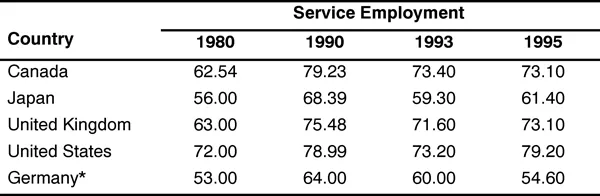
Source: OECD Economic Surveys, compiled from various editions (Paris: Organization for Economic Co-operation and Development, 1996).
* Figures for 1980, 1990, and 1993 are only for West Germany. Figure for 1995 is for the unified Germany.
As shown, the national economies of these five developed nations are dominated by the service industry in terms of employment. This demonstrates that these developed nations are more oriented toward the service industry, thus creating opportunities for service businesses. A larger proportion of the workforce in these countries is engaged in providing services in such areas as transportation, tourism and hospitality, banking, insurance, advertising, education, retailing, wholesaling, mass communication, and government.
The Hospitality Industry as a Service Export
Service exports differ in many aspects from those of merchandise. In merchandise exports, tangible goods are shipped from the place of production to the consumer in the market; Japanese cars are shipped from manufacturing plants in Japan to auto dealers in the United States for sale to consumers. The places of production and consumption are physically separated. In service exports, particularly in the hospitality industry, four unique business characteristics are identified: (1) export invisibility, (2) location-boundness, (3) intangible service performance, and (4) labor intensiveness.
The international hospitality industry is often described as an invisible export because it does not normally involve the tangible shipment of goods from the place of production to the place of consumption. On the contrary, tourists travel a distance from their home to the destination to receive these services in person. Since there is no tangible shipment of merchandise, only the movement of people, the hospitality industry is thus described as an invisible export.
Since tourists come to hotels and restaurants at various destinations to receive service and experience hospitality, the hospitality industry is characterized as a location-bound industry.4 Service is tied to the service production location because its time and space constraints are shared by both the producer and the guests. In other words, the guest receives products and services in the same place and at the same time as the product is made and the service is rendered. This location-boundness creates certain unique challenges for hospitality managers. If guests are not happy with certain products or services, they can complain to the manager and demand an immediate solution. The manager needs to come up with spontaneous and creative solutions to solve problems and make the guests happy.
The hospitality industry offers guests a memorable travel experience with a clean and comfortable room and a delicious meal. When tourists purchase foreign travel, there is no ownership of any tangible asset persisting after the stay at the hotel. In other words, when guests check out of a hotel, they have nothing tangible to show to others to prove that they once stayed at that hotel (which is probably why some guests tend to take some tangible things from the hotel as evidence of their visit, such as toiletry amenities or even towels with the hotel logo on them!). The guest’s stay at the hotel has become only a memory of an experience. That is why the hospitality industry is characterized as selling intangible services. Therefore, creating a pleasant and memorable experience for international guests is crucial to the success of hospitality operations.
Labor intensiveness is a unique characteristic associated with the hospitality industry. This industry strives to provide a home away from home to international tourists. To provide effective personalized services, the industry relies on individual employees to perform various hospitality functions and services. Unlike the manufacturing industry, where many production procedures have been automated to reduce labor cost, the hospitality industry offers the human touch of personal service to pamper every guest’s needs and wants. Therefore, the hospitality industry employs more workers to perform personal services. Normally, the more upscale and luxurious the hotel or restaurant, the more employees are hired.
This labor intensiveness also influences the movement of the global hospitality industry into developing countries, which provide abundant inexpensive labor resources. This development phenomenon can be explained by the factor endowment theory developed by Swedish economists Eli Heckscher and Bertil Ohlin. This theory states that different nations have different factor endowments in land, labor, and capital, the three primary factors for production. The availability of these factors explains the differences in factor costs. The more abundant a factor, the lower its cost. The more land and people a country has, the cheaper the land and labor.5 These are often the motivating factors for hospitality companies to move into developing countries, such as South America or Southeast Asia, for inexpensive land and labor.
Service Industry Earnings
Service exports play a significant role in a nation’s balance of payments. A nation’s balance of payments summarizes all economic transactions between a country and the rest of world during a given period of time. Service companies generate revenues from overseas sales, which are used to offset trade deficits in many developed countries. The United States has a large and intractable trade deficit that is bemoaned periodically by the news media, but it is a deficit in merchandise trade. In fact, the United States has a very large surplus in service exports, amounting to two-thirds of the merchandise trade ...
Table of contents
- Cover
- Half Title
- Title Page
- Copyright
- Dedication
- About the Author
- Contents
- Preface
- Acknowledgments
- Part I: An Overview of the International Hospitality Industry
- Part II: Differences in Cultural, Political, and Economic Systems
- Part III: Organizational Structures and Development Strategies
- Part IV: Hospitality Management Functions
- Part V: Future Development and Career Opportunities
- Notes
- Index
Trusted by 375,005 students
Access to over 1.5 million titles for a fair monthly price.
Study more efficiently using our study tools.
Frequently asked questions
Yes, you can cancel anytime from the Subscription tab in your account settings on the Perlego website. Your subscription will stay active until the end of your current billing period. Learn how to cancel your subscription
No, books cannot be downloaded as external files, such as PDFs, for use outside of Perlego. However, you can download books within the Perlego app for offline reading on mobile or tablet. Learn how to download books offline
Perlego offers two plans: Essential and Complete
- Essential is ideal for learners and professionals who enjoy exploring a wide range of subjects. Access the Essential Library with 800,000+ trusted titles and best-sellers across business, personal growth, and the humanities. Includes unlimited reading time and Standard Read Aloud voice.
- Complete: Perfect for advanced learners and researchers needing full, unrestricted access. Unlock 1.5M+ books across hundreds of subjects, including academic and specialized titles. The Complete Plan also includes advanced features like Premium Read Aloud and Research Assistant.
We are an online textbook subscription service, where you can get access to an entire online library for less than the price of a single book per month. With over 1.5 million books across 990+ topics, we’ve got you covered! Learn about our mission
Look out for the read-aloud symbol on your next book to see if you can listen to it. The read-aloud tool reads text aloud for you, highlighting the text as it is being read. You can pause it, speed it up and slow it down. Learn more about Read Aloud
Yes! You can use the Perlego app on both iOS and Android devices to read anytime, anywhere — even offline. Perfect for commutes or when you’re on the go.
Please note we cannot support devices running on iOS 13 and Android 7 or earlier. Learn more about using the app
Please note we cannot support devices running on iOS 13 and Android 7 or earlier. Learn more about using the app
Yes, you can access The International Hospitality Business by Kaye Sung Chon,Lawrence Yu,Larry Yu in PDF and/or ePUB format, as well as other popular books in Business & Business General. We have over 1.5 million books available in our catalogue for you to explore.