eBook - ePub
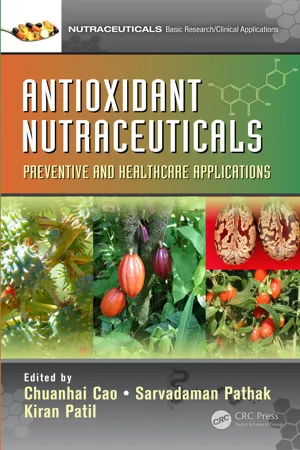
Antioxidant Nutraceuticals
Preventive and Healthcare Applications
- 414 pages
- English
- ePUB (mobile friendly)
- Available on iOS & Android
eBook - ePub
Antioxidant Nutraceuticals
Preventive and Healthcare Applications
About this book
This book addresses various clinical and sub clinical applications of antioxidant nutraceuticals, with a primary focus on preventive use for general wellness, common ailments, and such chronic illnesses as cancer and neurological applications. This unique book captures the applications of natural antioxidants, which have been used for thousands of years in Traditional Chinese Medicine and Ayurvedic Medicine as well as modern nutraceuticals formulations. It covers antioxidant applications in clinical scenarios including the historical perspective, basic antioxidant properties and applications, anti-inflammatory properties, and antioxidant applications in a variety of clinical conditions.
Information
Topic
MedicineSubtopic
Nutrition, Dietics & Bariatrics1
Antioxidant Nutraceuticals
Historical Perspective and Applications in Various Traditional Systems Worldwide
Contents
1.1 Introduction
1.1.1 Nutraceuticals definition
1.1.2 Antioxidant nutraceuticals
1.1.3 Antioxidant nutraceuticals categories and examples
1.1.4 Biochemical components of antioxidant nutraceuticals
1.1.5 Regulation of nutraceuticals
1.2 Nutraceuticals and historical perspectives
1.2.1 Ancient India
1.2.1.1 Castor oil
1.2.1.2 Ginger
1.2.1.3 Pomegranate
1.2.2 Ancient Chinese
1.2.2.1 Astragalus (huangqi)
1.2.2.2 Licorice (gancao)
1.2.2.3 Ginseng (renshen)
1.2.2.4 Wolfberry (goji)
1.2.3 Ancient Egyptians
1.2.3.1 Aloe vera
1.2.3.2 Coriander
1.2.3.3 Honey
1.2.4 Ancient Sumerians
1.2.4.1 Acacia
1.2.4.2 Myrrh
1.2.4.3 Thyme
1.3 Nutraceutical application in worldwide traditional systems
1.3.1 Asian medicine and nutraceuticals today
1.3.2 Nutraceuticals in western medicine
References
1.1 Introduction
1.1.1 Nutraceuticals definition
Different definitions for the term nutraceutical have been described over time. It is hard to gauge how big the nutraceutical market will be because the definition itself can be taken vaguely. For example, a nutraceutical could be described as something that has both nutritional and medical benefit. To this point, all foods could be considered nutraceuticals.
Nutraceuticals were first described by Dr. Stephen DeFelice and the Foundation for Innovation Medicine in 1989 in New York due to the heavily increasing number of research done in this area (Andlauer and Furst 2002; Kalra 2003; Pathak 2009). This research was believed to develop foods for the future, where the lines were obscure between food and drug. DeFelice described the term as, “a substance that is a food or part of food and provides medical and health benefit.” At this time, nutraceuticals were used to describe nutrients that were isolated from foods, dietary supplements, genetically engineered foods, and specific diets designed to increase a specific nutrient intake. The described nutraceutical food itself may be medically active, such as garlic or soybeans, or components of the food may be active, such as omega-3 fatty acids found in salmon and other fish.
This later portion was described further by Zeisal in that this was a “diet supplement that delivers a concentrated form of a presumed bioactive agent from food” (Zeisel 1999). These bioactive agents are those normally present in the foods we eat, but are increased in concentration and delivered as an object that people would not consider being a food.
The definition was updated in 2007 when Dr. Lockwood slightly redefined nutraceuticals using previous definitions as something that “describes a medicinal or nutritional component that includes a food, plant, or naturally occurring material which may have been purified or concentrated, and that is used for the improvement of health by either preventing or treating disease” (Lockwood 2007).
So then we can describe nutraceuticals as following the concurrent two definitions: nutraceuticals (1) are nutrition derived from food or plants that are naturally occurring, and that they (2) are specifically used for the prevention or improvement of disease or well-being. It is the combination of nutrients and their use as pharmaceuticals.
The term that is commonly heard today is referring to superfoods, or those which are nutrient rich and are particularly beneficial toward health. Most of these foods you find will be rich in flavonoids, antioxidants, and specific fatty acids that many say can prevent or treat chronic conditions, such as cancer or heart disease (Gebauer et al. 2006). Some of the most beneficially described nutrients are those that are labeled as antioxidants (Shibamoto et al. 2008; Caffrey 2015) (Table 1.1).
Table 1.1 Nutraceutical Categories/Examples
Category Title | Nutrient or Supplement | Foods Containing Nutrient |
Isoprenoids (Terpenoids) | Carotenoids | Carrots, carrot juice, sweet potatoes, apricots |
Saponins | Soybeans, legumes, and garlic | |
Tocopherols | Oils, nuts, seeds, whole grains | |
Phenolic compounds | Isoflavones | Berries, coffee, tea |
Lignin | Whole grains, wheat, legumes, nuts, seeds | |
Proteins/Amino acids | Amino acids | Meats, chia seeds, soybeans, spirulina, pumpkin, almonds, avocados |
Indoles | Cruciferous vegetables: collard and mustard greens, broccoli, kale, cabbage, turnips | |
Choline | Egg yolk, beef, fish, pork, soybean oil, chicken | |
Folate | Spinach, turnips, broccoli, bokchoy, parsley, romaine lettuce | |
Carbohydrate derivatives | Ascorbic acid (vitamin C) | Citrus fruit, strawberries, sweet peppers, broccoli |
Oligosaccharides | Leeks, onions, asparagus, Jerusalem artichoke | |
Fatty acid and lipids | N-3 PUFA | Oils (flaxseed, walnut, and canola), nuts, seeds (Vesper et al. 1999) |
MUFA | Olive oil, canola oil, avocados, olives, peanut oil, nuts (Vesper et al. 1999) | |
Sphingolipids | Dairy products, eggs, soybeans (Ferreyra et al. 2012) | |
Lecithin | Soy, egg yolk, vegetable oils | |
Minerals | Calcium | Dark green vegetables, dairy products, okra, almonds, fish |
Potassium | Beans, dark green vegetables, potatoes, squash, bananas, mushrooms | |
Zinc | Oysters, beef, wheat germ, spinach, nuts, pumpkin, and squash seeds | |
Microbial | Probiotics | Yogurt, sauerkraut, sourdough bread, miso, kimchi |
Prebiotics | Garlic, onions, leeks, asparagus, bananas | |
Antioxidants | Chocolate, pomegranates, cranberries, blueberries, beans, artichoke, pigmented potatoes |
Source: Crowe, K. M. and Francis, C., J. Acad. Nutr. Diet., 113, 1096–1103, 2013.
1.1.2 Antioxidant nutraceuticals
Antioxidant is a broad term that is used to describe any substance (vitamin, mineral, or enzyme) that can protect the cells of the body from oxidative damage, usually due to free radicals (Hart and DeAngelo 2013).
Free radicals are produced for a variety of reasons within the body and can be produced through radiation, environmental stress, or by the normal process of mitochondrial and cells. Early on in life, the enzymes and processes of the body are better able to handle the production of free oxygen radicals, but as the body ages, so does the handling of these components. This develops the need for a higher intake of antioxidants so that a person’s body is better equipped to handle the ever increasing number of free radicals produced in the slowly failing system. These chemicals produced are highly reactive and can interact with a number of components in the cells, such as deoxyribonucleic acid (DNA), ribonucleic acid (RNA), cellular proteins, and the lipids of the membranes.
Aging itself and almost every disease state that can affect the human body is thought to be caused, in part, by oxidative damage and the buildup of free radical damage over one’s lifetime. Therefore, all problems associated with aging should receive some benefit, if we could just learn how to utilize antioxidants efficiently to reduce oxidative stress (Bourassa and Tardif 2006).
1.1.3 Antioxidant nutraceuticals categories and examples
There is some classification of antioxidant molecules. Within the body there exist a number of enzymatic antioxidants, which have the ability to break down and remove free radicals. Most of these go through the process of converting the free radical into an intermediary, hydrogen peroxide, and then will convert this into water. Many of these enzymes utilize metal atoms, such as zinc, copper, and iron.
Other antioxidants that are not enzymatic in nature are molecules that have the ability to negate the action of free radicals. Most of this is due to the structure of the molecules, and many are large with phenolic groups to engage the effect of the free electrons in the radicals. Some of these important antioxidant molecules inc...
Table of contents
- Cover
- Half Title
- Title Page
- Copyright Page
- Dedication
- Table of Contents
- Foreword
- Series Preface
- Preface
- Editors
- Contributors
- 1 Antioxidant Nutraceuticals: Historical Perspective and Applications in Various Traditional Systems Worldwide
- 2 Antioxidant Nutraceuticals: Present Market and Future Trends
- 3 Antioxidant Nutraceuticals and Prostate Cancer
- 4 Natural Antioxidants in General Cancer Prevention
- 5 Antioxidant Nutraceuticals, Alzheimer’s Disease, and Dementia
- 6 Antioxidant Nutraceuticals and Parkinson’s Disease
- 7 Nutraceutical or Food-Based Antioxidants for Depression
- 8 Antioxidant Nutraceuticals and Preeclampsia
- 9 Antioxidant Nutraceuticals with Probiotic Applications
- 10 Antioxidant Nutraceuticals as Health Drinks for Prevention of Diseases
- 11 The Prevention and Treatment of Coronary Heart Disease and Congestive Heart Failure with Antioxidants and Nutritional Supplements
- 12 Nutraceuticals: A Preventative Measure against the Adverse Impact among Diabetic Patients
- 13 Antioxidant Nutraceuticals: Novel Strategies for Combating Chronic Inflammatory Diseases
- 14 Immunomodulation and Antioxidant Nutraceuticals
- 15 Free Radicals and Antioxidants in Better Healthcare
- 16 Pharmacology and Pharmacokinetics of Natural Antioxidants in the Human Body
- 17 Antioxidant Nutraceuticals and Skincare
- 18 Catechins as Potential Therapeutic Agents for Ocular Diseases
- 19 Antioxidant Nutraceuticals for the Prevention and Treatment of Acute and Chronic Lung Diseases: Current Trends and Future Prospects
- Index
Trusted by 375,005 students
Access to over 1.5 million titles for a fair monthly price.
Study more efficiently using our study tools.
Frequently asked questions
Yes, you can cancel anytime from the Subscription tab in your account settings on the Perlego website. Your subscription will stay active until the end of your current billing period. Learn how to cancel your subscription
No, books cannot be downloaded as external files, such as PDFs, for use outside of Perlego. However, you can download books within the Perlego app for offline reading on mobile or tablet. Learn how to download books offline
Perlego offers two plans: Essential and Complete
- Essential is ideal for learners and professionals who enjoy exploring a wide range of subjects. Access the Essential Library with 800,000+ trusted titles and best-sellers across business, personal growth, and the humanities. Includes unlimited reading time and Standard Read Aloud voice.
- Complete: Perfect for advanced learners and researchers needing full, unrestricted access. Unlock 1.5M+ books across hundreds of subjects, including academic and specialized titles. The Complete Plan also includes advanced features like Premium Read Aloud and Research Assistant.
We are an online textbook subscription service, where you can get access to an entire online library for less than the price of a single book per month. With over 1.5 million books across 990+ topics, we’ve got you covered! Learn about our mission
Look out for the read-aloud symbol on your next book to see if you can listen to it. The read-aloud tool reads text aloud for you, highlighting the text as it is being read. You can pause it, speed it up and slow it down. Learn more about Read Aloud
Yes! You can use the Perlego app on both iOS and Android devices to read anytime, anywhere — even offline. Perfect for commutes or when you’re on the go.
Please note we cannot support devices running on iOS 13 and Android 7 or earlier. Learn more about using the app
Please note we cannot support devices running on iOS 13 and Android 7 or earlier. Learn more about using the app
Yes, you can access Antioxidant Nutraceuticals by Chuanhai Cao,Sarvadaman Pathak,Kiran Patil in PDF and/or ePUB format, as well as other popular books in Medicine & Nutrition, Dietics & Bariatrics. We have over 1.5 million books available in our catalogue for you to explore.