Agile is a set of values, principles, techniques, and frameworks for the adaptable, incremental, and efficient delivery of work. Big Data is a rapidly growing field that encompasses crucial aspects of data such as its volume, velocity, variety, and veracity. This book outlines a strategic approach to Big Data that will render a business Agile. It discusses the important competencies required to streamline and focus on the analytics and presents a roadmap for implementing such analytics in business.
- 503 pages
- English
- ePUB (mobile friendly)
- Available on iOS & Android
eBook - ePub
Big Data Strategies for Agile Business
About this book
Information
Chapter 3
Data Science—Analytics, Context, and Strategies
Chapter Objectives

This chapter is mainly based on the second module of the Big Data Framework for Agile Business (BDFAB): data science—analytics, context, and technology. Specifically, as shown in Figure 2.1, this module draws attention to data, its various types and categories, and their utilization in analytics. Setting the context of a data point and the role of hex elementization in doing so is also discussed in this chapter. Furthermore, this chapter explains the crucial importance of granularity in data and analytics, and the setting of the OGL. Data science is presented as a discipline responsible for adopting and using Big Data in an iterative and incremental manner.
Data Science: Analytics, Context, and Strategies
Understanding the Importance of Data Science
Data science is a broad-ranging term that represents the technologies and analytics of Big Data. Additionally, though, data science can be understood as a discipline of utilizing technologies and analytics to convert data into actionable knowledge. Data science includes data mining, analytics (statistics), process modeling, machine learning (ML), parallel processing, and associated aspects of data management. The application of analytics to this data is the main step in arriving at insights. Therefore, data analytics remains at the core of data science. Data science, however, is closer to the business leadership and strategic decision making than data analytics. The evolution of data to actionable knowledge requires a specialist discipline that includes the study of data, its characteristics, its context in analytics, and eventually its value in business agility. These aforementioned activities require a wide coverage of various other disciplines within the organization and collaboration with many cross-functional teams. Therefore, the work of data science is interdisciplinary.
While analysis of data can focus on using the statistical expertise and management of data on the technical aspects, data science focuses on the strategic aspect of producing business value from data. This strategic aspect of data science requires domain knowledge of the industry where it is applied. For example, domain knowledge of the banking, finance, insurance, telecom, medical, and education industries is important in developing corresponding data strategies. Consider the following examples where data science provides value by combining the science of data with the domain knowledge:
Data science thus has wide-ranging applications in business decision making. Many internal organizational disciplines and functions provide input into data science. These are the disciplines of business strategies, project management, enterprise architecture, process modeling, solutions development, and quality assurance and testing. These disciplines complement those of data science. Figure 3.1 shows the effort involved in categorizing data, finding the correlation, undertaking analytics, and presenting the insights in an easy-to-use way for the end user.
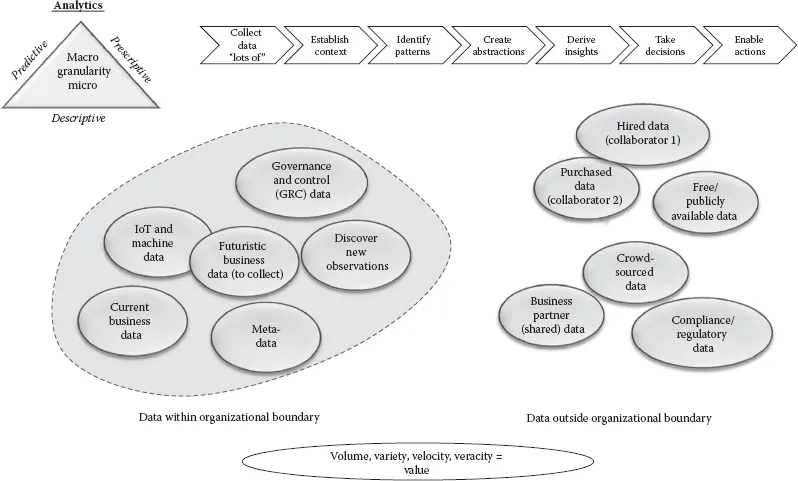
Figure 3.1Data analytics, data categories (pools), and a subprocess for data transformation.
Data science considers the following in order to provide business value:
Table of contents
- Cover
- Half-Title
- Title
- Copyright
- Dedication
- Series
- Contents
- List of Figures
- List of Tables
- Foreword
- Preface
- Acknowledgements
- About the Author
- Domain Terms and Acronyms
- SECTION I INTRODUCTION TO BIG DATA STRATEGIES AND OUTLINE OF BIG DATA FRAMEWORK FOR AGILE BUSINESS (BDFAB)
- SECTION II ANALYTICS, PROCESSES, TECHNOLOGIES, ARCHITE CTURE, AND DATABASES WIT HIN THE BDFAB
- SECTION III QUALITY, GRC, PEOPLE AND THEIR UPSKILLING, AND AGILE BUSINESS WIT HIN THE BDFAB
- SECTION IV CASE STUDIES IN BANKING, HEALTH, AND EDUCATION
Trusted by 375,005 students
Access to over 1.5 million titles for a fair monthly price.
Study more efficiently using our study tools.
Frequently asked questions
Yes, you can cancel anytime from the Subscription tab in your account settings on the Perlego website. Your subscription will stay active until the end of your current billing period. Learn how to cancel your subscription
No, books cannot be downloaded as external files, such as PDFs, for use outside of Perlego. However, you can download books within the Perlego app for offline reading on mobile or tablet. Learn how to download books offline
Perlego offers two plans: Essential and Complete
- Essential is ideal for learners and professionals who enjoy exploring a wide range of subjects. Access the Essential Library with 800,000+ trusted titles and best-sellers across business, personal growth, and the humanities. Includes unlimited reading time and Standard Read Aloud voice.
- Complete: Perfect for advanced learners and researchers needing full, unrestricted access. Unlock 1.5M+ books across hundreds of subjects, including academic and specialized titles. The Complete Plan also includes advanced features like Premium Read Aloud and Research Assistant.
We are an online textbook subscription service, where you can get access to an entire online library for less than the price of a single book per month. With over 1.5 million books across 990+ topics, we’ve got you covered! Learn about our mission
Look out for the read-aloud symbol on your next book to see if you can listen to it. The read-aloud tool reads text aloud for you, highlighting the text as it is being read. You can pause it, speed it up and slow it down. Learn more about Read Aloud
Yes! You can use the Perlego app on both iOS and Android devices to read anytime, anywhere — even offline. Perfect for commutes or when you’re on the go.
Please note we cannot support devices running on iOS 13 and Android 7 or earlier. Learn more about using the app
Please note we cannot support devices running on iOS 13 and Android 7 or earlier. Learn more about using the app
Yes, you can access Big Data Strategies for Agile Business by Bhuvan Unhelkar in PDF and/or ePUB format, as well as other popular books in Business & Information Management. We have over 1.5 million books available in our catalogue for you to explore.