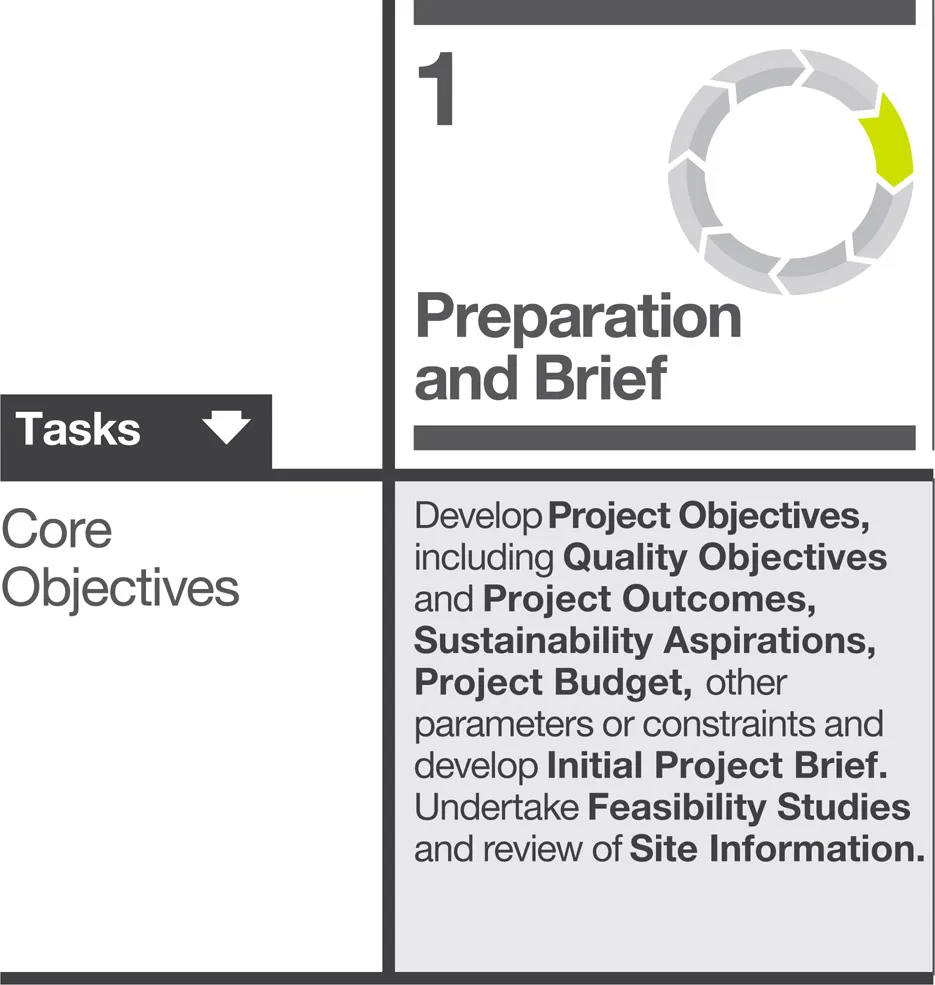
What are the Core Objectives of Stage 1?
What procurement activities are necessary at Stage 1?
Why is the Project Programme crucial at Stage 1?
How might town planning influence Stage 1?
What supporting tasks should be undertaken during Stage 1?
Why are Sustainability Checkpoints important?
What are the Stage 1 Information Exchanges?
Introduction
With Stage 0 having set the strategic framework for a project in the Strategic Brief and Project Programme, Stage 1 can begin in earnest, layering detail onto these documents. Stage 1 of the RIBA Plan of Work 2013 is a crucial project stage. Some might question this as no design or construction-related activity takes place, but the premise behind this stage is simple: if the Initial Project Brief is robust and comprehensively considered, and the project team has been assembled in a manner where each party knows what they have to do, when they have to do it and how they will do it, then Stage 2, and the subsequent stages, will be more efficient and effective.
This chapter considers why Stage 1 is of particular importance to the lead designer and the items that might be considered in relation to this subject. Assembling a Collaborative Project Team advocates the appointment of the design team by the end of Stage 1, ready for commencement of Stage 2. A major conundrum from the lead designer’s perspective is that many of the core documents used while they are undertaking their design management duties, such as the Project Execution Plan, Design Responsibility Matrix and Information Exchanges, may have been generated, determined or influenced by others prior to their own involvement.
Certainly, where one party (likely to be the project lead at Stage 1) has developed the Design Responsibility Matrix and other core design-related documents for the design team, the lead designer should stringently check these documents prior to concluding their own professional services contract. This review would consider and include all of the design team members’ professional services contracts, allowing the lead designer to be satisfied that each design team member is appointed in a manner that will deliver the right information at the right time.
A review should be undertaken regardless of who will appoint the design team members (the client, the contractor or the lead designer) because each design team member’s Information Exchanges impact on the lead designer’s ability to carry out their duties to coordinate at Stage 3 and integrate at Stage 4. The lead designer is increasingly responsible for appointing the design team. In these situations they will be responsible for all design aspects and their professional services contract will not need to contain the same granularity in relation to design responsibility. The lead designer will, however, need to ensure that each design team member’s professional services contract (possibly a subcontract) specifies the individual degree of design responsibility precisely. Such documents may be derived from templates or may have been generated by the lead designer and fine-tuned over a number of projects.
There are currently initiatives encouraging standard industry deliverables documents. Such initiatives are welcome and would make the preparation by the project lead and the checking by the lead designer more straightforward and the transition to Stage 2 easier.