eBook - ePub
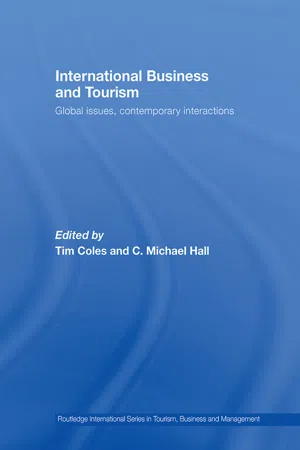
International Business and Tourism
Global Issues, Contemporary Interactions
- 304 pages
- English
- ePUB (mobile friendly)
- Available on iOS & Android
eBook - ePub
International Business and Tourism
Global Issues, Contemporary Interactions
About this book
Whether it?s bungee jumping in Queenstown or visiting the Guinness factory in Dublin, where we travel ? and what we do when we get there - has changed significantly in the past twenty years. This innovative textbook explores what is possibly the most unrecognized of international service industries, placing tourism in the context of contemporary gl
1
Introduction: tourism and international business – tourism as international business
C. Michael Hall and Tim Coles
Learning objectives
After considering this chapter, you will be able to:
- recognise key features of the relationship between tourism and international business;
- understand the different categories of international trade in tourism services;
- identify elements of the business environment for international tourism businesses.
Key terms
- international tourism;
- international business;
- services;
- cross-border supply;
- consumption abroad;
- commercial presence;
- presence of natural persons.
INTRODUCTION: ANOTHER RECORD YEAR FOR WORLD TOURISM
If one follows the line taken by many governments, institutions and public officials then tourism is a major international industry. The United Nations World Tourism Organization (UNWTO 2007a) reported under the heading ‘Another record year for world tourism’ that there were 842 million international tourism arrivals in 2006 (an increase of 36 million or 4.5 per cent on the previous year) and that the world is well on the way to reaching the UNWTO’s 2020 vision forecast/target of 1.6 billion international arrivals in 2020 (Table 1.1). In addition, the tourism sector was touted as ‘underscoring the links to economic progress’ while ‘as one of the most dynamic economic sectors, tourism has a key role to play among the instruments to fight against poverty, thus becoming a primary tool for sustainable development’ (UNWTO 2007a: no pages).
Table 1.1 International tourism arrivals and forecasts, 1950–2020
The economic dimensions of tourism are also significant on an international basis. Indeed, they are of orders of magnitude that are difficult to imagine or comprehend for most people. According to the World Travel and Tourism Council (WTTC 2007) forecasts for the world travel and tourism industry in 2007:
- Travel and tourism demand is expected to generate US$7,060 billion of economic activity worldwide, growing to US$13,231 billion by 2017.
- Of total world exports, travel and tourism accounts for 12 per cent (US$1,847.8 billion) and is expected to grow at a rate of 4.6 per cent per annum in the immediate future.
- Travel and tourism is expected to contribute 3.6 per cent to gross domestic product (GDP) (US$1,851 billion), rising in nominal terms to US$3,121.7 billion (3.4 per cent of total GDP) by 2017. When including the direct and indirect impact of the industry, tourism is expected to account for 10.4 per cent of global GDP (equivalent to US$5,390 billion), rising to 10.7 per cent (US$9,781 billion) by 2017.
- Global travel and tourism economy employment is estimated to reach 231.2 million jobs, representing 8.3 per cent of total employment worldwide (1 in every 12 jobs). By 2017, this figure is expected to rise to 262.6 million jobs, accounting for 8.3 per cent of total employment.
Table 1.2 Benchmarking the global trade in travel and tourism against the GDP of 15 leading economies in the world
Taking just the third set of claims about GDP: Table 1.2 benchmarks the earnings generated by travel and tourism globally against the top 15 economies in terms of their total GDP in 2005 as calculated and published by the World Bank. The value of travel and tourism would appear to be greater than the total value of all final goods and services of three members of the G8 (Italy, Canada and Russia), or the group of the world’s leading industrialised nations. If the direct and indirect impacts of travel and tourism are considered, then only the United States has larger GDP.
Of course, these are only broad comparisons and care must be taken especially with respect to indirect earnings. Nevertheless, even such a broad benchmarking emphasises two important points. Not only is it easy to see why states are keen to capitalise on the benefits of travel and tourism, but paradoxically, the sheer scale of travel and tourism earnings makes it all the more curious that tourism is marginalised in major global debates over the governance of society, economy, culture and environment. It is even more staggering, as we shall argue below, that tourism struggles for legitimacy in studies of international business. To be clear, all of this is not to start an account of international tourism yet again with the claim that tourism is the world’s largest industry, as not only are the methodological and empirical accounts of tourism numbers and economic impact open to question, but so too is the very question of whether tourism can actually be treated as an industry. However, what it does do is highlight the undeniable fact that tourism is an international economic activity of considerable importance with associated implications for international business and international relations.
According to World Trade Organization (WTO) statistics, travel accounted for about 5.4 per cent of world exports of merchandise and commercial services in 2005, representing 28.4 per cent of world exports of commercial services (see Table 1.3). However, it is perhaps surprising to some readers, given the publicity surrounding international tourism growth, that while the absolute value of travel has been increasing, the relative value of travel as a contributor to world exports of commercial services has actually been declining since 1990 when it accounted for approximately 34 per cent of the total value (WTO 2006: 109). This pattern is demonstrated on a regional scale in Table 1.4. The reasons for such shift in the relative value of service exports primarily relates to the development of cheaper travel and communications that has allowed relatively more high value services to be traded in financial services than in travel and tourism services (WTO 1998). Transportation services are usually regarded as the least dynamic category of services while within ‘other commercial services’ sub-categories such as financial services (including banking and insurance services), construction services, communication services and computer and information services have all demonstrated rates of export growth higher than that of travel.
Table 1.3 World exports of merchandise and commercial services, 2000–2005
Table 1.4 Share of travel services in total trade of commercial services by selected region, 2005
Even though the relative proportion of tourism’s contribution to international trade in services has declined, tourism remains an extremely significant contributor to the global economy, although its economic contribution, as with the flow of travellers, is uneven. Table 1.5 illustrates the top 15 exporters and importers of travel services on a national basis. The top 15 exporters account for approximately 62 per cent of travel exports while the top 15 importers account for approximately 68 per cent of all travel imports. A number of countries such as the United Kingdom, United States, Japan and Germany demonstrate significant imbalances between exports and imports of travel services (Table 1.6). The US, Spain and Italy have a significant positive balance of exports over imports which is reflected not only in their role as tourism destinations but just as importantly to the extent that nationals of those countries travel and spend internationally. In contrast, the UK, Germany and Japan are all significant international tourism destinations in their own right, however outbound travel and expenditure still significantly outnumbers inbound travel. The UNWTO (WTO 2006a, 2006b) ranked the UK sixth in the world in 2005 in terms of international arrivals and Germany eighth, while they were ranked fifth and seventh respectively in terms of international tourism receipts. Yet the international trading significance of travel services goes well beyond the developed world, with tourism being reported as the primary source of foreign exchange earnings in 46 of the 49 poorest nations that the United Nations (UN) describes as the least developed countries (Hall 2007).
Given the significance of tourism in the global economy in its own right and as an enabler of business mobility and connectivity (Malecki 2004), as well as the importance of international tourism for numerous national and regional economies, it may be expected that tourism has been a significant object of scholarship for the field of international business studies. However, this has most certainly not been the case with tourism rarely being a focal point of articles in the major international business journals or even in international business texts (Hall 2003a). For example, on the resources page of the Academy of International Business as of mid-2007 no tourism journals are listed in the journal resources section and no tourism research associations in the professional organisations section (http://aib.msu.edu/resources/). Similarly, as a body of knowledge tourism studies, which is sometimes accused of adopting theoretical developments and insights from other business and social science disciplines rather than developing its own (Tribe 1997, 2000; Franklin and Crang 2001), has not drawn on the significant body of international business literature in all but the most limited extent. Despite apparently obvious connections there has been relatively little academic dialogue between the two study areas.
Table 1.5 Top 15 exporters and importers of travel services
Table 1.6 Export/import relationship in select countries
This book therefore aims to connect cutting-edge research and critical thinking in tourism and international business in order to develop greater understanding and conceptualisation of tourism as a form of international business as well as to mutually inform the two academic fields. This first chapter seeks to outline some of the empirical and philosophical connections between the fields as well as providing several frameworks with which to understand tourism in international business terms.
CONCEPTUALISING TOURISM AND INTERNATIONAL BUSINESS
‘International business’ as a term is conceptualised and discussed in two common ways. The first centres on the practice of international business in a more general and abstract manner. It relates to the performance of ‘doing business’ internationally; that is, people and organisations interacting with one another in order to transact exchanges of capital, labour and knowledge. This requires contact, social relations and the politics of intermediation. In the case of tourism, this political process and interaction results in outcomes, perhaps in terms of tourist spending, investment in tourist attractions and facilities, and/or setting the regulatory frameworks and operating environments in which tourism will flourish and tourism-related businesses will function. This first approach is similar to the way in which any service is traded internationally. Thus, one of the best means by which this can be understood is via the four modes of international supply of services under the General Agreement on Trade in Services (GATS) (UN et al. 2002) (see Figure 1.1).
Cross-border supply: from the territory of one into the territory of another (generally referred to as mode 1 under GATS). This mode is similar to the traditional notion of trade in goods where both the consumer and the supplier remain in their respective territory when the product is delivered, such as freight transport services or e-ticketing for travel and tourism services. Supply takes place when the consumer remains in his or her home territory while the service crosses national borders; that is, the supplier is located in a different country with the delivery of the service achieved, for example, by various forms of information and communications technology (ICT) as well as traditional mail.
Consumption abroad: a consumer moves outside his or her home territory and consumes services in another country (mode 2). International tourism provides the classic example of consumption abroad although, as well as leisure consumption, it may also include medical-related travel of non-residents and education and language courses (usually under GATS statistical advice this would be classified as ...
Table of contents
- Cover Page
- Title Page
- Copyright Page
- List of figures
- List of tables
- List of contributors
- Acknowledgements
- 1 Introduction: tourism and international business—tourism as international business
- PART I Framing international business and tourism: governance and regulation
- PART II The internationalisation of tourism businesses
- PART III The internationalisation of tourism: practices and processes
- PART IV Tourism and destinations in the internationalisation of business
Trusted by 375,005 students
Access to over 1.5 million titles for a fair monthly price.
Study more efficiently using our study tools.
Frequently asked questions
Yes, you can cancel anytime from the Subscription tab in your account settings on the Perlego website. Your subscription will stay active until the end of your current billing period. Learn how to cancel your subscription
No, books cannot be downloaded as external files, such as PDFs, for use outside of Perlego. However, you can download books within the Perlego app for offline reading on mobile or tablet. Learn how to download books offline
Perlego offers two plans: Essential and Complete
- Essential is ideal for learners and professionals who enjoy exploring a wide range of subjects. Access the Essential Library with 800,000+ trusted titles and best-sellers across business, personal growth, and the humanities. Includes unlimited reading time and Standard Read Aloud voice.
- Complete: Perfect for advanced learners and researchers needing full, unrestricted access. Unlock 1.5M+ books across hundreds of subjects, including academic and specialized titles. The Complete Plan also includes advanced features like Premium Read Aloud and Research Assistant.
We are an online textbook subscription service, where you can get access to an entire online library for less than the price of a single book per month. With over 1.5 million books across 990+ topics, we’ve got you covered! Learn about our mission
Look out for the read-aloud symbol on your next book to see if you can listen to it. The read-aloud tool reads text aloud for you, highlighting the text as it is being read. You can pause it, speed it up and slow it down. Learn more about Read Aloud
Yes! You can use the Perlego app on both iOS and Android devices to read anytime, anywhere — even offline. Perfect for commutes or when you’re on the go.
Please note we cannot support devices running on iOS 13 and Android 7 or earlier. Learn more about using the app
Please note we cannot support devices running on iOS 13 and Android 7 or earlier. Learn more about using the app
Yes, you can access International Business and Tourism by Tim Coles,C. Michael Hall in PDF and/or ePUB format, as well as other popular books in Business & Business General. We have over 1.5 million books available in our catalogue for you to explore.