1.1Introduction
1.2Tropical Cyclone (TC) Formation
1.2.1Factors Affecting TC Formation
1.2.1.1TC Formation
1.2.2Theories of Cyclone Formation
1.2.2.1Conditional Instability Theory
1.2.2.2Air–Sea Interaction Theory
1.2.2.3Eddy Angular Momentum Theory
1.2.2.4Latent Heat Release Theory
1.2.3Cyclone Formation Basins and Their Characteristics
1.2.4Life Cycle of a Tropical Cyclone
1.3Tropical Cyclone Structure
1.3.1Cyclone Eye and Eyewall
1.3.2Spiral Cloud Bands
1.3.2.1Theories of Cloud Band Formation
1.4Tropical Cyclone Motion
1.5TC Track Forecasting Techniques
1.5.1Predictor Selection and Use
1.5.1.1Techniques Using Recent Past Track and Climatological Data (Historical Cyclone Track Data) as Predictors
1.5.1.2Techniques Using Steering Information as Predictors
1.5.1.3Techniques Using Both Historical and Steering Information as Predictors
1.5.1.4Techniques Using Satellite-Derived Information as Predictors
1.5.2Equation-System Use
1.5.2.1Techniques Using Statistical Equations
1.5.2.2Techniques Using Fluid Dynamics and Thermodynamics Equations
1.5.2.3Techniques Using a Combination of Mathematical and Statistical Equations
1.5.2.4Techniques Using Other Types of Equations
1.5.3Prediction Length and Performance
1.5.4Computational Resource Requirements
1.6Conclusions
References
1.1Introduction
Tropical cyclones (TCs), also known as hurricanes or typhoons, are among the most remarkable and deadliest meteorological phenomena. TCs are unique among all meteorological disasters because of their capacity to create both strong up-shore winds and high storm surges. In addition to these characteristics, TCs are well known for their ability to cause substantial property damage and human casualty. If we rank historical meteorological disasters (disasters that occurred during the period 1900–2011) based on inflicted human casualty and property damage, the historically largest TCs occupy positions 1 through 10 in both of these aspects. These 10 most lethal and most destructive meteorological disasters killed nearly 1 million people and caused $281,800 million in property damage.
The techniques used to predict cyclone track are not easily accessible to the layman. As cyclones are governed by thermodynamic and fluid-dynamic processes, the combination of factors underlying cyclone formation and movement is extremely complex and difficult to fully understand even for expert meteorologists. Moreover, as the formation period and movement pattern of TCs are ocean-basin-specific, this makes track forecasting even more difficult for meteorologists. Though several TC formation theories have been formulated based on the factors and processes involved in TC formation, these theories are still controversial. In contrast, TC track forecasting techniques are relatively well established in the meteorologist community. Factors governing TC movement can be of external and internal origin. A complex interaction between these factors and the TC vortex initiates horizontal motion to the low-pressure system. Principal factors responsible for TC motion include large-scale environmental circulations, Earth’s vorticity, upper wind-driven air circulations, barotropic instability, Rossby waves, sea–air interaction, relative humidity and boundary layer influences (influences of the Earth’s surface on the lower part of the troposphere). TC track forecasting techniques either directly model these factors’ influence on TC motion or consider the historical and/or recent past motion characteristics of TC, without actually modelling the underlying factors and forces, to predict the statistically most likely future movement direction of a cyclone.
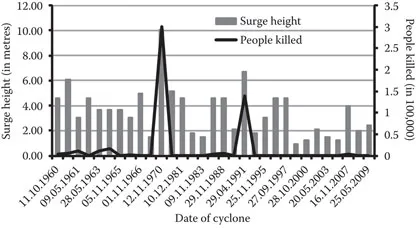
When TCs are accompanied by high surges, they can create huge property damage and human casualties (Figure 1.1), as here the force of cyclonic wind is coupled with the impact of flooding.
Figure 1.1Heights of tropical cyclone-induced surges along the Bay of Bengal coast and number of human casualties caused by those cyclones. Left vertical axis of the graph presents the surge level, right vertical axis presents the number of casualties and the horizontal axis presents dates on which the tropical cyclones made landfall.
Prediction accuracy of track forecasting techniques, both for shorter time periods (up to 24 hours) and longer time periods (>24 hours) depend mainly on the ability of the various techniques to capture the factors that influence TC motion. Prediction accuracy of statistically based techniques is additionally affected by the availability of suitable historical predictors (datasets from which the forecasts are produced). The main purpose of this chapter is to provide a straightforward exposition of the processes and factors governing TC formation and motion so far as they are understood today. This chapter also provides a detailed description of various TC track forecasting techniques where the focus is on explaining the predictors, clarifying the equations used to produce forecasts, comparing the performance of different forecasting techniques and describing each technique’s computational resource requirements.
1.2Tropical Cyclone (TC) Formation
Oceans in the tropical and subtropical regions receive immense amounts of energy from the sun. This energy is subsequently released into the atmosphere through an evaporation process. The energy released from the warm waters through evaporation is the main driving force of a tropical cyclone. This released energy warms up the air at the lowe...