Introduction to Rocket Science and Engineering, Second Edition, presents the history and basics of rocket science, and examines design, experimentation, testing, and applications. Exploring how rockets work, the book covers the concepts of thrust, momentum, impulse, and the rocket equation, along with the rocket engine, its components, and the physics involved in the generation of the propulsive force. The text also presents several different types of rocket engines and discusses the testing of rocket components, subsystems, systems, and complete products. The final chapter stresses the importance for rocket scientists and engineers to creatively deal with the complexities of rocketry.
- 320 pages
- English
- ePUB (mobile friendly)
- Available on iOS & Android
eBook - ePub
Introduction to Rocket Science and Engineering
About this book
Information
1What Are Rockets?
The 20th and 21st centuries brought forth the development of rockets that have enabled mankind to escape the bonds of planet Earth and go into the great “final frontier” that has mystified mankind since the first human looked up at the sky. Rockets have become commonplace in our everyday vernacular and culture to the extent that they are accepted technologies. We see them on television, in movies, in video games, and in books. Children have toys that apply general principles of rocket science and engineering and, for decades, have built rockets from kits that soar into the sky, generating excitement and enthusiasm. Rockets are exciting; it is as plain and simple as that!
That said, there is absolutely nothing “plain” or “simple” about a rocket. What the general “nonscientists” or “nonengineers” tend to misunderstand is how complicated and technically involved rockets actually are. The basic principles of rocket science might be easily explained to primary school-age students, but the devil is indeed in the details.
It is often stated as a major achievement of mankind that the Space Shuttle had something on the order of 2 million parts. The workings and functions of each of these parts are beyond the scope of this book, of course, but the understanding for the need of so many parts is something that will try to be emphasized herein. Rocket science and engineering are not a simple subject by any means; otherwise, the old joke about “it ain’t rocket science” wouldn’t be as funny as it is.
Therefore, this chapter will discuss a bit about how rockets were discovered and developed over mankind’s history. The basic principles governing rockets and rocket science will also be discussed and will hopefully lead the readers to a point where the old joke has a much deeper and profound meaning.
1.1The History of Rockets
1.1.1400 BCE
One of the earliest mentions of anything rocket-like in history appears to be from the writings of Aulus Gellius, a Roman. Gellius writes about a Greek individual named Archytas who is from the city of Tarentum, a part of what is now known as Southern Italy. In this story by Gellius, the character Archytas uses a wooden pigeon suspended by wires and propelled by steam to amaze and mystify the Tarentum locals. This is related to the history of rockets simply because it is the earliest known mention of man using Newton’s Third Law of action and reaction for a means of propulsion. It is especially interesting in that Newton’s laws would not be developed for about 20 more centuries to come.
1.1.2100 to 0 BCE
Sometime in the 1st century BCE, the Greek inventor Hero of Alexandria (70 to 10 BCE) is noted to have invented the device known as the aeolipile. The aeolipile was a steam-driven device that, like Archytas’s pigeon, also implemented Newton’s Third Law of action and reaction. Figure 1.1 shows an artist’s rendition of the aeolipile. It should also be noted here that the device is sometimes described as Hero’s engine.
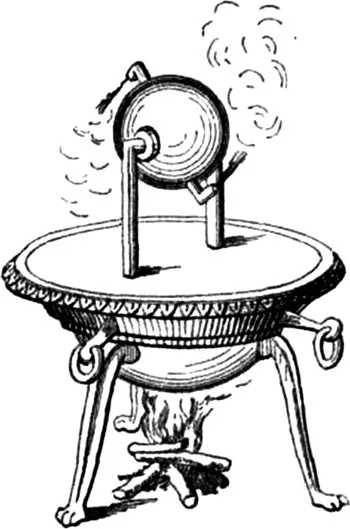
Figure 1.1Hero of Alexandria’s aeolipile demonstrates Newton’s Third Law of action and reaction, which is the driving principle behind modern rocketry.
The engine consisted of a fire to heat a reservoir of water, which was converted to steam. The steam then rose through tubes to a sphere, which collected the steam and became a pressure vessel as more and more steam became compressed into it. The sphere was suspended such that it could freely spin about a horizontal axis. On opposite sides of the sphere, orthogonal to the spin axis, were two small outlets for the steam. As the pressurized steam forced its way out of the pressure vessel and through the outlet “nozzles,” the force of the steam caused the sphere to rotate about the spin axis. In actuality, Hero’s engine contains most parts of a simple thermal rocket engine.
It is thought that the Chinese were also developing rockets in the form of fireworks sometime during this 1st century BCE. It is somewhat unclear as to the actual date when the first true rockets appeared, but it is certain that stories of rocket-like devices appear sporadically throughout this period in time. Some references suggest the Chinese had fireworks as early as the 2nd century BCE; however, others debate the claims.
1.1.30 to 100 AD
The Chinese most certainly began experimenting with compounds made from saltpeter (potassium nitrate, KNO3), realgar (arsenic sulfide, As4S4), sulfur (S), and charcoal (carbon, C) by this time period, three of which are the basic ingredients to gunpowder. (Realgar is not really required for gunpowder.) And, perhaps, the Chinese were experimenting with fireworks fashioned from these compounds.
1.1.4850 AD
The earliest certain record of gunpowder is likely from the book written in 850 AD, translated as Classified Essentials of the Mysterious Tao of the True Origin of Things. In this book, it is indicated that Taoist alchemists derived gunpowder in their efforts to develop an “elixir of immortality.” The book describes the alchemists being burned and even the building they were in burning down. It is believed that many Chinese alchemists were searching for this “elixir of immortality.” It is likely that some of them found what they were searching for by accidentally blowing themselves up. There are historical reports of large repositories of gunpowder ingredients causing major fatal accidents in ancient China during this era.
1.1.5904 AD
The Chinese began using gunpowder in warfare as incendiary projectiles by this time. These projectiles were known as “flying fires.” They were fired as arrows, grenades, and catapults.
1.1.61132 to 1279 AD
Chinese military began to expand on the flying fires and began to use gunpowder as a propellant. The earliest recorded experiments were mortars being fired from bamboo tubes.
Around 1232 AD, the Chinese reportedly used the first true rocket in their fight with the Mongols (Figure 1.2). It was reported that, at the battle of Kai-Keng, the Chinese used a tube, which was capped at one end and contained gunpowder, that was lit from the open end. The ignition of the gunpowder within the capped tube created heat, smoke, and other exhaust gases that were forced out of the open end of the tube, creating thrust. The tube was controlled by placing a stick along its side that stabilized the solid rocket’s flight path in the same way that a stick on a bottle rocket is used. Also, during this time frame, the English monk and alchemist Roger Bacon improved the formula for gunpowder for rockets. His work notably improved the range of rockets of the period.
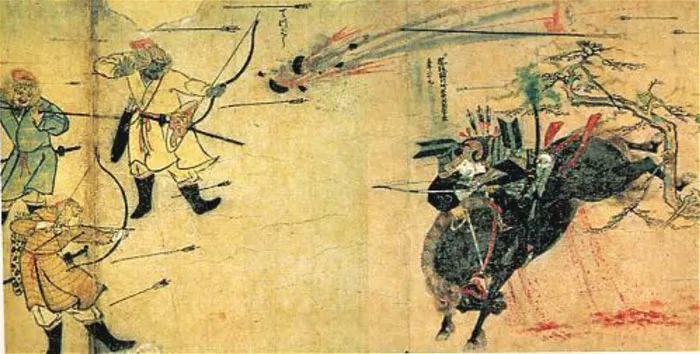
Figure 1.2The Chinese fought the Mongols using arrows and bombs as depicted in this painting, circa 1293 AD.
1.1.71300 to 1600 AD
Frenchman Jean Froissart discovered a means of improving the ...
Table of contents
- Cover
- Half Title
- Title Page
- Copyright Page
- Table of Contents
- List of Figures
- List of Tables
- Preface
- Author
- Introduction
- Chapter 1 What Are Rockets?
- Chapter 2 Why Are Rockets Needed?
- Chapter 3 How Do Rockets Work?
- Chapter 4 How Do Rocket Engines Work?
- Chapter 5 Are All Rockets the Same?
- Chapter 6 How Do We Test Rockets?
- Chapter 7 How Do We Design Rockets?
- Chapter 8 How Reliable Are Rockets?
- Chapter 9 Are We Thinking Like Rocket Scientists and Engineers?
- Suggested Reading for Rocket Scientists and Engineers
- Index
Trusted by 375,005 students
Access to over 1.5 million titles for a fair monthly price.
Study more efficiently using our study tools.
Frequently asked questions
Yes, you can cancel anytime from the Subscription tab in your account settings on the Perlego website. Your subscription will stay active until the end of your current billing period. Learn how to cancel your subscription
No, books cannot be downloaded as external files, such as PDFs, for use outside of Perlego. However, you can download books within the Perlego app for offline reading on mobile or tablet. Learn how to download books offline
Perlego offers two plans: Essential and Complete
- Essential is ideal for learners and professionals who enjoy exploring a wide range of subjects. Access the Essential Library with 800,000+ trusted titles and best-sellers across business, personal growth, and the humanities. Includes unlimited reading time and Standard Read Aloud voice.
- Complete: Perfect for advanced learners and researchers needing full, unrestricted access. Unlock 1.5M+ books across hundreds of subjects, including academic and specialized titles. The Complete Plan also includes advanced features like Premium Read Aloud and Research Assistant.
We are an online textbook subscription service, where you can get access to an entire online library for less than the price of a single book per month. With over 1.5 million books across 990+ topics, we’ve got you covered! Learn about our mission
Look out for the read-aloud symbol on your next book to see if you can listen to it. The read-aloud tool reads text aloud for you, highlighting the text as it is being read. You can pause it, speed it up and slow it down. Learn more about Read Aloud
Yes! You can use the Perlego app on both iOS and Android devices to read anytime, anywhere — even offline. Perfect for commutes or when you’re on the go.
Please note we cannot support devices running on iOS 13 and Android 7 or earlier. Learn more about using the app
Please note we cannot support devices running on iOS 13 and Android 7 or earlier. Learn more about using the app
Yes, you can access Introduction to Rocket Science and Engineering by Travis S. Taylor in PDF and/or ePUB format, as well as other popular books in Technology & Engineering & Aeronautic & Astronautic Engineering. We have over 1.5 million books available in our catalogue for you to explore.