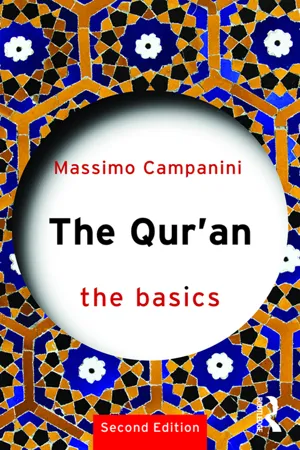
This second edition of a popular introduction to the Qur'an includes an essential updated reference guide, including a chronology of the revelation, links to internet resources, and suggestions for further reading. Exploring the Qur'an's reception through history, its key teachings, and its place in contemporary thought and belief, this volume analyzes: the Qur'an as the word of God; its reception and communication by the Prophet Muhammad; the structure and language of the text; conceptions of God, the holy law, and jihad; and Islamic commentaries on Qur'anic teachings through the ages. The Qur'an: The Basics, Second Edition is a concise and accessible introduction.
- 154 pages
- English
- ePUB (mobile friendly)
- Available on iOS & Android
eBook - ePub
About this book
Information
1
Islam and the Qurʾan
The Qurʾan is the sacred book of Islam. In Islamic culture it is the Book. It represents a point of essential reference to the essence of Islamic culture and is referred to on a daily basis by believers primarily as a religious guide but also in everyday colloquial expressions. In order to understand in what sense and how the Qurʾan carries out these functions, it is necessary to discuss the nature of Islam itself.
What is Islam?
Islam is of course a religion. That seems to be an obvious, even banal, remark. But it is important to establish that using the word religion to define Islam is, if not a mistake, at least rather imprecise. It is worth noting that from a methodological perspective terms like “religion” or “theology” are problematic or ambiguous, especially when applied to Islam. We will not make progress if we seek to define an expression such as the Islamic religion as though it is like the Christian religion. Similarly, theology in Islam is not the study of God, or argument about God, despite the literal sense of the Greek word (theos, “God”; logos, “reasoning”), but takes on an apologetic and dialectic character, as compared with dealing with divine issues.
In Arabic the word “religion” when applied to Islam may be translated in a number of ways, but the most satisfactory and precise term for it is din. The Qurʾan states at least twice that Islam is “the” din. For example, at 5.3: “Today I have perfected your religion (din) for you. I have applied my favor to you and have chosen Islam for you as your religion (din)” (but see also 3.19). In the context, however, the term Islam cannot refer to a “historical” Islam (“Islamdom”, Marshall Hodgson would have said), which did not yet exist. At the time of the Prophet neither an Islamic state nor an Islamic nation or empire existed. Islamic theology and philosophy did not exist as well; no “dogma” was established, no jurisprudence codified. Thus “Islam” must be understood as the “natural”, “monotheistic” religion wherein all humans are born. This natural inclination to God, this “submission” to Godʾs will, is truly “Islam”.
Secondly, a widely accepted definition contains three things: iman, ihsan and islam—that is, faith, right behavior and submission. Faith leads, right behavior binds and submission implies future retribution. A famous hadith—a reporting of a saying or an action of the Prophet Muhammad, transmitted among others by al-Nawawi—consists of the following anecdote:
One day, while we were sitting down listening to the Messenger of God, a man appeared in white clothes and with dark black hair. He did not look as though he had been on a journey and none of us knew who he was. He sat in front of the Prophet, put his knees together and the palms of his hands on his thighs, and said “Oh Muhammad, tell me what Islam is”. The Messenger of God said “Islam is that you bear witness that there is no other God than God and that Muhammad is the Messenger of God, that you carry out the ritual prayer, give zakat [alms], fast in the month of Ramadan and make pilgrimage to the House [the sacred mosque in Mecca], if you can”. “You say the truth”, the man said. We were surprised that he had been able to question the Prophet and been answered. The man then asked “Tell me what iman [faith] is”. The Prophet replied “It is that you believe in God, in his angels, in his Books, in his Messengers, and in the Last Day, and that you believe in the divine decree, and that it determines the good and the bad”. “You said the truth” replied the man, asking again “Tell me what is ihsan [right conduct]”. He replied “It is that you love God as though you see him, for if you do not see Him, He certainly sees you”. The man said “Tell me what the Hour [of final judgment] is”. The Prophet replied “He who is questioned does not know any more than he who asked the question”. […] After that the man disappeared and only I remained. Then the Prophet asked me “Omar, do you know who that was who questioned me?” I replied “God and His Messenger will surely know more about it”. “It was Gabriel” he said “who came to teach you your religion”.
(al-Nawawi 1990: 30–31)
This hadith, named “the hadith of Gabriel”, has been keenly interpreted by mystics and theologians alike. Faith is attestation by heart, by tongue and by limbs, that is by knowledge (islam), by reasoning (iman) and by action (ihsan). The domain of knowledge is spirit (ruh); the domain of reasoning is intellect (ʿaql); the domain of action is jurisprudence (shariʿa) (see Chittick 2000).
Despite the eminence of spiritual dimension, Islam is essentially orthopraxis—that is, practice (right behavior or ihsan) of the five pillars of faith. The most important of the five pillars is the belief that there is no other god than God and Muhammad is his Messenger (in the formula of the Arabic shahada). The two parts of the shahada do not appear together in the Qurʾan, but verse 37.35 states that “there is no other god than God” (la ilah illa Allah), while verse 48.29 states that “Muhammad is the Messenger of God” (Muhammad rasul Allah). Thus the profession of faith can be brought together from various parts of the Qurʾan. But Islam is more than the profession of faith; it is also—as we have said—complete surrender and belief in the will of God, and this is the primary meaning as well as the ordinary meaning of the term “Islam”. There is also a second fundamental implication. The God to whom one surrenders is One, and the Unity of God unifies the reality of nature and the same reality of humanity. This philosophical principle is very well described by the Muslim Brother Sayyid Qutb (1906–1966), the author of a fundamental commentary on the Qurʾan to which we shall return in the fifth chapter of this volume:
Islam is the religion of unification, and it is difficult to overemphasize this point. The religion of unity is very much centred around the notion of tawhid or unity as a central aspect of Islam. It means the Unity of God, the unification of all the religions in the religion of God, the uniformity of the message transmitted from all the prophets since the start of life.
(Shepard 1996: 33)
And also:
The essence of life, with all its various species, is one, and the essence of man, with all the infinite human varieties and potentialities, is one. […] The unique sweep of Islam is to determine the meaning of God’s worship in human life according to the Qurʾan. […] The realization of this human sweep remains impossible so long as we distinguish between the material and the spiritual parts of our lives. We should appreciate that our consciousness and our actions are part of a harmonious and single entity. Our notion of the Unity of God ought to reflect our ability to bring together and unify the various aspects of our life.
(Qutb 1991: 104–107 passim)
In the light of these considerations, we need to return to the issue of whether and how religion (din) is really connected to the “world” (dunya) since there are no distinctions between the acts of worship and social acts of behavior. It follows, Qutb writes, that
Islam is the religion that unifies the act of worship and the social act, dogma and law, spirit and matter, economic and essential values, this and the next life, earth and heaven.
(Shepard 1996: 33)
So Islam is both religion and (secular) world (din wa dunya). The great theologian al-Ghazali (1058–1111) has accordingly pointed out how exterior and interior aspects of human reality correspond and reflect each other, so that the legal practice of acts of worship work to purify and perfect the soul. It would not be superfluous to quote this long section of the Book of Forty Principles of Religion:
Know that the key to happiness is following the Sunna (behaviour) and imitating the Apostle of God in all his comings and goings, motion, and rest even as regards his eating, rising, sleeping and speaking. I do not say this only in regard to his practice in the arts of worship (adab al-ʿibadat), for there is no reason for neglecting the practices (al-Sunan) which appear therein, rather I say this in all matters of customs. Thus there results the absolute following [of Muhammad]. Allah said, “If you love God, follow me; God will love you”. And Allah also said, “Whatever the Prophet gave you, take it, and whatever he forbids you, desist from it”. It is incumbent upon you to put on full trousers (al-sarawil) while sitting and to attire yourself with a turban while standing. It is also incumbent upon you that, when you put on your shoes, you begin with the right foot; that you eat with your right hand; that you cut your fingernails beginning with the forefinger of the right hand and ending with the thumb of the right hand; that you begin with the little toe with the right foot and finish with the little toe of the left foot. Thus in all your movement and rest. Moreover you must not show levity in regard to these matters and say that these things relate only to customs and that there is no meaning in following them. For if you do this, there will close against you a great door of the doors of happiness.
Now, perhaps you desire at this moment to know the reasons for striving for the following in regard to these activities and you may consider it farfetched to suppose that there is an important matter underlying this topic. Know, therefore, that the mentioning of the secrets in regard to every one of these practices is long, and though it is not the purpose of this book to explain them, it is necessary that you understand that the Sunna contains secrets.
(al-Ghazali 1970: 102–103)
We should not be surprised that faith includes rules about dressing, eating or how to cut toe nails, since rectitude in exterior behavior is the precondition for rectitude of the spirit and soul. Many medieval theologians like Ibn Taymiyya (1263–1328) and especially the modern radical Muslims like the already mentioned Sayyid Qutb have argued that Islam is both a religion and a political system since in Islam one can see a strict integration between religion and politics. In a book like this on the Qurʾan, political issues do not concern us directly. However, it is important to underline that—if Islam is for all the believers a religion and a world, and for a few followers a religion and a state (dawla)—it is as much din as it is ideology. Here ideology is meant in the positive sense of the term—that is, as abstract and universal thought about reality. It is true, though, that one (like Marx and many Marxists) can treat ideology as like alienation or false consciousness, as manipulation by lies. But it is obvious, according to Ferruccio Rossi Landi, that ideology may be both action and social planning: “[L]ike a real social force, all ideology is capable of pervading society in which it is formed” (Rossi Landi 1978: 5). If it is true that Islam is a religion and universe, then it is ideology in the sense of a specific outlook pervading human life and influencing the nature of social organization (and this is broadly Gramsci’s opinion).
In order to present itself completely as a positive ideology, Islam has to take on board its historical background. A highly significant aspect of classical Islamic culture consists of what has been taken up in modern times as a result of an anti-utopian conception of history, or of a retrospective utopia. By this expression I mean the tendency to consider the past, especially the period of Muhammad and the first caliphs, as a perfect and incomparable golden age in which the connection between religion and politics, ethics and the community had been successfully realized to produce a perfect Islamic society. Such a golden age can be used as an exemplar, as something to be repeated perhaps, and as an argument against innovation and modernization. This anti-utopian (or retrospective utopian) strategy is clearly expressed in classical times by Hanbalite thinkers from Ibn Hanbal himself to Ibn Batta and Ibn Taymiyya, and in contemporary times by radical Muslims such as Sayyid Qutb and al-Mawdudi. The anti-utopian strategy can lead to and encourage the project of separating the sacred text from history. Removing the sacred text from history means, on the one hand, not linking it with the changing socio-political changes in which people live and, on the other, solidifying its meaning in just one direction (treating the text as having only one kind of meaning). We shall see in the fifth chapter of this volume how some contemporary Qurʾanic exegetes have tried to take a different approach by seeking to locate the Qurʾan in history.
The Characteristics of Islam as a Religion
For Muslims, Islam is the natural religion of humanity (fi tra or hanifiyya), a religion in which every individual is born. There is a hadith of the Prophet that says: “Every person is born in the natural religion. It is his/her parents who make him/her a Christian, a Jew or a Zoroastrian”. This conception finds support in the Qurʾanic verse 30.30 that Bausani translates in a way that could be rendered in English as “Turn steadfastly to the true religion, in purity of faith (hanifan), the original nature (fi tra) in which God made men” (Bausani 1988: 297). Bonelli by contrast translates it as “Whoever turns his face steadfastly to the true religion, the hanif [monotheist]; it is the institution of God to which He has made men naturally inclined” (Bonelli 1976: 376). For his part, Arberry translates fi tra as “God’s original” (Arberry 1982: 414). Abdel Haleem has this: “[A]s a man of pure faith, stand firm…. This is the natural disposition God instilled in mankind” (Abdel Haleem 2004: 258). Each spontaneous tendency to monotheism is shaped as a natural religion, through which, although it might seem to be paradoxical, the authentic Jew and the authentic Christian are really “Muslims”.
For Muslims, Islam is a prophetic religion, one that, like Judaism and Christianity, is based on the idea that the message of God is said to have been revealed through the sending of prophets. The prophetic story starts with Adam, the “father of human beings”, and continues by Noah,...
Table of contents
- Cover
- Title
- Copyright
- CONTENTS
- 1 Islam and the Qurʾan
- 2 Structure and Composition
- 3 God, Humanity and Prophecy
- 4 The Qurʾan and the Qurʾanic Sciences
- 5 Contemporary Approaches to the Qurʾan
- Appendix I: Glossary of Essential Terms
- Appendix II: Concise Traditional Chronology of the Revelation
- Appendix III: Websites on the Qurʾan
- Works Cited and Bibliography
- Index
Trusted by 375,005 students
Access to over 1.5 million titles for a fair monthly price.
Study more efficiently using our study tools.
Frequently asked questions
Yes, you can cancel anytime from the Subscription tab in your account settings on the Perlego website. Your subscription will stay active until the end of your current billing period. Learn how to cancel your subscription
No, books cannot be downloaded as external files, such as PDFs, for use outside of Perlego. However, you can download books within the Perlego app for offline reading on mobile or tablet. Learn how to download books offline
Perlego offers two plans: Essential and Complete
- Essential is ideal for learners and professionals who enjoy exploring a wide range of subjects. Access the Essential Library with 800,000+ trusted titles and best-sellers across business, personal growth, and the humanities. Includes unlimited reading time and Standard Read Aloud voice.
- Complete: Perfect for advanced learners and researchers needing full, unrestricted access. Unlock 1.5M+ books across hundreds of subjects, including academic and specialized titles. The Complete Plan also includes advanced features like Premium Read Aloud and Research Assistant.
We are an online textbook subscription service, where you can get access to an entire online library for less than the price of a single book per month. With over 1.5 million books across 990+ topics, we’ve got you covered! Learn about our mission
Look out for the read-aloud symbol on your next book to see if you can listen to it. The read-aloud tool reads text aloud for you, highlighting the text as it is being read. You can pause it, speed it up and slow it down. Learn more about Read Aloud
Yes! You can use the Perlego app on both iOS and Android devices to read anytime, anywhere — even offline. Perfect for commutes or when you’re on the go.
Please note we cannot support devices running on iOS 13 and Android 7 or earlier. Learn more about using the app
Please note we cannot support devices running on iOS 13 and Android 7 or earlier. Learn more about using the app
Yes, you can access The Qur'an by Massimo Campanini in PDF and/or ePUB format, as well as other popular books in Teología y religión & Teología islámica. We have over 1.5 million books available in our catalogue for you to explore.