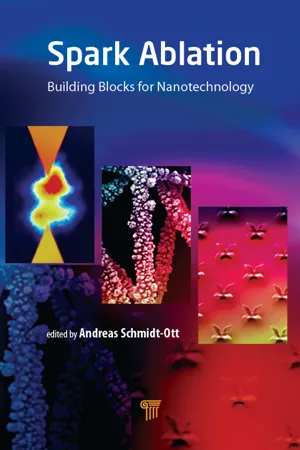
Spark ablation has been used worldwide for decades. However, in many fields, the special properties of nanoparticles, which come into play especially for sizes <20 nm, are just beginning to be exploited. The technique offers unprecedented flexibility regarding composition and size, and revolutions in the domains of catalysis and sensor technology, and more are to be expected. This book is the first review of spark ablation as a unique, scalable source of building blocks for nanotechnology and a powerful tool to promote this development. The introductory chapters give an overview of the technological fields that can exploit size effects, and explain the process of spark ablation in the gas phase, as well as principles of immobilizing particles to create novel products and materials. Fundamentals of the spark ablation process are then discussed, in addition to the characteristics of the particles formed. The rest of the book deals with a selection of application fields that profit from the spark ablation source from the perspective of research. With the authors' many years of experience in spark ablation and its applications, all the chapters complement one another and contain numerous cross-references in order to enable the reader to obtain a complete picture of the subject.
- 456 pages
- English
- ePUB (mobile friendly)
- Available on iOS & Android
eBook - ePub
About this book
Information
Topic
Physical SciencesSubtopic
BiologyChapter 1
Application Domains of <20 nm Particles and the Role of the Spark Discharge Generator
Eva A. J. Rennen,a Maurits F. J. Boeije,b and Andreas Schmidt-Ottb,c
aVSPARTICLE B.V., Molengraaffsingel 10, NL-2629 JD Delft, The Netherlands
bFaculty of Applied Sciences, Delft University of Technology, NL-2629 HZ Delft, The Netherlands
cEnvironment and Water Research Center, Cyprus Institute, Nicosia, Cyprus
The present chapter compiles application areas of nanoparticle production by spark ablation. The spark ablation technique is best applied to produce inorganic particles in the diameter range between atomic clusters (smaller than 2 nm) and 20 nm. In this range, particle properties are very different from macroscopic (bulk) materials and strongly size dependent.
1.1 Introduction
Particles close to the atomic size obey the laws of quantum mechanics, as expressed by Schrödinger’s equation, which represents the most important category of differences with respect to the bulk in the size range below 20 nm. A review by Roduner [1] explains the origin of these differences. For example, the solution of Schrödinger’s equation for the valence electrons in a small metal particle (similar to the electron-in-a-box problem) demands discrete (quantized) energy levels the electrons may occupy. This change in the electronic structure of sub-20-nm particles with respect to bulk systems changes virtually all properties. Additional influences of the small size on particle properties also governed by quantum mechanics are associated with collective electron oscillations (plasmons), the occurrence of superparamagnetism, and more. Other size effects that specifically apply to these very small particles are related to a reduced binding energy between surface atoms due to surface curvature, such as a reduced melting point and size-dependent catalytic activity. Astonishingly, nanotechnology has, until now, hardly exploited the most interesting features of this size range, where size effects are most prominent. We claim that difficulties in producing these particles in a clean, controlled, and flexible way are one reason for holding back this development. Another feature of such small nanoparticles that has practically not been exploited is to be seen in the stronger tendency to form alloys with respect to bulk material. It has frequently been observed that the phase diagrams of mixed materials allow for new mixed phases when the dimensions shrink [2]. Atomic mixing thus receives a new quality in nanoparticles and basically opens myriads of possibilities associated with new material properties.
We believe that the development of spark ablation nanoparticle production will play an important role in moving nanotechnology into the sub-20-nm size range, where exploiting new properties for applications promises to be most rewarding. This development will be aided by the feature of spark ablation to easily mix solid materials [2], from the atomic scale (alloys) to the scale of a few nanometers. This opens an exciting spectrum of new possibilities for functional materials as well as nanodevices.
In this chapter we list the basic size effects that govern the properties of sub-20-nm particles, and link them to applications that have already been found in products and those that are in the research stage. We also speculate on possible future applications that the properties seem to open up. The reader may use this overview of what is known today also as an inspiration of what may be done tomorrow.
Subsequently, features of spark ablation are briefly outlined and compared to other nanoparticle production methods. Indications of required quantities of nanoparticulate material per item are given for industrial applications, and a selection of examples illustrates the contribution of spark ablation in the development of applications listed in the overview that make use of the size effects.
1.2 Sub-20 nm Particle Properties and Their Application Domains
1.2.1 Basic Size Effects
Table 1.1 lists basic size effects that cause properties of very small particles to change with size and that are of practical interest. It groups them into three categories. Strictly speaking, the basic categories on the left are related (e.g., binding energy is also connected to quantum mechanics), but the separation is considered as illustrative. Some effects of practical interest are listed in the right-hand column. The basic properties of category B1 deal with the rather trivial, purely geometric consequences (mainly surface-to-volume ratio), which also apply to larger particles. The second category of surface curvature effects, B2, is based on the atomic structure of matter, which can be qualitatively explained by classical, non-quantum-mechanical arguments and that deal with important changes that occur when reducing particle size. Surface curvature in small particles reduces the coordination number of surface atoms, and that has some drastic consequences below 20 nm, as listed in the right-hand column of the second category. “Faster dissolution” is mentioned in both categories B1 and B2 because the kinetics of particle dissolution profits from a higher surface area (for the same volume), and additionally the weaker binding of surface atoms with rising surface curvature promotes dissolution. Category B3 deals with phenomena that can only be understood with the principles of quantum mechanics, even on a qualitative level.
Basic category | Basic size effects of practical interest |
|---|---|
B1. Geometry or surface-to-volume ratio related | B1.1 Faster mass transport to surface of particle in medium |
B1.2 Faster mass transport from surface to center of particle | |
B1.3 Faster dissolution | |
B1.4 Reduced strain in volume expansion | |
B2. Reduced binding energy between atoms due to surface curvature | B2.1 Reduced melting point |
B2.2 Increased vapor pressure | |
B2.3 Faster dissolution | |
B2.4 Increased chemical reactivity | |
B2.5 Size-dependent catalytic activity | |
B2.6 Increased adsorptive binding of atoms/molecules | |
B2.7 Larger variety of crystal habits | |
B2.8 Laplace pressure inside nanoparticle | |
B2.9 Superplasticity | |
B2.10 Reduced surface free energy | |
B3. Quantum-mechanical size effects | B3.1 Size-dependent plasma resonance |
B3.2 Size-tunable bandgap in quantum dots | |
B3.3 Photoelectron emission enhancement | |
B3.4 Superparamagnetism | |
B3.5 Formation of “superatoms” | |
B3.6 Strong size dependence of light scattering and absorption | |
B3.7 Surface-enhanced Raman scattering (SERS) from adsorbed molecules |
Application examples related to the basic categories of Table 1.1 are listed in Table 1.2. For example, catalysis is influenced by a high surface-to-volume ratio and is additionally influenced by a “coordination number effect,” that is, the changed atomic arrangement on a curved surface, leading to higher reactivity or stronger adsorptive binding with respect to the bulk. Some effects mentioned in Table 1.1 do not have any notable applications yet, which means that they are still to be found.
“Superatoms” is a term introduced in publications of the groups of Castleman and Khanna [3]. As pointed out before, valence electrons in a metal particle occupy discrete energy levels, and these particles thus mimic specific atoms in the periodic table and chemically behave like these (see also Ref. [1]). For example, Al13 behaves like a halogen atom, and Al7 behaves like an alkali metal atom. Eventually, it may be possible to design stable atomic clusters that form “cluster assembled materials” with new properties or properties of more expensive materials. This vision was already expressed in 1996 in Klaus Sattler’s book Cluster Assembled Materials, but since then there has been little progress in this field, and it remains a future perspective, which may now have become more realistic with the availability of flexible high-production-rate spark discharge generators combined with mobility classification (see Chapter 7).
1.2.2 Application Domains of sub-20 nm Particles
The basic properties described before bare the potential of many technological applications. Table 1.2 compiles applications that have been described in literature and links them to the size effects in Table 1.1. The application areas listed are examples, most of these have made use of spark ablation, and for all of them spark ablation would be an option. Chapters and sections of the present book that deal with the applications are indicated. In Section 1.4, many of these application examples are further described.
1.2.3 Requirements for Successful Applications
The effectiveness of the particles for specific applications, both in research and on an industr...
Table of contents
- Cover
- Half Title
- Title Page
- Copyright Page
- Table of Contents
- Preface
- 1. Application Domains of <20 nm Particles and the Role of the Spark Discharge Generator
- 2. Nanoparticle Production by Spark Ablation: Principle, Configurations, and Basic Steps toward Application
- 3. Spark Plasma Diagnostics
- 4. The Physics and Equivalent Circuit Modeling of Spark Ablation
- 5. Generation of Mixed Nanoparticles by Spark Ablation of Alloys and Spark Mixing
- 6. Characterization of Nanoparticles from Spark Ablation
- 7. Atomic Clusters: Potential of Spark Discharge Generation
- 8. The Use of Spark Ablation for Generating Cluster Beams: A Review
- 9. Patterned 3D Nanostructure Arrays from Charged Aerosols
- 10. Catalytic Applications of Nanoparticles Produced by Spark Ablation
- 11. Nanoparticles and Nanoparticle-Based Materials Produced by Spark Ablation for Environmental Gas Sensors
- 12. Alloy Plasmonic Nanoparticles and Their Applications
- 13. Spark Ablation for Biomedical Application
- 14. Application of a Spark Discharge Generator for Production of Combustion-Like Aerosols
- Index
Trusted by 375,005 students
Access to over 1.5 million titles for a fair monthly price.
Study more efficiently using our study tools.
Frequently asked questions
Yes, you can cancel anytime from the Subscription tab in your account settings on the Perlego website. Your subscription will stay active until the end of your current billing period. Learn how to cancel your subscription
No, books cannot be downloaded as external files, such as PDFs, for use outside of Perlego. However, you can download books within the Perlego app for offline reading on mobile or tablet. Learn how to download books offline
Perlego offers two plans: Essential and Complete
- Essential is ideal for learners and professionals who enjoy exploring a wide range of subjects. Access the Essential Library with 800,000+ trusted titles and best-sellers across business, personal growth, and the humanities. Includes unlimited reading time and Standard Read Aloud voice.
- Complete: Perfect for advanced learners and researchers needing full, unrestricted access. Unlock 1.5M+ books across hundreds of subjects, including academic and specialized titles. The Complete Plan also includes advanced features like Premium Read Aloud and Research Assistant.
We are an online textbook subscription service, where you can get access to an entire online library for less than the price of a single book per month. With over 1.5 million books across 990+ topics, we’ve got you covered! Learn about our mission
Look out for the read-aloud symbol on your next book to see if you can listen to it. The read-aloud tool reads text aloud for you, highlighting the text as it is being read. You can pause it, speed it up and slow it down. Learn more about Read Aloud
Yes! You can use the Perlego app on both iOS and Android devices to read anytime, anywhere — even offline. Perfect for commutes or when you’re on the go.
Please note we cannot support devices running on iOS 13 and Android 7 or earlier. Learn more about using the app
Please note we cannot support devices running on iOS 13 and Android 7 or earlier. Learn more about using the app
Yes, you can access Spark Ablation by Andreas Schmidt-Ott in PDF and/or ePUB format, as well as other popular books in Physical Sciences & Biology. We have over 1.5 million books available in our catalogue for you to explore.