- 336 pages
- English
- ePUB (mobile friendly)
- Available on iOS & Android
eBook - ePub
About this book
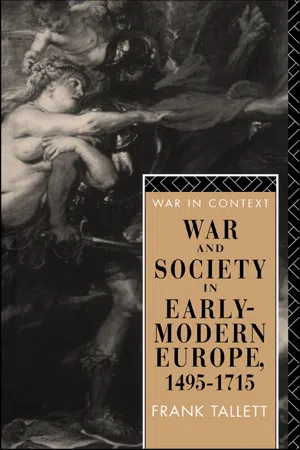
War and Society in Early Modern Europe takes a fresh approach to military history. Rather than looking at tactics and strategy, it aims to set warfare in social and institutional contexts. Focusing on the early-modern period in western Europe, Frank Tallett gives an insight into the armies and shows how warfare had an impact on different social gro
1
INTRODUCTION
REWRITING THE HISTORY OF WAR
The writing of military history has only just begun to escape from the unfortunate influence of its nineteenth- and early twentieth-century practitioners. For the most part these tended to be military men who wrote for other military men: either practising soldiers or teachers in the army staff colleges and training schools. The function of military history was seen as the provision of lessons and examples from the past of good generalship, strategy, tactical formations and the correct use of weapons. Military history was didactic, and since most nineteenth- and early twentieth-century soldiers saw the annihilation of the enemy’s forces as the chief aim of all strategy, the history they wanted was chiefly one of battles: how they had been ordered, fought and won.
Academic historians for a long time hesitated to become involved in military history. They were not welcomed by practising soldiers, being regarded with deep suspicion as amateur dabblers; and the subject was not anyway regarded as a suitable one for members of the profession. On learning that Hans Delbrück was about to embark on a history of the art of war von Ranke opined that the subject was not worth the effort; and as late as 1939 Charles Oman, doyen of Anglo-Saxon military historians, felt obliged to include a justificatory chapter entitled ‘A plea for military history’ in his general work On the Writing of History. Moreover, even when they did belatedly enter the arena, academic historians did not markedly deviate from the battle- and campaign-oriented approach of their military predecessors. To be sure, Hans Delbrück did attempt to relate military history to pertaining political forms and institutions, as the title of his monumental seven-volume History of the Art of War in the framework of Political History suggests, arguing that in any period between the Persian Wars and Napoleon changes in one sphere produced alterations in the other.1 And in the best Rankean tradition of scholarship, his work was characterized by a meticulous and critical approach to the sources (he showed, for example, that most accounts of battles vastly exaggerated the number of men involved), a characteristic the more especially laudable given the slapdash attitude of so many of his predecessors and contemporaries. Yet at no stage of his work did Delbrück provide a sustained analysis of the relationship between politics and war, and the uninformed reader might be forgiven for thinking that here was one more catalogue of campaigns through the ages.
Delbrück’s influence was almost entirely confined to Germany, yet elsewhere academic historians displayed an approach to military history which was scarcely less narrow. In France, military writers remained obsessed with Napoleon, especially in the aftermath of the defeat by Prussia in 1870, when an analysis of his successful campaigns seemed to promise the lessons—in respect of generalship, strategy and tactics—which would avoid the repetition of a similar national disaster and possibly lay the basis for a restoration of France’s military greatness. In England, the pattern for historical writing on military matters was established early on by the publication in 1851 of the amateur historian Sir Edward Creasy’s influential Fifteen Decisive Battles of the World, and subsequently confirmed in the prolific writing of Sir Charles Oman, especially his seven-volume History of the Peninsular War (1902–30) on which subject he was an acknowledged expert, his History of the Art of War in the Middle Ages (1898, 1924) and the sequel, A History of the Art of War in the Sixteenth Century (1937). As he noted in the latter, his purpose was to depict the ‘strategy, tactics and organisation of armies’,2 and these were illustrated by reference to a series of set-piece battles, which were loosely connected via a narrative framework dwelling on the political and diplomatic events of the period. In the hands of less competent practitioners than Oman this approach degenerated to become merely the chronicling of ‘one damn battle after another’, with interludes for the description of badges and buttons.
For all the very real worth of authors such as Oman this restricted, campaign- and battle-oriented approach does a disservice to the military history of the early-modern period (no less than to war in the Middle Ages, when, incidentally, knights were quite happy to get off their horses and fight on foot). It distorts our understanding of the nature of warfare which was not primarily characterized by pitched battles at all, but rather by sieges and what would now be called ‘low-intensity operations’: skirmishes, ambushes, raids, forays against civilians and prisoner-taking expeditions. Moreover, whole areas of enquiry which ought properly to be included in a study of warfare in the early-modern era, no less than in any other—the rank and file of an army, its supply, its camp-followers, relations with civilians, attitudes towards conflict for example—all go by default.
Set against this background the transformation which has taken place in the writing of military history in the last three decades or so can only be described as revolutionary. By taking advantage of the voluminous archive material which armies produced and by asking new questions of old material, historians have succeeded in elucidating a range of topics which were neglected by their predecessors. To be sure, much remains unclear. But we do now know a good deal more about the ordinary soldier for example: what impelled him to join up, what his conditions were like; about the ‘tail’ of an army: even the role of women in armies has been broached;3 and thanks to the efforts of Jacquart, Gutmann and Friedrichs amongst others, we are better informed about the impact armies had on the economy and civilian life.4 Even battle has been newly scrutinized, from the perspective of the ordinary soldier, in John Keegan’s brilliantly evocative The Face of Battle, in which he seeks to demonstrate what it was actually like to participate in a set-piece engagement.5 Indeed, what has not unfairly been termed the ‘socialization’ of military history has been carried so far that it is now near-impossible to produce a work on this topic without a reference to ‘society’ at some point in the title.6
The founding father of this new approach in France was André Corvisier, who, in 1964, produced a weighty study of his country’s army in the late seventeenth and eighteenth centuries.7 In the Anglo-Saxon world a shift in historians’ perspective on military history was signalled in Michael Roberts’s inaugural lecture to the University of Belfast in 1955: one of the few such occasions, surely, to produce a seminal piece of thinking.8 In this he focused attention on the sixteenth and seventeenth centuries, and suggested that the years 1560–1660 in particular witnessed a military revolution. Changes in weaponry and tactical formations, he argued, lay at the heart of wider developments, which included an enormous growth in the size of armies, an increased impact of warfare on civilians and the emergence of more powerful states in the seventeenth and eighteenth centuries characterized by their burgeoning professional bureaucracies, their willingness to intervene in matters of finance and the economy and a disregard for existing social structures. Roberts’s thesis has not gone unchallenged.9 The profundity, nature, genesis and even the reality of the changes he outlined have all been questioned; but not the least of his contributions to scholarship has been to promote further research and thinking on a topic and a period which most historians—whether or not they accept the military revolution thesis in detail—would agree did witness profound changes in warfare and its wider importance.
SOLDIERS, SOLDIERS, SOLDIERS
One change in the sixteenth and seventeenth centuries to which Roberts pointed and on the reality of which there is general agreement was the dramatic increase in the number of men under arms. Indeed, this was such a marked feature of the period, and so heavy with consequences, that it demands at the outset some extended discussion and analysis.
The growth in numbers is difficult to quantify with any precision. A conventional way of measuring growth is to look at the major engagements during the period, since most contemporary early-modern accounts of battles give some indication of the size of the forces involved, albeit often exaggerated. An increase is indeed clearly discernible, apparently being most marked at the very end of the seventeenth and beginning of the eighteenth centuries (see Table 1). However, battle accounts do not provide a reliable indicator, not least of all since we now know that the extra men under arms were not necessarily put into field armies, but were to be found serving in garrisons, laying siege to cities and forts and occupying territory. A more reliable assessment of growth can be obtained by looking at the total numbers of men mobilized for a particular campaign or maintained permanently in a theatre of war. To establish this is an exercise fraught with difficulties, however, for all statistics produced by early-modern governments need to be treated with caution, most especially those connected with the military. Rulers and their ministers were incorrigible wishful thinkers: Philip I V, for example, claimed in 1625 to have 300,000 men under arms, whereas the real number was not much more than half this.10
Table 1 Numbers in battle
Generally, administrators simply did not know with any degree of accuracy how many men were actually serving. ‘I am sure I may puzzle my brain to pieces, and not be able to make out such an account’, was the frank and unusually honest response of one harassed official in the Secretary of State for War’s office when pressed on the matter by Parliament in 1710.11 In theory, records of musters should have provided administrators with accurate totals of men present, especially as musters were subject to increasing scrutiny by cost-conscious royal officials in the later seventeenth century, but in fact fraudulent captains continued by a variety to means to pad out the actual numbers in their units, the real size of which was continuously being reduced by sickness and the ceaseless flow of deserters. As a result, numbers fluctuated widely during a campaign, and ‘paper’ strengths were never attained, a state of affairs which had perforce to be accepted by contemporary administrators. ‘If you wish to have 50,000 men serving, you must raise 100,000,’ was Richelieu’s realistic advice to the king in his Testament politique, ‘working on the assumption that a regiment of 20 companies which should include 2,000 men will in fact only have 1,000.’12
Table 2 Forces raised for a campaign or kept permanently in place
As a consequence, the figures in Table 2, which are culled from a number of sources and which I have sought to adjust up or (mainly) down in the interests of accuracy, must be regarded as very approximate. They nevertheless point clearly to a dramatic growth in the overall number of men under arms. Indeed, in two respects the figures may underplay the phenomenon. First, they do not fully reflect the growing permanence of armies. Governments throughout the period generally disbanded forces as soon as a campaign was over, either to save money or because they could not anyway be held together. Thus Louis XII’s army of 23–29,000 men used to capture Milan in the summer of 1499 was dispersed back to France in November, a force of only 500 being retained to hold the city (a dubious economy since it was lost and had to be expensively re-taken); and following the seizure of Amiens from a Spanish garrison under Portocarrero in September 1597 Henry IV wrote to his sister Catherine, ‘On Thursday evening I had 5,000 gentlemen [in the cavalry]: on Saturday at midday I have less than 500. Amongst the infantry the loss through disbanding is less, though still very great.’13 But there was a tendency to retain a larger core of men in peacetime around which fresh forces could be assembled quickly in time of emergency. The Valois kings were first off the mark, Francis I building on schemes of his predecessors with a proposal in 1534 for the formation of seven permanent infantry légions comprising 42,000 men, a proposal which, however, was more successful on paper than in reality; it is doubtful if peacetime levels rose much above 10,000 at any time during the sixteenth century, and were down to 8,500 in 1598, having fallen below this during the chaos of the Religious Wars. Yet by 1626 Richelieu estimated peacetime requirements at 22,000, a figure which may actually have been attained. After the Peace of the Pyrenees (1659) the size of the army, which had expanded enormously during the Thirty Years War, was reduced to a strength of 55,000, being built up again during the Dutch and Devolution Wars, to be held at a peacetime level of 130,000 after the Treaty of Nijmegen in 1678, at about which level it hovered for the next one hundred years. By this stage certain regiments enjoyed a clearly established permanent existence safe from the threat of peacetime dissolution: the Gardes Françaises, Maison du Roi, Gardes Suisses, plus the six ‘provincial’ regiments of Picardy, Piedmont, Navarre, Champagne, Normandy and La Marine.14 Similarly, the Spanish monarchy retained a nucleus of men in the Iberian peninsula after the conquest of Granada in 1492; and the subsequent acquisition of territory in Italy, notably Naples (1504) and Milan (1535) led to the permanent stationing of about 10,500 troops in the Italian dominions to guard against native rebellion and outside invasion. But its biggest force was the Army of Flanders, maintained in the Low Countries from 1569, which even during the Twelve Years Truce (1609–21) and after the Peace of the Pyrenees (1659) had a permanent core of 13–15,000 troops which could be expanded five- or sixfold in times of crisis.15 Or again, Spain’s occasional ally and competitor in the Mediterranean, Venice, had kept a permanent force of men since the first quarter of the fifteenth century, which by c. 1510 hovered around the 2,000 mark; it had more than doubled by the 1570s and stood at nearly 9,500 in 1615.16
Second, by the seventeenth century a number of small and medium sized states were supporting larger forces than ever before and doing so not just in time of war but also in time of peace. Whereas the sixteenth-century Vasa dynasty in Sweden had disposed of a handful of men, Charles XI maintained some 25,000 mercenaries, mainly in the Baltic provinces, in addition to yet larger numbers of native levies kept in the homeland. Within Germany, Brandenburg-Prussia was most notable for the expansion of its army: the Great Elector is generally regarded as having upwards of 30,000 troops at his death in 1688, a number which was to increase by one-third under his successor. But rulers in other German states, such as Hesse-Cassel, Württemberg, Saxony, Jülich and Berg, either because they wished to flex their muscles on the European scene or because they felt the need to look to their own defence once the protective umbrella provided by the Empire had been to some extent removed in the aftermath of the Peace of Westphalia, also sought to increase the size of their forces, though none of them matched Brandenburg-Prussia in this respect.17
Overall, we may posit a ten- or twelvefold increase in aggregate in the numbers of men under arms during the course of the sixteenth and seventeenth centuries. However, growth was not linear. The increase was marked in the first half of the sixteenth century, but reached a plateau around the 1550s. Charles V had a total of 148,000 men at his disposal, dispersed throughout his European and North African dominions in 1552; Henry II put together perhaps 40,000 for the attempt on Metz in 1552; whilst Philip II fielded 43,000 in July and August 1557 for his invasion of northern France, the largest single force thus far assembled by any monarch. Even England’s military efforts reached a mid-century numerical climax in 1544 with Henry VIII’s third French expeditionary force, numbering some 40,000. But these were levels which were unprecedented, and were not again attained until the seventeenth century.18 Another round of expansion then took place, connected mainly with the Thirty Years War (1618–48), which raised numbers to a new peak. Spain, France, the Empire and Sweden were each, at one stage or another and on various fronts, supporting forces in excess of 100,000; and at the height of the fighting there were over one-quarter of a million men engaged in soldiering in Germany.19 There followed a sharp reduction in numbers with the return to relative peace signalled by the treaties of Westphalia (1648), the Pyrenees (1659) and Oliva (1660), though peacetime forces nevertheless remained well above their prewar levels. But this was short-lived, and the inflationary process received yet another sharp boost from the 1670s onwards, from which only Spain of the major powers was excluded (a sure sign of her decline), to peak at an all-time high around 1710, by which time there were some 860,000 serving soldiers in central and western Europe, compared to roughly 300,000 in 1609, with the figure rising to 1.3 million if forces in Poland, Russia and Turkey are added in.20 Thereafter, numbers remained relatively stable throughout the eighteenth century, until the Revolutionary and Napoleonic Wars, which were marked by a further dramatic increase in army size.
Insignificant though these totals may be by twentieth-century standards, the multiplication of troops in the sixteenth and seventeenth centuries was wholly unprecedented, and marked a quantum leap forward in the number of men under arms. How is the phenomenon of growth in general, and how are the stages of growth in particular, to be explained?
Innovation in...
Table of contents
- COVER PAGE
- TITLE PAGE
- COPYRIGHT PAGE
- PREFACE
- MAPS
- 1: INTRODUCTION
- 2: THE CHANGING ART OF WAR
- 3: RECRUITMENT
- 4: LIFE AND DEATH IN THE ARMIES
- 5: THE IMPACT OF WAR
- NOTES
- SELECT BIBLIOGRAPHY
Trusted by 375,005 students
Access to over 1.5 million titles for a fair monthly price.
Study more efficiently using our study tools.
Frequently asked questions
Yes, you can cancel anytime from the Subscription tab in your account settings on the Perlego website. Your subscription will stay active until the end of your current billing period. Learn how to cancel your subscription
No, books cannot be downloaded as external files, such as PDFs, for use outside of Perlego. However, you can download books within the Perlego app for offline reading on mobile or tablet. Learn how to download books offline
We are an online textbook subscription service, where you can get access to an entire online library for less than the price of a single book per month. With over 1.5 million books across 990+ topics, we’ve got you covered! Learn about our mission
Look out for the read-aloud symbol on your next book to see if you can listen to it. The read-aloud tool reads text aloud for you, highlighting the text as it is being read. You can pause it, speed it up and slow it down. Learn more about Read Aloud
Yes! You can use the Perlego app on both iOS and Android devices to read anytime, anywhere — even offline. Perfect for commutes or when you’re on the go.
Please note we cannot support devices running on iOS 13 and Android 7 or earlier. Learn more about using the app
Please note we cannot support devices running on iOS 13 and Android 7 or earlier. Learn more about using the app
Yes, you can access War and Society in Early Modern Europe by Frank Tallett in PDF and/or ePUB format, as well as other popular books in History & Early Modern History. We have over 1.5 million books available in our catalogue for you to explore.