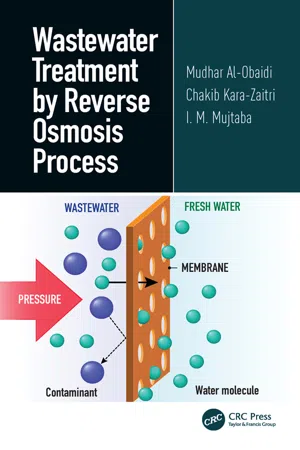
Wastewater Treatment by Reverse Osmosis Process provides a one-stop-shop for reverse osmosis (RO), outlining its scope and limitations for the removal of organic compounds from wastewater. This book covers the state-of-the-art on RO processes and describes ten RO process models of different features and complexities. It also covers the advanced model-based techniques for RO process operations, including various rigorous methods for process modelling, simulation, and optimization at the lowest energy cost, as well as advanced tools such as genetic algorithms for achieving the same.
• Highlights different types of physico–chemical and biological wastewater treatment methods including hybrid systems • Provides an overview of membrane processes, focuses on different types of membrane processes for water treatment and explains characteristics of membrane modules • Introduces the importance and challenges of process modelling for simulation, design, and optimization and offers examples across various industries
•Describes the concept of different types of genetic algorithms for process optimisation and provides the state-of-the art of the GA method in terms of its application in water desalination and wastewater treatment
•Emphasizes economic aspects of RO processes for wastewater treatment
With its focus on the challenges posed by an increasing demand for fresh water and the urgent need to recycle wastewater at minimum cost, this work is an invaluable resource for engineers and scientists working within the field of wastewater treatment.
Trusted by 375,005 students
Access to over 1.5 million titles for a fair monthly price.
Water affects all facets of life for humans, animals, plants, and the environment. Without it, there would be no vegetation on land, no oxygen for animals to breathe, and no humans to survive. Water is an essential component of nearly everything we eat and drink now and into the future. Even though there are a variety of water sources, such as rivers, lakes, and groundwater, fresh drinking water only constitutes 3% of the total global water available (Bielik et al., 2010). The increasing demand for fresh water in this heavily populated world and the continuously changing ecological environment due to greenhouse effects continue to pose a real and serious challenge. This is aggravated further with droughts, which are not limited to water-scarce regions of the world. In other regions of the world, where there is a shortage of drinking water, desalination water systems are used as they offer a technologically and economically viable solution (Kharraz et al., 2012; Droogers et al., 2012).
As the world population grows, the heavily industrialised world we live in continues to generate vast volumes of wastewater. This is, more often than not, plagued with industrial effluents, sewage, and many harmful, some carcinogenic, by-products, which are often disposed of in rivers and oceans. These contain heavy metals (Nyamayedenga, 2018) with highly toxic hydro-soluble metal ions and are major causes of environmental pollution. At the same time as this, there is a growing awareness of the impact of industrial effluents on wellbeing, health, and the ecosystem. With freshwater resources being depleted at a fast rate, it is clear that the demand for cleaner potable water is set to increase exponentially in future years, and the demand for high-quality water recycling and treatment will become even more prominent than ever before (Mujtaba et al., 2017, 2018). This is why there has been a surge of attempts to develop more cost-effective water treatment technologies. Many such attempts have focussed on treating wastewater to provide potable water at economical rates (Henze et al., 2008). The reused water from treated wastewater is one of the prominent sources of water being used in agriculture, municipalities (Levine and Asano, 2004; Jiménez and Asano, 2008), dairy and food industries (Buabeng-Baidoo et al., 2018), and power plants.
1.2 Wastewater
The fast-growing population and the associated increase in industrialisation have led to a significant increase of wastewater containing harmful industrial effluents and sewage. Such wastewater is, more often than not, disposed of in large volumes into surface water (Wade Miller, 2006; Henze et al., 2008; Mujtaba et al., 2018). The net effect of this is water pollution with abundant synthetic and geogenic organic compounds.
1.2.1 The Sources of Wastewater
Both the allowable quantity and quality of wastewater are dependent on the underlying industry it serves as well as the standards and regulations for that particular country. One hundred forty million tonnes of fertilisers and several million tonnes of pesticides are used globally each year. Unsurprisingly, Schwarzenbach et al. (2006) reported that 300 million tonnes of synthetic compounds are disposed annually into natural waters, and this number is rising. To deal with this problem, several attempts have been made to develop sustainable alternative methods such as recycling, reclaiming, and reusing of different types of wastewater.
1.2.2 Reused Water: Importance and Applications
The terms reused, recycled, and reclaimed water are used for different sources of water which include industrial wastewater, municipal water, agricultural return flows, and poor-quality well water. Water reuse is on the increase even in countries with little or no water shortage (Wade Miller, 2006), and this has contributed to reducing the quantity of wastewater being dumped into water sources. Water reuse can also alleviate the problems of (a) freshwater shortages, especially in communities with high demand, (b) water depletion, and (c) groundwater contamination. The expectation nowadays is that water recycling will increasingly become one of the most efficient resources of high-quality water.
A survey taken by the Australian Academy of Technological Sciences and Engineering confirmed, according to Radcliffe (2004), reported that a total of 43.91 billion gallons per year (bgy) of water was reused in 2001–2002 in Australia, compared to 29.83 bgy used during 1996–1999. Similarly, a growing practice of water reuse in several European Union countries was reported in another survey conducted by the Water Reuse Foundation for the Global Water Research Coalition in 2004 (Bixio et al., 2006), indicating over 200 water reuse projects in Europe.
A variety of industrial and agricultural applications use reclaimed and reused waters due to the continuously increasing water demand (Beltrán and Koo-Oshima, 2006). This is because such applications only require low-quality water for irrigation. Thus, a significant amount of recycled water is used to irrigate edible and non-edible agricultural crops. This in turn reduces the consumption of fertilisers due to the high nutrient content and low cost of wastewater. Low-quality reused water is also used in cooling towers and power plants. Table 1.1 shows several examples of different countries which have used recycling/reclaiming water in different applications (as reported by Jiménez and Asano, 2008.
Water reuse networks have been emerging globally for the last 50 years. Wilcox et al. (2016) reviewed the economic, social, and environmental issues related to implementing water reuse networks in cities. Manufacturing industries are the major users of reclaimed water. Cooling and process water recycling accounts for around 30% of all water reuse applications (Van der Bruggen, 2010). The distance between industries and urban areas offers opportunities for the recycling of municipal wastewater in a variety of industrial applications.
Table 1.1 Implementation of Reclaimed and Recycled Wastewater in Different Countries
Country
Purpose
Rate
Notes
Pakistan
Agricultural
96%
Non-treated wastewater
Tunisia
Agricultural
86%
Treated wastewater
Germany
Industrial
69%
Germany and USA have the largest number of recycling and reuse projects for several industrial applications
USA
Industrial
45%
Singapore
Municipal
45%
Singapore and Namibia have the largest water reuse from municipal projects
Namibia
Municipal
29%
(Adapted from Jiménez and Asano, 2008)
Industrial water reuse can be enhanced by increasing wastewater discharge taxes, requiring the gradual use of alternative water sources, and encouraging the development of technologies capable of removing a wider range of contaminants than does conventional wastewater treatment (Van der Bruggen, 2010). But many small-scale industries can still find it difficult to have sustainable stand-alone water supplies due to heavy economic and environmental penalties.
An interesting initiative, often known as eco-industrial parks (EIP), has emerged in areas where there is a cluster of industries/plants within a confined geographic proximity and who share wastewater treatment processes to reduce costs (Alnouri et al., 2017; Fadzil et al., 2018).
There is little doubt that the level of implementation of municipal wastewater reclamation and industrial effluents reuse is set to increase in the future.
1.2.3 Wastewater and Associated Challenges
Substantial amounts of wastewater effluents and sewage are disposed into rivers, lakes, and groundwater and severely affect human health and the natural ecosystem. For example, endocrine-disrupting chemicals (EDCs) are found in wastewater, surface water, and groundwater. Some of the known EDCs include agricultural chemicals such as pesticides, fungicides, and dioxins; phthalates such as butyl benzyl phthalate and diethyl phthalate; biphenyls such as bisphenol A; pharmaceutical drugs such as tamoxifen; and steroid estrogens such as the natural sex hormones estrone (E1) and 17β-estradiol (E2) and the synthetic hormone 17α-ethinyl estradiol (EE2) (Tizaoui et al., 2017). These EDCs can very easily get into water sources and can be the cause of adverse effects on humans and aquatic life (Tizaoui et al., 2017).
A considerable amount of research can be found in the literature on the recycling and reclaiming of wastewater with an efficient removal of micropollutants from wastewater. However, this is no small challenge because these highly toxic organic pollutants found ubiquitously in wastewater are neither easily nor cheaply removed. Mujtaba et al. (2018) reviewed a number of such wastewater treatment processes.
Henze et al. (2008) confirmed that wastewater treatment is a much more difficult process compared to seawater desalination, mostly due to the existence of the complex toxicological compounds in wastewater and the requirement to use advanced and integrated technologies to remove them. In this respect, Hendricks (2006), Bolong et al. (2009), and Mujtaba et al. (2018) have reviewed several challenges associated with the removal of micropollutants from wastewater. These are summarised below:
Several types of organic compounds can be found in wastewater. These increase the possibility of forming high toxicological compounds as a result of chemical reactions.
The establishment of a unique guideline of restricted concentration for new organic high-toxicity compounds such as N-nitrosamine in wastewater is not agreed yet.
The list of contaminants found in wastewater has increased to now include synthetic organics and countless disinfection by-products.
Some highly toxic organic compounds at a very low concentration (nanograms per litre), but still harmful, have been traced in the secondary treatment process of effluents. These would require complex and effective analytical techniques because of the very low concentration rates of contaminants.
Increased knowledge of pollutants and their ecological and health effects has tightened the already stringent rules by requiring the removal of disinfection by-products.
The necessity to explore all feasible solutions for wastewater treatment methods for reducing contaminant concentrations is clear. Designing a wastewater treatment plant should be flexible enough to accommodate more stringent requirements, which are likely to emerge in the future. There will therefore be a continuous need for improving the reliability of current treatment methods and for exploring the feasibility of integrating several technologies: for example, (a) hybrid trickle bed reactor–reverse osmosis process for the removal of phenolic compounds from industrial wastewater effluents (Al-Obaidi et al., 2018a) and (b) hybrid photocatalytic degradation–anaerobic digestion for treating wastewater contaminated with methylene blue (Apollo et al., 2018). The combination of two and three processes in the treatment plant has already proven to offer improved contaminants removal commensurate with water quality standards. Nevertheless, the challenge of removing highly toxic compounds of very low concentrations in wastewater remains.
1.3 Pollutants
According to the US Public Health Service drinking water stand...
Table of contents
Cover
Half Title
Title
Copyright
Contents
Preface
Authors’ Biographies
Chapter 1 Introduction
Chapter 2 Wastewater Treatment Methods
Chapter 3 Membrane Processes
Chapter 4 Applications of Reverse Osmosis Process in Wastewater Treatment
Chapter 5 Modelling and Model Validation of Reverse Osmosis Process for Wastewater Treatment
Chapter 6 RO Steady State and Dynamic Simulations for Wastewater Treatment
Chapter 7 Optimisation of RO Process Superstructure for Wastewater Treatment
Chapter 8 Optimisation of an RO-Based Wastewater Treatment Process Using Genetic Algorithms
Chapter 9 Recent Advances of Reverse Osmosis Design for Wastewater Treatment
Chapter 10 Economic Aspects of RO Process for Wastewater Treatment
Frequently asked questions
Yes, you can cancel anytime from the Subscription tab in your account settings on the Perlego website. Your subscription will stay active until the end of your current billing period. Learn how to cancel your subscription
No, books cannot be downloaded as external files, such as PDFs, for use outside of Perlego. However, you can download books within the Perlego app for offline reading on mobile or tablet. Learn how to download books offline
Perlego offers two plans: Essential and Complete
Essential is ideal for learners and professionals who enjoy exploring a wide range of subjects. Access the Essential Library with 800,000+ trusted titles and best-sellers across business, personal growth, and the humanities. Includes unlimited reading time and Standard Read Aloud voice.
Complete: Perfect for advanced learners and researchers needing full, unrestricted access. Unlock 1.5M+ books across hundreds of subjects, including academic and specialized titles. The Complete Plan also includes advanced features like Premium Read Aloud and Research Assistant.
Both plans are available with monthly, semester, or annual billing cycles.
We are an online textbook subscription service, where you can get access to an entire online library for less than the price of a single book per month. With over 1.5 million books across 990+ topics, we’ve got you covered! Learn about our mission
Look out for the read-aloud symbol on your next book to see if you can listen to it. The read-aloud tool reads text aloud for you, highlighting the text as it is being read. You can pause it, speed it up and slow it down. Learn more about Read Aloud
Yes! You can use the Perlego app on both iOS and Android devices to read anytime, anywhere — even offline. Perfect for commutes or when you’re on the go. Please note we cannot support devices running on iOS 13 and Android 7 or earlier. Learn more about using the app
Yes, you can access Wastewater Treatment by Reverse Osmosis Process by Mudhar Al-Obaidi,Chakib Kara-Zaitri,I. M. Mujtaba in PDF and/or ePUB format, as well as other popular books in Technology & Engineering & Biotechnology. We have over 1.5 million books available in our catalogue for you to explore.