Bring SAT Math prep into the classroom to enhance student learning! In this new copublication from Routledge and test-prep experts A-List Education, you'll learn how the updated SAT exam is closely aligned with the Common Core, making it easy to weave test prep into your curriculum and help students hone the skills they need for college readiness. The book is filled with practical examples of how the Common Core State Standards are connected to specific sections, question types, and strategies applicable to the SATs, so you can simultaneously prepare your students for the test while improving their overall math and reasoning skills.
eBook - ePub
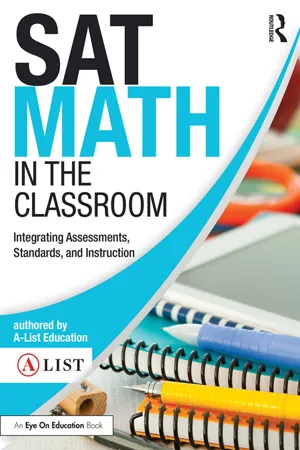
SAT Math in the Classroom
Integrating Assessments, Standards, and Instruction
- 94 pages
- English
- ePUB (mobile friendly)
- Available on iOS & Android
eBook - ePub
About this book
Information
1
About the SAT
The SAT is a college admissions test, first and foremost. It was designed for that purpose and has been used as such since 1926. In the century since its creation, it has substantially changed a number of times, but its primary goal has remained the same: to provide a standardized metric for colleges to be able to judge students from disparate backgrounds.
With the redesign of the SAT in 2016, however, the College Board has been trying to shift the focus of the test more towards the K–12 market. Much of the rhetoric surrounding the redesign centered around “real-world skills” and “math that matters most”, eliminating “irrelevant vocabulary”.
Of course, this is not the first time the SAT has been redesigned—most recently in 2005 when analogies were removed and the Writing component and essay were added, or in 1994 when calculators were first permitted and non-multiple-choice grid-in questions were added. It seems like every redesign has been surrounded by rhetoric of focusing on real-world, important skills. With this redesign, the College Board has made an active effort to emphasize college readiness benchmarks to a greater degree than they did before. They are reorganizing their suite of tests, including versions the PSAT starting as early as eighth grade, and moving toward a longitudinal assessment of benchmarks throughout high school. They are moving past the market of individual students taking the test for college and marketing their tests directly to schools, to be used both for college admissions and for skills assessment.
Is this a good idea? Who knows? Very limited data is currently available, so it’s impossible to say yet whether the test does a good job at assessing these skills. We don’t even know how well the new test serves for admissions. The old SAT, when combined with high school GPA, was a stronger predictor of college performance than was either of those metrics alone. We shall see how the new tests shape up when we see more data and that new-test smell starts to wear off.
In the meantime, it’s here, so we must acknowledge it and deal with it. While we don’t know much about how the scores will shape up, we do know quite a bit about what’s on the test, enough that we can make a concerted effort to prepare students for it.
We want to help you incorporate SAT material into your classroom in order to prepare students, without running an explicit SAT prep course. To do so, the first and most important thing is simply to know what’s on the test and what the test is like. The best way to do that is firsthand: you should absolutely do some official practice tests yourself. There are four full-length SATs and one PSAT available for free download on the College Board’s website. Go do one and see what you think.
In the meantime, we’re not going to go through our whole prep book (it is, however, for sale on our website!), but we do want to give you an overview of the structure and content of the test.
Format
The SAT is split into two subjects, Evidence-Based Reading and Writing and Mathematics. The test has four sections, two for each of the subjects, plus an optional fifth section for the Essay. The test lasts 3 hours, or 3 hours and 50 minutes if you choose to do the essay.
Besides the Essay, most sections have only multiple-choice questions, with one exception: each Math section will contain some questions for which students must produce their own responses. All multiple-choice questions will have four possible choices.
The two sections for Evidence-Based Reading and Writing (henceforth called EBRAW) will cover two different content areas: Reading and Writing and Language. The two Mathematics sections will cover mostly the same material, but on one section calculators are permitted and on the other they are not.
Table 1.1 SAT Format
| Section | Portion | Number of Questions | Time | Description |
| | ||||
| Evidence-Based Reading and Writing | 1. Reading Test | 52 questions | 65 min | 5 passages, each with 10-11 questions on reading comprehension |
| 2. Writing & LanguageTest | 44 questions | 35 min | 4 passages, each with 11 questions on grammar, usage, and style | |
| Total | 96 questions | 100 min | ||
| Math | 3. No Calculator | 20 questions | 25 min | 15 multiple-choice questions 5 student-produced response questions (grid-ins) |
| 4. Calculator OK | 38 questions | 55 min | 30 multiple-choice questions 8 student-produced response questions (grid-ins) | |
| Total | 58 questions | 80 min | ||
| Essay | 5. Essay | 1 essay | 50 min | Optional. One 1–4 page essay. |
| Total | 154 questions | 3 hours | ||
| with essay | 154 questions + 1 essay | 3 hours 50 min | ||
Scores
Each student will get a Section Score ranging from 200 to 800 for each of the two subjects. These scores are added together to produce a total score ranging from 400 to 1600. These are scaled scores, calculated by taking the number of right answers and converting them to the scaled score using a scoring table unique to the particular test the student took. This is done to ensure that differences in difficulty across forms will not affect scores. Note that students do not lose points for wrong answers.
Each student will also get three Test Scores in Reading, Writing and Language, and Mathematics ranging from 10 to 40. These scores are tied directly to the section scores: the EBRAW section score is the sum of the Reading and Writing test scores multiplied by 10. The Math section score is your Math test score multiplied by 20.
Each student will also get a variety of subscores for different types of questions within each section. These scores are either on a 1 to 15 or 10 to 40 scale. Students who take the essay will get three scores for the essay, each on a 2 to 8 scale. The essay scores are separate from the rest of the test; they will not be factored into students’ EBRAW section scores or any other scores.
This book will focus on the Mathematics portions of the test. We will not be discussing the Evidence-Based Reading and Writing section or the Essay.
Table 1.2 Math Subscores
| Name | Type | Scale | Sections |
| | |||
| Heart of Algebra | Subscore | 1-15 | Math |
| Passport to Advanced Math | Subscore | 1-15 | Math |
| Problem Solving and Data Analysis | Subscore | 1-15 | Math |
| Analysis in Science | Cross-Test Score | 10-40 | Reading, Writing and Language, Math |
| Analysis in History/ Social Studies | Cross-Test Score | 10-40 | Reading, Writing and Language, Math |
Math
Format
Table 1.3. shows a general overview of the sections:
Table 1.3 Math Format
| Section | Time | Content |
| | ||
| Section 3: No calculator | 25 minutes | 20 questions: |
| 15 multiple-choice questions | ||
| 5 grid-ins | ||
| Section 4: Calculator OK | 55 minutes | 38 questions: |
| 30 multiple-choice questions | ||
| 8 grid-ins | ||
| Total | 80 minutes | 58 Questions |
Each section contains some four-choice multiple-choice questions followed by non-multiple-choice “Student-Produced Response Questions” (which we call “grid-ins” for short). For these questions, students must determine their own solution and fill it into a grid on their answer sheet. Answers may contain no more than four digits (including nonnumerical cha...
Table of contents
- Cover
- Title
- Copyright
- Contents
- eResources
- About the Author
- Introduction and Overview
- 1 About the SAT
- 2 Alignment With Common Core Math Standards
- 3 SAT Math in the Classroom
- Appendix: All Math Alignment Tables
- Additional Resources
Trusted by 375,005 students
Access to over 1.5 million titles for a fair monthly price.
Study more efficiently using our study tools.
Frequently asked questions
Yes, you can cancel anytime from the Subscription tab in your account settings on the Perlego website. Your subscription will stay active until the end of your current billing period. Learn how to cancel your subscription
No, books cannot be downloaded as external files, such as PDFs, for use outside of Perlego. However, you can download books within the Perlego app for offline reading on mobile or tablet. Learn how to download books offline
Perlego offers two plans: Essential and Complete
- Essential is ideal for learners and professionals who enjoy exploring a wide range of subjects. Access the Essential Library with 800,000+ trusted titles and best-sellers across business, personal growth, and the humanities. Includes unlimited reading time and Standard Read Aloud voice.
- Complete: Perfect for advanced learners and researchers needing full, unrestricted access. Unlock 1.5M+ books across hundreds of subjects, including academic and specialized titles. The Complete Plan also includes advanced features like Premium Read Aloud and Research Assistant.
We are an online textbook subscription service, where you can get access to an entire online library for less than the price of a single book per month. With over 1.5 million books across 990+ topics, we’ve got you covered! Learn about our mission
Look out for the read-aloud symbol on your next book to see if you can listen to it. The read-aloud tool reads text aloud for you, highlighting the text as it is being read. You can pause it, speed it up and slow it down. Learn more about Read Aloud
Yes! You can use the Perlego app on both iOS and Android devices to read anytime, anywhere — even offline. Perfect for commutes or when you’re on the go.
Please note we cannot support devices running on iOS 13 and Android 7 or earlier. Learn more about using the app
Please note we cannot support devices running on iOS 13 and Android 7 or earlier. Learn more about using the app
Yes, you can access SAT Math in the Classroom by A-List Education in PDF and/or ePUB format, as well as other popular books in Education & Education General. We have over 1.5 million books available in our catalogue for you to explore.