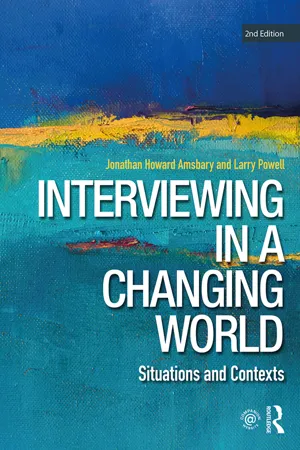
Interviewing in a Changing World offers students the broadest coverage of interviewing available today by including several unique interview situations. Students begin to develop a better understanding of how to utilize strong interviewing skills in several different settings, as this text demonstrates that interviewing techniques differ in accordance with varying situations and contexts. The Second Edition covers employment contexts such as job interviews, persuasive interviews, performance and appraisal interviews, as well as media interviews on radio, television, newspapers, and political reporting. There are two full chapters on research, including interviewing skills needed for both qualitative and quantitative research. The book covers several unique interviewing situations that are on the cutting edge of communication research with an interview with a professional from the field and multiple sidebars on related theoretical and applied issues within each chapter.
eBook - ePub
Interviewing in a Changing World
Situations and Contexts
- 206 pages
- English
- ePUB (mobile friendly)
- Available on iOS & Android
eBook - ePub
About this book
Information
Section 1
Introduction
1
The Basics of Interviewing
John sits nervously in the outer office of a major corporation. Within a few minutes, he will have a job interview that, if successful, could get him a position with the company of his dreams.
June works for a telephone research center. Each night, she places calls to individuals that she has never met with the intent of asking them a series of questions about a new product that will soon be on the market.
Carlos is a reporter for a major newspaper. His job involves gathering information from newsmakers, asking them questions about what is happening that is of importance to the public.
Juanita is a nurse. Part of her job is talking with patients, getting a brief summary of their symptoms and problems, so that the physician can make a thorough diagnosis of their condition.
Each of these people is engaged in the process of interviewing. Indeed, in modern society, the role of interviewing has been increasing as more jobs require some element of interviewing skills. But, what is this skill which is so important in today’s career environment? For the purposes of this book, interviewing is defined as a process of purposeful interaction involving two parties and which involves the asking and answering of questions. Consider this definition in terms of its component parts.
First, an interview is a purposeful interaction. Each person enters the interview with a goal in mind, and each person participates with the intent of increasing his/her chances of achieving that goal. John will enter his employment interview with the intent of impressing the interviewer enough that he will be hired by the company. Across the desk, his interviewer will be working toward a different purpose—seeking to assess the strengths and weaknesses of each applicant for the purpose of hiring the best new employee for the company. As a reporter, Danny will be seeking information that can be used in the writing of an informative news story. Some of the people he interviews, though, may be trying to hide some information that would be useful to that story. The purposes of the participants may vary, but without such a purpose an interview doesn’t exist.
In many ways the satisfaction that you will have during various interviews will be determined long before the first question is asked and answered. Interviewing is a goal-driven activity. Each party, the interviewer and interviewee, has an objective they want to accomplish during the interview. Sometimes the goal may be the same; for instance, both you and your doctor will likely have similar goals when he or she takes your medical history: your well-being. On the other hand, there are interviews where the two parties will be at cross-purposes. An employer wants to find the best employee to fill the position he or she is trying to fill, and applicants want the employer to hire them, whether they are the best fit or not. Certainly many people come away from press interviews feeling frustrated because the interviewee has a story to tell, but the reporter may have a very different story to tell.
Second, an interview is dyadic when it involves two parties. The operative word here is parties, not people. In some instances, the interviewee may be more than one person, i.e., a group of people are brought together and interviewed at the same time. Such interviews are known as panel interviews (Hamilton & Parker, 1990, p. 201; Dipboye, Gaugler, Hayes, & Parker, 2001). They are frequently used in research studies in the form of panel studies or focus groups. In other instances, the number of interviewers might outnumber the number of interviewees. Such instances create what is known as a board interview. For example, a congressional subcommittee may call for testimony from an expert on terrorism. The expert would then appear before the entire committee, with each committee member allowed to ask questions of the expert.
Third, an interview involves the asking and answering of questions. Interviews are not merely an exchange of questions and answers. Sometimes the interviewer simply makes a statement and waits to see how the interviewee responds. Sometimes the interviewer simply remains silent, encouraging the interviewee to provide more information. Still, the asking and answering of questions is the backbone around which the rest of the interaction is organized. The purpose of most interviews involves some element of information exchange or sharing, and the Q&A process is crucial to its success.
Interviewing is often—but not always—a zero-history interaction. The parties in an interview will sometimes have a history of interaction with each other. Counseling, performance interviews, health care interviews, and exit interviews all encompass situations in which the interviewer and the interviewee have had some previous interactions. In many other situations, however, there is likely to have been no previous interaction. Market research interviewers randomly call individuals that they’ve never met before. College graduates seeking their first job may have never met the people who will be deciding whether to hire them. News reporters may be doing a story on individuals they’ve never met before. Indeed, one of the purposes in many interviews is for the parties to meet and learn something about each other. Because of this, the interactions in interviews tend to be more formal than in other contexts.
The purpose of this book will be to help the reader understand the various elements of this definition. As a starting point, it is important to understand the basic factors that influence the structure and effectiveness of an interview. Those factors are (1) the different types of interviews, (2) the different phases of the interview process, (3) the various techniques that might be used in many interviews, and (4) an understanding of how the structure of interviews can vary. This chapter will look at these four elements from a basic perspective. Each of the following chapters will explore them in more detail, showing how they pertain to interviews in differing types of situations. It is important to understand that interviewing takes place in many other contexts, but these general contexts cover enough ground that you should be able to generalize the information into many contexts.
Types of Interviews
Workplace Interviews
These interviews include employment, performance review, grievance, exit, and persuasive interviews.
Employment interviews are the poster child of interviewing techniques. Most books that talk about interviews focus on this area. Although it is not the only type of interview, it is easily the most visible and the one that nearly every person will experience at some time in their careers. Employment interviews are a screening technique by which organizations make initial evaluations regarding hiring decisions of new employees. They involve multiple aspects and functions, including information gathering and assessment.
The performance review interview is an interview that is used to assess the work of an individual or group. Devito (2000) calls it an “appraisal” interview (p. 224). Many organizations use annual performance review interviews. Such interviews allow them to (1) identify those workers who are performing at an exceptional level, (2) identify potential weak spots in performances before they become troublesome, (3) create a clear understanding between the employer and employee regarding the employer’s level of satisfaction with their work, and (4) allow both parties to focus on future performance.
Hamilton and Parker (1990) define the grievance interview as “any type of one-to-one encounter involving conflict and resolution” (p. 200). Some organizations have a formal grievance procedure in which any employee with a complaint against the company can file for and request a grievance interview. For others, the grievance interview is an informal process in which a dissatisfied worker simply makes a request to their immediate supervisor regarding a complaint that they have. In either instance, though, the grievance interview is a combination of information exchange and persuasive effort.
Some people switch jobs, moving to another that offers better pay, better benefits, or a better work environment. Some people simply burn out from working too long and too hard at one single position. Some people just decide to retire. Organizations, though, may never know why any one person leaves a job with the company unless they ask. That’s why many organizations schedule exit interviews with all personnel who decide to quit or retire. Such interviews give the employer a chance to assess what mistakes they might be making that would drive people away from jobs. They give the departing worker one last chance to contribute to the company’s success.
Media Interviews
These interviews take place in a variety of contexts and through a growing number of media. Traditionally, these types of interviews were conducted by reporters for newspapers. Although the number of newspapers in America is declining, the variety of press media is expanding—from blogs, to cable news, to traditional broadcast news, to social media. The amount of information being released to the public is staggering. The ability to handle one’s self at a press conference or with a reporter with a microphone and/or camera has never been more important for public figures.
Research Interviews
These interviews include information seeking (or research interviews), information giving, and information sharing. A telephone survey represents a type of information-seeking interview; the interviewer asks specific questions designed to provide the researcher with specific information. A telemarketing sales call would be an example of an information-giving interview; the salesperson hopes to speak with the interviewee long enough to give them some information about the product. Three people on a panel, responding to a moderator’s questions, would be an example of an information-sharing interview. The questions would spark different responses so that multiple views on the same topic could be obtained.
Informational interviews can also vary in terms of (1) the level of information needed and (2) the expertise required to conduct the interview. A doctor who interviews a patient, for the purpose of diagnosing their condition, might need more information than with some other informational interviews. Similarly, the expertise required for such a medical interview would be higher than the skills needed for a telemarketing interview.
Phases in the Interview Process
Most interviews can be divided into four distinct stages: (1) preparation, (2) opening, (3) Q&A, and (4) closing.
Preparation
Successful interviews start with anticipating and planning. Anticipating the situation allows both the interviewer and interviewee to evaluate and assess their own strengths and weaknesses as it relates to approaching the interview. Planning helps in the identification of the goal for the interview. That latter element is critical. To make the interview more effective and efficient, Edwards and Brilhart (1981) recommend that you use your preparation time to identify the goal of the interview and then be prepared to reveal it to the other person quickly.
Opening
The opening, or first contact, of the interview is often crucial to its success or failure. That initial interaction sets the tone and mood for the interaction that follows, creating a climate for the rest of the interview (Klinzing & Klinzing, 1985, p. 60). Those first few moments can be important in any health-care interview, but it is absolutely critical in therapeutic situations. In those instances, the interviewer’s first goal must be to establish a climate that will foster trust and understanding (Northouse & Northouse,1985, p. 182). For that reason, the interviewer cannot rush into some topics. Instead, many interviewers use this time to introduce themselves, to learn the name of the interviewee, and to ask a few questions about the interviewee’s interests—looking for common ground that can help establish rapport (Banyard & Fernald, 2002).
For information-oriented interviews, the opening stages of the interview should be used to clarify the purpose of the interview and establish mutual goals with the patient. A common understanding of those goals is a key factor here. If the interviewer and interviewee dance around issues for the remainder of the interview, little will be accomplished. That may seem like a simple concept, but it is easily ignored, particularly if the interviewer rushes through this stage too quickly. False agreement can easily be achieved by speaking in vague terms about the purpose and goal of the interview, and the interviewer may move on to the next stage under the mistaken belief that the interviewee is ready to follow and participate freely in the discussion.
Q&A
Q&A is the exploration, or working phase, of the interview. The interviewer offers questions and seeks responses from the interviewee during this phase. The interviewer must constantly monitor the interviewee’s feedback to seek some indication that not all of the necessary information has been provided. The interviewer must also carefully monitor their own communication behavior so that they can maintain an effective relationship with the other person, and thus continue the interview in a productive manner.
One factor affecting the behavior within the interview is the expectation level of each participant. Burgoon’s (1993) expectancy violation theory posits that preconceived expectations influence observers’ reactions to behaviors and the actors who perform them. Nonconformity to expected norms will either be condoned or condemned, depending on the perceptions of the violator as either rewarding or threatening. Valence is important, with high credible medical personnel allowed to deviate more from the social norm before the behavior is perceived as a violation. Low credibility and female personnel have less freedom in message selection, because—for them—aggressive strategies would be a negative violation of expectations that would inhibit attitude change (Burgoon & Miller, 1985).
Closing
Interviews should not be abruptly ended just because the interviewer has all the information they need. Instead, a successful interview will include an identifiable closing stage in which both participants realize that it’s time to close the interview (Sundeen et al., 1981). Unfortunately, that doesn’t always happen. Ideally, the closing of the interview should accomplish both of those goals: It should (1) summarize the key points of the interview and (2) ensure that both participants have had an opportunity to say the things they believe should be said. At the very least, the interviewer should ask if the interviewee has any final questions.
Techniques for Interviews
Question Sequence
Stewart and Cash (1982) identified three different sequences that are used in interviews: (1) the funnel sequence, (2) the inverted funnel, and the (3) tunnel sequence. In the funnel sequence, the interviewer begins by asking broad questions and then proceeds to more specific questions. This approach gradually focuses the discussion to a specific topic.
The inverted funnel, as its name implies, reverses this process. In this approach, the interviewer begins by asking a series of specific questions and gradually broadens the approach to obtain an overall view of the topic being discussed. The inverted funnel is particularly useful in stimulating responses from a reticent and non-talkative interviewee. If someone is reluctant to talk, they will tend to fend off broad, open-ended questions, particularly at the beginning of the interview. But they will respond to short, specific questions, and these can be used as an ice-breaker to get them to talk more freely about all of their symptoms and their emotional responses to their problems.
The tunnel sequence is an interview that uses a series of similar questions of the same format. The tunnel sequence is effective when the interviewer needs to cover a number of different topics, but in-depth information on those topics is not necessary.
Verbal Tools
The interviewer’s ultimate tools are their personal set of verbal skills. The ab...
Table of contents
- Cover
- Title
- Copyright
- Contents
- Section 1 Introduction
- Section 2 Interviewing in the Organizational Setting
- Section 3 Interviewing in the Media
- Section 4 Research Interviews
- Index
Trusted by 375,005 students
Access to over 1.5 million titles for a fair monthly price.
Study more efficiently using our study tools.
Frequently asked questions
Yes, you can cancel anytime from the Subscription tab in your account settings on the Perlego website. Your subscription will stay active until the end of your current billing period. Learn how to cancel your subscription
No, books cannot be downloaded as external files, such as PDFs, for use outside of Perlego. However, you can download books within the Perlego app for offline reading on mobile or tablet. Learn how to download books offline
Perlego offers two plans: Essential and Complete
- Essential is ideal for learners and professionals who enjoy exploring a wide range of subjects. Access the Essential Library with 800,000+ trusted titles and best-sellers across business, personal growth, and the humanities. Includes unlimited reading time and Standard Read Aloud voice.
- Complete: Perfect for advanced learners and researchers needing full, unrestricted access. Unlock 1.5M+ books across hundreds of subjects, including academic and specialized titles. The Complete Plan also includes advanced features like Premium Read Aloud and Research Assistant.
We are an online textbook subscription service, where you can get access to an entire online library for less than the price of a single book per month. With over 1.5 million books across 990+ topics, we’ve got you covered! Learn about our mission
Look out for the read-aloud symbol on your next book to see if you can listen to it. The read-aloud tool reads text aloud for you, highlighting the text as it is being read. You can pause it, speed it up and slow it down. Learn more about Read Aloud
Yes! You can use the Perlego app on both iOS and Android devices to read anytime, anywhere — even offline. Perfect for commutes or when you’re on the go.
Please note we cannot support devices running on iOS 13 and Android 7 or earlier. Learn more about using the app
Please note we cannot support devices running on iOS 13 and Android 7 or earlier. Learn more about using the app
Yes, you can access Interviewing in a Changing World by Jonathan H. Amsbary,Larry Powell in PDF and/or ePUB format, as well as other popular books in Languages & Linguistics & Communication Studies. We have over 1.5 million books available in our catalogue for you to explore.