Stage Lighting: The Fundamentals is written specifically for introductory stage lighting courses. The book begins with an examination of the nature of light, perception, and color, then leads into a conversation of stage lighting equipment and technicians. Lamps, luminaries, controls/dimming, and electricity form the basis of these chapters. The book also provides a detailed explanation and overview of the lighting design process for the theatre and several other traditional forms of entertainment. Finally, the book explores a variety of additional areas where lighting designers can find related future employment, such as concert and corporate lighting, themed design, architectural and landscape lighting, and computer animation.
New for this edition:
enlarged full-color illustrations, photographs, light plots and examples of lighting design; updated information on LED lighting and equipment; expanded discussion of the practical use of color as a designer; expanded discussion of psychological/perceptual effects of color; new discussion of color mixing through light sources that make use of additive mixing; expanded discussion of industry professions; expanded discussion and illustrations relating to photometrics; expanded discussion and examples of control protocols and new equipment; and updated designer profiles along with the addition of still more designer profiles.
BEFORE YOU CAN learn to design with light it is important to gain a basic understanding of the nature of light. Unlike other areas of design, light isn’t tangible: it appears to be mysterious and can cause unpredictable results, yet it has an impact on everything it touches. Light is controlled in ways that require at least some understanding of optics and electricity—topics that easily intimidate many people. As lighting designers, light itself is our medium, and we can usually convey our design ideas only through indirect methods such as with pencils, paints, or computer simulations. This is very different when compared to other artistic disciplines where the media are tangible. You can’t easily draw or render light as you would in a rendering of a scenic or costume design or with a sketch of a building, where a viewer can easily gain an understanding of a structure and color schemes that are created by a designer. The effects of light are in many ways a mystery until the lights are turned on and a subject is illuminated. Because of this, it is important to develop an understanding of the actual medium of light. What is it? How does it behave? How might we control it? What is its effect on other objects? With experience, you can predict many of the answers to these questions, but even then, you can’t be completely sure of your design choices until you see them actually revealed in light.
In this chapter I examine the physical properties of light, its makeup, and how it moves through space. I will also provide you with several methods that we use to describe light. Finally, I examine how light functions within our daily lives. These fundamental principles hold true not only in lighting dramas and other entertainment programs, but also for lighting buildings and natural settings where the sun and other light sources can be observed.
WHAT IS LIGHT?
Quite simply, light is a form of energy. Specifically, it is a form of radiant energy that is associated with a given portion of the electromagnetic spectrum. Radiant energy is a form of energy given off by radiant bodies (heat/light sources) such as stars, like our sun. Radiant energy moves away from its source at a constant speed while light is but one form of radiant energy which has a speed of 186,000 miles/second. Most of us know this as the “speed of light.”
The Electromagnetic Spectrum
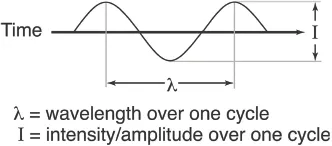
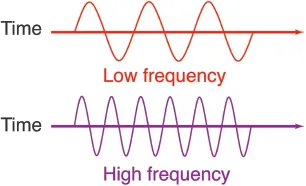
The electromagnetic spectrum represents all forms of radiant energy. Some researchers identify the electromagnetic spectrum with a particle-based theory while others refer to a wave-theory approach. Regardless of the theory, the general principles are the same. In each case, energy is thought to pulsate outward from a source at the speed of light in oscillations that create a wavelike effect and form patterns that can be measured. In fact, the variables that we generally use to describe radiant energy are based on wave theory. Most commonly we make distinctions between different forms of radiant energy through measurements of either frequency (f) or wavelength (λ). Wavelength is the distance between similar points in a waveform over the time that a wave completes one cycle, while frequency refers to the number of oscillations or cycles that a waveform completes over a given time. These variables are inversely proportional to one another: as frequency increases, the wavelength gets shorter, or as frequency decreases, the wavelength gets longer. The strength or amplitude of the waves is commonly called the intensity (I). In visible light we often refer to this as the brightness of the light. Figure 1.1 illustrates the relationship between intensity, frequency, and wavelength.
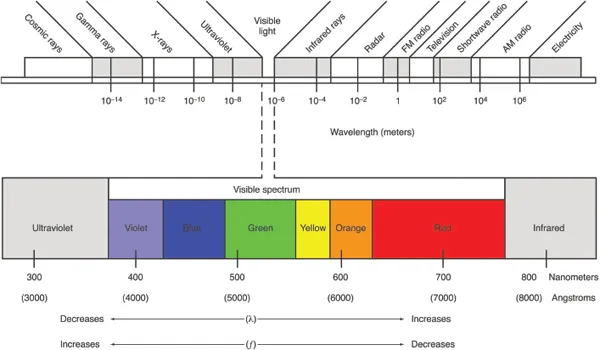
In lighting, we generally use a measurement of wavelength to make a distinction between different types of light. The range of wavelengths produced by radiant sources is extreme. At one end of the electromagnetic spectrum we find electrical waves with wavelengths measured in miles. The 60-cycle electrical currents that are used in our homes may have a wavelength of more than 3,000 miles. Many other forms of electromagnetic radiation (ER) are associated with wavelengths so small that a special unit, the angstrom (Å), has been introduced to measure them. One angstrom is equal to 1/254,000,000 of an inch. At the opposite end of the electromagnetic spectrum from electricity are cosmic rays, which may have wavelengths as small as 1/10,000 Å. The electromagnetic spectrum is a collection of different types of radiant energy that can be specified through their varied wavelengths.
The Visible Spectrum
What concerns us as lighting designers is a very limited range of wavelengths contained within the electromagnetic spectrum that we commonly refer to as the visible spectrum. This is a collection of wavelengths that can be sensed by the human eye. Those energy forms that lie outside of our perception with wavelengths that are longer than we can sense include infrared, radar, television and radio waves (with increasingly longer wavelengths). Energy forms with progressively shorter wavelengths that also lie outside the realm of our visibility include ultraviolet, x-ray, gamma and cosmic rays. Figure 1.2 illustrates the relationship between wavelength and the individual classifications of energy that make up the electromagnetic spectrum.
Figure 1.1a Wave relationships. a. Relationship of intensity (I), wavelength (λ), and cycle or frequency (f)
Figure 1.1b Frequency (f) and wavelength (λ) are inversely proportional
The visible spectrum can be further broken down into smaller components representing individual colors—each color representing a specific wavelength of radiant energy. We have all witnessed the rainbow effect produced through the refraction and separation of light into these individual colors by a prism, a storm cloud, or water spray from a hose or fountain. Every color represents light of a different wavelength or frequency. The range of wavelengths generally found within the visible spectrum extends from approximately 400 (violet) to 700 (red) nanometers. A nanometer is one-billionth of a meter. A second manner of expressing wavelength has already been introduced through the measurement known as an angstrom. An angstrom is 1/10 of a nanometer. In this case, the visible spectrum would be expressed as having wavelengths in the approximate range of 4,000–7,000 Å.
THE EYE AND SEEING
Our observation of the world around us is based solely on the manner in which we sense our environment. We can’t directly observe anything without the aid of various senses. If you think back to a basic biology class you will probably remember that the human body is equipped with five sensory devices. The senses that these manage include sound, touch, smell, taste, and sight. Each sense consists of a series of sensory organs that convert physical phenomena into nervous impulses that our brains process in a way that helps us to observe the world around us. Our skin allows us to feel, our ears allow us to hear, and our eyes allow us to see.
The visible spectrum represents the range of wavelengths to which the human eye can sense light. If we were sensitive to light relating to a different range of wavelengths, our visible spectrum would shift to a different portion of the electromagnetic spectrum. An infrared camera, such as the ones used in defense or security systems, is sensitive to a different portion of the electromagnetic spectrum than the human eye. Hence, in a situation such as a dark night where we cannot see the movements of people like prowlers or soldiers, the camera is able to “see” for us.
Figure 1.2 The electromagnetic and visible spectrums
THE CONTROLLABLE QUALITIES OF LIGHT
It is important at this point to introduce a vocabulary that enables us to define and describe light. One of the most difficult tasks for a lighting designer is in describing the lighting envisioned for a project. Light is our medium and it cannot be illustrated effectively through an indirect means such as with a model or rendering. A scenic designer can illustrate to a reasonable degree of success a final design and color palette for a project through the use of markers, pencils, or paints. Likewise, in addition to renderings, a costumer can present swatches or scraps of fabric to indicate the materials from which a costume will be created. This isn’t so with a lighting design, where light itself is the medium and where nobody can get a true sense of the outcome of a design until the actual lights (luminaires) are placed in the performance space, colored, and balanced through setting specific brightness levels for each light. Because of this, several descriptive qualities have been defined to help us communicate with one another about light. These are generally not thought of in terms of quantitative elements but are used instead to help us set up a comparison between various lights and lighting effects. While absolutes may come into the discussion, most of these qualities are used solely within a descriptive or comparative basis. These qualities are also universal and can be translated to any field of lighting, whether working in traditional theatre or lighting an office tower, garden, or the latest Rolling Stones tour. While there may be slight variations in terminology between lighting disciplines, most designers have come to refer to four primary qualities for describing light. Any light, no matter how produced or modified can be described through these four attributes. The variation of any one of these qualities will make a distinction between any given example of light. These qualities include intensity, distribution, color, and movement. As a whole, these are essentially the same qualities that Stanley McCandless described in 1932 when he first wrote A Method of Lighting the Stage.
Intensity
The most easily described quality of light is intensity, which refers to the brightness of the light. While it might be described very specifically and can be evaluated through measurements such as the candela or foot-candle, it is more often described through a comparative basis. “This light is brighter than that light,” “this light is approximately half the intensity of another light,” or “that light is as bright as the moon” are examples of this type of comparison. The human eye can perceive light at an extreme range of intensities. In World War II, soldiers learned that a German scout plane nicknamed “Bed Check Charlie” could see the tip of a lit cigarette from several miles away. If they were spotted, soldiers could anticipate a visit from a bomber sometime later that night. At the other extreme, the intensity of a light can be so bright that it becomes harmful and could even cause damage to our eyes. Examples of this would include looking directly into the sun or being exposed to the bright light that accompanies welders as they strike an arc. In most theatrical venues we are generally concerned only with the relative appearance of the light and whether there is enough visibility to see what has to be seen at any given moment on the stage. In video and film lighting, the intensity isn’t as flexible, and there is a minimum threshold of intensity that a director of photography must provide to maintain a proper exposure for a setting. We have all taken photographs of last Friday night’s party or some other special event to find that the results that our phone or camera captured produced only shadowy silhouettes that we think we recognize as our friends. Even with today’s mobile phone cameras we often find that images can suffer from poor lighting and are either under or overexposed. Architectural lighting designers speak of a minimum amount of illumination for a given visual task or job. These tasks require a minimum number of footcandles or lumens of illumination. For example, the lighting levels required for a personal home are much lower than those needed at a retirement home, where elderly residents often have trouble seeing, while a meeting room requires higher intensity levels than a restaurant seating area—although none of these settings would require the illumination levels needed for an assembly line producing high-tech products. Regardless of whether describing a specific level of illumination (i.e., footcandles) or simply describing intensity on a comparative basis, intensity becomes one of the most important ways of helping us distinguish between different types of light and lighting.
Another important element of intensity relates to the principle whereby the intensity of a light drops off dramatically as the distance from the source is increased. This is expressed through a concept/formula known as the Inverse Square Law. This law will be presented in more detail in Chapter 7, but simply states that the illuminance of a light source is inversely...
Table of contents
Cover
Half Title
Title Page
Copyright Page
Table of Contents
Preface
Acknowledgments
About the Author
PART ONE—LIGHT: THE MEDIUM
PART TWO—LIGHT: THE TOOLS
PART THREE—LIGHT: DESIGN FUNDAMENTALS
PART FOUR—LIGHT DESIGN APPLICATIONS
Appendices
Glossary
Bibliography
Index
Trusted by 375,005 students
Access to over 1.5 million titles for a fair monthly price.
Study more efficiently using our study tools.
Frequently asked questions
Yes, you can cancel anytime from the Subscription tab in your account settings on the Perlego website. Your subscription will stay active until the end of your current billing period. Learn how to cancel your subscription
No, books cannot be downloaded as external files, such as PDFs, for use outside of Perlego. However, you can download books within the Perlego app for offline reading on mobile or tablet. Learn how to download books offline
Perlego offers two plans: Essential and Complete
Essential is ideal for learners and professionals who enjoy exploring a wide range of subjects. Access the Essential Library with 800,000+ trusted titles and best-sellers across business, personal growth, and the humanities. Includes unlimited reading time and Standard Read Aloud voice.
Complete: Perfect for advanced learners and researchers needing full, unrestricted access. Unlock 1.5M+ books across hundreds of subjects, including academic and specialized titles. The Complete Plan also includes advanced features like Premium Read Aloud and Research Assistant.
Both plans are available with monthly, semester, or annual billing cycles.
We are an online textbook subscription service, where you can get access to an entire online library for less than the price of a single book per month. With over 1.5 million books across 990+ topics, we’ve got you covered! Learn about our mission
Look out for the read-aloud symbol on your next book to see if you can listen to it. The read-aloud tool reads text aloud for you, highlighting the text as it is being read. You can pause it, speed it up and slow it down. Learn more about Read Aloud
Yes! You can use the Perlego app on both iOS and Android devices to read anytime, anywhere — even offline. Perfect for commutes or when you’re on the go. Please note we cannot support devices running on iOS 13 and Android 7 or earlier. Learn more about using the app
Yes, you can access Stage Lighting Second Edition by Richard E. Dunham in PDF and/or ePUB format, as well as other popular books in Media & Performing Arts & Communication Studies. We have over 1.5 million books available in our catalogue for you to explore.