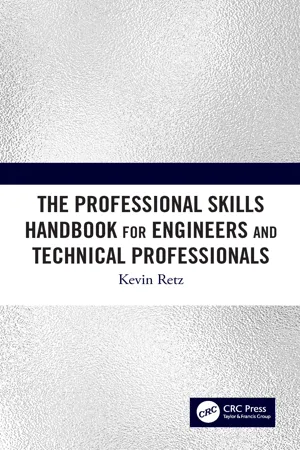
This new handbook covers a wide range of engineering skills generally not taught in today's college-level technical programs. New engineers, though technically sound, need to master these other skills upon entering the professional world. Topics covered include teaming, root cause analysis, Lean manufacturing and management, presentation skills, innovation, and change leadership. Based on the author's 30 years of engineering and leadership experience, this work contains a wealth of practical tips and advice, as well as lessons learned the hard way. Portable and concise, the handbook can help new engineers thrive in and enjoy the technical world and their professional careers.
- 98 pages
- English
- ePUB (mobile friendly)
- Available on iOS & Android
eBook - ePub
The Professional Skills Handbook For Engineers And Technical Professionals
About this book
Information
1 | Lessons Learned and Food for Thought |
In this chapter, I will talk about some lessons that I have learned over the years. These rules and lessons are usually not discussed in classes, but when they come up, and they will, you will wish they had been. Some of these are life lessons, and some of these are common sense that just need to be re-mentioned from time to time. Some of these I have learned and re-learned the hard way. Please learn from some of my mistakes or at least pause and think.
LEARN TO SAY “I DON’T KNOW”
Follow “I don’t know” up with “but I can find the answer” or “let me find that answer out for you.” We have all been in meetings when somebody has gone off on a long rant, it is obvious that they do not know a thing about the subject at hand. This rant makes them look foolish and, in many cases, lose respect and wastes time. We have all given presentations or have been in meetings and asked questions for which we don’t know the answer. Don’t try to bluff your way out of it. It will show to more than one individual in the room that you do not know the answer.
Instead of bluffing your way through the question and answer, “I don’t know, but I can find the answer for you and report back to you at the next review,” or in some other appropriate manner or time.
By answering in this fashion, you are giving yourself time to learn something new and you’re not making a fool of yourself. If you try to gloss over or bluff your way through an answer, you will lose respect, validity in your knowledge, and your presentation will not be taken seriously. The audience will lose interest (or worse become agitated).
I will also caution about the tendency some people have of “winging it.” Trying to make it look like they have the answer when they really don’t. I have seen more than once how engineers try to inject information that they have heard from a second or third source as fact and firsthand knowledge. I have also seen engineers rattle off numbers, equations, and random facts to try to inject themselves into the process. In all cases, the engineer came off as a nuisance. Even Teflon wears out after time, and when something sticks to it, it’s hard to get off. Think of that old Teflon-coated baking pan that you had to throw away after too many uses. You may get by winging it once, but it will catch up to you. Always stick to the facts, and when you don’t know, say so and then offer to get the answer. If possible, defer the question to somebody that is an expert in the field. Let the expert take the question so that everybody can learn at the same time.
None of us have all the answers. We are only human, admit it. Take the action item, respond to the action item, and move on.
BE CAREFUL WHAT YOU COMMIT TO “IT’S EASIER TO GET UP A TREE THAN DOWN A TREE”
The old saying “It’s easier to get up a tree than down a tree” I have heard in many similar forms. I don’t know who has credit for it, but it is not me—“You can always fall or get knocked out of a tree. When you fall, it’s going to hurt when you hit the ground or branches on the way down.”
Think about the pictures of cats or bear cubs stuck in trees. Or if you ever climbed a tall tree as a little kid and thought once you got way up into it, how am I going to get down? Now, what this saying is telling us is be very careful what we commit to. Making commitments and taking on work assignments is great and required for job and professional growth.
But only commit when you have a clear understanding of what you’re committing to. There are questions you need to ask. “What are the expectations?” “What is the deliverable?” “Do I have the time and the resources to follow through in the expected time frame?” When you commit to do something, always expect to be held accountable for that commitment. A commitment is your reputation.
When you make a schedule (which is the same as a commitment), think of all the players that should have input. When you’re working on a design, think about the tooling team and the manufacturing team. Get their input to make sure you can tool and build what you’re designing. You’re going to look foolish when during the design review your operations lead states “I can’t build that,” usually followed by some very colorful forms of the English language. By involving all elements of the team early, you know you can make the schedule and hit your commitment.
When you make a commitment, you need to keep in mind that things will happen. Try to figure out what those can be before you make the commitment. If it’s just finding an answer to a question, that is one thing. But if you need to involve others, keep that in mind and get them involved early. The other members on your team have their own commitments and their own bosses to please. It is not a good day when you go and talk to your boss and tell them that you could not complete a task because of things out of your control. “Results always speak better than excuses.”
Remember, only make commitments when you have the bandwidth and the resources to hit that commitment. Commitments come in many forms: budget, schedule, memo, drawings, and document submittals.
Stick with your commitment. If problems come up, face these problems. If necessary, adjust the deliverable with the customer. Never just let a commitment slide. When commitments are not met or are constantly adjusted, your reputation will suffer.
NEWTON’S THIRD LAW, “FOR EVERY ACTION, THERE IS AN OPPOSITE AND EQUAL REACTION”
Newton’s third law is true in life as well as physics. All actions have consequences, some good, and some may not be so good! Think through your actions and plan accordingly. This also goes with schedules and program plans. Use this same thought process as you set up a schedule and move through a program. Put milestones and checkpoints into the schedule so you can make sure you’re making progress. Track your progress and, if needed, adjust in a timely manner.
Remember for every action, there is a reaction, you do one thing, something else cannot get done. If you take this course over this other course of action, the potential outcomes are different. If you select this requirement, then these systems will not meet specifications. If you chose this manufacturing process, then only these materials can be used.
I wonder if Mr. Newton knew his law would impact all aspects of life, not just physics, science, and engineering?
LOOK FOR WHAT’S MISSING IN THE CONVERSATION OR NOT BEING RECOGNIZED
People can always look at what is broken right in front of them and find a solution. It’s finding the hidden broken or missing piece that is difficult. Humans like to focus on what is in front of them and what is apparent. Always think about what is not being shown and what is not visible. This is especially critical in design reviews, root cause analysis, and contract negotiations. By doing this during contract negotiations, it can help you drive to a better contract. During a program review or root cause analysis, it can help increase the solution space. You can also use this when touring a plant, look at your surroundings and what is not being discussed or pointed out. Look for the red tags on parts, the number of tools in rework, or the amount of inventory in work or sitting in job racks. You’re not doing this to put anybody on the spot, use it to give clarity to the situation and to ask questions.
This approach can also be used when you are reviewing your own presentations and program plans. Look for the pros and the cons, all potential solutions, and actions. Make a list. Once the list is made, you can find answers to the questions and develop mitigation plans as needed.
ALWAYS GIVE YOUR BEST, TENACITY, AND PERSISTENCE MATTER
When given a task by your boss, just do it, even if you think it is beneath you. Set high standards for yourself and keep to those standards. Small tasks can be trials that lead to bigger and more visible assignments. When you make simple tasks shine, bigger assignments will follow.
When you are faced with challenges, don’t give up, there is always a solution, so find it. Ask questions and don’t be afraid to ask for help. The key is results, when you come up against a roadblock, get help and figure a way around it, through it, or over it, but do not just stop and quit. All projects will face challenges. When facing challenges, the key is to stay focused and work through the challenges with the same passion that you had at the start of the project. Don’t let off the gas as you near the completion of a project. The hardest 10 yards are the 10 yards right before the goal line. Keep the pressure on and always complete the project to the best of your and your team’s ability. If you show passion and drive, it will rub off on those around you.
Do not use the words “never” or “it’s impossible” until you can show through hard work or analysis that the task cannot be done. Going to the moon was not possible nor was breaking the sound barrier, until a lot of hard work was put in and obstacles were overcome.
Always give your best, it will reflect well on you.
PRAISE IN PUBLIC AND CRITICIZE IN PRIVATE
In today’s world, the statement “praise in public and criticize in private” is often forgotten. You will be at some presentation and somebody will just belittle the presenter. When this happens, think about how the presenter feels right then and what if that were you in their shoes. If a presenter is having a bad presentation, give some probing questions that will help them get on track. If you’re a manager or a leader, give an excuse for a break to give the individual time to get over their nerves or talk to them in private and ask if they are truly ready for the presentation. Try to help the individual get out of the hole they may have dug.
Another scenario is when you have to talk to a team member that is not pulling their weight or an assignment that was just turned in and was not quality work. Your first reaction might be to send off an email to them and their boss and let them have it. Instead of the email to their boss, tell them upfront about the issue and give them a chance to correct the issue. If they cannot or will not correct the issue, then take it up with their manager, but remember to always stay above board and give the individual a chance to correct the issue. Conduct work always above board and fairly. Honesty and integrity will be noticed and remembered, and keep in mind, you may be working for that same individual in a few years.
When giving a critical comment or review always keep it about the situation and never about the individual. If discussing an area where the individual needs to improve give solid examples and never call the individual stupid or make them feel inferior. Always have critical conversations in private, never in an open forum where others may hear.
The flip side of this is when somebody does a good job or goes that extra mile let them know and let others know. Everybody likes pats on the back and peer recognition. When you let others know that you expect, recognize, and appreciate stellar work and performance, you will become the team leader or manager they want to work for or have on their team. When an individual does a great job, make sure that their boss and others on the team know. If possible, let their family know about the great job they did and the contribution it made, give them movie tickets or some small award. This extra step of giving recognition helps build not only confidence in the individual, but also respect.
SPEAK UP AND CONTRIBUTE
Don’t be afraid, if you can add something to a conversation, speak up. Speaking up may be adding additional information or asking a question. Presentations are a good way to learn, so ask the question. Questions can trigger more discussion, which could lead to a better solution.
Caution: Do not ask questions or present additional information in a way that puts the presenter into a corner or makes them look bad. Don’t be afraid to speak up and offer to take an action item. If questions are being asked or ideas are being kicked around and you can contribute to the conversation, make your voice heard and share your knowledge and ideas. Work is a participant sport, so get into the game. The question, idea, or thought that you state may be the spark that the team needs to come up with the great solution or breakthrough. If you can add to a conversation, then do it, and be confident in yourself. If you cannot add to the conversation, sit back, observe, and learn.
MEETING MINUTES ARE A MUST, SO ARE ACTION LOGS
I have learned this more than once: meeting minutes need to be done and sent out as soon as possible after all meetings. Meeting minutes are a pain, but serve some very important functions. Meeting minutes help people remember what was said and covered and what actions were taken and given out.
All meetings should serve several functions. First, inform the team what is going on and discuss next steps, help needed, and required actions. It is amazing how different people will remember different things or take away a different perspective from the same conversation. Meeting minutes helps everybody stay on the same page. If you see meeting minutes come out that you don’t believe truly covered the meeting, take the time to get clarification before the team goes off in the wrong direction. Taking the time to get clarification and provide feedback saves time and frustration both for you and your teammates.
Action logs help people stay accountable. Sometimes, people work best on a deadline. Action logs that are clear, crisp, and have names and dates for each action can keep a team and the individuals on track and committed to the project. Action logs and meeting minutes are also a vehicle to give team and individual recognition for performance and accomplishments.
DON’T PUT LIPSTICK ON A PIG OR POLISH A ROCK
We have all or will work on a project that is just not going to meet the objectives, close the business case, or is no longer relevant, these projects are often times referred to as pigs. It may be a project that we have put a lot of work, sweat, and tears into! Let it go.
Managers and leaders need to recognize when a project is not going to go anywhere, and then talk to the team and either give them direction to make the project relevant or cut the project. As engineers, we need to recognize that a project we are working on is not meeting the objectives and either ask for help or ask to terminate the project. A pig will always be a pig even with a wig and lipstick. If the project is turning into a pig, we need to say so and stop the effort or get the assistance to get the project where it needs to go. If we are not sure, we need to ask for a review and see if others have the same conclusion.
Again, this is a saying I cannot take credit for, but understand it and live it. I have had to accept it myself or direct teams to stop working on a project when it was not going to give the desired results and future efforts could b...
Table of contents
- Cover
- Half Title
- Title Page
- Copyright Page
- Table of Contents
- Preface
- Acknowledgments and Thanks
- Author
- Introduction
- Chapter 1 Lessons Learned and Food for Thought
- Chapter 2 Leading and Working with Your Team
- Chapter 3 Virtual Teams, Leading and Working with Virtual Teams
- Chapter 4 Developing and Delivering Presentations
- Chapter 5 Understanding Creativity and Innovation
- Chapter 6 Critical Thinking Skills
- Chapter 7 Developing Requirements, Goals, and Objectives
- Chapter 8 Developing and Understanding Strategy
- Chapter 9 Root Cause Analysis/What to Do When Things Do Not Go as Planned
- Chapter 10 Lean Engineering the Basics
- Chapter 11 Cost Estimation/How Do You Figure Out the Cost of Manufacturing
- Closing Thoughts
- Index
Trusted by 375,005 students
Access to over 1.5 million titles for a fair monthly price.
Study more efficiently using our study tools.
Frequently asked questions
Yes, you can cancel anytime from the Subscription tab in your account settings on the Perlego website. Your subscription will stay active until the end of your current billing period. Learn how to cancel your subscription
No, books cannot be downloaded as external files, such as PDFs, for use outside of Perlego. However, you can download books within the Perlego app for offline reading on mobile or tablet. Learn how to download books offline
Perlego offers two plans: Essential and Complete
- Essential is ideal for learners and professionals who enjoy exploring a wide range of subjects. Access the Essential Library with 800,000+ trusted titles and best-sellers across business, personal growth, and the humanities. Includes unlimited reading time and Standard Read Aloud voice.
- Complete: Perfect for advanced learners and researchers needing full, unrestricted access. Unlock 1.5M+ books across hundreds of subjects, including academic and specialized titles. The Complete Plan also includes advanced features like Premium Read Aloud and Research Assistant.
We are an online textbook subscription service, where you can get access to an entire online library for less than the price of a single book per month. With over 1.5 million books across 990+ topics, we’ve got you covered! Learn about our mission
Look out for the read-aloud symbol on your next book to see if you can listen to it. The read-aloud tool reads text aloud for you, highlighting the text as it is being read. You can pause it, speed it up and slow it down. Learn more about Read Aloud
Yes! You can use the Perlego app on both iOS and Android devices to read anytime, anywhere — even offline. Perfect for commutes or when you’re on the go.
Please note we cannot support devices running on iOS 13 and Android 7 or earlier. Learn more about using the app
Please note we cannot support devices running on iOS 13 and Android 7 or earlier. Learn more about using the app
Yes, you can access The Professional Skills Handbook For Engineers And Technical Professionals by Kevin Retz in PDF and/or ePUB format, as well as other popular books in Design & Leadership. We have over 1.5 million books available in our catalogue for you to explore.