This practical treatment explains the applications complex calculus without requiring the rigor of a real analysis background. The author explores algebraic and geometric aspects of complex numbers, differentiation, contour integration, finite and infinite real integrals, summation of series, and the fundamental theorem of algebra. The Residue Theo
Complex numbers originate from a desire to extract square roots of negative numbers. They were first taken seriously in the eighteenth century by mathematicians such as de Moivre, who proved the first theorem in the subject in 1722. Also Euler, who introduced the notation i for
, and who discovered the mysterious formula eiθ = cosθ + i sin θ in 1748. And third Gauss, who was the first to prove the fundamental theorem of algebra concerning existence of roots of polynomial equations in 1799. The nineteenth century saw the construction of the first model for the complex numbers by Argand in 1806, later known as the Argand diagram, and more recently as the complex plane. Also the first attempts to do calculus with complex numbers by Cauchy in 1825. Complex numbers were first so called by Gauss in 1831. Previously they were known as imaginary numbers, or impossible numbers. It was not until the twentieth century that complex numbers found application to science and technology, particularly to electrical engineering and fluid dynamics.
If we want square roots of negative numbers it is enough to introduce
since then, for example,
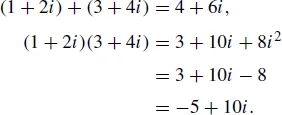
. Combining i with real numbers by addition and multiplication cannot produce anything more general than x + iy where x, y are real. This is because the sum and product of any two numbers of this form are also of this form. For example,
Subtraction produces nothing new since, for example,
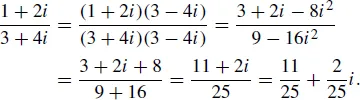
Neither does division since, for example,
The number 3 — 4i is called the conjugate of 3 + 4i. For any x + iy we have
so division can always be done except when x = y = 0, that is, when x + iy = 0.
It is also possible to extract square roots of numbers of the form x + iy as numbers of the same form. For example, suppose
then we have
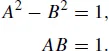
So we require
The second equation gives B = 1/A, which on sub...
Table of contents
Cover Page
Title Page
Copyright Page
Preface
Chapter 1 Complex numbers
Chapter 2 Complex functions
Chapter 3 Derivatives
Chapter 4 Integrals
Chapter 5 Evaluation of finite real integrals
Chapter 6 Evaluation of infinite real integrals
Chapter 7 Summation of series
Chapter 8 Fundamental theorem of algebra
Solutions to examples
Appendix 1: Cauchy’s theorem
Appendix 2: Half residue theorem
Bibliography
Trusted by 375,005 students
Access to over 1.5 million titles for a fair monthly price.
Study more efficiently using our study tools.
Frequently asked questions
Yes, you can cancel anytime from the Subscription tab in your account settings on the Perlego website. Your subscription will stay active until the end of your current billing period. Learn how to cancel your subscription
No, books cannot be downloaded as external files, such as PDFs, for use outside of Perlego. However, you can download books within the Perlego app for offline reading on mobile or tablet. Learn how to download books offline
Perlego offers two plans: Essential and Complete
Essential is ideal for learners and professionals who enjoy exploring a wide range of subjects. Access the Essential Library with 800,000+ trusted titles and best-sellers across business, personal growth, and the humanities. Includes unlimited reading time and Standard Read Aloud voice.
Complete: Perfect for advanced learners and researchers needing full, unrestricted access. Unlock 1.5M+ books across hundreds of subjects, including academic and specialized titles. The Complete Plan also includes advanced features like Premium Read Aloud and Research Assistant.
Both plans are available with monthly, semester, or annual billing cycles.
We are an online textbook subscription service, where you can get access to an entire online library for less than the price of a single book per month. With over 1.5 million books across 990+ topics, we’ve got you covered! Learn about our mission
Look out for the read-aloud symbol on your next book to see if you can listen to it. The read-aloud tool reads text aloud for you, highlighting the text as it is being read. You can pause it, speed it up and slow it down. Learn more about Read Aloud
Yes! You can use the Perlego app on both iOS and Android devices to read anytime, anywhere — even offline. Perfect for commutes or when you’re on the go. Please note we cannot support devices running on iOS 13 and Android 7 or earlier. Learn more about using the app
Yes, you can access Calculus with Complex Numbers by John B. Reade in PDF and/or ePUB format, as well as other popular books in Mathematics & Applied Mathematics. We have over 1.5 million books available in our catalogue for you to explore.