How to Read Architecture
eBook - ePub

How to Read Architecture

An Introduction to Interpreting the Built Environment

  1. 402 pages
  2. English
  3. ePUB (mobile friendly)
  4. Available on iOS & Android
eBook - ePub

How to Read Architecture

An Introduction to Interpreting the Built Environment

About this book

How to Read Architecture is based on the fundamental premise that reading and interpreting architecture is something we already do, and that close observation matters. This book enhances this skill so that given an unfamiliar building, you will have the tools to understand it and to be inspired by it. Author Paulette Singley encourages you to misread, closely read, conventionally read, and unconventionally read architecture to stimulate your creative process.

This book explores three essential ways to help you understand architecture: reading a building from the outside-in, from the inside-out, and from the position of out-and-out, or formal, architecture. This book erodes boundaries between the frequently compartmentalized fields of interior design, landscape design, and building design with chapters exploring concepts of terroir, scenography, criticality, atmosphere, tectonics, inhabitation, type, form, and enclosure. Using examples and case studies that span a wide range of historical and global precedents, Singley addresses the complex interaction among the ways a building engages its context, addresses its performative exigencies, and operates as an autonomous aesthetic object.

Including over 300 images, this book is an essential read for both undergraduate and postgraduate students of architecture with a global focus on the interpretation of buildings in their context.

Frequently asked questions

Yes, you can cancel anytime from the Subscription tab in your account settings on the Perlego website. Your subscription will stay active until the end of your current billing period. Learn how to cancel your subscription.
No, books cannot be downloaded as external files, such as PDFs, for use outside of Perlego. However, you can download books within the Perlego app for offline reading on mobile or tablet. Learn more here.
Perlego offers two plans: Essential and Complete
  • Essential is ideal for learners and professionals who enjoy exploring a wide range of subjects. Access the Essential Library with 800,000+ trusted titles and best-sellers across business, personal growth, and the humanities. Includes unlimited reading time and Standard Read Aloud voice.
  • Complete: Perfect for advanced learners and researchers needing full, unrestricted access. Unlock 1.4M+ books across hundreds of subjects, including academic and specialized titles. The Complete Plan also includes advanced features like Premium Read Aloud and Research Assistant.
Both plans are available with monthly, semester, or annual billing cycles.
We are an online textbook subscription service, where you can get access to an entire online library for less than the price of a single book per month. With over 1 million books across 1000+ topics, we’ve got you covered! Learn more here.
Look out for the read-aloud symbol on your next book to see if you can listen to it. The read-aloud tool reads text aloud for you, highlighting the text as it is being read. You can pause it, speed it up and slow it down. Learn more here.
Yes! You can use the Perlego app on both iOS or Android devices to read anytime, anywhere — even offline. Perfect for commutes or when you’re on the go.
Please note we cannot support devices running on iOS 13 and Android 7 or earlier. Learn more about using the app.
Yes, you can access How to Read Architecture by Paulette Singley in PDF and/or ePUB format, as well as other popular books in Architecture & Architecture General. We have over one million books available in our catalogue for you to explore.

Information

Introduction to Part 1

Reading Between the Lines

Our buildings, above all the public buildings, ought in some fashion to be poems. And the images they offer to our senses must excite in us sentiments analogous to the functions to which the buildings are devoted.1
—Étienne-Louis BoullĂ©e
Architect and architectural theorist Marco Frascari unequivocally asserted that “buildings are texts which are generated by assembling three-dimensional mosaics of fragments, excerpts, citations, passages, and quotations.”2 While the conceptual parallel between buildings and writing dates back at least to the late eighteenth century, when Étienne-Louis BoullĂ©e articulated his analogy between architecture and poetry, the linguistic turn rekindled toward the end of the 1960s inaugurated a system for interpreting architecture according to the rules of language and semiotics. “Linguistics, semiotics, rhetoric, and various models of ‘textuality’” as W. J. T. Mitchell observed in 1994 “had become the lingua franca for critical reflections on the arts, the media, and cultural forms.”3
Lebbeus Woods perfectly summarized the search for meaning at this time when explaining that the grammar and syntax of written language were believed to organize a coherent and meaningful system that clearly related to architecture. As Woods put it, by the 1970s and 1980s, linguistic and literary theorists concluded “that written texts do not have a fixed meaning established by what its author intended to say, but rather multiple meanings that readers have to interpret for themselves by using various cultural codes and references.”4 In other words, while architecture could be read as a cultural text, the actual meaning of that text was fluid. Meaning therefore paradoxically was evacuated from both architecture and the architect’s intentions, with the end result for Woods being that “form does not follow any a priori function but has autonomous existence that must, in the end, be ‘read’ on its own terms.”5 As Woods concluded, “the meaning of architecture is to be found only in architecture itself.”6 The comparison between books and buildings that promised to vitalize architecture as a potentially legible enterprise rebounded into an alibi for evacuating meaning from form and thereby further rarefying its interpretive capacity for an elite audience indoctrinated in its abstruse jargon. The linguistic cure had become literary poison.
In this section the linguistic turn operates as both an historical moment suspended in amber and a contemporary approach to the reading of architecture that begins on the surfaces of buildings featuring supplementary textual content. Chapter 1 approaches engraving as a process of carving into a building’s surface that carries gravitas, as in a grave or serious meaning, where architecture operates as communicator of cultural meaning through its originary status in burial. From signage as contemporary inscription to signs as linguistic tools to scripting as autonomous design, Chapter 2 considers architecture as a process of inscription. It considers the ways in which daily life and roadside attractions inscribe themselves on architecture, often in contradistinction to a designer’s will. Both chapters explore the enduring quarrel between buildings and books.

Notes

1 Etienne-Louis BoullĂ©e BoullĂ©e’s Treatise on Architecture & Complete Presentation of the “Architecture Essas sur l’art” which forms part of the BoullĂ©e papers (Ms. 9153) in the BibliothĂšque Nationale Paris (London: Tiranti, 1953), p. 26.
2 Marco Frascari, “Carlo Scarpa in Magna Graecia: The Abatellis Palace in Palermo,” in AA Files 9 (London: Architectural Association School of Architecture, 1985), p. 3.
3 W. J. T. Mitchell, Picture Theory: Essays on Verbal and Visual Representation (Chicago: University of Chicago Press, 1994), p. 11. Mitchell is referencing Richard Rorty, Philosophy and the Mirror of Nature (Princeton: Princeton University Press, 1979), p. 263.
4 Lebbeus Woods, “Libeskind’s Machines,” November 24, 2009, https://lebbeuswoods.wordpress.com/2009/11/24/libeskinds-machines.
5 Ibid.
6 Ibid.

Chapter 1

Engraving

The circle, the square, are the letters of the alphabet used by the architects for the structures of their best works.1
—Claude Nicolas Ledoux
Long before books were printed and the Internet established worldwide connectivity, architecture was the most accessible and durable form of public media. Architecture emerged as a conduit of cultural expression whose greater function had been to frame rituals, consecrate sites, suspend thresholds between sacred and profane zones, and articulate these spatial performances in conjunction with meaning written on and by its material surfaces. If past civilizations combined inscriptions, symbolic images, and sculptural groups on building surfaces as allegorical programs to expand legibility to less literate audiences, then the complementary presence of words and symbols on today’s architecture remains the most direct means of ascertaining a building’s purpose. In short, focusing on the words, signs, symbols, and emblems appended to a building offers a good place to start to read architecture. While neon lights and digital screens may substitute for words carved in stone, studying the signs and symbols of these more recent contributions to writing on buildings merits the same close attention epigraphists apply to deciphering ancient inscriptions. Inscriptions and their contemporary counterpart of signage may directly or indirectly identify a building or monument’s purpose, construction period, patron, architect, historical context, or poetic aspirations. When it comes to reading architecture, then the first place to start is by seeking out any words, epigraphs, icons, numbers, or symbols that may be appended to it.
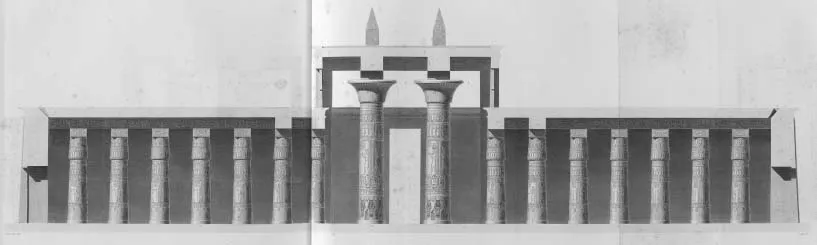
Emblematic of the space that writing occupies in ancient architecture, the great hypostyle hall of Amun-Re at Karnak in Egypt features inscriptions, cartouches, and bas-relief sculpture on every surface. Built during the time of Sety I (reigned 1294–1279 BCE) and his son Ramesses II (reigned 1279–1213 BCE), the hall’s dense intercolumniation represents a primordial papyrus thicket, while its relief carvings illustrate historical and religious stories. This petrified forest contains 12 giant columns in the central space, or nave, standing at about 70 feet tall and 10 feet wide, and 122 columns at the lower side aisles standing at about 33 feet tall. The hall’s surfaces depict the daily rituals priests conducted in the temple sanctuary. The sanctuary was the house of the deity, the final and lowest room in the temple’s processional route that led from an entrance pylon to a peristyle court to a hypostyle hall to the final naos or central shrine. Papyrus column capitals, with open blossoms in the nave and closed buds on the flanking aisles, represent the mythological marsh of creation and the fertile Nile flood plain from out of which they grew. The entire hall operates at multiple levels and scales of legibility: as a shelter for religious practices, an edifice that depicts the rituals it instantiates, a primordial grove, and the deity’s domicile.
Figure 1.1 Diagram of a typical Egyptian temple, drawn by Gavin Friehauf
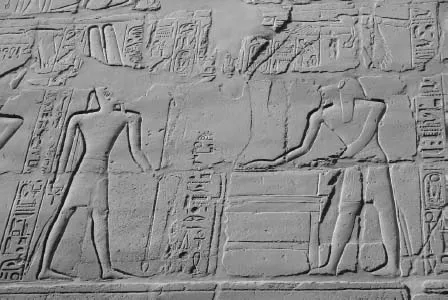
Painted in bright colors, bas-relief sculpture depicts temple rituals and augments the hieroglyphic inscriptions of sacred rites so that even an illiterate public would have been able to glean the message of scenes such as the pharaoh being crowned with a diadem, sacrifices to Amun-Re, or the procession of annual festivals. These engraved surfaces also depict the foundation rites of the temple itself, including such tasks as surveying, designating a sacred boundary, and molding a brick. In temples such as those at Karnak, extensive textual references and ornamental programs transform the building into a guidebook of itself, where deep ritual mysteries are carved on stone pages.
Hieroglyphs mythologize the origins of writing, a gift that liberated people from the burden of having to preserve stories through memorization. This gift, however, was paradoxical. Writing in Phaedrus, Plato described the discovery of writing as a pharmakon: a cure that also acts as a poison. According to Egyptian legend, the god Theuth (Thoth) developed the art of letters among his other inventions of arithmetic, geometry, and astronomy. The Egyptian King Thamus replied to this offering with circumspection, arguing that “this discovery of yours will create forgetfulness in the learners’ souls, because they will not use their memories; they will trust to the external written characters and not remember of themselves.”2 A prescription to save memory, inscription transforms the surfaces of architecture—an art form whose endurance uniquely ties to the ars memoriae or memory arts—into permanent historical records, and indeed into books. But, in this poison–cure dynamic the pharmacological tensions between inscription, prescription, architecture, writing, forgetting, and remembering also identify a fundamental rivalry between words and buildings. Does writing render buildings into mere surfaces awaiting inscriptions or does architecture’s monumentality dwarf the words inscribed on its walls? For John Ruskin, a 19th-century architectural critic: “It is as the centralization and protectress of this sacred influence, that Architecture is to be regarded by us with the most serious thought. We may live without her, and worship without her, but we cannot remember without her.”3
Figure 1.2 Transverse section of the Great Hypostyle Hall from the Precinct of Amun-Re in the Karnak Temple Complex at Thebes. From Description de l’Égypte: ou, Recueil des observations et des recherches qui ont Ă©tĂ© faites en Égypte pendant l’expĂ©dition de l’armĂ©e française publiĂ© par les ordres de Sa MajestĂ© l’empereur NapolĂ©on le Grand (Paris: Imprimerie impĂ©riale, 1809–1828)
Figure 1.3 Ramesses II molding a mud brick before Amun-Re using a wooden mold, a ritual similar to laying the cornerstone of a building ceremonies, from the Great Hypostyle Hall at Karnak. Photo by Dr Peter Brand and image courtesy of P. Brand/Karnak Hypostyle Hall Project
Trajan’s Column, a commemorative columna cochlis in Rome dating from 113 CE, offers a case in point to demonstrate this rivalry. It is a marker that depicts sequential sculptural groups of the emperor’s two victories over the Dacians on a narrative frieze spiraling fr...
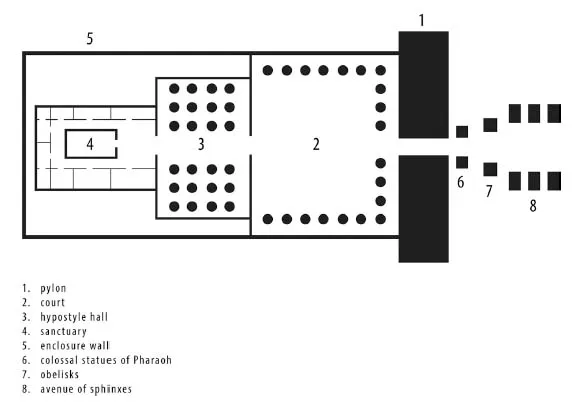
Table of contents

  1. Cover
  2. Half Title
  3. Title Page
  4. Copyright Page
  5. Dedication Page
  6. Contents
  7. Acknowledgments
  8. Introduction: Ground Rules
  9. Introduction to Part 1 Reading Between the Lines
  10. Introduction to Part 2 Outside-In Architecture
  11. Introduction to Part 3 Inside-Out Architecture
  12. Introduction to Part 4 Out-and-Out Architecture
  13. Index