- 496 pages
- English
- ePUB (mobile friendly)
- Available on iOS & Android
eBook - ePub
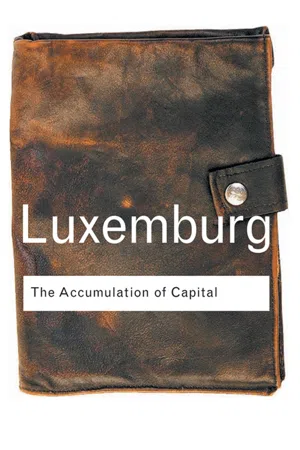
The Accumulation of Capital
About this book
Rosa Luxemburg was a revolutionary socialist who fought and died for her beliefs. In January 1919, after being arrested for her involvement in a workers' uprising in Berlin, she was brutally murdered by a group of right-wing soldiers. Her body was recovered days later from a canal. Six years earlier she had published what was undoubtedly her finest
Historical Exposition of the Problem
10
Sismondi's Theory of Reproduction
The first grave doubts as to the divine character of the capitalist order came to bourgeois economists under the immediate impact of the first crises of 1815 and 1818–19 in England. Even then it had still been external circumstances which led up to these crises, and they appeared to be ephemeral. Napoleon’s blockade of the Continent which for a time had cut offEngland from her European markets and had favoured a considerable development of home industries in some of the continental countries, was partly responsible; for the rest the material exhaustion of the Continent, owing to the long period of war, made for a smaller demand for English products than had been expected when the blockade was lifted. Still, these early crises were enough to reveal to the contemporary world the sinister aspects of this best of all social orders. Glutted markets, shops filled with goods nobody could buy, frequent bankruptcies—and on the other hand the glaring poverty of the toiling masses—for the first time all this starkly met the eyes of theorists who had preached the gospel of the beautiful harmonies of bourgeois laissez-faire and had sung its praises in all keys. All contemporary trade reports, periodicals and travellers’ notes told of the losses sustained by English merchants. In Italy, Germany, Russia, and Brazil, the English disposed of their commodity stocks at a loss of anything between 25 per cent and 33⅓ per cent. People at the Cape of Good Hope in 1818 complained that all the shops were flooded with European goods offered at lower prices than in Europe and still unmarketable. From Calcutta there came similar complaints. From New Holland whole cargoes returned to England. In the United States, a contemporary traveller reports, ‘there was no town nor hamlet from one end of the other of this immense and prosperous continent where the amount of commodities displayed for sale did not considerably exceed the means of the purchasers, although the vendors tried to attract custom by long-term credits, all sorts of facilities for payment, payment by instalments and acceptance of payment in kind’.
At the same time, England was hearing the desperate outcry of her workers. The Edinburgh Review of 18201 quotes an address by the Nottingham frame-work knitters which contained the following statements:
‘After working from 14 to 16 hours a day, we only earn from 4s. to 7s. a week, to maintain our wives and families upon; and we farther state, that although we have substituted bread and water, or potatoes and salt, for that more wholesome food an Englishman’s table used to abound with, we have repeatedly retired, after a heavy day’s labour, and have been under the necessity of putting our children supperless to bed, to stifle the cries of hunger. We can most solemnly declare, that for the last eighteen months we have scarcely known what it was to be free from the pangs of hunger.’2
Then Owen in England, and Sismondi in France, almost simultaneously raised their voices in a weighty indictment of capitalist society. Owen, as a hard-headed Englishman and citizen of the leading industrial state, constituted himself spokesman for a generous social reform, whereas the petty-bourgeois Swiss rather lost himself in sweeping denunciations of the imperfections of the existing social order and of classical economics. And yet, by so doing, Sismondi gave bourgeois economics a much harder nut to crack than Owen, whose fertile practical activities were directly applied to the proletariat.
Sismondi explained in some detail that the impetus for his social criticism came from England, and especially her first crisis. In the second edition of his Nouveaux Principes d’Economie Politique Ou De La Richesse Dans Ses Rapports Avec La Population,3 eight years after the publication of the first edition in 1819, he writes as follows:
‘It was in England that I performed the task of preparing the new edition. England has given birth to the most celebrated Political Economists: the science is cultivated even at this time with increased ardour.... Universal competition or the effort always to produce more and always cheaper, has long been the system in England, a system which I have attacked as dangerous. This system has used production by manufacture to advance with gigantic steps, but it has from time to time precipitated the manufacturers into frightful distress. It was in presence of these convulsions of wealth that I thought I ought to place myself, to review my reasonings and compare them with facts.—The study of England has confirmed me in my “New Principles”. In this astonishing country, which seems to be subject to a great experiment for the instruction of the rest of the world, I have seen production increasing, whilst enjoyments were diminishing. The mass of the nation here, no less than philosophers, seems to forget that the increase of wealth is not the end in political economy, but its instrument in procuring the happiness of all. I sought for this happiness in every class, and I could nowhere find it. The high English aristocracy has indeed arrived to a degree of wealth and luxury which surpasses all that can be seen in other nations; nevertheless it does not itself enjoy the opulence which it seems to have acquired at the expense of the other classes; security is wanting and in every family most of the individuals experience privation rather than abundance....Below this titled and not titled aristocracy, I see commerce occupy a distinguished rank; its enterprises embrace the whole world, its agents brave the ices of the poles, and the heats of the equator, whilst every one of its leading men, meeting on Exchange, can dispose of thousands. At the same time, in the streets of London, and in those of the other great towns of England, the shops display goods sufficient for the consumption of the world.—But have riches secured to the English merchant the kind of happiness which they ought to secure him? No: in no country are failures so frequent, nowhere are those colossal fortunes, sufficient in themselves to supply a public loan to uphold an Empire, or a republic, overthrown with as much rapidity. All complain that business is scarce, difficult, not remunerative. Twice, within an interval of a few years, a terrible crisis has ruined part of the bankers, and spread desolation among all the English manufacturers. At the same time another crisis has ruined the farmers, and been felt in its rebound by retail dealers. On the other hand, commerce, in spite of its immense extent, has ceased to call for young men who have their fortunes to make; every place is occupied, in the superior ranks of society no less than in the inferior; the greater number offer their labour in vain, without being able to obtain remuneration.—Has, then, this national opulence, whose material progress strikes every eye, nevertheless tended to the advantage of the poor? Not so. The people of England are destitute of comfort now, and of security for the future. There are no longer yeomen, they have been obliged to become day labourers. In the towns there are scarcely any longer artisans, or independent heads of a small business, but only manufacturers. The operative, to employ a word which the system has created, does not know what it is to have a station; he only gains wages, and as these wages cannot suffice for all seasons, he is almost every year reduced to ask alms from the poor-rates.—This opulent nation has found it more economical to sell all the gold and silver which she possessed, to do without coin, and to depend entirely on a paper circulation; she has thus voluntarily deprived herself of the most valuable of all the advantages of coin: stability of value. The holders of the notes of the provincial banks run the risk every day of being ruined by frequent and, as it were, epidemic failures of the bankers; and the whole state is exposed to a convulsion in the fortune of every individual, if an invasion or a revolution should shake the credit of the national bank. The English nation has found it more economical to give up those modes of cultivation which require much hand-labour, and she has dismissed half the cultivators who lived in the fields. She has found it more economical to supersede workmen by steam-engines; she has dismissed . . . the operatives in towns, and weavers giving place to power-looms, are now sinking under famine; she has found it more economical to reduce all working people to the lowest possible wages on which they can subsist, and these working people being no longer anything but a rabble, have not feared plunging into still deeper misery by the addition of an increasing family. She has found it more economical to feed the Irish with potatoes, and clothe them in rags; and now every packet brings legions of Irish, who, working for less than the English, drive them from every employment. What is the fruit of this immense accumulation of wealth? Have they had any other effect than to make every class partake of care, privation and the danger of complete ruin? Has not England, by forgetting men for things, sacrificed the end to the means?’4
This mirror, held up to capitalist society almost a century before the time of writing, is clear and comprehensive enough in all conscience. Sismondi put his finger on every one of the sore spots of bourgeois economics: the ruin of small enterprise; the drift from the country; the proletarisation of the middle classes; the impoverishment of the workers; the displacement of the worker by the machine; unemployment; the dangers of the credit system; social antagonisms; the insecurity of existence; crises and anarchy. His harsh, emphatic scepticism struck a specially shrill discord with the complacent optimism, the idle worship of harmony as preached by vulgar economics which, in the person of MacCulloch in England and of Say in France, was becoming the fashion in both countries. It is easy to imagine what a deep and painful impression remarks like the following were bound to make:
5 ‘There can only be luxury if it is bought with another’s labour; only those will work hard and untiringly who have to do so in order to get not the frills but the very necessities of life.’5
‘Although the invention of the machine which increases man’s capacity, is a blessing for mankind, it is made into a scourge for the poor by the unjust distribution we make of its benefits.’6
‘The gain of an employer of labour is sometimes nothing if not despoiling the worker he employs; he does not benefit because his enterprise produces much more than it costs, but because he does not pay all the costs, because he does not accord the labourer a remuneration equal to his work. Such an industry is a social evil, for it reduces those who perform the work to utmost poverty, assuring to those who direct it but the ordinary profits on capital.’7
‘Amongst those who share in the national income, one group acquires new rights each year by new labours, the other have previously acquired permanent rights by reason of a primary effort which makes a year’s labour more advantageous.’8
‘Nothing can prevent that every new discovery in applied mechanics should diminish the working population by that much. To this danger it is constantly exposed, and society provides no remedy for it.’9
‘A time will come, no doubt, when our descendants will condemn us as barbarians because we have left the working classes without security, just as we already condemn, as they also will, as barbarian the nations who reduced those same classes to slavery.’10
Sismondi’s criticism thus goes right to the root of the matter; for him there can be no compromise or evasion which might try to gloss over the dark aspects of capitalist enrichment he exposed, as merely temporary shortcomings of a transition period. He concludes his investigation with the following rejoinder to Say:
‘For seven years I have indicated this malady of the social organism, and for seven years it has continuously increased. I cannot regard such prolonged suffering as the mere frictions which always accompany a change. Going back to the origin of income, I believe to have shown the ills we experience to be the consequence of a flaw in our organisation, to have shown that they are not likely to come to an end.’11
The disproportion between capitalist production and the distribution of incomes determined by the former appears to him the source of all evil. This is the point from which he comes to the problem of accumulation with which we are now concerned.
The main thread of his criticism against classical economics is this: capitalist production is encouraged to expand indefinitely without any regard to consumption; consumption, however, is determined by income.
‘All the modern economists, in fact, have allowed that the fortune of the public, being only the aggregation of private fortunes, has its origin, is augmented, distributed and destroyed by the same means as the fortune of each individual. They all know perfectly well, that in a private fortune, the most important fact to consider is the income, and that by the income must be regulated consumption or expenditure, or the capital will be destroyed. But as, in the fortune of the public, the capital of one becomes the income of another, they have been perplexed to decide what was capital, and what income, and they have therefore found it more simple to leave the latter entirely out of their calculations. By neglecting a quality so essential to be determined, Say and Ricardo have arrived at the conclusion, that consumption is an unlimited power, or at least having no limits but those of production, whilst it is in fact limited by income....Theyannounced that whatever abundance might be produced, it would always find consumers, and they have encouraged the producers to cause that glut in the markets, which at this time occasions the distress of the civilised world; whereas they should have forewarned the producers that they could only reckon on those consumers who possessed income.’12
Sismondi thus grounds his views in a theory of income. What is income, and what is capital? He pays the greatest attention to this distinction which he calls ‘the most abstract and difficult question of political economics’. The fourth chapter of his second book is devoted to this problem. As usual, Sismondi starts his investigation with Robinson Crusoe. For such a one, the distinction between capital and income was still ‘confused’; it becomes ‘essential’ only in society. Yet in society, too, this distinction is very difficult, largely on account of the already familiar myth of bourgeois economics, according to which ‘the capital of one becomes the income of another’, and vice versa. Adam Smith was responsible for this confusion which was then elevated to an axiom by Say in justification of mental inertia and superficiality. It was loyally accepted by Sismondi.
‘The nature of capital and of income are always confused by the mind; we see that what is income for one becomes capital for another, and the same object, in passing from hand to hand, successively acquires different denominations; the value which becomes detached from an object that has been co...
Table of contents
- Cover
- Title
- Copyright
- Contents
- INTRODUCTION TO THE ROUTLEDGE CLASSICS EDITION
- TRANSLATOR'S NOTE
- A NOTE ON ROSA LUXEMBURG
- INTRODUCTION
- SECTION I The Problem of Reproduction
- SECTION II Historical Exposition of the Problem
- SECTION III The Historical Conditions of Accumulation
- INDEX
Trusted by 375,005 students
Access to over 1.5 million titles for a fair monthly price.
Study more efficiently using our study tools.
Frequently asked questions
Yes, you can cancel anytime from the Subscription tab in your account settings on the Perlego website. Your subscription will stay active until the end of your current billing period. Learn how to cancel your subscription
No, books cannot be downloaded as external files, such as PDFs, for use outside of Perlego. However, you can download books within the Perlego app for offline reading on mobile or tablet. Learn how to download books offline
Perlego offers two plans: Essential and Complete
- Essential is ideal for learners and professionals who enjoy exploring a wide range of subjects. Access the Essential Library with 800,000+ trusted titles and best-sellers across business, personal growth, and the humanities. Includes unlimited reading time and Standard Read Aloud voice.
- Complete: Perfect for advanced learners and researchers needing full, unrestricted access. Unlock 1.5M+ books across hundreds of subjects, including academic and specialized titles. The Complete Plan also includes advanced features like Premium Read Aloud and Research Assistant.
We are an online textbook subscription service, where you can get access to an entire online library for less than the price of a single book per month. With over 1.5 million books across 990+ topics, we’ve got you covered! Learn about our mission
Look out for the read-aloud symbol on your next book to see if you can listen to it. The read-aloud tool reads text aloud for you, highlighting the text as it is being read. You can pause it, speed it up and slow it down. Learn more about Read Aloud
Yes! You can use the Perlego app on both iOS and Android devices to read anytime, anywhere — even offline. Perfect for commutes or when you’re on the go.
Please note we cannot support devices running on iOS 13 and Android 7 or earlier. Learn more about using the app
Please note we cannot support devices running on iOS 13 and Android 7 or earlier. Learn more about using the app
Yes, you can access The Accumulation of Capital by Rosa Luxemburg in PDF and/or ePUB format, as well as other popular books in Economics & Business General. We have over 1.5 million books available in our catalogue for you to explore.