- 256 pages
- English
- ePUB (mobile friendly)
- Available on iOS & Android
eBook - ePub
About this book
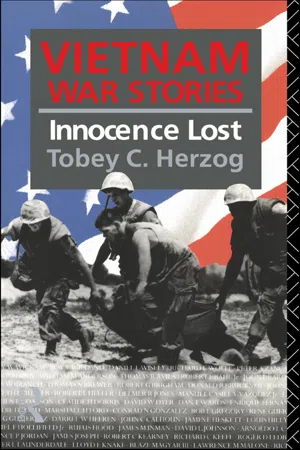
The Gulf War and its aftermath have testified once again to the significance placed on the meanings and images of Vietnam by US media and culture. Almost two decades after the end of hostilities, the Vietnam War remains a dominant moral, political and military touchstone in American cultural consciousness. Vietnam War Stories provides a comprehensi
Information
1
Thematic Contexts
There’s nothing new to tell about Vietnam; I’m saying it was just a war like every war.
Tim O’Brien, Going After Cacciato
Paul Fussell, John Wayne, Heart of Darkness, The Naked and the Dead, and Post-Traumatic Stress Disorder—what do these people, books, and a psychological disorder have in common with American literature about the Vietnam War? The answer: each represents a thematic context (a war theme) to aid readers in understanding and evaluating Vietnam war stories by connecting them to historical events, other modern war literature, and American culture. This chapter introduces five of these contexts, ones that significantly help readers appreciate these narratives. Such contextual approaches to reading these works counteract the tendency of inexperienced readers of war literature to approach Vietnam narratives in a vacuum. Immersed in this popular contemporary literature, these readers often are unaware of the literary, cultural, and historical connections directly or indirectly influencing the purpose, content, and form of Vietnam war stories. Were the combat experiences of Americans in Vietnam unique among wars; or is the epigraph from Tim O’Brien’s Going After Cacciato about the sameness of wars also accurate? Compared to soldier-authors writing about other wars, do Vietnam veterans view their experiences differently and present war stories in distinct forms? Or is there a continuity among themes, characters, and narrative strategies throughout modern war literature? These are some of the questions addressed in this chapter on contexts.
Certainly, the critic’s goal to explore such connections within w stories shapes four current studies of Vietnam narratives and American society during the war: Philip D.Beidler’s American Literature and the Experience of Vietnam, John Hellmann’s American Myth and the Legacy of Vietnam, Thomas Myers’s Walking Point: American Narratives of Vietnam, and Loren Baritz’s Backfire. Each critic establishes historical, cultural, or literary connections, perhaps as an antidote to what James C.Wilson calls the inability of Vietnam soldiers and some authors to see their war in political, moral, and historical context (1982, 52). Each of these critics suggests that in the Vietnam narratives, fiction and nonfiction, readers find literary or mythic visions that Beidler labels “prophecy and context.” Thus, using old and new literary conventions, authors consciously or unconsciously combine new visions with traditional myths and thematic patterns. In short, as Beidler notes, they mix old and new experiences:
American writing about Vietnam, for all one’s sense of the new and even unprecedented character of the experience it describes, often turns out to be very much in context…with regard to our national traditions of literature and popular myth-making at large. (1982, 19)
Accordingly, for Beidler the literary Vietnam experience is prefigured in works by American authors such as James Fenimore Cooper, Mark Twain, and Herman Melville; the historical documents of exploration and settlement written by the first colonists; and the later mythology surrounding the settlement of the American West.
Hellmann explores in much greater detail the context of American myths shaping Vietnam War literature, specifically the thematic influence of mythic heroes, values, and actions associated with the American frontier. These were resurrected during our early involvement in Vietnam through President Kennedy’s “New Frontier” and his close identification with the Green Berets: “Above all the Green Berets symbolized the rededication to the American errand, the reassertion of the virtues and imperatives of America’s frontier mythos” (1986, 37–8). Thus, Hellmann notes that Vietnam narratives often portray Americans’ expectations that this war will be an opportunity to regenerate our traditional frontier values of self-reliance, democratic idealism, ingenuity, practicality, and generosity while bringing democracy to Southeast Asia. However, much of this war literature also undercuts these frontier myths, suggesting that instead of following the romantic plot of a traditional John Wayne western the unconventional movie script for Vietnam seems more appropriate for a surrealistic foreign film.
In Walking Point: American Narratives of Vietnam, Thomas Myers also proposes contexts for understanding the form and content of Vietnam narratives. He examines the American character (myths and beliefs) and literary traditions, particularly those of the historical novel and war genre, influencing these books. Echoing Beidler, he suggests that the best works about Vietnam are those that move beyond battlefield realism and incorporate or play against historical, experiential, cultural, and literary connections—previous wars, popular myths, and American historical novels:
In regard to specific narrative inevitabilities, the Vietnam War was, despite its claims to difference, the extension and evolution of a number of deeply rooted American traditions, a crucial national experience requiring both text and context. (1988, 5)
Finally, social historian Loren Baritz in Backfire presents a broad context for understanding the war and its literature: an overriding tension between the realities of the war and America’s moral and political beliefs. As a result, in Vietnam Americans conducted “an American way of war congruent with the American way of life, with American culture” (1986, viii). At the heart of this American way is a vision characterized by John Winthrop’s admonition in 1630 to his Puritan followers to establish a “City upon a Hill,” a chosen people becoming a moral and political example to the rest of the world. This point of view results in a political and moral idealism that, according to Baritz, underlies the Government’s and military’s conduct of the Vietnam War; surfaces as an important theme in soldiers’ memoirs; and crumbles under the political, moral, cultural, and military realities of Vietnam.
The Ironic Spirit: War is Hell
My own search for connections partially arises from the contexts described in these four critical studies, but moves into five other areas, ones rooted primarily in literary contexts but also containing cultural and historical elements. The first of these springs from Paul Fussell’s seminal book The Great War and Modern Memory. This accessible critical study, written by an American combat veteran of World War II and well-known literary critic, examines British literature (memoir, fiction, and poetry) emanating from World War I. It is a model for readers and critics exploring themes and structures in modern war literature, including works about Vietnam. Fussell’s book explores the soldier-authors’ uses of memory and imagination in recalling, recreating, and mythologizing war experiences. More precisely, he examines patterns in this body of literature to demonstrate how the soldier-author recalls the war (content) and orders these recollections (form).
Among the various thematic and structural patterns Fussell discusses, he notes the ironic spirit pervading the most thoughtful and revealing pieces of World War I literature written by Wilfred Owen, Siegfried Sassoon, Robert Graves, Edmund Blunden, and others. A simple reality shapes these British soldier-authors’ perceptions of their war experiences: “Every war is ironic because every war is worse than expected” ([1975] 1981, 7). This tension between the soldier’s romantic expectations of war and the harsh realities of the battlefield influences the World War I authors as they recall their experiences. Such a familiar archetypal pattern of “hope abridged” becomes an important theme and also an ordering device—a way of shaping and dramatically heightening war stories.
According to Fussell, “the fuel of hope is innocence” (p. 18). British soldiers entered World War I with unrealistic notions of war engendered by the language, popular myths, and chivalrous conduct found in popular “male romances” and more literate works by Alfred Tennyson, William Morris, and Rupert Brooke (p. 21). With this idealism, visions of courage and heroism, a secure sense of purpose and control of their destiny, and an almost “sporting” view of the war, they expected to make quick work of the Germans. Fussell quotes A.J.P.Taylor as saying, “No man in the prime of life knew what war was like. All imagined that it would be an affair of great marches and great battles quickly decided” (p. 21). But as Fussell notes, “Irony is the attendant of hope…” (p. 18), and the British soldiers encountered neither a “sporting” war nor a quick end to the conflict. The horrors of protracted trench warfare, deadly gas, frequent artillery barrages, and the killing efficiency of the machine-gun quickly destroyed innocence. How could glorious illusions remain after 60,000 British soldiers lost their lives in one day of fighting at the Somme on 1 July 1916? Soldiers quickly realized how far removed from normal patterns of life and moral conduct were the realities of the battlefield. Their unshaken beliefs in purpose and destiny waned.
Such an ironic vision of these experiences also influenced the soldier-author’s telling of these events. The result, according to Fussell, is an underlying three-part structure in the paradigmatic British World War I memoir and even in some of the poetry:
first, the sinister or absurd or even farcical preparation [for battle]; second, the unmanning experience of battle; and third, the retirement from the line to a contrasting (usually pastoral) scene, where there is time and quiet for consideration, meditation, and reconstruction. The middle stage is always characterized by disenchantment and loss of innocence…. (p. 130)
The third stage, a more open-ended period of contemplation, begins on the battlefield, but may continue long after the war has ended and the soldiers have returned home. It may even extend into a fourth stage, one that Fussell does not identify, where soldiers not only continue to reflect on their war experiences but also struggle to adjust to civilian life. Obviously, Fussell’s tripartite pattern of innocence, experience, and consideration has archetypal connections, and in various forms shapes much of the general Bildungsroman, or rite-of-passage, literature focusing on the education, spiritual growth, or mythic quest of a central character. Since so many war narratives are typically a form of this initiation literature, Fussell’s structure of irony and evolution, especially stages one and two, underlies many of the best pieces of modern war writing: Crane’s The Red Badge of Courage, Remarque’s All Quiet on the Western Front, Hemingway’s A Farewell to Arms, Jones’s The Thin Red Line, and even portions of Joseph Heller’s Catch-22.
Moving to the Vietnam narratives, we find this ironic spirit and structure also present. For example, Caputo’s war memoir, A Rumor of War, best illustrates the content, style and tripartite structure of Fussell’s paradigm.1 Caputo describes his movement from the innocent and patriotic Marine officer in basic training to the hardened combat veteran, to the chastened officer on trial for his part in a war atrocity. This progression through innocence, experience, and reflection is also an important structural device in two other nonfiction works—Michael Herr’s Dispatches and Ron Kovic’s Born on the Fourth of July—and in Tim O’Brien’s novel Going After Cacciato. But Fussell’s way of looking at war literature is also helpful with those works containing only two of the stages (innocence and experience) Gustav Hasford’s The Short-Timers for instance—or with works focusing on one or more characters moving through stages of innocence and battlefield disillusionment. The experiences of Lieutenant Anderson in David Halberstam’s One Very Hot Day, Corporal Chelini in John Del Vecchio’s The 13th Valley, and Lieutenant Hodges in James Webb’s Fields of Fire are examples of this thematic pattern shaping individual characterization rather than the overall structure of the book.
Perhaps most significant, Fussell’s observations about the three-part theme and structure guide readers and critics evaluating the quality of many war books. The least successful works, usually promoting an upbeat, romantic view of war, are centered in one of the categories. Characters maintain the youthful innocence and idealism throughout their entire war experiences, or the book focuses on the experience section at the expense of others. In the latter category, authors make realism the ultimate goal of their recreation. As a result, these books, whether nonfiction or fiction, are merely battlefield diaries or warfare manuals. Authors emphasize experience while excluding truths, internal conflict, moral dilemmas, or character development. More sophisticated war literature, however, moves beyond innocence and battlefield experiences into Fussell’s third category as the soldiers attempt to order and understand their experiences. This third stage of memory, reconstruction, and consideration may result in repudiation or affirmation of the war, insight about the ironies of war, self-awareness, nostalgia for the war environment and battlefield friends, or social estrangement. Such moments can occur in the war environment—for example, Paul Berlin’s night of consideration in Going After Cacciato—or this reflection may primarily occur on a return to the States, as in Herr’s Dispatches.
The John Wayne Syndrome: The Ideal Soldier
Picture this final scene in The Green Berets, Hollywood’s and John Wayne’s 1967 version of the Vietnam War. Colonel Kirby (John Wayne) has his arm around the young Vietnamese orphan, Hamchung, whose American benefactor, a Green Beret, has been killed by a Vietcong booby-trap. As they walk into the sunset (with the sun inexplicably setting in the east), Hamchung asks Kirby what will happen to him now that his friend is dead. Kirby turns to the boy and says: “You let me worry about that, Green Beret; you’re what this war is all about.” It’s a scene right out of an American western movie updated for Vietnam. It’s also a scene introducing a second thematic context for understanding the Vietnam works—the John Wayne Syndrome. Suggested by this dialogue is Hollywood’s, and especially John Wayne’s, connection to the complicated process of shaping American soldiers’ views of Vietnam prior to their involvement in combat and of creating society’s expectations for the ideal warrior. If, as Fussell suggests, innocence, idealism, and unrealistic expectations are customary baggage for young soldiers going off to war, the question becomes who or what are the sources for these illusions and myths? For the large number of literate British soldiers fighting as common soldiers in World War I, Fussell notes that their sources of images, beliefs, and values about war frequently came from literary romances—specifically Bunyan’s Pilgrim’s Progress (1673) and the “Victorian pseudo-medieval romances” of Tennyson’s poetry and the prose romances of William Morris ([1975] 1981, 135).
But neither literature nor medieval knights are the principal cultural influences for American soldiers fighting in Vietnam. Granted the fictional character Alden Pyle in Graham Greene’s The Quiet American has his idealism and illusions about Vietnam of the early 1950s shaped by the books of the fictional author York Harding. But as a key influence for many Americans, soldiers and civilians, Hellmann cites political figures and their rhetoric, principally President Kennedy’s mythic frontier values and symbolic call to action embodied in his “New Frontier” (1986, 36). Lloyd B.Lewis in The Tainted War: Culture and Identity in Vietnam War Narratives comments that, as was true for combatants in previous wars, family (especially fathers) and the military influenced these young soldiers. He goes on to say that for this first true electronic-media generation,
[m]ore than any other single factor cited in the Vietnam War literature, the media (especially motion pictures) served to initiate young American males into the mysteries of making war, the purposes war is intended to accomplish, and the role one is expected to adopt within that war. (1985, 22)
And Julian Smith, in Looking Away: Hollywood and Vietnam, labels Vietnam “America’s first film-generated war…the first…war to grow out of attitudes supported, perhaps even created, by a generation of [World War II] movies depicting America’s military omnipotence” (1975, 4). The values, purposes, and nature of war portrayed in these films suggested for Americans in the 1960s that the Vietnam War should be modelled af ter World War II, “the Big One” as television-character Archie Bunker always labeled it. The irony of such a naïve view of World War II is that this war had also been romanticized by authors, historians, veterans, and filmmakers. As Fussell notes in his recent book on World War II, Wartime: Understanding and Behavior in the Second World War, “For the past fifty years the Allied war has been sanitized and romanticized almost beyond recognition by the sentimental, the loony patriotic, the ignorant, and the bloodthirsty” (1989, ix).
Several Vietnam authors and characters readily cite the media’s influence on their expectations for the war and their image of the ideal soldier. For example, Jamie Hawkins, the narrator in Charles Durden’s No Bugles, No Drums, observes that “like it ‘r not, we’d all been raised on late-night TV movies that glamourized Americans wadin’ ashore under an umbrella of palm fronds ‘n’ 40mm cannon fire from the fleet. And the only guys who got killed were extras” (1976, 3). Ron Kovic also recalls his fascination with World War II movies:
I’ll never forget Audie Murphy in To Hell and Back. At the end he jumps on top of a flaming tank that’s just about to explode and grabs the machine gun blasting it into the German lines. He was so brave I had chills running up and down my back, wishing it were me up there…. It was the greatest movie I ever saw in my life. ([1976] 1977, 54)
Finally, several soldier-authors demonstrate their film literacy by using movie metaphors to explain their narrative strategies: “I can recall only snatches of that time; fragmentary scenes flicker across my mental screen like excerpts from a film…” (Caputo [1977] 1978, 295).
If movies were indeed the principal introduction to war for young Americans going off to Vietnam, then one movie figure, perhaps, did more than anyone else, even Audie Murphy (a World War II hero and later a movie actor), to develop Americans’ expectations about this war and the people fighting it. That person was, as Lewis and others have noted, John Wayne. In the early 1960s, as President Kennedy was influencing young Americans with his calls to action and his visions for an expanded role of the Green Berets in Vietnam, another prominent American...
Table of contents
- Cover Page
- Title Page
- Copyright Page
- Acknowledgements
- Introduction
- 1: Thematic Contexts
- 2: Innocence
- 3: Experience
- 4: Consideration
- 5: Aftermath
- Afterword
- Notes
- Bibliography
Trusted by 375,005 students
Access to over 1.5 million titles for a fair monthly price.
Study more efficiently using our study tools.
Frequently asked questions
Yes, you can cancel anytime from the Subscription tab in your account settings on the Perlego website. Your subscription will stay active until the end of your current billing period. Learn how to cancel your subscription
No, books cannot be downloaded as external files, such as PDFs, for use outside of Perlego. However, you can download books within the Perlego app for offline reading on mobile or tablet. Learn how to download books offline
Perlego offers two plans: Essential and Complete
- Essential is ideal for learners and professionals who enjoy exploring a wide range of subjects. Access the Essential Library with 800,000+ trusted titles and best-sellers across business, personal growth, and the humanities. Includes unlimited reading time and Standard Read Aloud voice.
- Complete: Perfect for advanced learners and researchers needing full, unrestricted access. Unlock 1.5M+ books across hundreds of subjects, including academic and specialized titles. The Complete Plan also includes advanced features like Premium Read Aloud and Research Assistant.
We are an online textbook subscription service, where you can get access to an entire online library for less than the price of a single book per month. With over 1.5 million books across 990+ topics, we’ve got you covered! Learn about our mission
Look out for the read-aloud symbol on your next book to see if you can listen to it. The read-aloud tool reads text aloud for you, highlighting the text as it is being read. You can pause it, speed it up and slow it down. Learn more about Read Aloud
Yes! You can use the Perlego app on both iOS and Android devices to read anytime, anywhere — even offline. Perfect for commutes or when you’re on the go.
Please note we cannot support devices running on iOS 13 and Android 7 or earlier. Learn more about using the app
Please note we cannot support devices running on iOS 13 and Android 7 or earlier. Learn more about using the app
Yes, you can access Vietnam War Stories by Tobey C. Herzog in PDF and/or ePUB format, as well as other popular books in Literature & Historical Literary Criticism. We have over 1.5 million books available in our catalogue for you to explore.