This book intends to provide a comprehensive overview on different aspects of mechanisms and techniques for information security. It is written for students, researchers, and professionals studying in the field of multimedia security and steganography. Multimedia security and steganography is especially relevant due to the global scale of digital multimedia and the rapid growth of the Internet. Digital watermarking technology can be used to guarantee authenticity and can be applied as proof that the content has not been altered since insertion. Updated techniques and advances in watermarking are explored in this new edition. The combinational spatial and frequency domains watermarking technique provides a new concept of enlarging the embedding capacity of watermarks. The genetic algorithm (GA) based watermarking technique solves the rounding error problem and provide an efficient embedding approach. Each chapter provides the reader with a fundamental, theoretical framework, while developing the extensive advanced techniques and considering the essential principles of the digital watermarking and steganographic systems. Several robust algorithms that are presented throughout illustrate the framework and provide assistance and tools in understanding and implementing the fundamental principles.
eBook - ePub
Digital Watermarking and Steganography
Fundamentals and Techniques, Second Edition
- 270 pages
- English
- ePUB (mobile friendly)
- Available on iOS & Android
eBook - ePub
About this book
Information
1 | Introduction |
Digital information and data are transmitted more often over the Internet now than ever before. The availability and efficiency of global computer networks for the communication of digital information and data have accelerated the popularity of digital media. Digital images, video, and audio have been revolutionized in the way they can be captured, stored, transmitted, and manipulated. This gives rise to a wide range of applications in education, entertainment, the media, industrial manufacturing, medicine, and the military, among other fields [1].
Computers and networking facilities are becoming less expensive and more widespread. Creative approaches to storing, accessing, and distributing data have generated many benefits for digital multimedia, mainly due to properties such as distortion-free transmission, compact storage, and easy editing. Unfortunately, free-access digital multimedia communication also provides virtually unprecedented opportunities to pirate copyrighted material. Therefore, the idea of using a digital watermark to detect and trace copyright violations has stimulated significant interest among engineers, scientists, lawyers, artists, and publishers, to name a few. As a result, research into the robustness of watermark embedding with respect to compression, image-processing operations, and cryptographic attacks has become very active in recent years, and the developed techniques have grown and been improved a great deal.
In this chapter, we introduce digital watermarking in Section 1.1 and digital steganography in Section 1.2. The differences between watermarking and steganography are given in Section 1.3. Finally, a brief history is described in Section 1.4.
1.1DIGITAL WATERMARKING
Watermarking is not a new phenomenon. For nearly a thousand years, watermarks on paper have been used to visibly indicate a particular publisher and to discourage counterfeiting in currency. A watermark is a design impressed on a piece of paper during production and used for copyright identification (as illustrated in Figure 1.1). The design may be a pattern, a logo, or some other image. In the modern era, as most data and information are stored and communicated in digital form, proving authenticity plays an increasingly important role. As a result, digital watermarking is a process whereby arbitrary information is encoded into an image in such a way as to be imperceptible to observers.

FIGURE 1.1 A paper watermark.
Digital watermarking has been proposed as a suitable tool for identifying the source, creator, owner, distributor, or authorized consumer of a document or an image. It can also be used to detect a document or an image that has been illegally distributed or modified. Another technology, encryption, is the process of obscuring information to make it unreadable to observers without specific keys or knowledge. This technology is sometimes referred to as data scrambling . Watermarking, when complemented by encryption, can serve a vast number of purposes including copyright protection, broadcast monitoring, and data authentication.
In the digital world, a watermark is a pattern of bits inserted into a digital medium that can identify the creator or authorized users. Digital watermarks— unlike traditional printed, visible watermarks— are designed to be invisible to viewers. The bits embedded into an image are scattered all around to avoid identification or modification. Therefore, a digital watermark must be robust enough to survive detection, compression, and other operations that might be applied to a document.
Figure 1.2 depicts a general digital watermarking system. A watermark message W is embedded into a media message, which is defined as the host image H . The resulting image is the watermarked image H* . In the embedding process, a secret key K — that is, a random number generator— is sometimes involved to generate a more secure watermark. The watermarked image H* is then transmitted along a communication channel. The watermark can later be detected or extracted by the recipient.
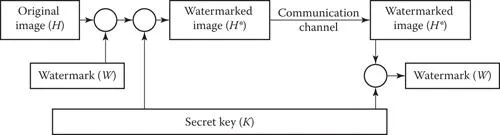
FIGURE 1.2 A general digital watermarking system.
Imperceptibility, security, capacity, and robustness are among the many aspects of watermark design. The watermarked image must look indistinguishable from the original image; if a watermarking system distorts the host image to the point of being perceptible, it is of no use. An ideal watermarking system should embed a large amount of information perfectly securely, but with no visible degradation to the host image. The embedded watermark should be robust, with invariance to intentional (e.g., noise) or unintentional (e.g., image enhancement, cropping, resizing, or compression) attacks. Many researchers have focused on security and robustness, but rarely on watermarking capacity [2,3]. The amount of data an algorithm can embed in an image has implications for how the watermark can be applied. Indeed, both security and robustness are important because the embedded watermark is expected to be imperceptible and unremovable. Nevertheless, if a large watermark can be embedded into a host image, the process could be useful for many other applications.
Another scheme is the use of keys to generate random sequences during the embedding process. In this scheme, the cover image (i.e., the host image) is not needed during the watermark detection process. It is also a goal that the watermarking system utilizes an asymmetric key, as in public or private key cryptographic systems. A public key is used for image verification and a private key is needed for embedding security features. Knowledge of the public key neither helps compute the private key nor allows the removal of the watermark.
For user-embedding purposes, watermarks can be categorized into three types: robust , semifragile , and fragile . Robust watermarks are designed to withstand arbitrary, malicious attacks such as image scaling, bending, cropping, and lossy compression [4– 7]. They are usually used for copyright protection in order to declare rightful ownership. Semifragile watermarks are designed for detecting any unauthorized modifications, while at the same time enabling some image-processing operations [8]. In other words, selective authentication detects illegitimate distortion while ignoring the applications of legitimate distortion. For the purpose of image authentication, fragile watermarks [9– 13] are adopted to detect any unauthorized modification at all.
In general, we can embed watermarks in two types of domains: the spatial domain or the frequency domain [14– 17]. In the spatial domain we can replace the pixels in the host image with the pixels in the watermark image [7,8]. Note that a sophisticated computer program may easily detect the inserted watermark. In the frequency domain, we can replace the coefficients of a transformed image with the pixels in the watermarked image [19,20]. The frequency domain transformations most commonly used are discrete cosine transform, discrete Fourier transform, and discrete wavelet transform. This kind of embedded watermark is, in general, difficult to detect. However, its embedding capacity is usually low, since a large amount of data will distort the host image significantly. The watermark must be smaller than the host image; in general, the size of a watermark is one-sixteenth the size of the host image.
1.2DIGITAL STEGANOGRAPHY
Digital steganography aims at hiding digital information in covert channels so that one can conceal the information and prevent the detection of the hidden message. Steganalysis is the art of discovering the existence of hidden information; as such, steganalytic systems are used to detect whether an image contains a hidden message. By analyzing the various features of stego-images (those containing hidden messages) and cover images (those containing no hidden messages), a steganalytic system is able to detect stego-images. Cryptography is the practice of scrambling a message into an obscured form to prevent others from understanding it, while steganography is the practice of obscuring the message so that it cannot be discove...
Table of contents
- Cover-Page
- Half-Title Page
- Title Page
- Copyright
- Dedication
- Contents
- Preface
- Acknowledgements
- Author
- Chapter 1 Introduction
- Chapter 2 Classification in Digital Watermarking
- Chapter 3 Mathematical Preliminaries
- Chapter 4 Digital Watermarking Fundamentals
- Chapter 5 Watermarking Attacks and Tools
- Chapter 6 Combinational Domain Digital Watermarking
- Chapter 7 Watermarking Based on Genetic Algorithms
- Chapter 8 Adjusted-Purpose Watermarking
- Chapter 9 High-Capacity Watermarking
- Chapter 10 Reversible Watermarking
- Chapter 11 Steganography and Steganalysis
- Chapter 12 Steganography Based on Genetic Algorithms and Differential Evolution
- Index
Trusted by 375,005 students
Access to over 1.5 million titles for a fair monthly price.
Study more efficiently using our study tools.
Frequently asked questions
Yes, you can cancel anytime from the Subscription tab in your account settings on the Perlego website. Your subscription will stay active until the end of your current billing period. Learn how to cancel your subscription
No, books cannot be downloaded as external files, such as PDFs, for use outside of Perlego. However, you can download books within the Perlego app for offline reading on mobile or tablet. Learn how to download books offline
Perlego offers two plans: Essential and Complete
- Essential is ideal for learners and professionals who enjoy exploring a wide range of subjects. Access the Essential Library with 800,000+ trusted titles and best-sellers across business, personal growth, and the humanities. Includes unlimited reading time and Standard Read Aloud voice.
- Complete: Perfect for advanced learners and researchers needing full, unrestricted access. Unlock 1.5M+ books across hundreds of subjects, including academic and specialized titles. The Complete Plan also includes advanced features like Premium Read Aloud and Research Assistant.
We are an online textbook subscription service, where you can get access to an entire online library for less than the price of a single book per month. With over 1.5 million books across 990+ topics, we’ve got you covered! Learn about our mission
Look out for the read-aloud symbol on your next book to see if you can listen to it. The read-aloud tool reads text aloud for you, highlighting the text as it is being read. You can pause it, speed it up and slow it down. Learn more about Read Aloud
Yes! You can use the Perlego app on both iOS and Android devices to read anytime, anywhere — even offline. Perfect for commutes or when you’re on the go.
Please note we cannot support devices running on iOS 13 and Android 7 or earlier. Learn more about using the app
Please note we cannot support devices running on iOS 13 and Android 7 or earlier. Learn more about using the app
Yes, you can access Digital Watermarking and Steganography by Frank Y. Shih in PDF and/or ePUB format, as well as other popular books in Informatica & Crittografia. We have over 1.5 million books available in our catalogue for you to explore.