![]()
1 Transparent project leadership
While leadership is often traditionally associated with heroic or romantic ideas of powerful people making their mark on the pages of history, less attention has been given to more mundane, everyday leaders; the people who set about important work on a daily basis, bringing others along with them in achieving success. Whatever the scale on which you are operating, the basic principles of practical leadership are the same for any leader performing within a team, organisation, community, or society at large.
We will explore your leadership potentials both in general and also specifically in relation to projects, programmes, and project portfolio management. The essential context of project leadership includes: (1) the project – a non-routine set of tasks with defined scope and resources, designed to reach a particular goal; (2) the project team – the people charged with realising the project goals and made up of those who lead and those who follow; and (3) the project environment or the circumstances under which the project is undertaken.
Given the context, we have included at various points in the text an extensive commentary on the personal and social competences of the Individual Competence Baseline (ICB4) of the International Project Management Association (IPMA, 2015) which are: self-reflection and self-management, personal integrity and reliability, leadership, resourcefulness, and results orientation. In our book on project communication, in the same series, we take a closer look at the competences ICB4 defines as personal communication, relations and engagement, teamwork, negotiation, conflict, and crisis. The books on project leadership and project communication are intertwined. In this book we touch upon these themes from an intra-personal perspective. In our book on project communication, we will look at them from a social and interpersonal perspective with a focus on communication and team dynamics. In our books on project strategy and project planning we explore the more organisational and executive aspects of project, programme, and portfolio management. In this chapter you will learn the basics of leadership and how leadership relates to self-reflection and personal integrity.
Understanding leadership demands insights into both individual and social psychology. Our primary focus here is on the individual psychology, whereas we will cover the more social aspects of group psychology in our book on communication in the same series. This book sets out to prepare you for leadership in any number of fields. Your role may be to lead a project team, manage an organisation, or head up a political movement — or it may be to support someone else in their role as leader. We believe that the more people who come to appreciate the nature and importance of leadership, the better able we will be to learn collectively from the experience and encourage equitable and sustainable approaches to projects and to work in general.
What is leadership?
Leadership can entail a variety of things, for example it can be defined as the talent to (1) form a future vision; (2) inspire in others the ambition to reach desired goals; and (3) facilitate and enable those who can to turn that vision into a reality. It also involves having the tenacity and drive to see things through to completion as circumstances change. Sometimes leaders form their vision alone and sometimes they do it with others. Leadership theory explores the nature of leadership including influences, styles, and achievements, and can be both descriptive and prescriptive. Descriptive leadership theory describes what is best known about leadership as it has been observed in practice, while prescriptive leadership theory describes how leadership skills can be developed, acting as a guide to the skills and art of getting others to do what needs to be done.
In our overall model of leadership, we consider transparency to be a key factor, meaning that at any given moment in your leadership role you are conscious of the assumptions, reflections, and conclusions that underpin your decisions. This does not mean that you reveal all your emotions, feelings, and thought, but rather that you can understand how and why you are responding to what is happening and you are capable of managing that response appropriately and constructively in the heat of the moment. Any leader will benefit from a well conducted self-reflection and the ideas and techniques we offer will provide you with the knowledge, skills, and competences to work towards increased self-awareness and better self-management. We also believe that a better understanding of your own motivations and behaviours will enable you to better understand others. To this end, we include several self-reflective questions at the end of each chapter that are aimed at facilitating personal growth and professional development. You will get the most out of the book if you take the time to consider them and to write down your answers. The obvious first questions to ask:
• What drew you to this book?
• Are you a born leader looking for a confirmation of your talent?
• Have you found yourself called upon to lead within an organisation, family, or in the public arena?
• Do you feel you lack leadership skills and would like to acquire them?
Whatever your answers may be, it is clear in our minds that the world needs qualified project leaders who have the ability to self-reflect and self-manage in their leadership roles. This need is amplified in times of economic and political turmoil when we should be making a serious review of both our leaders and our systems. History provides headline examples of leaders who wreaked havoc. Some, without doubt, had good intentions but lacked skills; others had the skills but lacked good intentions. Sometimes leaders lose track; sometimes power corrupts them; sometimes their psychological flaws undermine their intentions — sometimes the consequences are trivial, sometimes very costly —and occasionally catastrophic.
Your approach to project leadership development should be enjoyable and may be challenging; and there are many possible routes. The path we have chosen is that of the intra-personal aspects of the leadership experience. This approach explores how your inner life can have an impact on your ability to influence others, and on your mental resilience in the face of challenges. This inner life can be, for instance, your impulses, emotions, fantasies, aspirations, thoughts, and dreams. We shine a spotlight into your mind and your ways of thinking. The idea is that you need to consider what is happening around you and how you are interpreting and responding to these events. It is only when these two threads are intertwined that they form one durable rope that can be used to pull others along.
This book will make you self-reflect for the benefit of better self-management. It will provide you with the ability to recognise, reflect on, and understand your emotions, behaviours, and values. It will also encourage you to set personal goals, progress, and to cope with the challenges of daily work in an organised way.
Reflection points:
• How would you define leadership?
• What do you know about leadership theory?
• What is your experience of leadership?
• What type of leadership was demanded of you in these circumstances?
• What characterises the interplay between a leader and a follower?
The development of your leadership abilities
Your personal experience influences how you make sense of the world and influences your thinking and actions. Understanding this can reduce the risk of bias. So, we can start by asking, how does your personal experience influence your leadership? Were you born with leadership abilities? Or, did you acquire them in your upbringing? Or through your life experience? In other words, are leaders born or made? Some children and teenagers show a greater interest in leading rather than following. Some are more assertive from an early age than others. Some seem better at relating to others and to get more attention from their peers. Equally, some children show definite personality traits that can clearly relate to their potential leadership approach later in life. Genetics may surely play their part, but there is undeniably also a very strong environmental component in how we grow and develop as leaders.
The potential to develop leadership skills is like all other forms of mental and physical abilities, greatly dependent on our childhood experience and our influencers; the people who brought us up. British psychoanalyst Donald W. Winnicott put it like this: “Home is where we start from” (Winnicott, 1990), meaning that your sense of self, self-awareness, and self-image take shape in your childhood and upbringing; and it is on that emotional and intellectual platform that you stand on when it comes to assuming and accepting your own feelings, thoughts, and behaviour as an adult. If something goes wrong during this delicate process, you are more likely to look for explanations for your problems outside yourself, which can undermine your ability to assume the responsibilities required when in a challenging leadership role. As an adult your continued intellectual and emotional development will largely depend on you.
The first step towards developing leadership competences is the ability to read and trust your own feelings and emotions — and on that basis to form coherent thoughts and take responsible actions. In your formative years, it was your parents, or whoever brought you up, who supported this endeavour. Later, other role models such as friends, teachers, celebrities, colleagues, authorities, and leaders begin to increasingly influence your views and perception. As an adult, and especially when you have taken on a leadership role — you, and you alone, are responsible for your emotions, thoughts, and behaviour. This is an important insight which has significant social implications. Winnicott, whom we mentioned previously, pointed out that democracy, which is one of the most important tools for collective decision-making, can only prosper if enough people in society have sufficient insight into themselves to be able to take responsible decisions (Winnicott, 1990).
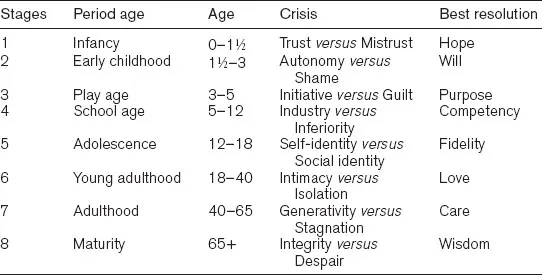
The American psychoanalyst Erik Erikson in his book Identity and the Life Cycles speculated on the formation of personality and the connection between self and society (Erikson, 1959). In this book he examines the lifespan of the individual from the perspective of the social development of the personality, and identifies distinctive developmental stages he believes can foster, or hinder, personal growth. Each of these transitions are, according to Erikson, marked off by a specific type of conflict and the working through of this conflict. In a healthy development process, conflict is initially tolerated and then constructively solved. If there is no or only limited processing at a particular stage or if the outcome is not satisfactory, then the individual may need to deal with problems related to these unresolved issues later in life. Table 1.1 is based on this idea.
Table 1.1 Developmental stages according to Erik Erikson
On the basis of Erikson’s theory, we can assume that an individual who has managed to work through the challenges of each stage of development satisfactorily is better able to tackle — due to a higher level of maturity — the challenges of leadership than someone who has not managed to do so. Failure at a particular ...