Make sure your students are prepared for the difficult decisions they’ll face every day in the tourism industry Cases in Sustainable Tourism is a groundbreaking teaching tool that places students in real-life situations where they’re faced with complex decisions on the economic, social, and environmental sustainability of act
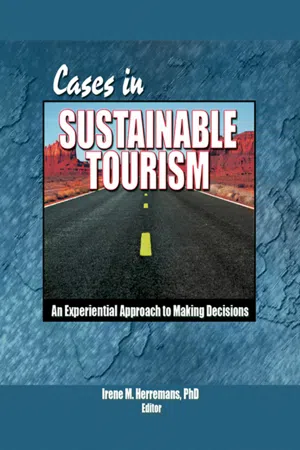
- 342 pages
- English
- ePUB (mobile friendly)
- Available on iOS & Android
eBook - ePub
About this book
Part I:
Introduction to Cases and Environmental Thought Leaders
Introduction
How to Use Cases for Experiential Learning
Thus, simulated scenarios are an excellent teaching device. But it probably profits no one if we simply turn our pupils loose on these scenarios. Action alone is of little value. What makes more sense is to assemble a battery of different scenarios that expose our participants to a “symphony of demands” posed by various systems. We should also have experts observe participants as they plan and act. These observers could pinpoint cognitive errors, and identify their psychological determinants. In carefully prepared follow-up sessions, the participants could be shown the kinds of mistakes they made and the probable causes. (Dörner, 1989/1996, p. 197)
By creating simulated scenarios with the cases provided in this book, students can wrestle with some of the multidimensional, complex, sustainability issues they will confront in several different roles including:
• tourists,
• businesses providing goods and services to tourists,
• governments or their agencies attempting to regulate the tourism industry,
• members of a community receiving tourists,
• organizations concerned with the health of the environment, or
• combination of all.
The World Tourism Organization (WTO) recognizes that tourism encompasses more than activities for leisure time and vacations. The WTO officially defines tourism as “the activities of persons traveling to and staying in places outside their usual environment for not more than one consecutive year for leisure, business, and other purposes” (WTO, 2001; WTO, 2005). Therefore, it is highly likely that we will all be tourists at some time in our lives. Consequently, in order to make sound decisions, we should be aware of the impacts that our activities create.
The cases in this book are designed to be used in a variety of tourism courses; however, many of the cases can effectively be used in courses without tourism or environmental content. The topic of sustainability was not of grave concern until the 1990s; therefore, we are all students learning how to lead sustainable lives. For this reason, each case is sufficiently flexible and can be adapted to meet various course objectives, depending on the experience and depth of the students’knowledge. Each chapter includes extensive information to supplement the case, eliminating the necessity for time-consuming research on the instructor’s part in order to use the case effectively. Supplemental materials, such as journal articles, Web site addresses, videos, books, additional readings, and transparencies have been included in each case study chapter. Use of these supplemental materials places the students at the center of the learning experience and the instructor in a position of facilitator. This is often a more effective method of learning than the traditional lecture approach. These materials, supplemented with imaginative approaches by the instructor, can make a case more realistic by embellishing the situation with local speakers, field trips, newspaper articles, and other props that turn the case into an experience for the learner. By recognizing the unique characteristics of your students and providing program opportunities for capitalizing on them, students can play the role of one of the case characters and more effectively learn to handle difficult, but realistic, sustainability decisions.
TRADITIONAL CASE METHOD OR EXPERIENTIAL LEARNING
All cases have been designed to be used with either the traditional case teaching approach or in an experiential case teaching approach. Because much has been written on the traditional case teaching approach, it will not be discussed here. However, we have included some discussion on how to use these cases in an experiential approach.
The experiential approach will allow students the flexibility to draw on their own work and personal experiences to help find solutions or approaches for addressing the dilemmas presented. All the cases are based on real problems that the organizations represented in the cases had to resolve. Several cases are written in docudrama format, many with dialogue, to make it easier for students to relate to the situation presented and to better understand their own capacity to learn (Evans, 1992) especially in the dynamic, evolutionary society of the twenty-first century, which requires us to think differently about organizations’ various and diverse relationships to society and the environment. Experiential learning makes use of life and work experiences that are generally informally acquired. An instructor can then use these experiences to present a learning situation that combines theory with practice in such a manner that will allow students to realize how much they really know. Evans (1992) has stated this process of realization as follows: “Most people know more than they think they know if only they knew that they know it” (p. 41).
The experiential use of cases works best with adult learners who have had an array of life experiences. Whom is an adult learner depends on the ability of the learner to use life experiences, not on the chronological age of the learner. The instructor allows the student to become the center of the learning experience, placing more of the responsibility for learning on the learners themselves (Knowles, 1990).
EXPERIENTIAL LEARNING
One type of experiential session might include a set of activities and learning elements that occur both in preparation for and as follow-up to a focal, experiential classroom session, class presentation, or discussion with a core theme. The expectations are that each student will take full responsibility for her or his own learning and be accountable for that learning. The follow-up aspect, then, “closes the circle” on that accountability both from the perspectives of the program and from the students. Having had the opportunity to work with students in experiential learning situations, the authors provide a set of principles distilled from their experience.
Sessions should be planned with the following principles in mind.
Overriding Principles
1. Have a clear understanding of what outcomes are expected from the session.
2. Consider the students’ levels of academic sophistication, life experiences, and their needs and interests.
3. Emphasize the higher learning levels of application, analysis, synthesis, decision making, evaluation, and judgment (Bloom, 1956)
4. Have students reflect on their learning experience in some manner at the completion of the session.
The cases presented in this book can be easily adapted, applied, or translated to a situation or organization that is local. Students could be asked to write their own cases by patterning their work after one of the cases in this book and their own life experiences. Frequently, students can be asked to break apart the elements of a case in order to more fully analyze certain relationships or dimensions and then to synthesize these so that they not only understand the separate parts but also how the parts work as a system. Finally, and most important, students can be challenged to make decisions about what they would do, often requiring informed judgments on their part which are supported with logical reasoning and quantitative evidence.
GETTING STARTED
One approach for creating an experienced-based learning situation could begin with planning the details of the experiential session (goals, subject/company, local corporate involvement), then designing specific activities (focal scenario, roles, and role-playing process), selecting information for appropriate students’preparation (knowledge of focal company, knowledge of models/constructs), and concluding with an assessment/evaluation.
Exhibit I.1 on the accompanying CD provides a framework to transform cases from this book into an experience. The framework in the table can be applied to any case. Then, Exhibit I.2 takes the Yosemite case and demonstrates how it can be transformed into an experiential session.
Even though the students’ preparation for the experiential session must obviously come before the session itself, the focal scenario determines what advanced preparation is necessary. If a stakeholders’ meeting or a town council meeting is to be held, the students need to know how to act in the positions they are to play. In some programs, databases can be used to provide articles written about the organizations. Also, information from the organizations’ Web sites, organization literature, and readings related to the specific theories or constructs would be helpful in addressing the complex problem.
Instructors can be creative in adapting the preparation for the experiential session to the particular needs of the students. For some sessions, the students can be asked to prepare a memo, briefing, short report, or position paper as if they were playing the role of a speaker who will come to the classroom in a future class session. Other cases work well after viewing a selected video or movie. Sometimes controversial issues can be discussed via teleconference with employees from another organization or students from another university.
By using this approach and its incorporation of guided practice and experience with thoughtful follow-up and learning, perhaps we can provide a solid grounding for establishing tourism programs that are living and sustainable.
BIBLIOGRAPHY
Bickerstaffe, George (1994). Lesson of the Masters. International Management, 49(3), 54+.
Bloom, Benjamin S. (1956). Taxonomy of Educational Objectives: The Classification of Educational Goals. New York: David McKay.
Dörner, Dietrich (1996). The Logic of Failure (Rita and Robert Kimber, Translators) New York. Metropolitan Books. (Original work published in 1989 by Rowohlt Verlag GMBH).
Evans, Norman (1992). Experiential Learning: Assessment and Accreditation. Oxford, UK: Routledge.
Griffith, William (1999). The Reflecting Team As an Alternative Case Teaching Model: A Narrative, Conversational Approach. Management Learning. 3(30), 343-362.
Herremans, Irene M. and Ron Murch (1999). International Corporate Responsibility and MBA Programs: Using an Integrated Approach. Journal of Teaching in International Business, 11(1), 91-117.
Knowles, Malcolm (1990). The Adult Learner: A Neglected Species, Fourth Edition. Houston, TX: Gulf Publishing Company.
Lindeman, Eduard C. (1926). The Meaning of Adult Education. New York: New Republic.
Monks, Kathy (1995). Combining Academic Rigour and Transferable Skills: A Business Degree for the 1990s. Education & Training, 37(1), 17+.
Rogers, C. R. (1969). Freedom to Learn. Columbus, OH: Merrill.
World Tourism Organization (2001). Tourism 2020 Vision. Author.
World Tourism Organization (2005). www.nric.net/tourism/what_is.htm.
Part II:
Traveling Responsibly
Resource Guide for Chapter 3
Implementing Ecosystem Management: Mount Assiniboine Lodge, Mount Assiniboine Provincial Park, British Columbia
RECOMMENDED USE
This case is appropriate for both graduate and undergraduate students in programs that include business administration, environmental science, and tourism and recreation studies. Instructors of hospitality and resort management would also find this case useful for attempting to differentiate between traditional lodges and ecolodges. The case has been used successfully in a program of recreation studies at Texas A&M with good results.
In addition to raising the question of what characteristics are necessary for accommodations to qualify as ecolodges, this case also helps students understand the numerous environmental considerations with which a lodge owner/manager must be concerned when working in a natural environment. To ensure that the impacts of operations are minimized in sensitive ecosystems, backcountry tourism accommodations must consider a complete range of environmental factors and how they can be managed in given circumstances.
Ecosystem management is an excellent way to understand the interdependence of a number of factors that affect sustainable development in natural areas. This is of particular importance in backcountry tourism in protected areas an...
Table of contents
- Cover
- Title
- Copyright
- Contents
- Part I: Introduction to Cases and Environmental Thought Leaders
- Part II: Traveling Responsibly
- Part III: Sustainable Nature-Based and Adventure Tourism Activities
- Part IV: Wrestling with the Sustainability of National Parks
- Part V: Land Development and Governance Issues
- Appendix. Return on Investment Information
- Index
Trusted by 375,005 students
Access to over 1.5 million titles for a fair monthly price.
Study more efficiently using our study tools.
Frequently asked questions
Yes, you can cancel anytime from the Subscription tab in your account settings on the Perlego website. Your subscription will stay active until the end of your current billing period. Learn how to cancel your subscription
No, books cannot be downloaded as external files, such as PDFs, for use outside of Perlego. However, you can download books within the Perlego app for offline reading on mobile or tablet. Learn how to download books offline
Perlego offers two plans: Essential and Complete
- Essential is ideal for learners and professionals who enjoy exploring a wide range of subjects. Access the Essential Library with 800,000+ trusted titles and best-sellers across business, personal growth, and the humanities. Includes unlimited reading time and Standard Read Aloud voice.
- Complete: Perfect for advanced learners and researchers needing full, unrestricted access. Unlock 1.5M+ books across hundreds of subjects, including academic and specialized titles. The Complete Plan also includes advanced features like Premium Read Aloud and Research Assistant.
We are an online textbook subscription service, where you can get access to an entire online library for less than the price of a single book per month. With over 1.5 million books across 990+ topics, we’ve got you covered! Learn about our mission
Look out for the read-aloud symbol on your next book to see if you can listen to it. The read-aloud tool reads text aloud for you, highlighting the text as it is being read. You can pause it, speed it up and slow it down. Learn more about Read Aloud
Yes! You can use the Perlego app on both iOS and Android devices to read anytime, anywhere — even offline. Perfect for commutes or when you’re on the go.
Please note we cannot support devices running on iOS 13 and Android 7 or earlier. Learn more about using the app
Please note we cannot support devices running on iOS 13 and Android 7 or earlier. Learn more about using the app
Yes, you can access Cases in Sustainable Tourism by Kaye Chong in PDF and/or ePUB format, as well as other popular books in Business & Hospitality, Travel & Tourism Industry. We have over 1.5 million books available in our catalogue for you to explore.