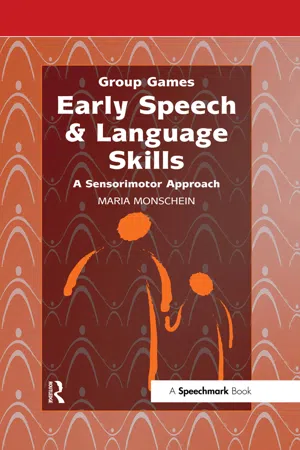
Full of practical ideas that can be easily implemented with minimal preparation, this book contains a wealth of games and activities for developing language with young children. Following a multi-sensory approach, the games focus on having fun and working on speech language difficulties without having to concentrate directly on speaking. The games are organised around the school year and are themed according to which sense they specifically aim to develop. Most games can be carried out with little preparation, are easily adaptable and can be differentiated according to different children's abilities. Includes: Sense of touch games; Games for proprioception; Balancing games; Listening games; Games for developing hand-eye coordination and finger-motor skills; Games for promoting oral motor skills; Games for working on individual problematic speech sounds.
- 448 pages
- English
- ePUB (mobile friendly)
- Available on iOS & Android
eBook - ePub
About this book
Information
Part 1
Games for developing a sense of touch and proprioception
Children with speech and language problems are sometimes undersensitive with regard to their sense of touch and their proprioceptive sense. The sense of touch processes sensations that occur through touching skin or mucous membranes in order for us to feel that touch. Proprioception refers to sensory information that, at all points in time, tells our brain when and to what extent our muscles are contracting or extending, and when and to what extent our joints are bending, stretching, or are being pulled or pushed. Proprioception also makes it possible for our brains constantly to register the position of each and every body part, and how each part is moving. Together, both senses contribute fundamentally to a person’s body perception and are therefore also very important for speaking.
The following games aim to help improve the senses of touch and proprioception and, as a result, speech and language skills.
Games for developing a sense of touch
Real understanding of a concept involves hands-on experience. If a child is confronted with an environment that offers few opportunities to stimulate their sense of touch, or if a child is not encouraged to touch things at all, he is likely to end up experiencing problems with concept development. There are also some children who require more stimulation than is available during their everyday life.
Each child needs to experience the actuality of a concept in many different situations before he is able to apply that concept freely. For example, in order to be able to use the abstract concept ‘soft’ correctly, many ‘soft’ experiences (such as cotton wool, fur, hair, a feather duvet, a towel, and so on) are necessary. In order to internalise as many concepts as possible, a child also needs as many touch experiences as possible.
1 Who could that be?
Depending on the children’s developmental age, a minimum of three children is needed to play this game. Each child in turn is studied and described by the rest of the group.
Then one child closes his eyes. One of the children who has already been described stands in front of him, and now has to be recognised through touch only. Who could it be? The child doing the touching can also try to describe what he is feeling: ‘I can feel short hair. I can feel a woolly jumper and trousers. It’s you, Andrew!’
Aims: tolerating body contact, developing tactile awareness and perception, visual perception, describing physical appearances, learning each other’s names, memory training
Materials: none
2 Blind touch
The children form a circle. One child is blindfold, and stands in the middle of the circle. The blindfold child is spun around, and then has to try to identify the person in front of him, using his sense of touch (by feeling with his hands). He should also try and describe what he is feeling:‘I can feel a head with long hair. Also, a dress and tights. It is …’ The blindfold child is allowed to ask the other child questions, in order to recognise him by voice alone.
Aims: developing tactile awareness and perception, being gentle, enjoying talking, developing acoustic perception
Materials: scarf or blindfold
3 Who is the dragon going to eat?
One child plays the dragon. He stands on one side of the room. All of the other children stand on the opposite side of the room. The dragon calls, ‘The dragon is going to eat Julie!’ Now the other children have to shout, ’No, you are not going to eat Julie!’ and try to protect Julie. For example, they can quickly make a circle around her. If the dragon manages to catch the child, that child turns into the dragon and calls out the name of the person he wants to eat.
Aims: developing tactile perception, dexterity, agility, group spirit, consolidating everybody’s names, developing articulation (especially dr)
Materials: none
4 Holiday souvenir
The children bring to the group objects that they have collected in the holidays (shells, pebbles, snail shells, roots, fir cones, entrance tickets, souvenirs, postcards) or things that they used frequently during the holidays (snorkel, flippers, goggles, swimming trunks, swimming costume, towels, sun screen, sunglasses, binoculars, camera, map, roller skates, ball, badminton racket). If they want to, the children can also talk about specific holiday experiences.
The objects are then placed under a blanket. Each child has to feel an object and name it. If a child names an object wrongly, or is unable to give it a name, it is put back under the blanket and another child tries to guess a different object. Once all objects have been felt and guessed, they are put back under the blanket. Now the children need to recall what is under the blanket, saying, ‘There is a … under the blanket.’ If they can remember correctly, they are given the object to hold. The game continues until there is nothing left under the blanket.
Finally, five objects can be lined up and the children can take turns to recall them with their eyes closed. Each child is given his own objects (he could always try and break his own personal record by increasing the number of objects, one at a time). Perhaps the individual objects would also like to talk about what they have experienced. To do this, each child could choose an object and pretend to talk on behalf of the object.
Aims: developing tactile perception, vocabulary, use of preposition under, developing memory, visual perception (line perception), imagination
Materials: objects that remind children of holidays, blanket
5 Vegetable harvest
Different vegetables are put on the table. The children feel, smell and name them. Everyone thinks about where different vegetables grow (above or below ground), then prepare a box, which is placed upside down on the floor with the open end to the floor. The box represents a vegetable patch. A hole is cut into one side to put in those vegetables that grow underground.
One child closes his eyes and is given a vegetable to hold. He now has to guess what that vegetable is. For example, he might say, ‘It’s a carrot. Carrots grow underground’. He then puts the carrot into the box. Or he could say, ‘That’s a pea. Peas grow above ground’. He then puts the pea on top of the box. Then the next child takes his turn.
When all the vegetables have been sorted, the children line up behind each other in front of a mat or soft blanket. The first child says, ‘I like eating … What about you?’ After he has said what he likes, he does a somersault. All the children get a turn.
Then you could get the children to say, ‘I don’t like … What about you?’ or you could ask the children, one by one, ‘Do you like eating …?’ You could then play a memory game with the children. ‘The vegetables that grow underground are not visible. Who can remember them?’
Once the children have mastered the different vegetable names, the vegetables are washed and cut into bite-sized pieces. Each child now has to taste what he has in his mouth with his eyes closed. The children could also experiment with holding their noses while tasting a vegetable, to help them work out that tasting is more difficult without a sense of smell. Or maybe they could try to guess different vegetables by smell only, tasting them with their eyes closed.
Any leftover vegetables can be used to make vegetable soup. Even this could be built into a little fairy story: Grandmother visits a Prince (or any suitable puppet), and tells him that she would love to cook a vegetable soup, but unfortunately she has forgotten which vegetables can be used to make a soup. The children help her, and tell her the names of the different vegetables. The Prince enjoys the soup and then takes the children on an adventurous journey.
Variation
Fruit could be substituted for vegetables and a ‘Fruit Harvest’ game played.
Everyone thinks about what sorts of plants carry these fruits and where they grow. (Remember that the question, ‘Above or below ground?’ is redundant here.) Instead of vegetable soup, you could prepare a fruit salad.
Aims: developing tactile perception, vocabulary, use of the prepositions above and below, developing a sense of smell, a sense of taste, body coordination, proprioception, memory, and encouraging children to...
Table of contents
- Cover
- Half Title
- Title
- DEDICATION
- Copyright
- Contents
- About the Author
- Acknowledgements
- List of Games
- Introduction
- How to Use the Games
- 1 Games for developing a sense of touch and proprioception
- 2 Balancing games
- 3 Listening games
- 4 Games for facilitating hand-eye coordination and finger motor skills
- 5 Games for promoting oro-motor function
- 6 Additional games for working on specific speech sound problems
Trusted by 375,005 students
Access to over 1.5 million titles for a fair monthly price.
Study more efficiently using our study tools.
Frequently asked questions
Yes, you can cancel anytime from the Subscription tab in your account settings on the Perlego website. Your subscription will stay active until the end of your current billing period. Learn how to cancel your subscription
No, books cannot be downloaded as external files, such as PDFs, for use outside of Perlego. However, you can download books within the Perlego app for offline reading on mobile or tablet. Learn how to download books offline
Perlego offers two plans: Essential and Complete
- Essential is ideal for learners and professionals who enjoy exploring a wide range of subjects. Access the Essential Library with 800,000+ trusted titles and best-sellers across business, personal growth, and the humanities. Includes unlimited reading time and Standard Read Aloud voice.
- Complete: Perfect for advanced learners and researchers needing full, unrestricted access. Unlock 1.5M+ books across hundreds of subjects, including academic and specialized titles. The Complete Plan also includes advanced features like Premium Read Aloud and Research Assistant.
We are an online textbook subscription service, where you can get access to an entire online library for less than the price of a single book per month. With over 1.5 million books across 990+ topics, we’ve got you covered! Learn about our mission
Look out for the read-aloud symbol on your next book to see if you can listen to it. The read-aloud tool reads text aloud for you, highlighting the text as it is being read. You can pause it, speed it up and slow it down. Learn more about Read Aloud
Yes! You can use the Perlego app on both iOS and Android devices to read anytime, anywhere — even offline. Perfect for commutes or when you’re on the go.
Please note we cannot support devices running on iOS 13 and Android 7 or earlier. Learn more about using the app
Please note we cannot support devices running on iOS 13 and Android 7 or earlier. Learn more about using the app
Yes, you can access Early Speech & Language Skills by Maria Monschein, Lilo Seelos in PDF and/or ePUB format, as well as other popular books in Education & Education General. We have over 1.5 million books available in our catalogue for you to explore.