Multi-Tiered Systems of Support in Elementary Schools
eBook - ePub

Multi-Tiered Systems of Support in Elementary Schools

The Definitive Guide to Effective Implementation and Quality Control

  1. 314 pages
  2. English
  3. ePUB (mobile friendly)
  4. Available on iOS & Android
eBook - ePub

Multi-Tiered Systems of Support in Elementary Schools

The Definitive Guide to Effective Implementation and Quality Control

About this book

Multi-Tiered Systems of Support in Elementary Schools is the leadership handbook and practitioner's field guide to implementation of Multi-Tiered Systems of Support (MTSS) in elementary schools, leading to improved student outcomes and school safety. Schools can creatively customize replicable best practices using this in-depth operations manual to guide MTSS teams in planning and delivering tiers of academic and integrated social-emotional and behavioral supports to meet the needs of all students. This text introduces Healthy Minds, Safe Schools, an evidence-based program that significantly improves student well-being, school safety, and teacher feelings of self-efficacy for delivering social-emotional and behavioral curriculum in the classroom.

Featuring team exercises and real perspectives from educators, this text shows how to make incremental yet manageable changes at elementary schools in accordance with public policy mandates and evidence-based practices by developing smart teams and programs, identifying roles and responsibilities, implementing layers of academic support and services, improving social-emotional and behavioral health of students, and creating an inclusive school culture. It details organizational psychology and socially just educational practices and is a handbook aligned with the U.S. Secret Service National Threat Assessment Center guidebook for preventing school violence and with the National Center for School Mental Health Curriculum.

Frequently asked questions

Yes, you can cancel anytime from the Subscription tab in your account settings on the Perlego website. Your subscription will stay active until the end of your current billing period. Learn how to cancel your subscription.
No, books cannot be downloaded as external files, such as PDFs, for use outside of Perlego. However, you can download books within the Perlego app for offline reading on mobile or tablet. Learn more here.
Perlego offers two plans: Essential and Complete
  • Essential is ideal for learners and professionals who enjoy exploring a wide range of subjects. Access the Essential Library with 800,000+ trusted titles and best-sellers across business, personal growth, and the humanities. Includes unlimited reading time and Standard Read Aloud voice.
  • Complete: Perfect for advanced learners and researchers needing full, unrestricted access. Unlock 1.4M+ books across hundreds of subjects, including academic and specialized titles. The Complete Plan also includes advanced features like Premium Read Aloud and Research Assistant.
Both plans are available with monthly, semester, or annual billing cycles.
We are an online textbook subscription service, where you can get access to an entire online library for less than the price of a single book per month. With over 1 million books across 1000+ topics, we’ve got you covered! Learn more here.
Look out for the read-aloud symbol on your next book to see if you can listen to it. The read-aloud tool reads text aloud for you, highlighting the text as it is being read. You can pause it, speed it up and slow it down. Learn more here.
Yes! You can use the Perlego app on both iOS or Android devices to read anytime, anywhere — even offline. Perfect for commutes or when you’re on the go.
Please note we cannot support devices running on iOS 13 and Android 7 or earlier. Learn more about using the app.
Yes, you can access Multi-Tiered Systems of Support in Elementary Schools by Alison G. Clark,Katherine A. Dockweiler in PDF and/or ePUB format, as well as other popular books in Education & Behavioural Management. We have over one million books available in our catalogue for you to explore.

Information

Chapter 1

New Foundations for Multi-Tiered Systems of Support

Key Terms

  • Social Justice
  • Multi-Tiered Systems of Support
  • Implementation Science
  • LIQUID Theory
  • Ecosystem
  • Counterintuitive Cultures

Chapter Concepts

In this chapter, readers will learn:
  1. The intersection of MTSS and social justice.
  2. How to use this practice guide to implement sustainable MTSS programming for academics, behavior, and mental health.
  3. How to reframe organizational thinking and consider multiple perspectives.
  4. The key tenets of a new theoretical model to ground MTSS implementation: LIQUID.
  5. How to avoid counterintuitive practices.
  6. Legal, perceptual, and value aspects of MTSS.
Working in schools has never been more challenging for educators than right now. Zeitgeist of the times is putting more pressure on public schools to perform miracles like never before with fewer resources and higher stakes when systems fail. Corporate interest campaigns have successfully damaged public perception of public schools, allowing for-profit schools to make significant dents in redirecting federal funding and general support away from public schools in state and national policies, without providing better outcomes. Schools are expected to provide greater service delivery to students, who have more needs than ever, while competing for funding that is inadequate to meet those needs. Civil rights in schools are precarious. Safety for students and staff at schools can no longer be taken for granted. Public education is on the verge of existential crisis, and time will tell whether the public education sector can figure out how to meet the evolving needs of children while making education more effective and relevant. The challenge will be for public education to effectively address these needs before the corporate world perfects the illusion that it can do it better, and in the process of convincing the public it is a good idea, they take away students’ rights to a free appropriate public education.
Socially just practices in schools, at the individual and group levels, must include respect, equity, and access to all of a school’s resources and benefits (Shriberg et al., 2008). This social justice occurs when all children, from all different backgrounds, regardless of socioeconomic background or demographic characteristics, are valued in a school community and have access to a relevant education. Current educational realities demand that teachers stop teaching a curriculum for the masses and start teaching a differentiated curriculum to real students with real challenges (Quintero, 2017; Rodriguez, Loman, & Borgmeier, 2016; Jimerson, Burns, & VanDerHeyden, 2016; Lane, Carter, Jenkins, Dwiggins, & Germer, 2015; Sprick, 2013). The Multi-Tiered Systems of Support (MTSS) framework is a socially just approach to providing equitable access and support to all students in the educational setting. Furthermore, it can be differentiated for real schools to address real student challenges; MTSS “is an evidence-based framework for effectively integrating multiple systems and services to simultaneously address students’ academic achievement, behavior, and social-emotional well-being” (National Association of School Psychologists, 2017, para. 1). MTSS is an ideal framework for school systems because it relies on quality universal instruction and preventative proactive methods while providing increasingly strategic supports for students as their needs become more severe. This book demonstrates how MTSS is a recipe that can be replicated across schools with enough flexibility to adapt to the uniqueness of each school and their teams.
This unique approach to the implementation of MTSS in elementary schools is much like a bull’s approach to organizing a china shop. Necessity is the mother of invention, so a system was devised through strategic data leverage points that crashed through much of the preestablished notions of what could and could not be accomplished. Through feedback looping and program evaluation, this approach to quality control of effective MTSS in elementary schools lends itself to reevaluation and refinement each school year (Yuen, Terao, & Schmidt, 2009; Hanson, 2003). This guide is intended as a road map for state departments of education, district superintendents, professors, administrators, principals, school psychologists, teachers, and other motivated educators who are attempting to implement real school change and ultimately increase achievement, promote student well-being, and improve promotion and graduation rates, especially for at-risk students. It requires confidence at the leadership level of decision making because change is not always welcome in the ranks. Change is hard to come by. The main questions for beginning this journey are, Where do you want to go, and where do you start?
Schools bear the brunt of responsibility for student outcomes, regardless of students’ environmental challenges and the practical realities of adequately educating every student who has experiences beyond the control of educators. Many stakeholders understand why they need MTSS to expand supports for students, but most are unable to define what to implement or how to implement MTSS at the elementary level. This is especially true for SEB MTSS and using a data-based progress monitoring method to inform on its use at a variety of leverage points including student, staff, administration, and program level. Research is clear that MTSS models are a necessity for adequately addressing our students’ needs on an individual level as well as a systems level (Bamonto-Graney & Shinn, 2005; Shinn, 2007; Sprick, 2009; Shinn & Walker, 2010; Sprick, 2013; Sink, 2016; Rodriguez et al., 2016; Jimerson et al., 2016; Francis, Mills, & Lupton, 2017). However, at the elementary level, these practices are frequently reported to be implemented but rarely are evident, let alone implemented systematically and with fidelity.
This practical guide was developed to help educators make manageable changes at their elementary schools in accordance with public policy and best practices. It was also designed as a therapeutic guide to accompany educational leaders and professionals on the difficult journey of transforming their elementary campuses in multiple stages to allocate resources among the three tiers. Embedded throughout are Connection to Practice examples, Voices from the Field narratives from real educators, and Exercises to help guide teams through the MTSS process. The process required to instill new practices and systems, especially in large bureaucratic settings, is always fraught with barriers that require creative problem solving to address culture changes, implementation fidelity, and relationship issues among staff members that can be improved by consulting implementation science, which promotes the systematic application of data and research into practical use by professionals and into public policy. (Bryk, Gomez, Grunow, & LeMahieu, 2016). Implementation science incorporates the integration, application, and refinement of evidence-based practices in the field. Creating a climate to improve achievement, student well-being, and school safety is not easy on any campus, let alone in schools with significant risk factors. Creating and sustaining MTSS in elementary schools to systematically address the needs of all students is not for the faint of heart. Practitioners may be in the process of implementing tiered supports, or they may be starting on a new path because school outcomes are not what it could or should be. Schools are complex organizations that are inherently resistant to change. A wise master educator often emphasized with novices that one can lead a horse to water and can make it drink; however, if the horse does not drink, one cannot blame the horse.
From a managerial standpoint, if the sale is not made, it is not the customer’s fault the salesman did not close the deal. It is the job of school administrators, the leadership team, and motivated educators to get staff and stakeholders on board and engaging with best practices through MTSS. It is up to schools to work more like smart organizations: using the skills of highly talented individuals in teams to operate efficiently and learn together to adaptively grow an organization and best practices by leveraging tools, information, knowledge, relationships, and collaborative experiences. Administrative leadership of smart teams must recognize that schools, like any other organization, are institutional in nature with political influences that impact change (Meijer & Bolívar, 2015).
What Is MTSS?

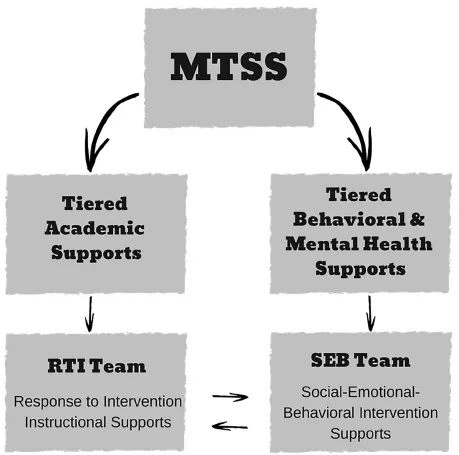
As mentioned earlier, MTSS is an ideal framework for school systems because it relies on quality universal instruction and preventative proactive methods, while providing increasingly strategic supports for students as their needs become more severe. Built on the familiar foundation of the tiered Academic MTSS framework, the Social-Emotional-Behavioral MTSS model is an extension of the same schema. There are numerous books and references as to why a multi-tiered support system is a best practice, and readers are directed to peruse explicit practitioners’ texts, including the comprehensive list of more than 100 MTSS and related resources compiled by Shinn (2013), for further information. For practitioners who are already on board with intentions to implement a multi-tiered support system at a school but are not really sure how to put the processes in action, this is the right place to get inspired by practices that have been tried and were successful. Elementary multi-tiered support systems are an established practice and are generally more universally accepted than secondary multi-tiered support systems, but the evidence is clear that MTSS is best practice at all grade levels. Figure 1.1 is a visual representation of the multiple-tiered support system. This book will comprehensively review the components essential to both Academic MTSS, also commonly referred to as “Response to Intervention” (RTI), as well as Social-Emotional-Behavioral MTSS, also referred to as “behavioral and mental health” intervention. This includes a review of the tiered model, assessment, data-based decision making, and collaborative problem solving.
Not all schools require the same amount of intensity or the same scope of opportunities, depending on the student population. As described in the Safe and Civil Schools (Sprick Booher, & Garrison, 2009; Sprick, 2009, 2013) approach, higher-needs classrooms’ risk factors indicate the need for more intensive classroom structures, and higher-needs schools need a more intensive structure for tiers of support. The higher the needs of the student population, the higher the structure that is needed to support them. The lower the needs, the lower the structure needed. In reading this text, you will learn how to determine whether your school is low-, medium- or high-needs and then be guided through the steps to create a team to make the best decisions for students on your campus. Processes are outlined to help teams create levels of support that grow with a team’s and school’s needs, which have checks and balances based on a model of continuous improvement.
Figure 1.1
Figure 1.1Multi-Tiered System of Support
Note
Response to Intervention and Social-Emotional-Behavioral MTSS each have their own tiers of support and decision points. Systemic implementation includes evidence-based practices and procedures that must be followed with fidelity, at each tier, to ensure universally consistent instruction and behavior management.

Organizational Framing

Bolman and Deal (2017) assert that there are four different perspectives from which organizations can be viewed in order to understand how they work: structural, human resource, political, and symbolic. Structural is rooted in sociology and is metaphorically represented as factories, human resource is rooted in psychology and is represented as extended families, political is rooted in political science and is represented as jungles, and symbolic is rooted in anthropology and is represented as temples. Viewing organizational operations through each distinct lens is a powerful tool in which to examine systems and practices from diverse angles simultaneously to understand the whole picture of how an organization operates. Each perspective may have an impact on leadership challenges, reframed as opportunities to grant authorship, love, power, or significance within the corresponding organizational ethics of excellence, caring, justice, and faith, respectively.
When schools are viewed through the structural frame with the goal of excellence, there is an expected hierarchy with rules, assigned roles, procedures, and systems. When schools are viewed through the lens of human resource with the goal of caring, unique individuals must be validated through interpersonal relationships and a shared sense that the collective health of the organization is a main priority. In schools viewed through the political frame with goals of justice and power, educators are motivated by leaders’ power sharing and can be incentivized to concentrate efforts on shared purpose, with fairness as the currency. Last, in schools viewed through the symbolic lens, with the goal of faith and significance, culture is aligned with values and traditions rooted in stories, school spirit, and greater purpose. These leaders provide ceremony and promote faith in sacred shared beliefs within the organization.
When building MTSS at a school, all four leadership frames must be considered, beginning with structure. Bolman and Deal (2017) make a case that differentiation and integration are opposite sides of the same coin of structure, requiring individuals with specialized roles and responsibilities grouped into working units, to effectively coordinate efforts laterally (within and across teams) and vertically (up the hierarchy). The more complex the system, such as the implementation of MTSS, the clearer the roles, responsibilities, and procedures must be to meet the needs of individuals and the collective.

Theory

In addition to supporting MTSS as a practical framework that can be used to differentiate student needs and to provide interventions, this text also offers a theoretical approach in which to view MTSS. This new theoretical approach is referred to as LIQUID and consists of the conceptual notions of Leadership, Inclusiveness, Quality control, Universality, Implementation and feedback looping, and Data-based decision making.
Spanning more than 20 years, the researchers collected observations, staff interviews, student performance data, and MTSS artifacts and analyzed the data at iterative cycles using the qualitative procedure of emerging design grounded theory (Glaser, 1992) to hone and refine their theory until saturation was achieved (Bernard & Ryan, 2010). Grounded theory research “is a systematic, qualitative procedure used to generate a theory that explains, at a broad conceptual level, a process, an action, or an interaction about a substantive topic” (Creswell, 2008, p. 432). In this case, the substantive topic was the constructs necessary for successful MTSS implementation and sustainability. Structuring implementation and sustainability through the commonalities of a theory can enhance fidelity and ensure quality of the tiered program.
Glaser (1992) proposes a flexible approach to grounded theory research consisting of conceptual notions versus stringent codes or visual representations that must be forced into set categories. Moreover, he suggests grounded theory must align with four criteria: fit, work, relevance, and modifiability. The theory must fit the reality of those that it serves, and it must work to explain variations of participant (e.g., administrator, teacher, student) behavior. If both conditions of fit and work are met, then the theory has relevance. Finally, the theory must be modifiable and be malleable to change as new data become available. The LIQUID Theory meets these four conditions and is described in greater detail in the following section.

LIQUID Model

The LIQUID Model is a new theoretical construct to frame essential components in the implementation of MTSS to promote academic, mental, and behavioral health in elementary and secondary schools. The LIQUID Model was designed as a tool to assist in customizing MTSS for individual schools with unique needs and demographics; just as liquid fits the shape of any container. Across the three intervention tiers, the foundation of solid academic, mental, and behavioral health supports at a school rests on six micro and macro factors: leadership, inclusiveness, quality control, universality, implementation and feedback looping, and data-based decision making.
Borrowing from the configuration of an atom, Figure 1.2 illustrates how LIQUID components orbit and overlap to build and sustain the system. Each L–I–Q–U–I–D are “electrons” that orbit the MTSS “nucleus.” As learned in chemistry, all physical matter is constructed of atoms, and electrons are essential components that balance the nucleus. The theoretical model of LIQUID must be present to balance MTSS. The MTSS chemical equation would not work without any of the six “electrons”. H2O requires two hydrogen atoms and one oxygen to be present in the right proportion to form water; the same is tr...

Table of contents

  1. Cover
  2. Half Title
  3. Title
  4. Copyright
  5. Dedication
  6. Contents
  7. List of Illustrations
  8. Foreword
  9. Acknowledgments
  10. Introduction
  11. 1 New Foundations for Multi-Tiered Systems of Support
  12. 2 Evaluating Your School’s Needs and Building Your Team
  13. 3 Invest in Resources at Your School
  14. 4 How to Build Your Program
  15. 5 How an Academic MTSS Team Works Together
  16. 6 It Is the Format, Not the Forms
  17. 7 Special Education Eligibility and Other Considerations
  18. 8 Early Childhood Recommendations
  19. 9 Family Engagement
  20. 10 School Safety and Student Well-Being
  21. 11 Social-Emotional-Behavioral MTSS
  22. 12 Program Evaluation and Feedback Looping
  23. 13 Advocacy and Policy Making
  24. 14 Troubleshooting Guide
  25. 15 Moving Forward Together
  26. 16 Resources and Glossary
  27. Index