- 236 pages
- English
- ePUB (mobile friendly)
- Available on iOS & Android
eBook - ePub
About this book
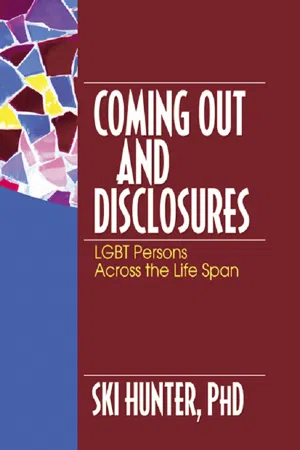
LGBT persons face multiple challenges when entering the coming out process, regardless of their age or place in society. Coming Out and Disclosures: LGBT Persons Across the Life Span is a comprehensive guide to the coming out process for LGBT individuals, how to prepare for disclosure, and how disclosure is received in various groups. The book exam
Information
Subtopic
Gender StudiesIndex
Social SciencesPart I:
Figuring Out Who One is and Coming Out
Chapter 1
Sexual Orientation and Sexual Identity
Sexual Orientation
Sexual orientation is not easy to define. Often, it has been associated with whom one has sex with, as done in the Kinsey studies (Kinsey, Pomeroy, & Martin, 1948; Kinsey, Pomeroy, Martin, & Gebbard, 1953). The Kinsey group developed a 7-point bipolar scale to identify sexual orientation, with heterosexual on one end and “homosexual” on the other end. Positioning on this continuum depended upon the proportion of a person’s sexual behavior that was oriented to one or the other sex-gender. This proportion resulted in a score that ranged from 0 (exclusive heterosexual behavior), to the midpoint of 3 (equal heterosexual and “homosexual” behavior), to 6 (exclusive “homosexual” behavior).
The Kinsey work was revolutionary (V.L. Bullough, 1994), yet it had notable shortcomings. For example, sexual orientation was reduced to numerical categories leading to the presumption that all persons who attain the same number are the same sexual type (V.L. Bullough, 1998; Laumann, Gagnon, Michael, & Michaels, 1994; Sell, 1996). The seven-point scale also essentially divided persons into exclusive heterosexual or “homosexual” categories. This made the scale problematic for respondents who reported that they could potentially become sexually involved with either women or men or that they experienced former sexual relations with both women and men (E. Stein, 1999). Since “homosexual” experiences were of more interest to the Kinsey group, “bisexual” was a default category (Guidry, 1999).
Kinsey’s work began to be challenged in the 1970s. Factors other than sex were added to scales such as love and affection. And the intensity level of emotional and sexual attraction was assessed. In addition, separate scales have been developed to measure same sex-gender orientation and other sex-gender orientation (Kinsey had one scale). With this development, one of the findings was that same sex-gender and other sex-gender behaviors were independent; persons showed high levels of both same sex-gender and other sex-gender sexual behavior, low levels of both, or levels of each that varied in strength (Klein, Sepekoff, & Wolf, 1985; Shively & De Cecco, 1977; Storms, 1980).
One of the more influential advances in the measurement of sexual orientation was the Klein Sexual Orientation Grid (KSOG) (Klein et al., 1985). This scale assumes that sexual orientation is multivariate and dynamic. Seven components are measured:
- sexual attraction;
- sexual behavior;
- sexual fantasies;
- emotional preference;
- social preference;
- self-identification; and
- living as a lesbian woman or gay man, heterosexual woman or man, or bisexual woman or man.
Each component is represented on a 7-point scale with a range from same sex-gender only to other sex-gender only. One can be at different places on the scale for each component so that the positions can be congruent or incongruent with each other. Positions may also be different across time periods: present, past, and ideal future. While this scale is an advancement, it also made the same binary assumption of sexuality as did the Kinsey group.
Other researchers included even more components (e.g., Coleman, 1978; Sell, 1996). A scale developed by Berkey, Perelman-Hall, and Kurdek (1990) was a more sophisticated version of the Klein scale and not binary (E. Stein, 1999). But, all the scales have limitations, and no thorough factor analysis of the components has been done. The scales also do not accommodate other possibilities. For example, do transgender or “intersex” persons constitute a second sex-gender or a third or a fourth? If so, where do we locate them on scales? And where do we locate women and men who experience attractions to “intersex” or transgender persons but are not “intersex” or trans-gender themselves (E. Stein, 1999)? Or, as posed by Bockting (1999), where do we locate transgender persons who experience attractions to women, men, or other transgender persons, and who may sexually interact with lesbian, gay, bisexual, or heterosexual identified others? As suggested by Tarver (2002), some persons may adopt a political sex-gender of female or male, although they are not that sex-gender biologically or psychologically.
Persons can be sorted into various groups by virtue of their sexual interests, including body type, hair color, personality, profession, sex-gender, types of sexual acts, locations for engaging in sexual acts, and entities engaged (e.g., humans, animals, inanimate objects) (E. Stein, 1999). Furthermore, Savin-Williams (2005) noted that what sex means to any particular person varies. Youths, for example, are likely to think of a large variety of behaviors as sex; intercourse is only one form. Romance may be more important to lesbians than genital sex.
Where do these developments and questions leave sexual orientation? Although there have been advancements post-Kinsey, many questions about sexual orientation remain unanswered. A paradigm is emerging that conceptualizes sexual orientations still on a continuum, but acknowledges a highly individualized process of arriving at a sexual orientation (Garnets, 2001). And most likely there are a number of categories of sexual orientations beyond the current narrow group (E. Stein, 1999).
Sexual Identity
Whereas sexual orientation has to do with sexual dispositions, sexual fantasies, sexual desires, and sexual behaviors, sexual identity has to do with what one identifies oneself to be. We choose a sexual identity from a given pool of potentialities, and the cultural and historical contexts of our lives provide meaning to the selected sexual identity (A.L. Ellis & Mitchell, 2000). In addition, in contrast to sexual orientation, which is stable and resistant to self-control or control by others, sexual identity is fluid. It can change or take on new meanings (Savin-Williams, 2005). For example, Diamond (2005) found that over an eight-year period 60 percent of young women changed their sexual identity at least once and nearly 50 percent gave up a lesbian or bisexual label. Others may not link their sexual orientation to a sexual identity. Over half (53 percent) of lesbians studied by S.C. Anderson and Holliday (2005) did not view their sexual orientation as central to their identity whereas others (47 percent) did view being lesbian as central to their identity. However, the centrality of sexual identity decreased with age; these women more likely saw their sexual identity as just one of multiple identities they claimed.
We typically expect that a person’s selected sexual identity is concordant with certain components such as sexual desire, affectional desire, sexual behavior, and community participation (Firestein, 1996; Golden, 1987; Laumann et al., 1994; Rothblum, 1994; Shively, Jones, & De Cecco, 1983–1984; E. Stein, 1999). Lesbian and gay persons may have a more congruent sexual orientation/sexual identity than heterosexual or bisexual persons. If they think of themselves as lesbian or gay they tend to have behaviors, fantasies, attractions, and preferences that correspond with this self-view. Some bisexual and heterosexual persons, however, label their sexual orientation in ways that are inconsistent with their behavior, fantasies, attractions, and preferences (Moore & Norris, 2005). Yet, nothing is definite about the links between these components for any group as they are independent of one another (see S. Hunter, Shannon, Knox, & Martin, 1998; S. Hunter & Hickerson, 2003). They also mix in different ways, as exemplified in the following list:
Sexual desire incongruent with sexual identity: Some persons who claim sexual desire for others of the same sex-gender do not claim a lesbian, gay, or bisexual identity. In a national sample of adults, more had same sex-gender attractions (8 percent) than identified as lesbian, gay, or bisexual (2 percent) (Laumann et al., 1994). Yet, certain psychological literature would say that if one has sexual desires for others of the same sex-gender, one is lesbian, gay, or bisexual, as sexual desire is seen as a basic indicator of sexual orientation (Marmor, 1980). Other persons can experience the reverse incongruency: they self-identify as lesbian, gay, or bisexual but experience no sexual desire for a same sex-gender partner. Or, sexual desire that was once present disappeared (Esterberg, 1997; Peplau & Cochran, 1990).
Sexual desire and sexual behavior incongruent with sexual identity: Not all women and men who experience sexual desires for and sexual behavior with persons of the same sex-gender self-identify as lesbian, gay, or bisexual (Massey & Ouellette, 1996; Radonsky & Borders, 1995). In surveys on sexual behavior and mental (cognitive/affective) states, about one-third of women and men who in the past year desired same sex-gender partners and had sex with them did not identify themselves as lesbian, gay, or bisexual (Davis & Smith, 1993; Laumann et al., 1994). This circumstance also happens among persons in sex-gender segregated institutions such as prisons (Wooden & Parker, 1982).
Affectional desire incongruent with sexual desire and sexual identity: This arrangement has been called “romantic friendships” or “Boston marriages.” Some women are psychologically or emotionally passionate about each other but do not sexually desire each other and do not self-identify as lesbian (Faderman, 1981; Rothblum & Brehony, 1993; Rupp, 1997).
Affectional and sexual desire congruent with self-identity but not behavior: Some women and men identify as lesbian, gay, or bisexual and experience both affectional and sexual desire for others of the same sex-gender but currently have no sexual partner. This could be a desired or undesired state (Davis & Smith, 1993; Esterberg, 1997; Laumann et al., 1994; Peplau & Cochran, 1990).
Sexual desire and sexual identity incongruent with community participation: Some persons who self-identify as lesbian or gay, and desire sex with persons of the same sex-gender, or who self-identify as bisexual and desire sex with persons of both sex-genders, do not participate in LGB social or political events. They may lack interest or time, or they may choose not to make their sexual identity public (Herek, 1991).
Sexual desire incongruent with sexual identity and community participation: Some persons who have no desire to participate in same sex-gender sexual behavior, self-identify as lesbian, gay, or bisexual and participate in LGB communities. They do this for social or political purposes (Rothblum, 1994). Women are more likely to do this as they base their identities more on social and political factors compared to men who base their identities more directly on their sexual attractions and experiences (Rust, 2000). An example is a woman who prefers sex with men but adopts a lesbian identity to express emotional and political solidarity with the lesbian feminist community (Faderman, 1984–1985; Golden, 1994). Women who adopt lesbian or bisexual identities for political or ideological reasons, however, are not always uninvolved sexually with women. The political pursuit of some women studied by Golden seemed to be an erotic as well as a political choice. Elective or political lesbians studied by Diamond (1998) also did not report fewer sexual attractions to women than those who did not identify as political.
Given the variations here, each person experiences a unique combination of erotic and affectional desires, fantasies, emotional attachments, behaviors, sexual identities, and community involvement. When there are only a few categories, people try to fit into one of them, but it may not accurately represent their experiences.
Racial and Ethnic Persons and Identity
Sexual identifications can also be influenced by one’s racial and ethnic culture. Persons in these cultures who have same sex-gender sexual relations may not identify as lesbian, gay, or bisexual. No sexual identities in East Asian cultures are analogous to the modern Western constructs of lesbian and gay identities (Chan, 1997). Some African American women reject the term lesbian because it is Eurocentric (Mason-John & Khambatta, 1993).
In some cultures, it is not uncommon for men to engage in sex with other men without labeling themselves as gay. In Latino cultures, this is especially common with men who take the masculine active sexual role of inserter (Carballo-Diéguez, 1989; Espin, 1984). These men may also not identify as gay because they view this identity as part of the white gay political movement (Morales, 1990). They more easily view themselves as experiencing bisexual sexual experiences (but not the identity). Bisexual sexual practices are partly extensions of heterosexual machismo or masculine heterosexuality. For some Latino men, however, these practices hide a gay sexual orientation (Manalansan, 1996). In some Native American communities, a masculine male who engages in the active role of inserter in sex with another male is also not labeled as gay. If a male is masculine, the sex-gender of a sexual partner is irrelevant. However, a male who takes the role of a passive, receptive partner while experiencing sex with another male gets labeled as gay (Tofoya, 1996).
Youths and Identity
Most youths who identify, or who eventually identify, as lesbian, gay, or bisexual may engage in heterosexual sex during adolescence (D’Augelli, 1991; Golden, 1997). In Savin-Williams’s (1995a, 1998a) studies of boys, some did not recognize or acknowledge a gay or bisexual sexual identity but still desired sex with other boys exclusively, or engaged in sex with both boys and girls. Other boys self-identified as gay but were celibate. Some youths experienced substantial and persistent sexual attractions for and fantasies about persons of the same sex-gender but were unprepared to identify with a culturally defined sexual identity category because of developmental or political reasons (Savin-Williams, 2001).
One study found that over 80 percent of youths in an urban community-based social and recreational agency considered at some point in their development that they might be lesbian, gay, or bisexual. This indicated that they were in a process of sexual questioning (Rosario et al., 1996). Some youths realize the obvious and inevitable and go ahead and claim a nonheterosexual identity. Others, however, do not link sexual questioning during adolescence to sexual identity; most wait until their high school years to make this link (Savin-Williams, 2005). For boys, sex may be the main event moving this transition along (Dubé, 2000; Herdt & Boxer, 1993). But for girls, sex is not central. Instead, it is an emotional attachment or crush that moves them along, or it could be a book, college course, or movie that is the motivator (Savin-Williams, 2005).
Women and Identity
Women show striking variability in their combinations of sexual identity, sexual attractions, and sexual behaviors. This variability was demonstrated in Golden’s (1996, 1997) sample of over 100 women in their twenties, thirties, and forties (primarily white, but of varying sexual orientations and social classes). The identifications of these women included the following:
- Identifying as lesbian but experiencing sex only with men
- Identifying as heterosexual or bisexual but currently experiencing sex only with women
- Identifying as lesbian or heterosexual, but experiencing sex with both women and men
- Identifying as bisexual but only experiencing sex with men
Some bisexual women studied by Golden (1997) reported that although they did not fall in love with other women, they were sexually attracted to women. Some heterosexual women reported they were in love with their girlfriends but not sexually aroused by them. Some lesbians reported that their relationships with other women, though loving, were asexual. Some women experienced same sex-gender attractions but never acted on them sexually, whereas other women made a conscious determination to pursue and act on the sexual part of their attractions to other women.
As noted earlier, sexual identity can be fluid; women are more fluid in sexual identity than are men. Women may change their identities or alternate between heterosexual and lesbian identities (Kinnish, Strassberg, & Turner, 2005). Rust (2003) reported that less than 4 percent of lesbians had been at the same point on an 11-point scale of sexual attraction all their lives. Over half (58 percent) had moved 5 scale points or more. This could reflect movement from exclusive attraction to one sex-gender to 50–50 attraction to both sex-genders, or from predominant attraction to one sex-gender to predominant attraction to the other sex-gender.
In a sample of young nonheterosexual women, Diamond (2003) did three interviews over a five-year period. Lesbian/bisexual identities were relinquished by over a quarter of this sample. Half reclaimed heterosexual identities, and half gave up all identity labels. So, not all women who claim sexual minority identities during adolescence and young adulthood continue to do so indefinitely. Since experimentation is more socially tolerated during adolescence and young adulthood, situational same sex-gender sexuality may be particularly likely during this time. However, those who changed identities did not differ from those who maintained lesbian/bisexual identities in the following respects: the age at which they underwent sexual identity milestones, the factors that precipitated their sexual questioning, or their recollection of childhood “indicators” of same sex-gender activity. And, although these women had been pursuing less and less same sex-gender behavior over the five years, their same sex-gender attractions did not show similar declines. So, identity relinquishment does not represent a fundamental change in sexual orientation but in how one interprets and acts on one’s sexual orientation. All these women acknowledged the possibility of future same sex-gender attractions and/or behaviors, and they were not admitting that their previous sexual minority identity was “wrong.” Diamond (2005) reported that over an eight-year period, the physical and emotional attractions and sexual and romantic behavior of fluid lesbians were primarily oriented to women. However, they were less likely than stable lesbians to maintain a lesbian identity over time. They tended to change identity labels and to adopt nonl...
Table of contents
- Cover
- Half Title
- Title Page
- Copyright
- Dedication
- Contents
- Acknowledgments
- Introduction
- Part I: Figuring Out Who One is and Coming Out
- Part II: Disclosures Across the Life Span
- Part III: Practice with Clients Who Are Coming Out and Making Disclosures
- References
- Index
Trusted by 375,005 students
Access to over 1.5 million titles for a fair monthly price.
Study more efficiently using our study tools.
Frequently asked questions
Yes, you can cancel anytime from the Subscription tab in your account settings on the Perlego website. Your subscription will stay active until the end of your current billing period. Learn how to cancel your subscription
No, books cannot be downloaded as external files, such as PDFs, for use outside of Perlego. However, you can download books within the Perlego app for offline reading on mobile or tablet. Learn how to download books offline
Perlego offers two plans: Essential and Complete
- Essential is ideal for learners and professionals who enjoy exploring a wide range of subjects. Access the Essential Library with 800,000+ trusted titles and best-sellers across business, personal growth, and the humanities. Includes unlimited reading time and Standard Read Aloud voice.
- Complete: Perfect for advanced learners and researchers needing full, unrestricted access. Unlock 1.5M+ books across hundreds of subjects, including academic and specialized titles. The Complete Plan also includes advanced features like Premium Read Aloud and Research Assistant.
We are an online textbook subscription service, where you can get access to an entire online library for less than the price of a single book per month. With over 1.5 million books across 990+ topics, we’ve got you covered! Learn about our mission
Look out for the read-aloud symbol on your next book to see if you can listen to it. The read-aloud tool reads text aloud for you, highlighting the text as it is being read. You can pause it, speed it up and slow it down. Learn more about Read Aloud
Yes! You can use the Perlego app on both iOS and Android devices to read anytime, anywhere — even offline. Perfect for commutes or when you’re on the go.
Please note we cannot support devices running on iOS 13 and Android 7 or earlier. Learn more about using the app
Please note we cannot support devices running on iOS 13 and Android 7 or earlier. Learn more about using the app
Yes, you can access Coming Out and Disclosures by Ski Hunter in PDF and/or ePUB format, as well as other popular books in Social Sciences & Gender Studies. We have over 1.5 million books available in our catalogue for you to explore.