eBook - ePub
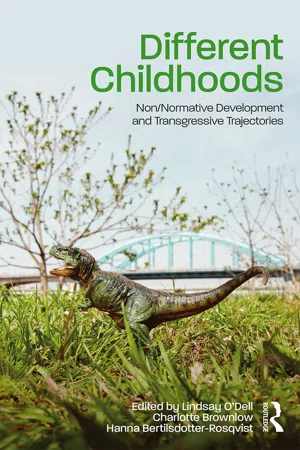
Different Childhoods
Non/Normative Development and Transgressive Trajectories
- 160 pages
- English
- ePUB (mobile friendly)
- Available on iOS & Android
eBook - ePub
Different Childhoods
Non/Normative Development and Transgressive Trajectories
About this book
Different Childhoods: Non/Normative Development and Transgressive Trajectories opens up new avenues for exploring children's development as contextual, provisional and locally produced, rather than a unitary, universal and consistent process. This edited collection frames a critical exploration of the trajectory against which children are seen to be 'different' within three key themes: deconstructing 'developmental tasks', locating development and the limits of childhood. Examining the particular kinds of 'transgressive' development, contributors discuss instances of 'difference' including migration, work, assumptions of vulnerability, trans childhoods, friendships and involvement in crime. Including both empirical and theoretical discussions, the book builds on existing debates as part of the interrogation of 'different childhoods'. This book provides essential reading for students wishing to explore notions of development while also being of interest to both academics and practitioners working across a broad area of disciplines such as developmental psychology, sociology, childhood studies and critical criminology.
Information
1
INTRODUCING NORMATIVE AND DIFFERENT CHILDHOODS, DEVELOPMENTAL TRAJECTORY AND TRANSGRESSION
Lindsay O’Dell, Charlotte Brownlow and Hanna Bertilsdotter-Rosqvist
Introduction
At the time of writing this chapter, the first of the children from the ‘Jungle’ in Calais, France (a supposedly temporary camp for refugees), have been permitted by the British government to join their families in Britain. The reporting, particularly in the right-wing press, has been concerned with the supposed age of these children. Concerns have been expressed that instead of saving children (a notion linked back, sometimes explicitly, to a romanticised representation of British sentiment and actions regarding kindertransport during the late 1930s), the British public are being duped, as these are not children. The images of young, vulnerable children are in sharp contrast to the young men who have (finally) arrived in the United Kingdom.
Particular images of childhood have been brought into play in discussions about the children arriving from the ‘Jungle’ in which assumptions about age, vulnerability, ethnicity and, arguably, gender are evident. Whilst children are seen to be vulnerable and in need of protection, the children in question are not seen as deserving or in need of such services. ‘Difference’ in this instance has an obviously political and moral frame, with the underlying message that if these are indeed children, they are not the kind of children ‘we’ were expecting.
It is a difficult but important time to be considering ‘different childhoods’ and to be challenging ideas about ‘development’. In the British context, but also more widely in Europe and around the world, ideas about development position children as either deserving or undeserving of help and protection, and naturalise particular ways of developing through time. Burman (2008a) and others point to the cultural production of developmental psychology within the United States, United Kingdom and more generally the global north, and its importation in other places. To continue with our example, the concept of age as a mechanism for determining actions taken on behalf of children/adults has been clearly and powerfully invoked in media concern about refugees from the ‘Jungle’ and elsewhere (for example, in policy/practice with unaccompanied child migrants in Caritas Sweden, n.d.). Whilst there is no reliable medical test to determine age (Burman, 2016), the use of mechanisms such as dental testing are being called for in public commentary to determine whether the person is in actual fact a child. The status of ‘child’ thus affords protection and refuge that is not afforded to adults.
Whilst it is possible (and we argue, essential) to talk about deconstructing development, developmental discourse exerts a powerful influence. Concepts of age, development and the differential status of children are very much in evidence with a contrast drawn between ‘real’ children and ‘others’, and between adults and children. The notion of normative development is core to developmental psychology as a discipline as well as everyday knowledge and understandings of children. The aim of this collection is to consider the impact of developmental psychology and developmentalist discourse more broadly and to discuss how ideas about normative development position children who stand outside of these developmental norms (for a wide range of reasons) as ‘different’ and transgressive in some way.
Normative development?
As evident in the example discussed in the previous section, normative development, and normative childhoods, are easily recognisable in their transgression. In their imagining, developmental psychology and other ‘psy’ disciplines articulate development in particular ways. Rose (1989) argued that this applies not only to psychology but also to related disciplines which draw on psychological knowledge in their practice, such as therapists and school nurses. Our intention is not to simplify developmental psychology into a singular entity; we recognise that there are many different approaches, methodologies and theories within the discipline. However, we draw on a variety of critical resources to argue that the view of development as a (largely) universal, progressive accumulation of skills and ability through time is a discursive production.
Theorists such as Rose (1985) and Vandenburg (1993) have drawn our attention to the concept of ‘development’ as an assumed progression through time as a product of a specific cultural/historical moment that has become naturalised and taken for granted as an enduring fact. The notion of development as progressive arose at a time when Judeo Christian theology viewed humans’ movement through time as progressive, and also at a time in the global north that saw the advent of evolutionary thinking (Vandenberg, 1993). The concept of time from this perspective assumes linearity, with a move towards a specific end point, rather than movement through time as a cyclical or degenerative process. The concept of a movement through time applies to both humans as a species and to individual children specifically.
Constructing development in this way enables individual children to be measured and benchmarked against norms derived from measurements of populations of children, setting up normative practices of evaluation in order to monitor (and if necessary intervene) to ensure ‘appropriate’ development (Rose, 1989). Developmental psychology became the mechanism by which children’s development through time is understood, normalised and taken to be ‘natural’; it seems obvious that children grow to adulthood (Rose, 1989). Hence, development is naturalised, with children’s development coming to be seen as a biological process of incremental steps and advances in abilities and proficiency through time (Morss, 1990).
The move from theology to science, and in particular developmental science, positioned psy disciplines as not just charting or observing development but also making judgements about what is ‘right and good’ (Vandenberg, 1993). The proposition of a developmental trajectory sets up an automatic link between the past, present and future as something that is obvious and natural. Invoking ‘natural’ or biological explanations of development serves to construct ‘appropriate’ and ‘inappropriate’ developmental activities and, hence, normative and transgressive developments. Cultural priorities (of the global north) are woven through ideas about development, such as the desired outcomes of development, rationality and independence, and being able to literally (and metaphorically) stand on your own two feet (Burman, 2008b, 2016; Walkerdine, 1993).
Rose (1989), drawing on Foucault, argued that ‘normative’ childhood is understood through deviation, through making visible those who stand outside of the norm and are in need of intervention and correction. Children who stand outside of normative expectations of the developing child are seen as different and often pathological (Walkerdine, 1993).
Themes and structure of the book
Contributors to this book have taken as their starting point the view that development is partial, contextual and relational. The chapters offer a discussion about difference and transgression through a series of empirical, conceptual and literature-based exemplars. In framing this edited collection, we have used the concept of ‘transgression’ purposively, drawing on its meaning as ‘violating a formal rule and/or moral principle, crossing a boundary of acceptable conduct’ (Blackwell Sociology reference, n.d) to illustrate the sense of evaluation and judgement made when assuming difference. The production of (a particular kind of) childhood is embedded within particular systems of meaning, largely produced within the global north. Hence, the use of the concept of transgression makes visible the ‘norm’, enables us to challenge the view of the norm as neutral, natural and enduring, and highlights the moral dimension and risks of being ‘different’.
In this book we, along with the other contributing authors, explore what is meant by normative childhoods and how children who transgress this constructed notion are understood and positioned. Across the collection, the authors address the ways in which normative ideas about childhood impact on understandings of particular kinds of children and set up assumptions about the norms against which ‘others’ are judged. The theoretical frame of the book overall draws on a conceptualisation of childhood and child development as an intersectional and shifting set of identities, attributes and representations, invoked in diverse ways. Authors engage with ‘difference’ as a multifaceted construction to examine how difference is articulated and assumed within specific developmental issues and topics. The chapters draw on a range of dimensions of difference, including how difference is manifested through geographical location; economic differentiation and identification through social class; embodied differences such as gender and disability; and through a developmental lens, which demarcates activities as congruent within a particular developmental age or as transgressive.
The topics covered in this edited collection should not be seen as either a ‘compendium of deviations’ (as was a fear of one of the reviewers of our book proposal) or as illustrative cases of alternative developments, which would buttress naturalised assumptions about how children move through time by illustrating ‘deviations’ or special cases. The exemplars provided are a few of the many ways of configuring ‘different’ childhoods. We, and many others, assume that the notion of the ‘normal child’ is in itself a ‘cultural invention’ (Kessen, 1979). What is core to the examples selected for this collection is the opportunity to consider the locatedness of development through specific instances of children’s lives. The chapters seek to understand and theorise these instances in ways that attend to the local, contingent and partial knowledges about contexts of development and movements through time.
The collection is organised around three core themes: deconstructing developmental tasks, locating difference and the limits of childhood. The themes are informed by, and aim to complement, the themes of Burman’s framing of her book Deconstructing Developmental Psychology. In her book, Burman explores how developmental descriptions and methods produce particular kinds of children and how “normative descriptions provided by developmental psychologists slip into naturalised prescriptions” (Burman, 2016, p. 4). She also questions a lack of focus on context and the abstraction of the child from their environment, and centres on the roles of mothers in particular, but also fathers, and assumptions about appropriate mothering.
The first section of this book, deconstructing developmental tasks, explores aspects of normative development and subjects these to scrutiny. The production of both the ‘normative’ and by implication the ‘non-normative child’ is assumed and regulated through tools, such as developmental checklists that describe developmental tasks relevant to the age of individual children. Theorists such as Burman (2016) and Walkerdine (1993) have argued that developmental descriptions are not neutral but actively produce particular kinds of subjects, where descriptions provide not only the language but also the practices through which children are produced as subjects of concern, intervention and study. Understandings of normal development become enshrined in everyday practices such as the ‘red book’, which in the United Kingdom is a record of a child’s development given to all parents/carers of newborn children (Personal Child Health Record, Royal College of Paediatricians, 2009, in Goodley et al., 2016). The ‘red book’ enables practitioners to record measurements of growth (such as the height and weight of the child). Developmental tasks are recorded as milestones charting progression through time, such as when the child began to crawl, first words, and so on.
Developmental tasks articulated and assumed within developmental psychological descriptions are the activities children must negotiate and master as part of normative development. The examples that are discussed in this collection are focused on the development of ‘appropriate’ sociality and gender. In Chapter 2, Georgena Ryder and Charlotte Brownlow examine how developmental understandings assume that children’s engagement in hobbies and interests is evidence of an appropriate developmental trajectory. However, when a child has a label of autism, such interests and hobbies take on a special function, and therefore require the scrutiny of psy-professionals to ensure that such interests are within a normative range or trigger the need for intervention and correction. In Chapter 3, Katherine Johnson draws on the experiences of transgendered children in making sense of their own and others’ experiences of gender. In the final chapter of the first section, Hanna Bertilsdotter-Rosqvist and Charlotte Brownlow examine assumptions about how girls develop friendships and assumptions about what are appropriate friendship roles as portrayed by girls’ magazines published in Australia, Sweden and the United Kingdom.
The second section of the edited collection focuses on the locatedness of development within broad geopolitical and societal spaces. Burman (2008b, p8) asked of developmental psychology, “why is it that gender should function as the key axis of difference (…) whereas, for example, notions of classed or racialised/ethnic positions do not”. Her view, and also our position in this book, is that an intersectional analysis is required to interrogate the many axes of difference that produce shifting positions of privilege and otherness.
The chapters in the second section of the book locate development in relation to social class, gender, geography and ideas about nation. In Chapter 5, Maxine Woolhouse examines issues of social class in relation to ‘foodwork’, and the intersections of class and gender in the ability to demonstrate ‘successful mothering’ in the raising of healthy children. Issues of gender and parenting are also explored in Chapter 6, in which Martin Robb, Brid Featherstone, Sandy Ruxton and Michael R.M. Ward examine the expectation that male role models are important for boys’ development. They argue that this assumption oversimplifies experience, boys’ development and understandings more broadly of the role of gender in working with children. In Chapter 7, Jane Callaghan, Joanne Alexander and Lisa Fellin explore how assumptions about a child’s agency and perceived vulnerability set up particular understandings and practices with children who have experienced domestic violence.
The final section of the book addresses the limits of childhood, examining the constructed distinction between adulthood and chil...
Table of contents
- Cover
- Half-Title
- Title
- Copyright
- Contents
- Acknowledgements
- Author biographies
- 1 Introducing normative and different childhoods,developmental trajectory and transgression
- PART I Deconstructing ‘developmental tasks’
- PART II Locating development
- PART III The limits of childhood
- Index
Trusted by 375,005 students
Access to over 1.5 million titles for a fair monthly price.
Study more efficiently using our study tools.
Frequently asked questions
Yes, you can cancel anytime from the Subscription tab in your account settings on the Perlego website. Your subscription will stay active until the end of your current billing period. Learn how to cancel your subscription
No, books cannot be downloaded as external files, such as PDFs, for use outside of Perlego. However, you can download books within the Perlego app for offline reading on mobile or tablet. Learn how to download books offline
Perlego offers two plans: Essential and Complete
- Essential is ideal for learners and professionals who enjoy exploring a wide range of subjects. Access the Essential Library with 800,000+ trusted titles and best-sellers across business, personal growth, and the humanities. Includes unlimited reading time and Standard Read Aloud voice.
- Complete: Perfect for advanced learners and researchers needing full, unrestricted access. Unlock 1.5M+ books across hundreds of subjects, including academic and specialized titles. The Complete Plan also includes advanced features like Premium Read Aloud and Research Assistant.
We are an online textbook subscription service, where you can get access to an entire online library for less than the price of a single book per month. With over 1.5 million books across 990+ topics, we’ve got you covered! Learn about our mission
Look out for the read-aloud symbol on your next book to see if you can listen to it. The read-aloud tool reads text aloud for you, highlighting the text as it is being read. You can pause it, speed it up and slow it down. Learn more about Read Aloud
Yes! You can use the Perlego app on both iOS and Android devices to read anytime, anywhere — even offline. Perfect for commutes or when you’re on the go.
Please note we cannot support devices running on iOS 13 and Android 7 or earlier. Learn more about using the app
Please note we cannot support devices running on iOS 13 and Android 7 or earlier. Learn more about using the app
Yes, you can access Different Childhoods by Lindsay O'Dell, Charlotte Brownlow, Hanna Bertilsdotter-Rosqvist, Lindsay O'Dell,Charlotte Brownlow,Hanna Bertilsdotter-Rosqvist in PDF and/or ePUB format, as well as other popular books in Psychology & Developmental Psychology. We have over 1.5 million books available in our catalogue for you to explore.