Smart, strategic inventory management delivers competitive advantage, yet Inventory Turn trends suggest that little seems to change. Sustainable improvement through increasing control of systems and processes generates savings that can, in turn, be invested in growth initiatives. Inventory is not something that just concerns planning, production and finance. By working to better understand and control their inventory-related processes, everyone can drive improvements that will harness inventory's potential to become a source of sustainable competitive advantage.
Unlike other guides to inventory management, this book is not only aimed at planners or inventory managers, but details the impact, both direct and indirect, that all functions have on inventory. It is rich in practical tools that can be clearly implemented, including a detailed purchasing strategy and guide to error management. It is also rich in best-practice cases that further show how to implement these methodologies in a real-world context.
This book is essential reading for any manager or executive looking to boost their organisation's competitive advantage, as well as students of inventory management, production and operations management.
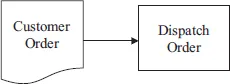
At its most basic, the order fulfilment process is quite simple (see Figure 1.1).
The presumption is that sufficient inventory is in place to meet the order. Multiple orders, as they are received and processed, will ultimately deplete inventory and, unless action is taken, a point will be reached where an order cannot be fulfilled. Of course, there are instances where inventory always appears to be available, examples of which are websites where music and books can be digitally downloaded to your player or reader. Of course, what we really have is the capability to manufacture a product with virtually zero delivery lead-time and zero process time, and that, in truth, has zero inventory.
However, for the great majority of organisations the only way to satisfy any order immediately is by having sufficient inventory to deal with any demand as it arises. In truth, organisations will in all likelihood be unable to achieve this utopian scenario.
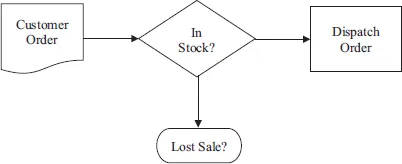
The more usual scenario is shown in Figure 1.2.
In the first instance, inventory will clearly be available. However, as the number of orders increases, inventory, at some point, will reach zero. Once reached, if the customer is not prepared to wait, the result will be a lost sale.
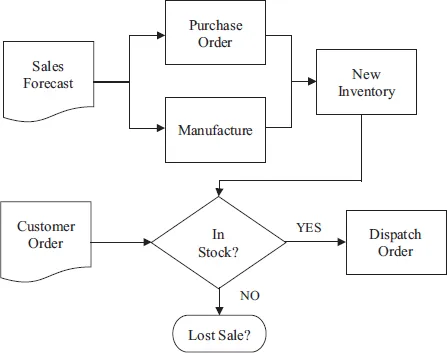
Clearly, whether in a retail or industrial environment, no one wants a lost sale. Dealing with this involves manufacturing in advance of a requirement. In other words, organisations (or individuals) will look to anticipate demand and act accordingly. Typically, this will mean either ordering the appropriate quantities or scheduling manufacture. The two scenarios are illustrated in Figure 1.3.
Whilst Figures 1.1, 1.2 and 1.3 might be considered to be too simplistic, the fact that we move from two elements in Figure 1.1 to eight elements in Figure 1.3 clearly shows that having to anticipate demand leads to an increase in complexity.
With most organisations having many products, the whole process of forecasting and inventory management becomes even more challenging leading to a level of complexity that can often only be effectively managed using some form of planning tool.
Figure 1.1 Basic order fulfilment.
Figure 1.2 Normal order fulfilment process.
Figure 1.3 Typical order fulfilment using forecasts.
Inventory phases
Few systems are perfect, and the process of inventory management is no different. Taking raw materials and converting them into saleable product sounds quite simple. From this point of view, inventory flow can be fairly easily described (Figure 1.4).
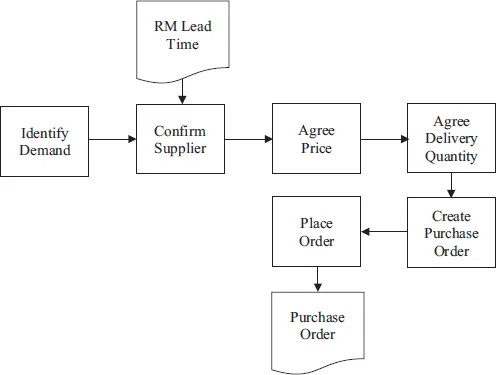
This flow will, in many instances, describe fundamentally what many organisations are doing. However, the simplicity of this flowchart belies an underlying complexity and does not take account of the steps within each phase where people are faced with many challenges and issues relating to ‘getting it right’. On closer examination, each step needs its own flowchart in order to properly describe what is involved. The example of raw material (RM) purchase is shown in Figure 1.5.
Figure 1.4 Inventory phases.
Figure 1.5 Raw material purchase process.
Even this flowchart can be considered to be an over-simplification, and clearly, when considering the other phases, the whole process begins to look much more complex.
Stable equilibrium
When operating efficiently, all processes can be considered to be in a stable equilibrium, requiring little change or intervention. An efficient and stable process will have both raw material and product inventory at optimal levels. However, having so many flowchart elements and, in particular, interfaces between elements, there will always be a risk of instability.
Instability can occur in many parts of the inventory process. Some of the more obvious examples, and ones which most people would be familiar with, include:
Excess raw material purchase
Damaged raw material inventory
Minimum batch size or production run creating more product than required
Production of rejected product
Damaged product inventory
Poor inventory rotation
There are, however, other, less obvious causes of inventory issues that can lead to process instability and ones that, as illustrated in the chapters that follow, involve every part of an organisation.
Instability will invariably lead to either inventory loss or the creation of unusable inventory. Issues that give rise to instability require time and resource to identify, investigate and resolve. Time spent correcting errors and dealing with inventory issues is time that could be better spent focussing on improvements and value-added activities.
Conflicting objectives
Responsibility for inventory will usually sit with functions such as Planning and Production, with all other functions considering themselves as internal customers. However, most of an organisation’s functions will, to a greater or lesser degree, play a part in and have an impact on the process of inventory management. A function’s impact on inventory will vary, but the small details all add up, and if a process is to run perfectly smoothly, every factor needs to be examined, which means looking at every single function’s role.
From an inventory perspective, one can consider the degree to which a function, in its normal operation, adds to the complexity of the whole process. One way of illustrating this can be found in Table 1.1. This assesses the degree to which a function impa...
Table of contents
Cover
Half Title
Title
Copyright
Dedication
Contents
Acknowledgements
Preface
Terms
Introduction
1 Background
2 Finance
3 Planning
4 Production
5 Dispatch
6 Goods Inwards
7 Purchasing
8 Sales
9 Technical Service
10 Customer Service
11 Marketing
12 Research and Development
13 Error management
14 Summary
Appendix 1 Inventory count checklist
Appendix 2 Analysis template
Appendix 3 Safety Stock
Appendix 4 Safety Stock review
Appendix 5 Anticipated order pre-approval
Appendix 6 Detailed production plan
Appendix 7 Production briefing agenda
Appendix 8 Shift handover form
Appendix 9 Dispatch variance report
Appendix 10 Standard selection list
Appendix 11 Dispatch instructions template
Appendix 12 Goods Inwards instructions template
Appendix 13 Preferred purchase quantity approval
Appendix 14 Manufacture without purchase order
Appendix 15 Consignment inventory request
Appendix 16 Consignment inventory administration
Appendix 17 Customer trial checklist
Appendix 18 Initial use checklist
Appendix 19 Ongoing use checklist
Appendix 20 Market research checklist
Appendix 21 New raw material introduction
Appendix 22 Formula and process change management
Appendix 23 ECR segment attributes
Index
Trusted by 375,005 students
Access to over 1.5 million titles for a fair monthly price.
Study more efficiently using our study tools.
Frequently asked questions
Yes, you can cancel anytime from the Subscription tab in your account settings on the Perlego website. Your subscription will stay active until the end of your current billing period. Learn how to cancel your subscription
No, books cannot be downloaded as external files, such as PDFs, for use outside of Perlego. However, you can download books within the Perlego app for offline reading on mobile or tablet. Learn how to download books offline
Perlego offers two plans: Essential and Complete
Essential is ideal for learners and professionals who enjoy exploring a wide range of subjects. Access the Essential Library with 800,000+ trusted titles and best-sellers across business, personal growth, and the humanities. Includes unlimited reading time and Standard Read Aloud voice.
Complete: Perfect for advanced learners and researchers needing full, unrestricted access. Unlock 1.5M+ books across hundreds of subjects, including academic and specialized titles. The Complete Plan also includes advanced features like Premium Read Aloud and Research Assistant.
Both plans are available with monthly, semester, or annual billing cycles.
We are an online textbook subscription service, where you can get access to an entire online library for less than the price of a single book per month. With over 1.5 million books across 990+ topics, we’ve got you covered! Learn about our mission
Look out for the read-aloud symbol on your next book to see if you can listen to it. The read-aloud tool reads text aloud for you, highlighting the text as it is being read. You can pause it, speed it up and slow it down. Learn more about Read Aloud
Yes! You can use the Perlego app on both iOS and Android devices to read anytime, anywhere — even offline. Perfect for commutes or when you’re on the go. Please note we cannot support devices running on iOS 13 and Android 7 or earlier. Learn more about using the app
Yes, you can access Inventory Management for Competitive Advantage by Keith Jones in PDF and/or ePUB format, as well as other popular books in Business & Business General. We have over 1.5 million books available in our catalogue for you to explore.