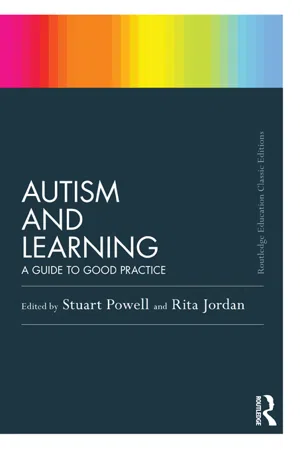
eBook - ePub
Autism and Learning (Classic Edition)
A guide to good practice
- 168 pages
- English
- ePUB (mobile friendly)
- Available on iOS & Android
eBook - ePub
Autism and Learning (Classic Edition)
A guide to good practice
About this book
Autism is a complex and often puzzling disorder in which pinning down a set of rules surrounding the teaching of children with it is almost impossible to do. Many theories and approaches claim to have the solution to teaching, yet few provide the answers when an autistic child goes against the status quo.Autism and Learning addresses this problem w
Information
Chapter 1
Rationale for the approach
Some basic premises
This book does not set out to explain autism; we would refer the reader to other texts for that explanation. What we aim to do is to pinpoint some key features in our understanding and interpretation of the condition, that we feel underpin examples of good practice. At the root of our beliefs about the education of those with autism is the notion that we need to respect the way in which those individuals think and learn. By ‘respect’ we mean more than the acknowledgement of a right to the kind of respect that is necessary in any human relationship if it is to be truly of the human kind. We use the term here to include a notion of recognition at a psychological level that the world is as it seems to the individual with autism for him/her. We think this holds true in as much as the way in which the child perceives and reacts to the social and physical worlds in which they live represents a reality for him/her. We may not be able to share autistic ways of understanding but that is our problem as teachers and our starting point for any move towards real learning on the part of our students. There is a natural tension (which professionals need to resolve) between, on the one hand, respecting the individual's autism and so working within its constraints, and, on the other hand, trying to enable individuals with autism to work effectively and live productively within the non-autistic world by improving the effectiveness of their thinking and learning.
Having described our intention to report in this book examples of good practice it is important to note here that we do not expect such examples to be flawless. We know that teaching individuals with autism is difficult and that the best laid plans may not prove fruitful. What we would wish is that the difficulties should be recognised and ways of dealing with them considered. In short, what we offer in this book are descriptions of how teaching and learning in autism develops rather than a recital of the ‘way it should be done’. We do not want, therefore, to be seen to say, ‘Do this and all will be well’, but rather to show how to make sense of what the child with autism does and how to build a teaching approach based on this understanding.
What is needed is both a recognition of the real nature of the problem in autism and knowledge of the individual to determine how that ‘problem’ has affected development in that particular case. Teachers who are not experienced in autism may find it difficult to recognise, let alone teach, the ‘achievements’ that are part of normal spontaneous processes of learning, since the learning is so early, and so implicit. When working with children with autism, however, such achievements cannot be assumed; they will need to be explicated. What is required then is a truly reflective model of teaching – one in which the teacher engages in a process of reflection on their own learning and reactions as part of their analysis of how the learning situation is for the child with autism and subsequently what they need to do to make that situation more effective for the learner. The danger with a recipe approach to teaching (which we note above that we are seeking to avoid) is that teachers will begin at the second level of this reflection (that is what needs to be done to the situation). In our view the first level (that is, reflection on own learning and how it is for their student) is of primary importance.
We need to recognise, as indicated below, that for many children with autism, especially those with additional learning difficulties, even direct and explicit teaching may not enable them to attain a significant level of understanding. In the chapters of this book, therefore, we have asked contributors to include in their descriptions of practical approaches, the kinds of compensatory strategies that can be taught and which may enable the student to develop intellectually in spite of problems and thereby to gain access to new learning and new ways of behaving. But this leads to another important premise: we should be wary of assuming failure and having low expectations. We would not deny the difficult challenge that autism represents for education nor would we want to claim that we have a ‘cure’ or even that following the examples given will automatically lead to success. We have had sufficient failures in our own teaching to recognise such claims as false or at least naive. Nevertheless, we have also witnessed remarkable achievements in young people with autism and it is unjust to their efforts and those of their teachers to deny their success or always to claim that ‘they couldn't have been that autistic in the first place’. We think that good teaching can make a difference and high expectations (as long as they accept the child's difficulties) are as important in the education of those with autism as for any other group. We cannot always know why one child succeeds and another does not, and we know the difference in outcome is not always because of the way they were taught. Yet we do believe that an optimistic and determined approach, based on sound principles, can make a difference.
An educational ‘diagnosis’
It is important to recognise that autism is a developmental disorder and so any initial or fundamental disability will not just have an effect on development equivalent to difficulties resulting from that disability. A blind child does not develop in a way that equals ‘normal development minus sight’. Rather, every aspect of development is affected by the switch from visual to other forms of obtaining and processing information; there will be strengths (at least in a relative sense) as well as weaknesses in a congenitally blind child's thinking and learning. Exactly the same will be true of autism so that even if we can identify (or agree) the fundamental disability in autism, the results will not just be in terms of deficits but rather in a different way of thinking and learning – an ‘autistic’ way.
We also need to remember that autism does not often occur in a ‘pure’ form; many individuals with autism will have additional difficulties, most commonly, additional general and/or specific learning difficulties. These additional difficulties will in turn constrain the kind of development that takes place and the teaching approaches that can be adopted. We do not distinguish various sub-sets of the autistic spectrum (such as Asperger's Syndrome) in our analyses, partly because we are not convinced of the validity of these sub-divisions as separate syndromes, but also because it confuses medical diagnosis with diagnosis for education. Whether or not there are good medical and scientific grounds for separating different syndromes within the autistic spectrum, we hold the position that it is the commonality of disturbance through the entire spectrum – the triad of impairments (Wing, 1988) that makes autism an important diagnosis educationally. It is the psychological reason for the co-occurrence of that pattern of diagnostic features that makes it autism and that makes for a characteristic unique learning style.
Of course, we do not mean to deny that differences in general cognitive ability and in the degree of language ability will have enormous implications for the development of the child. However, these differences need to be accounted for in one's consideration of the individual aspects of each child's development, rather than in considering the implications of their autism. The chapters in this book, then, do not necessarily specify a particular ‘autistic population’ to which they refer. In most cases, the children dealt with will cover the spectrum of ability and, where particular approaches are most suited to a particular general or language ability level, this will be indicated.
Propositions underlying our understanding of autism
In this section we formulate a conceptual framework which is intended to be in the first place explanatory of autism and in the second indicative of possible effective educational approaches. We will suggest that there are four key interconnected features of autistic thinking: firstly the way in which information is perceived, secondly the way in which the world is experienced, thirdly the way in which information is coded, stored and retrieved in memory, and finally the role of emotion as a context in which those processes may or may not operate. It is neither possible nor appropriate to give the full research and theoretical base of our position here; we state our position, not to argue for it as fact, but to enable the reader to grasp the rationale for our approach. It is interesting that many of our principles might derive from other understandings of autism, and it is not necessary for the reader to subscribe fully to our understanding of autism to find value in the practical approaches given in this book.
Perception
It is clear from the writings of many high functioning individuals with autism that stimuli from the environment are not perceived in the same way as is the case for the majority of non-autistic individuals. Accepting that everyone, in one sense, perceives things in their own way and that there will be individual differences across a range of kinds of stimuli, it is clear that the degree of commonality that is found in the non-autistic population is not present in the autistic. What is initially striking is that across the range of the five senses there is not the regularity of perception in individuals with autism that typifies the non-autistic way of perceiving. Some of this may result from abnormalities in interpreting sensory information and some from the failure of socialisation to provide a specific social and cultural meaning for what is perceived. Often it is difficult to distinguish the two. If the child with autism is unable to selectively attend to verbal instructions in the classroom, is that because the auditory signal fades in and out and is thus inherently difficult to attend to (as some able people with autism have claimed) or is it because verbal information has no special social or cultural significance and so it is no more salient than the sound of a distant fan or the feel of the clothes on the skin? If speech is not meaningful, then the child will not be practised at paying attention to it in preference to what we would normally classify as ‘background’ stimulation.
So, to the child with autism, particular sounds and the feel of materials, for example, may shift over time in terms of the intensity with which they are perceived. That is true for us all, but for the majority there is more conscious directing of our attention, and social stimuli (such as the teacher's instructions) are usually more salient unless other stimuli are insistent (a pain, for example), persistent (the increasing uncomfortableness of a hard chair as we sit through a long lecture) or charged with emotional impact (fear from a phobic reaction to a spider we have just seen). All these factors are also important in the direction of attention in autism, but people with autism appear to have more difficulty in perceiving in uniform ways, and in attaching social or personal meaning to what they see (or hear; the evidence for the proximal senses is unclear). Regularity is one of the necessary features of learning. The child in the cot learns about the world precisely because things happen with regularity (when they cry someone comes and makes particular kinds of response); it is this regularity that enables them to begin to make predictions – if I cry then someone will come. Certainly, the example we have given may be a primitive non-cognitive behaviour, but it is one which is built upon to form early learning. And, again, the essential building block is regularity and hence predictability. If the child with autism has difficulty perceiving the regularities ‘out there’ in the world or in sharing a view of the world where these patterns are literally pointed out and given meaning, then it is not surprising if they seek to impose regularity and predictability by the stereotyped ordering of their world.
So, if a regular sense of perception that is commonly shared with others is so central to learning, it becomes clear that in autism that process of learning will be impaired. The question arises, as we have indicated, as to whether perceptual irregularities in autism create conceptual problems or whether in fact it is conceptual problems in the first place that have created the perceptual irregularities. Clearly, the relationship between concept and percept is a transactional one; both develop through an interaction with the other. If you have no conception of the meaning of hammer then the object lying on the table remains just that and this ‘object’ can only be described in terms of what is conceptually available to the individual (perhaps for example: ‘a piece of wood with a piece of metal stuck across the top’). On the other hand if you cannot achieve a constant image of the object which can be shared with others and thus established as the tool we know as hammer then it will be difficult to develop a conceptual understanding.
This becomes even more problematic when considering concepts of the self and other. As Hobson (1993) has argued, infants have to have some idea that they belong to the same kind of class as others (that is, that they are all persons) before they can start attributing emotions, thoughts, intentions, to others, on the basis of analogy with their own. Is it the cognitive capacity to make the analogy that is missing in autism (as some theorists claim) or is it the initial intuitive perception of a person that would make the analogy possible? All of this is important because it underlies the nature of the difficulty in autism.
Our own view is that there is an inbuilt disturbance in perception (which we will elaborate further below) which means that the world is somehow seen objectively, in a way that is not only devoid of social meaning but also of emotional directedness. This means that the physical properties of objects may be more salient than their functional, emotional or social significance. At the extreme, objects would only be responded to according to their ability to attract attention (through such primitive features as brightness, proximity and movement), and a sense of purposeful action, of agency, would be slow to develop. In time, for all but those with the most severe additional learning difficulties, patterns would emerge and there would be directed search for objects to fulfil repetitive actions, looking for the piece of fluff to twiddle, the angles and shadows made as fingers are held against a stream of light, the simple effect of turning a light on and off. The more able will begin to see patterns in people's behaviour and to work out cause and effect relations, but social and emotional stimuli may never give rise to intuitive insights into another (or even into themselves). They will not, then, directly perceive someone's joy or despair, although they can come to ‘work out’ how certain facial expressions and behaviours are associated with certain given labels such as ‘sad’ or ‘happy’, and they may even, with skilled teaching, come to recognise and respond to their own emotions and learn to apply these concepts to others. To paraphrase a very able young man with autism: ‘If only someone had told me what my emotions were, instead of always trying to get me to control or express them!’ (Sinclair, 1992).
Experiencing the world
There is a sense in which one can both experience the world and know that one has experienced it. This latter level (the level of conscious awareness) is essential if learning is to be transferable and eventually generalisable. The learner needs to be aware of having learnt something to be able to use that knowledge flexibly in future problem solving situations. In autism, however, there seems to be a difficulty in respect of the way in which the world is experienced.
As indicated above, certainly individuals with autism experience the world, indeed they may present as experiencing acutely what is happening in terms of particular sounds, sights and so on. But there is a quality to that experiencing which suggests that while they are aware at one level that things are happening they are not aware that those things are happening to them. A range of phenomena in autistic thinking and behaving (e.g. difficulties in agency, use of pronouns, remembering personal episodes) suggest that the relationship between self and experience is unique in autism. We have described elsewhere in some detail (Jordan and Powell, 1995) the role of the experiencing self in autism. Here it may suffice to note that what is important for the educator is an understanding that any learning experience is precisely that: an experience which the learner has and which may or may not correlate with what is presented or organised by the teacher. In short, what is delivered by the teacher is not always what is received by the pupil.
In autism then, children may perform tasks satisfactorily but they may do so in a way which remains detached from any sense of self. They may do things but not be aware at a meta level that they are doing them; they may be able to act but not reflect upon that action in such a way as to make it into a meaningful learning experience. In this way autistic learning remains at the level of the particular. Able adults with autism describe very clearly this sense of things happening as if they were witnessing a video of life, rather than being actively involved in it. The memory of those events, therefore, will not have this personal element (as will be detailed below) and all learning will become habitual and rote, being cued by the environment, by the teacher, or by the action that comes before. Rituals and routines, are not just a way of creating regularity in an otherwise confusing perceptual world, they are also ways of re-activating memory sequences and cueing their own learning.
Clearly, there are implications for the educator in all of this. First teachers need to recognise this fundamental feature of autistic thinking and try to offer alternative structures that will fulfil the functions that spontaneous reflection performs in non-autistic learning. That is, they can draw the child's attention to the salient features of a task and, more importantly, to the way in which the child him/herself is going about it. They can build in time, in every learning session, for reflection on what the child has experienced and learnt and how that learning relates to past learning and to future planned experiences. Second they need to use emotionally salient experiences as contexts for learning. Children with autism need to be made aware of how they are feeling about what they are doing when they are engaged in learning situations and we need to capitalise on their natural interests and involvement, rather than expect them to ‘tune in’ to ours. We suggest that it is the evaluative appraisal of new learning that is missing in autism and therefore that appraisal has to be made explicit so it can become the focus of any planned learning experience.
Memory
As indicated above, a difficulty in experiencing events as personally relevant, will lead to individuals with autism being able to perform rote memory tasks satisfactorily (and sometimes extremely well) but having difficulty in remembering what they have done (without cueing), even a short while previously. For example, a boy with autism could remember considerable detail about the route taken by a particular visitor to the school, ev...
Table of contents
- Front Cover
- Autism and Learning
- Routledge Education Classic Edition Series
- Title Page
- Copyright
- Contents
- List of contributors
- Preface
- 1 Rationale for the approach
- 2 Translating theory into practice
- 3 Developing and using play in the curriculum
- 4 Beyond compliance: the importance of group work in the education of children and young people with autism
- 5 The teaching of science
- 6 Dance and drama
- 7 Autism and information technology: therapy with computers
- 8 Assessment
- 9 Communication
- 10 The development of the outdoor education programme at Storm House School
- Index
Trusted by 375,005 students
Access to over 1.5 million titles for a fair monthly price.
Study more efficiently using our study tools.
Frequently asked questions
Yes, you can cancel anytime from the Subscription tab in your account settings on the Perlego website. Your subscription will stay active until the end of your current billing period. Learn how to cancel your subscription
No, books cannot be downloaded as external files, such as PDFs, for use outside of Perlego. However, you can download books within the Perlego app for offline reading on mobile or tablet. Learn how to download books offline
Perlego offers two plans: Essential and Complete
- Essential is ideal for learners and professionals who enjoy exploring a wide range of subjects. Access the Essential Library with 800,000+ trusted titles and best-sellers across business, personal growth, and the humanities. Includes unlimited reading time and Standard Read Aloud voice.
- Complete: Perfect for advanced learners and researchers needing full, unrestricted access. Unlock 1.5M+ books across hundreds of subjects, including academic and specialized titles. The Complete Plan also includes advanced features like Premium Read Aloud and Research Assistant.
We are an online textbook subscription service, where you can get access to an entire online library for less than the price of a single book per month. With over 1.5 million books across 990+ topics, we’ve got you covered! Learn about our mission
Look out for the read-aloud symbol on your next book to see if you can listen to it. The read-aloud tool reads text aloud for you, highlighting the text as it is being read. You can pause it, speed it up and slow it down. Learn more about Read Aloud
Yes! You can use the Perlego app on both iOS and Android devices to read anytime, anywhere — even offline. Perfect for commutes or when you’re on the go.
Please note we cannot support devices running on iOS 13 and Android 7 or earlier. Learn more about using the app
Please note we cannot support devices running on iOS 13 and Android 7 or earlier. Learn more about using the app
Yes, you can access Autism and Learning (Classic Edition) by Stuart Powell, Rita Jordan, Stuart Powell,Rita Jordan in PDF and/or ePUB format, as well as other popular books in Education & Education General. We have over 1.5 million books available in our catalogue for you to explore.