European Military Rivalry, 1500–1750: Fierce Pageant examines more than 200 years of international rivalry across Western, Central, and Eastern Europe and the Mediterranean rim.
The book charts the increasing scale, expenditure and duration of early modern wars; the impact of modern fortification on strategy and the movement of armies; the incidence of guerrilla war and localized conflict typical of the French wars of religion; the recourse by warlords to private financing of troops and supplies; and the creation of disciplined standing armies and navies in the age of Absolutism, made possible by larger bureaucracies. In addition to discussing key events and personalities of military rivalry during this period, the book describes the operational mechanics of early modern warfare and the crucial role of taxation and state borrowing. The relationship between the Christian West and the Ottoman Empire is also extensively analysed.
Drawing heavily upon international scholarship over the past half-century, European Military Rivalry, 1500–1750: Fierce Pageant will be of great use to undergraduate students studying military history and early modern Europe.
Medieval life was resolutely local for the vast majority of the population, reliant on autarchy for the maintenance of justice and for defence against predators. European kings might reign over large political entities, but their power rested on a host of local mediators whose allegiance could not be taken for granted. Most medieval conflicts unfolded within large states – and the actors included bishops and monasteries, knights and towns, guarding a multitude of defensive structures, such as castles, mills, bridges and churches, against a wide array of threats, from bandit gangs to rebellious lords, as well as armies invading from abroad. Medieval campaigns were conceived to inflict as much damage as possible to the enemy’s resources, without stopping to besiege towns and castles in a systematic manner. This chevauchée war rewarded its participants with animals, captives for ransom, the arms and armour of vanquished opponents, and punished the enemy warlord by setting fire to his farms and fields. ‘War without fire is like sausages without mustard: it has no value!’ King Henry V of England once exclaimed. Defence against predation of this sort was, above all, self-defence; villagers assembled to defend their hearths and their livestock, under the direction of their lords. Monarchs without charisma found themselves hamstrung for resources, and their great subjects might ally themselves with foreign rulers. Most of the earlier medieval kings were umpires rather than autocrats, who arbitrated the competing interests of the elites under their wardship. In Western Europe, the advent of rulers who were able to emerge stronger than any coalition of their subjects dates largely from the late fourteenth or the fifteenth centuries.1 For a long time after, a coalition of warlords seeking vindication of their rights could make large states limit their ambitions.
When they finally emerged, European states engaged in an ongoing ‘tournament’ of war against each other, a series of contests with a constantly-changing array of participants who sought to achieve their goals of expansion.2 The ambitions of kings to dominate their neighbours were often a prime mover in the genesis of wars, fed by concepts of honour and glory, but this could lead to a sort of social Darwinism of international competition using war as its process.3 Honour and glory are sometimes thought to be motives in themselves, but behind the ideological reasons, one should seek more tangible underpinnings for armed conflict. For monarchs, war and expansion appeared not merely possible, but necessary if the realm were to survive in the longer term. Size mattered: opting out of territorial expansion would not be sensible in the long run, for a peaceful state would eventually become the target of an ambitious neighbour. Rulers sought simultaneously to gain territory and to consolidate their authority within it, both of which increased their profile among princes.4 Rulers of smaller states had every interest in broadcasting their readiness to defend their lands and interests by force or arms, in order to dissuade all but the mightiest of foes. They were careful to erect powerful castles, make strategic alliances (usually through marriage) and to have on hand a war-chest of ready cash to hire soldiers.
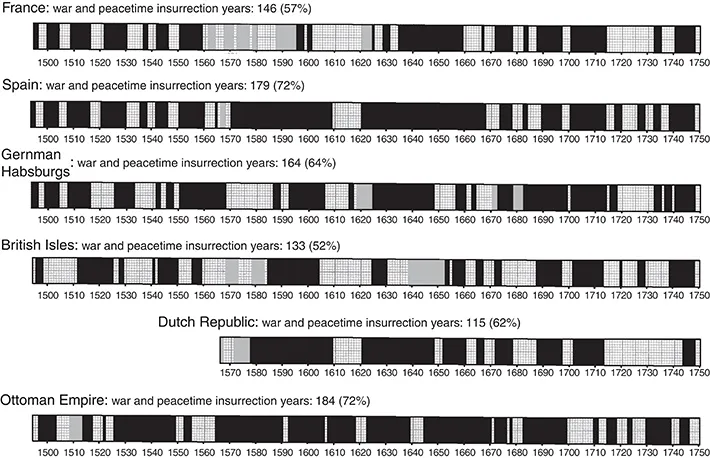
When laying out the chronology of war for the six principal powers of Europe between 1494 and 1750, the sobering conclusion is that war dominated the history of states. If one were to combine the years of international conflict with those of major rebellions, and to consider only those of some considerable scale (that is, not counting small-scale colonial operations), not a single ‘country’ was at peace for half the 257 years under consideration. Great Britain stood largely free of continental entanglements from the end of the Hundred Years’ War in 1453 until the Dutch coup d’état in 1688, but it was still at war 52% of the time. French kings managed wars against myriad adversaries for 57% of the years encompassed here. Measuring 185 years, beginning with the first rebellion against Spain, the Netherlands was at war for 62% of the time until 1750. The German Habsburgs waged wars almost two years out of three, at 64%, against the Ottomans, against the French, the Swedes and Hungarian insurgents. The Ottoman Empire fought major wars against its neighbours, both Christian and Islamic, for almost three-quarters of this quarter-millennium, at 72%. Spain’s rulers fought primarily defensive wars, but these spanned 72% of the years also (see Chart 1).
Chart 1 Military chronology of European powers 1494–1750
No state was more ambitious than France, Europe’s most populous single state until the unification of Germany in 1870. After ejecting the English from the continent in 1453 (English monarchs claimed the French crown until the nineteenth century), French kings recovered breakaway Burgundy in 1477, brought Provence into the realm in 1480 and forcibly subdued Brittany in 1488, with singular consistency of policy aimed at reducing feudal autonomy. They then turned their attention to expanding the kingdom abroad, with the ultimate aim of restoring Christian rule to Constantinople and the Middle East.5 The dukes of Milan and Ferrara actively solicited King Charles VIII to intervene in Italy, confident that they could manipulate the French monarch to their advantage against their local rivals. The Kingdom of Naples was disputed for most of the fourteenth century and much of the fifteenth between a French royal house (the Angevins, descending from the ducal Anjou branch of the reigning Valois dynasty) and the Aragonese of Spain, who recovered the kingdom in 1442 and held it until the death of King Ferrante in 1494. Charles saw the opportunity to make good on his legal claim to the kingdom and gathered a great army to take possession of it.
The invasion of Italy by Charles VIII and the march of the French to Naples in 1494 triggered a period of momentous conflict lasting over two generations. By their duration and their scale, these Italian Wars (1494–1559) inaugurated a new period in European military history and spurred a number of innovations whose effects would play out over the entire world for centuries. Until then, Italian states competed with each other in short armed contests punctuated by modest battles that did not alter the balance of power. In the absence of any overall monarch protecting the rights of the weaker states against the strong, northern and central Italy experienced a rapid reduction in the number of autonomous city-states, numbering circa 100 in 1300, but only a handful of larger territorial states survived two centuries later. By the late fifteenth century, the five largest powers (Milan, Venice, Florence, the Papacy and Naples) could each maintain an army of 10,000 men without excessive strain. King Charles, with an army of 30,000 men and a collection of 40 siege cannon overwhelmed them all ‘in a kind of blitzkrieg’, accompanied by an excess of terroristic violence to which they were not accustomed.6 Most Italian states submitted temporarily to an army they could not stop with their own resources. Charles then treated the kingdom of Naples as conquered territory – that is, he ruled without recognizing pre-existing institutions and power relations – but, since he never intended to take up residence there, he returned home after a few short months. In the interval, several Italian states, including Mantua and the Republic of Venice, coalesced with the intention of destroying his army on its return home. They were bested at the River Taro fording of Fornovo, near Parma; Charles was lucky to escape, and he quickly lost control of Naples to several weak claimants of the Aragonese dynasty.
His successor, Louis XII (ruled 1498–1515), collected a new force and, for good measure, laid claim to the rich Duchy of Milan ruled by the Sforza dynasty. French armies in Lombardy also asserted claims on Genoa and the Venetian Terraferma (the Republic’s territory on solid land behind the lagoon) and troops based there would be able to reach Naples more easily. Both Milan and Naples were held for a time by the French king, whose territorial ambitions in 1501 seemed limitless. The Sforza dukes of Milan recognized Imperial, not French, suzerainty, and Louis’s claims to northern Italy were contested by the Habsburg Holy Roman Emperor, Maximilian I. The heir to the Aragonese dynasty in southern Italy, Ferdinand of Aragon (whose domains included Sardinia and Sicily), prepared to recover Naples from the invaders. Ferdinand and his wife, Queen Isabella of Castile, united the various Spanish realms following their marriage in 1469 and conquered the last remaining Muslim kingdom of Granada in 1492. Ferdinand’s battle-hardened professional army quickly ejected the French from Naples in 1503 and restored the Spanish connection to southern Italy that would endure for two centuries. The French enjoyed a brief success against their Venetian adversaries for control over Lombardy, but the combination of Venice, the Pope Julius II, the Emperor Maximilian, the Spanish and the Swiss confederacy proved too strong. Despite winning the bloody battle of Ravenna in 1512, a defeat at Novara the next year precipitated a new French retreat from Italy.
In 1515, the young King François I led a new invasion of Lombardy that confronted the hostile Swiss just south of Milan at Melagnano (Marignan). The ponderous Swiss pike phalanxes were on the point of overwhelming the French foot and horse in their entrenchments on the second day of fighting when Venetian allies arrived on their flank and drove them off. Scores of French cannon had already inflicted grievous losses on the attackers. Newly ensconced in Lombardy, François dreamed of marching on Naples, too, but had to renounce the project for the time being in order to repel the German army of emperor Maximilian. Battles in Italy were on a much grander scale than before, with larger and more diverse armies, and thanks to the appearance of field artillery and musketry, they were much more bloody, too. Soldiers from Italy, France, Spain, Germany and Switzerland took the measure of each other in constantly shifting alliances. The wars were a proving-ground for modern weaponry and new tactical formations that combined polearms with musketeers.7 Over the first two decades, commanders tried different combinations of weapons and tactics by trial and error. Swiss blocks consisting of thousands of disciplined pikemen marching in unison fought musket-wielding armoured cavalry, and confronted batteries of cannon aligned behind entrenchments.8
The struggle amplified still more after 1519 when young King Charles I of Spain inherited the Holy Roman Empire from his German Habsburg grandfather. Now the Habsburg monarch controlled three composite realms: 1: the Germanic Imperial title and its Austrian heartland north of the Alps, 2: the Burgundian inheritance of the combined Low Countries from his father (modern Belgium, Netherlands, Luxembourg, northern France and the Franche-Comté of Burgundy), and 3: the united Spanish kingdoms acquired from his maternal grandparents, (Castile, Aragon, then Navarre in 1512) including Sardinia, Sicily and Naples. These combined possessions of the Emperor Charles V (German numbering) were now at least the equal of his French opponent. The wars then spread from Italy to theatres in the Pyrenees and Northern Europe, where the king of England, Henry VIII, was an intermittent Habsburg ally hoping to conquer France from his base in Calais.
French armies invaded Italy anew in 1521 under the Vicomte de Lautrec, and held Milan briefly before they were ejected from it again in 1522. King François I, unwilling to concede defeat, led a new army into Lombardy at the end of 1524. He was laying siege to Pavia in the winter of 1525 when an Imperial force under Charles de Lannoy attacked his army from the rear. Spanish arquebusiers fighting as skirmishers disorganized the French heavy cavalry and prevented it from deploying effectively. The French monarch was captured in the close fighting that followed, and was compelled in the ensuing negotiations to cede all his claims in Italy, and extensive lands in eastern France as well, to Charles V. After returning home, the king repudiated the treaty, and prepared a new Italian expedition. Pope Clement VII Medici, an important French ally, was unable to prevent the unfurling of Imperial troops over northern Italy. A German army swelled by Spanish and Italian deserters hungry for booty then seized and sacked Rome itself in 1527. A French army under Lautrec came very close to capturing Naples with a new invasion in 1528, but the Republic of Genoa, a key ally that ensured the French army’s supply by sea, changed sides during the siege and Lautrec’s force melted away due to disease and desertion. The advantage of war in Italy gradually passed to the Habsburg ruler. The Medici Pope and the emperor struck a bargain to replace the fractious Florentine republic with a Medici principality in 1530 that would be anchored in the Imperial alliance. As emperor, Charles V also enjoyed the right to designate the heir to any state in the Empire without a legal successor. The last Sforza Duke of Milan died childless in 1535, so Charles added the strategic duchy to his own territories and planted a permanent garrison of Spaniards there. After 1530, the monarch maintained about 3,000 to 4,000 Spaniards each in Lombardy, Naples and Sicily, strengthening the territories against a new French invasion. These troops also facilitated the mobilization of money, food and weapons from these rich territories for the Habsburg cause.9
After a brief pause in the fighting, a new Fre...
Table of contents
Cover
Half Title
Title Page
Copyright Page
Dedication
Table of Contents
List of maps, charts, and table
List of images
Preface
1. Renaissance innovations
2. Clash of civilizations 1550–1610
3. Modern fortification and its impact
4. French wars of religion 1561–1629
5. Europe’s first great war 1618–1659
6. The age of military entrepreneurs
7. The advent of standing armies and navies
8. Ottoman wars in the seventeenth and early eighteenth centuries
9. The wars against French ascendancy 1667–1714
10. The classical campaign
11. The classical siege in the age of Vauban
12. The classical battle
13. War finance in the classical age 1689–1720
Conclusion: eighteenth-century continuity
Glossary
References
Index
Trusted by 375,005 students
Access to over 1.5 million titles for a fair monthly price.
Study more efficiently using our study tools.
Frequently asked questions
Yes, you can cancel anytime from the Subscription tab in your account settings on the Perlego website. Your subscription will stay active until the end of your current billing period. Learn how to cancel your subscription
No, books cannot be downloaded as external files, such as PDFs, for use outside of Perlego. However, you can download books within the Perlego app for offline reading on mobile or tablet. Learn how to download books offline
Perlego offers two plans: Essential and Complete
Essential is ideal for learners and professionals who enjoy exploring a wide range of subjects. Access the Essential Library with 800,000+ trusted titles and best-sellers across business, personal growth, and the humanities. Includes unlimited reading time and Standard Read Aloud voice.
Complete: Perfect for advanced learners and researchers needing full, unrestricted access. Unlock 1.5M+ books across hundreds of subjects, including academic and specialized titles. The Complete Plan also includes advanced features like Premium Read Aloud and Research Assistant.
Both plans are available with monthly, semester, or annual billing cycles.
We are an online textbook subscription service, where you can get access to an entire online library for less than the price of a single book per month. With over 1.5 million books across 990+ topics, we’ve got you covered! Learn about our mission
Look out for the read-aloud symbol on your next book to see if you can listen to it. The read-aloud tool reads text aloud for you, highlighting the text as it is being read. You can pause it, speed it up and slow it down. Learn more about Read Aloud
Yes! You can use the Perlego app on both iOS and Android devices to read anytime, anywhere — even offline. Perfect for commutes or when you’re on the go. Please note we cannot support devices running on iOS 13 and Android 7 or earlier. Learn more about using the app
Yes, you can access European Military Rivalry, 1500–1750 by Gregory Hanlon in PDF and/or ePUB format, as well as other popular books in History & Public Finance. We have over 1.5 million books available in our catalogue for you to explore.