This book offers a solutions-based approach to climate change problems which potentially impinge on human beings within the tropics. It largely comprises research articles with supplementary applications and illustrations. The effects of atmospheric phenomena, energy acquisition, wind power, CO2 sequestration, are linked with soils, aquatic life, reducing deforestation, rainwater harvesting and clay pot farming, climate, plant disease and food security to show that no area of life is untouched by the phenomenon of climate change. It discusses specific problem areas and provides an overview of geotechnical and sustainable solutions to lessen the impact of climate.
- 499 pages
- English
- ePUB (mobile friendly)
- Available on iOS & Android
eBook - ePub
About this book
Information
1 | Introduction: Countering Global Climate Change: Tropical Solutions |
An Experimental Approach
1.1 General Remarks
One hundred years before the publication of “On the Origin of Species,” John Smeaton of England told a gathering that the power available from the wind is proportional to the cube of the wind speed (Kovarik et al. 1979). Kovarik et al. (1979) continue: “That is, when the speed doubles, the power available in the wind increases eight times.” Smeaton also investigated many types of Dutch and English windmills and determined their horsepower and efficiency. His work remains a classic study of wind power. But neither Smeaton’s work nor the work of others to improve windmills could forestall the downfall of the working windmill in England and Europe. For nearly three centuries the Dutch used approximately 10,000 windmills to grind grain, pump water, make paper and saw lumber. With the introduction of the steam engine and the beginning of the industrial revolution, the use of windmills began a sharp decline. By 1900 only 2500 windmills were in use by the Dutch, with a similar decline in windmill numbers in other industrialized nations.”
The above report dramatizes the power of ignorance and of knowledge, one decimating the windmill; the other resurrecting it.
The present work contains 26 research journal articles in chapter format. Twenty-two are original works. The remaining four are developed from previous journal articles by the author. Thus, Chapter 2 builds on “The Role of Water Vapour Condensation in Global Warming,” (Advances in Environmental Science: Nova Science Publishers Volume 2, 2008, pp. 368–372), Chapter 6 builds upon on “Fragility of a Dark Gray Shale in North-Eastern Jamaica: Effects and Implications of Landslip Exposure,” (Environ Earth Sci (2010) 61: 369. https://doi.org/10.1007/s12665-009-0348-2), while Chapter 12 supersedes “Quenching of Phosphorus-Fixation in a Disturbed Caribbean Bauxite Mine Overburden Using Root Exudates: Implications for Acidic Tropical Soils” (In: Geobiotechnological Solutions to Anthropogenic Disturbances. Environmental Earth Sciences. Springer, Cham DOI https://doi.org/10.1007/978-3-319- 30465-6_14).
The Greenhouse Effect is essential for life (Figure 1.1; heat increases biomass). Without it, Earth’s radiation balance (solar input vs. IR output) produces an Earth temperature of –20°C, and almost all water on the planet would be ice. But life requires liquid water. To this end, CO2 is needed in the atmosphere. This is vividly portrayed on the planet Venus.
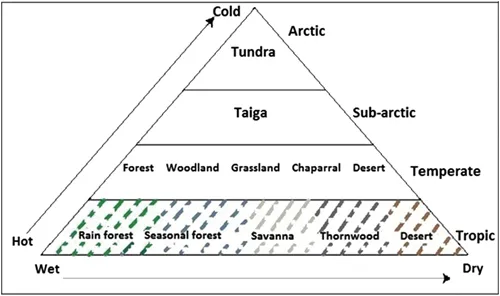
FIGURE 1.1 Twelve global climates and vegetation zones maintained partly by CO2 on Earth.
1.2 Warming Trends
On planet Earth, cities are at risk of gradual, slow-onset climate change impacts, such as sea-level rise and coastal erosion (Figure 1.2). Large urban populations, including those residing in some of the world’s largest megacities (The World Bank 2010), live in low elevation coastal zones (LECZs). Figure 1.2 indicates the proportion of national populations living in the LECZs. It shows that urban populations in the Caribbean, Southeast Asia and the Pacific are particularly vulnerable to the impacts of sea level rise.
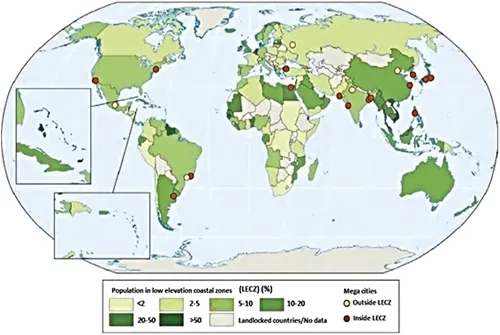
FIGURE 1.2 Cities and populations at risk of rising sea levels.
Source: World Bank 2010.
As shown in Figures 1.3 through 1.6, evidence of excess warming is also found in extratropical zones.
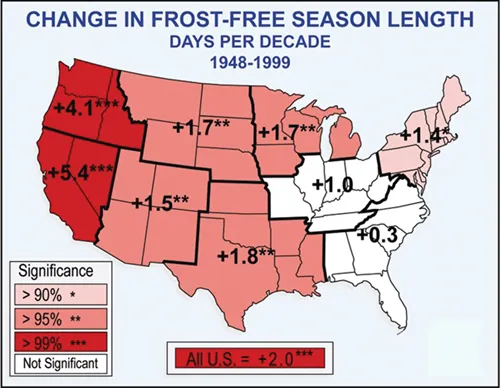
FIGURE 1.3 Extratropical evidence of excess warming in recent decades.
Source: NOAA.

FIGURE 1.4 Arctic sea ice cover, 1979 and 2003: According to NASA measurements, between 1979 and 2003, Arctic perennial sea ice has been decreasing at a rate of 9% per decade. The image at left shows the minimum sea ice concentration for the year 1979, while the image at right shows the minimum sea ice concentration in 2003.
Source: NASA Goddard Space Flight Center.
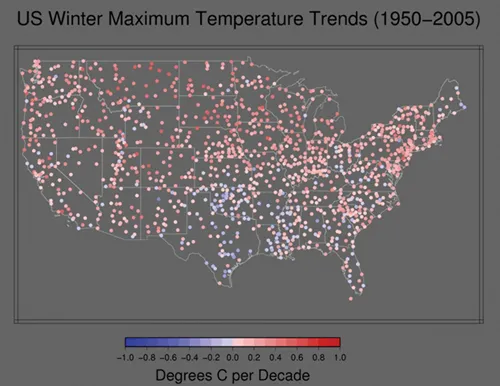
FIGURE 1.5 Evidence from winter maxima.
Source: National Climate Data Center, NOAA.
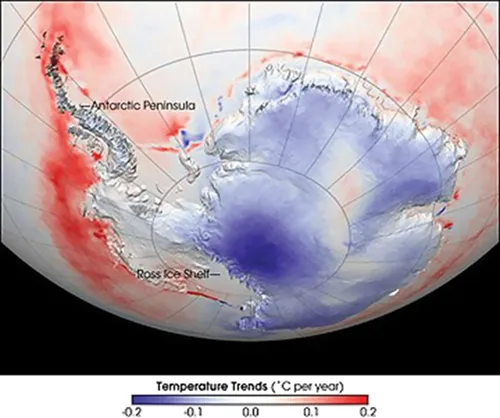
FIGURE 1.6 Evidence from Antarctic Temperature Trends: Western Antarctica is warming, while the eastern part is cooling.
Source: NASA.
Being closer to the Sun, Venus intercepts twice the solar flux of Earth. However, this is almost compensated for by the albedo of Venus, it being approximately twice that of Earth. Hence the surface temperature on Venus, considering only radiation balance, is not very different from Earth’s, i.e., −29°C. Yet its surface temperature averages +435°C, where 90 atmospheres of CO2 give an IR thickness of 68. Earth’s optical thickness is only 0.68. But CO2 isn’t the only molecule trapping heat in Earth’s atmosphere. Had Venus been shrouded in 90 atmospheres of water vapor rather than CO2, its surface temperature would have far exceeded its present value. The next section presents Chapter 2, which details the warming potency of water vapor on Earth.
1.3 The Power of “New” Water Vapor
Rationale: Burning of fossil fuels adds new water vapor to the atmosphere. What are the implications of new water vapor for climate change?
The two most effective greenhouse gases on earth, H2O (g) and CO2, as explained in Chapter 2: Water Vapor Condensation from Fossil Fuels and Tropical Volcanoes: Potential Effects on Global Warming, both water vapor condensation from fossil fuels and tropical volcanoes absorb outbound Infrared (IR) and reradiate it in all directions. Therefore Earth intercepts approximately half that absorbed (IR) and gains heat up to +15°C, thereby ensuring the presence of H2O (liquid). The warm conditions of Earth are helped by water vapor as well as several other gases, some of which never existed in the atmosphere prior to human influence. Together, the other greenhouse gases account for roughly a third of the molecules trapping heat in the atmosphere—and more than a third of the overall warming of average temperatures globally.
Chapter 2 discusses the results of some human activities, such as condensing liquid water from “new” water vapor, a topic which had not been previously seen in the literature. During combustion of fossil fuels, large quantities, not only of CO2, but of water vapor, are produced. A proportion of the water vapor thus created as a by-product condenses almost immediately, thereby releasing vast quantities of heat in the lower atmosphere. All are newly created, based on their prior inert existence (not having been activated in historic times). Even without any fossil fuel combustion, it has been scientifically established that global heat caused by water vapor condensation powers hurricanes. Pushing hundreds of millions of tons of air at speeds of up to 300 kph or more, a hurricane generates 300–400 billion KW hours of electrical energy per day, i.e., 200 times the total energy produced in the U.S.—all powered by the condensation of water, not CO2.
1.4 Climate Change, Occupational Health and Safety
Rationale: Attention to outdoor safety under a warming climate can mitigate unpredicted disasters.
Chapter 3: Operation of Motor Vehicles below Recommended Engine Temperatures in the Tropics, Excess Greenhouse Gases and Health.
CO2 currently emanates from the mouths of all humans and the power plants and cars in all countries—and is responsible for the bulk of global warming to date. But reducing emissions of some of the other greenhouse gases may prove quite a lot simpler than cutting back on CO2—and may forestall catastrophic climate change. In fact, some of the measures—such as capturing the methane released during oil production—actually save money in addition to the climate. The United Nations Environment Program estimates that cutting back on methane and soot emissions alone could prevent 0.7° Celsius of additional warming by 2040—and those cooling benefits could come faster than comparable cuts in CO2.
However, a lack of sufficient understanding of the internal combustion engine processes in some tropical areas underlies the prevalent, yet erroneous, belief that engine temperature control devices (thermostats) are necessary only in “cold countries.” This belief has led to a large proportion of automobile operators in some tropical areas routinely removing and discarding the motor-engine thermostats. This causes the release of un-burned hydrocarbons into the atmosphere (Chapter 3), with attendant climate-change and health issues.
Chapter 4: Potential Climate Changes and Air Pollution by Cassava Cyanide: Role of Moisture-Pressure Combination Treatments.
Drought-tolerant, low-nutrient-requiring agricultural crops such as cassava are potentially useful industrial raw materials and food sources in extreme soil and climate conditions. This became more applicable after Harris and Koomson (2010), using moisture-pressure combination treatments, decreased toxic cyanide in bitter cassava to the unprecedented low levels level of 12.5%. However, the increasing industrialization of cassava products and the discovery that the cassava skin contains more starch than the interior of the tuber has led to the incorporation of cassava skin in the manufacture of starch-rich products such as beer. Unfortunately, increased starch in cassava correlates positively with higher levels of cyanid...
Table of contents
- Cover
- Half-Title
- Title
- Copyright
- Contents
- Foreword
- Preface
- Acknowledgements
- Author
- Contributors
- Chapter 1 Introduction: Countering Global Climate Change: Tropical Solutions
- Chapter 2 Water Vapor Condensation from Fossil Fuels and Tropical Volcanoes
- Chapter 3 Operation of Motor Vehicles in the Tropics below Recommended Engine Temperatures
- Chapter 4 Meteorological Configurations for Atmospheric Pollution by Cassava Cyanides in Tropical Locations
- Chapter 5 Qualitative Correlations between Antecedent Rainfall and Landslip Frequency on Thin Shale Beds
- Chapter 6 Sixteen Landslip Provinces: A Hazard Classification Scheme in a Warming, Humid Trade Wind Climate
- Chapter 7 Rising Sea Levels and Parked-Vehicle Safety on Hill Slopes
- Chapter 8 Wind Vector Resultants through Restricted Sea Straits
- Chapter 9 Geotechnical Implications of Aging on Impact Resistance of Uncalcined Red Mud Mortars in a Wet, Warm Climate
- Chapter 10 Erodibility of Two Soft Limestone Road Bases under Tropical Rain
- Chapter 11 Carbon Sequestration in the Humid Tropics
- Chapter 12 Decomposition Rates of a Tropical Softwood after Removal of Non-Structural Carbohydrate
- Chapter 13 Potential for Heat-Insulating Paper from an Invasive Tropical Softwood Using Bamboo Alcoholic Alkali in Water for Retting*
- Chapter 14 Case Study: Thunderstorm Correlations with Deforestation in a Small Tropical Island
- Chapter 15 A Procedure for Sustainable Deforestation Preceding Mineral Extraction in the Humid Tropics
- Chapter 16 Cold-Water Starch-Extracted Bamboo Used as Banana Tree-Braces
- Chapter 17 Tensile Strength of Bamboo after Five Years of Tropical Subaerial Exposure following Cold-Water Starch Dissolution
- Chapter 18 Rainwater Harvesting under a Warming Climate and Effects of Algae on Changes to Water Storage Levels
- Chapter 19 Five Methods for Humidification of Sweet Potato Stem-Cuttings
- Chapter 20 Non-Chemical Decrease of Anthracnose Mango Fungus in Tropical Highlands
- Chapter 21 Case Study: Controlled Defoliation of Mangifera indica (Mango) against Anthracnose Disease
- Chapter 22 Feeding Preference and Growth of Beet Army Worm on Allium fistulosum and Allium cepa under a Hot Humid Climate*
- Chapter 23 Phosphorus-Quenching in Soils under Tropical Climates
- Chapter 24 Clean-Weeding
- Chapter 25 Post-Mining Correlations with Dispersion of Unvegetated Soil in Stored Bauxite Overburdens under Climate Change
- Chapter 26 Conclusions: Coping with Global Climate Change
- Appendix A: Solar Panel Orientation Using Gravitational Energy, and Azimuthal PositioningSchematized Options
- Appendix B: Impacts of Incremental Heating on Physicochemical Properties of Castor Seed Oil and Its Potential as a Renewable Alternative*
- Appendix C: Gas (LNG) Refrigerator Combined with Photovoltaic Alternate Energy
- Appendix D: Detoxified Starch from Bitter Cassava: Implications of Prolonged Gelatinization and Pressure
- Appendix E: Mechanism of Low-Temperature Alcoholic Alkali Dissolution of Starch in Cold Water
- Appendix F: Direct and Indirect Enhanced Greenhouse Effects (EGE)
- Glossary: Climate Change Terms
- Index
Trusted by 375,005 students
Access to over 1.5 million titles for a fair monthly price.
Study more efficiently using our study tools.
Frequently asked questions
Yes, you can cancel anytime from the Subscription tab in your account settings on the Perlego website. Your subscription will stay active until the end of your current billing period. Learn how to cancel your subscription
No, books cannot be downloaded as external files, such as PDFs, for use outside of Perlego. However, you can download books within the Perlego app for offline reading on mobile or tablet. Learn how to download books offline
Perlego offers two plans: Essential and Complete
- Essential is ideal for learners and professionals who enjoy exploring a wide range of subjects. Access the Essential Library with 800,000+ trusted titles and best-sellers across business, personal growth, and the humanities. Includes unlimited reading time and Standard Read Aloud voice.
- Complete: Perfect for advanced learners and researchers needing full, unrestricted access. Unlock 1.5M+ books across hundreds of subjects, including academic and specialized titles. The Complete Plan also includes advanced features like Premium Read Aloud and Research Assistant.
We are an online textbook subscription service, where you can get access to an entire online library for less than the price of a single book per month. With over 1.5 million books across 990+ topics, we’ve got you covered! Learn about our mission
Look out for the read-aloud symbol on your next book to see if you can listen to it. The read-aloud tool reads text aloud for you, highlighting the text as it is being read. You can pause it, speed it up and slow it down. Learn more about Read Aloud
Yes! You can use the Perlego app on both iOS and Android devices to read anytime, anywhere — even offline. Perfect for commutes or when you’re on the go.
Please note we cannot support devices running on iOS 13 and Android 7 or earlier. Learn more about using the app
Please note we cannot support devices running on iOS 13 and Android 7 or earlier. Learn more about using the app
Yes, you can access Confronting Global Climate Change by Mark Harris in PDF and/or ePUB format, as well as other popular books in Biological Sciences & Environmental Science. We have over 1.5 million books available in our catalogue for you to explore.